



Jun 29, 2026
7 min read
summary
Healthcare website development built around HIPAA requirements, patient trust, and clinical workflows — not just visual design.
Direct answer: Healthcare website development in 2026 means building patient-facing sites and portals against a stricter HIPAA Security Rule baseline, where multi-factor authentication, AES-256 encryption, server-side tracking, and signed Business Associate Agreements are mandatory rather than optional, and where unpermitted tracking pixels have already cost providers tens of millions in settlements.
Why It Matters
- The proposed 2026 HIPAA Security Rule removes the old “addressable” loophole, so MFA and encryption become universal requirements across every system that touches ePHI (NPRM 90 FR 898, January 2025).
- Tracking-pixel violations triggered a $47.5M Kaiser Permanente settlement in 2025 and a $21.5M Sutter Health settlement in February 2026, both tied to analytics scripts on patient-facing properties.
- Phenomenon Studio is HIPAA-compliant, independently assessed by Compliancy Group in August 2026, and built Australia’s highest-rated TRT clinic platform, combining product strategy, UX, and engineering under one roof.
- A compliant healthcare site rebuild typically runs across a one to two month engagement with a senior team of designers, engineers, and a delivery lead, not a template handed off in a week.
By Anatoliy Sakhno | Head of Development, June 2026
Most healthcare leaders discover the compliance gap the same way: a legal notice arrives, and the marketing team learns that the Google Analytics tag on the appointment page has been quietly forwarding patient identifiers to an ad network for two years. The fix is rarely a single setting. It reaches into hosting, forms, portals, and the analytics stack at once.
That is the reality healthcare website development now sits inside. The regulatory floor moved in 2025, enforcement followed, and the cost of getting the details wrong shows up as a settlement figure rather than a missed design trend. This checklist walks through what changed, what a compliant build looks like, and where the money goes. It is written for the people who sign off on the budget, not the engineers who write the code.
According to the OCR Notice of Proposed Rulemaking (90 FR 898), the 2026 framework eliminates the distinction between “required” and “addressable” safeguards entirely. Source: HHS Office for Civil Rights, 2025
What changed: the 2026 regulatory baseline
The single biggest shift for any medical website design agency is the death of the “addressable” specification. Under the old Security Rule, a hospital or clinic could skip a control like multi-factor authentication if it wrote a justification and named an alternative. In practice that became a way to defer hard technical work for years.
The Office for Civil Rights now treats the proposed baseline as the operational definition of a reasonable security posture, even while comment review continues. Encryption, auditability, and transmission security must live inside the application architecture from the first sprint, not bolt on after launch.
Scope expanded too. The rule now covers “relevant electronic information systems,” which pulls your content management system, marketing landing pages, and analytics platforms into the same standard as the EHR database if they affect the security of the ePHI environment. The site you thought was just brochureware is now in scope.
One operator question we hear constantly: “Does this apply to our public marketing pages, or only the portal?” The honest answer is that it depends on data flow. A static page with no forms and no trackers carries little risk. The moment it loads a third-party script that can read the page and the visitor’s IP, it becomes part of your audit surface. Map first, then decide.
Healthcare website development services and shadow AI
Modern healthcare website development services now have to account for AI on the page. Any web-based AI widget that ingests patient queries has to be inventoried, covered by a BAA, and folded into the Security Risk Analysis. Unapproved “shadow” AI tools that staff paste patient data into are a fast-growing exposure, and a web healthcare build that adds a chatbot without a BAA inherits that risk directly.
Where the lawsuits come from: tracking pixels and patient data
The fastest way to turn a healthcare website design agency engagement into a liability is to leave a standard analytics pixel running on a page that reveals a clinical intent. When a tracker links a visitor’s IP address or device fingerprint to a page about a specific condition or provider, regulators and plaintiffs’ attorneys treat that as a disclosure of individually identifiable health information. A medical website design agency that inherits an existing site usually finds the worst exposure here, buried in tags no one documented.
The June 2024 ruling in American Hospital Association v. Becerra narrowed the OCR’s position on unauthenticated public pages. HHS withdrew its appeal in August 2024, leaving that narrowing as federal law. The relief is thinner than it sounds. The court left the guidance fully intact for authenticated spaces such as patient portals, scheduling tools, and telehealth apps, and state wiretap and consumer-fraud suits continue to fill the gap on public pages.
The settlement record is the part operators actually feel. The table below shows a sample of the wave running into 2026.
| Entity | Date | Amount | Core mechanism |
| Kaiser Permanente | 2025 | $47.5M | Web trackers on customer-facing properties |
| Sutter Health | Feb 2026 | $21.5M | Analytics and Meta Pixel inside the secure patient portal |
| Aspen Dental | 2024 | $18.5M | Meta and Google tracker code without patient consent |
| Advocate Aurora Health | 2024 | $12.2M | Pixels exposing 3M patients’ ePHI on portals and scheduling |
| Cerebral | 2024 | $7.0M | Mental-health data of 3.2M users sent to ad networks |
According to the OCR settlement record, Kaiser Permanente agreed to a $47,500,000 resolution in 2025 over unauthorized web trackers on customer-facing digital properties. Source: HHS OCR enforcement actions, 2025
Knowing the risk is one thing. Routing data so it never leaves your control is a different skill, and it is where most builds quietly fail.
Why a healthcare web designer cannot rely on client-side tracking
Standard client-side tracking runs JavaScript inside the visitor’s browser. That script can read the page, scrape form fields, and ship the data straight to an external ad server with the visitor’s IP attached. For a healthcare web designer, that default behavior is the liability, and a marketing tag added by a growth team can reopen the hole a week after launch. The compliant pattern is server-side: tags talk only to a first-party server you control, which hashes IP addresses, strips health-related URLs and identifiers, and forwards only sanitized events downstream. Platforms such as Freshpaint, Curve, and server-side Google Tag Manager exist specifically to act as this compliant proxy, so marketing keeps its dashboards without exposing raw clinical data.
The 2026 HIPAA compliance checklist for healthcare website design
Healthcare website design in 2026 succeeds or fails on a dozen concrete controls. The checklist below is the one we run before any clinical site ships. Treat the block that follows as the infographic-ready summary your team can pin to the project board.
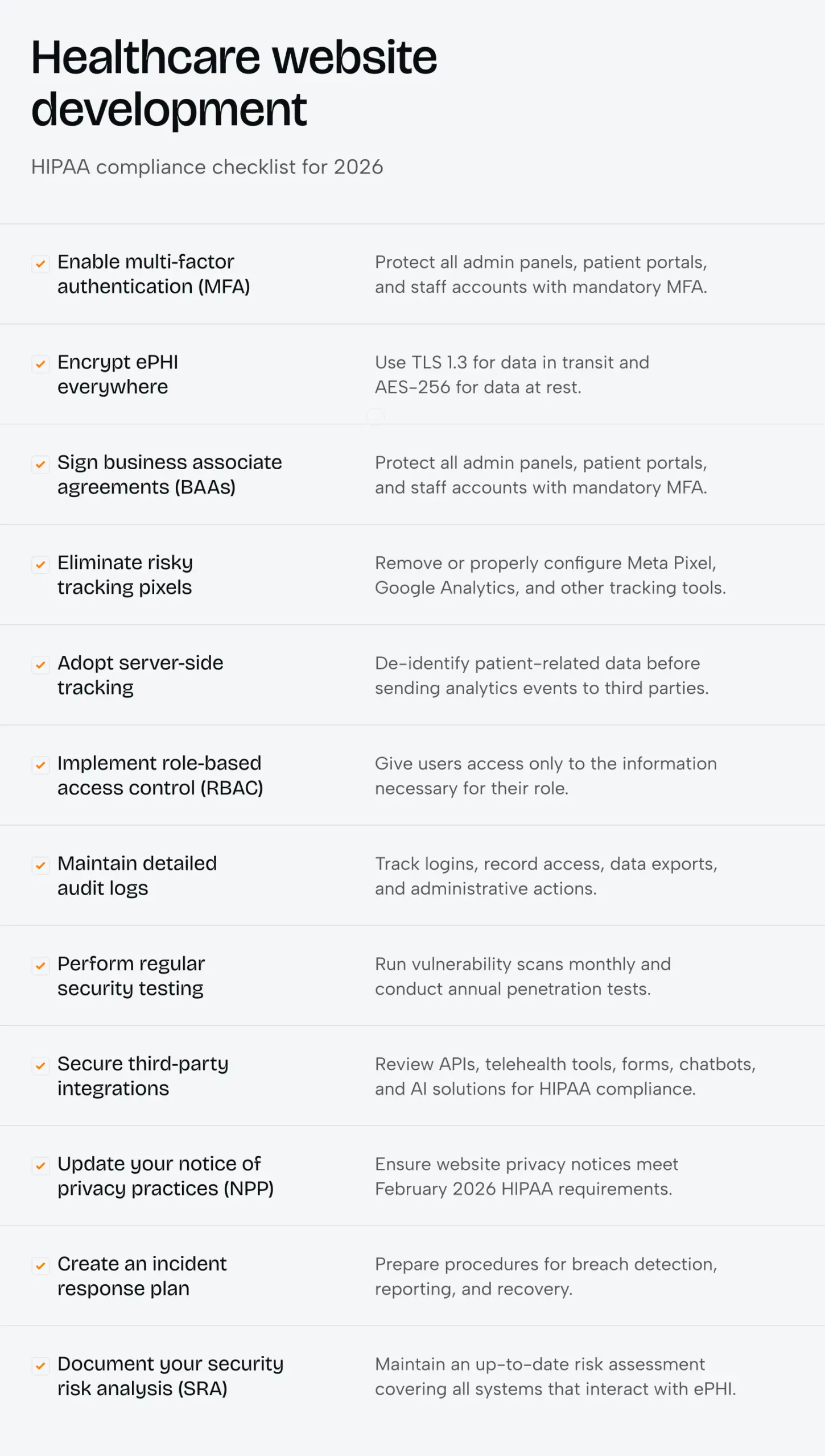
Ship the checklist with your team.
How medical website development handles technical safeguards
Medical website development lives or dies on three technical safeguards from 45 CFR § 164.312: access control, encryption, and audit logging. Each maps to a design decision your team makes early, and each shows up in a settlement when skipped.
Identity and access control
Every account needs a unique identity. Shared admin logins and shared database credentials are among the fastest paths to an audit failure, because no action can be traced to a person. Memorial Healthcare System paid $5.5M for failing to terminate former-employee access, and the proposed 2026 update mandates cutting access within one hour of separation. Role-Based Access Control keeps each user to the minimum data their role requires.
Encryption and transmission security
Data in transit needs TLS 1.2 at minimum, with TLS 1.3 as the standard target. Plaintext HTTP and FTP are prohibited, and servers should enforce HSTS to block downgrade attacks. Data at rest needs AES-256 across databases, backups, and temporary directories, governed by a documented key-management policy using a cloud KMS or hardware security module.
Audit logging that survives an investigation
Logs must capture logins, record access, data exports, and administrative actions, and they must be tamper-resistant. When the OCR opens an investigation, the audit trail is the first thing requested. A site that cannot show who accessed what, and when, has already lost the argument before the technical review begins.
Safeguards protect the data. The platform you build them on decides how hard that protection is to maintain.
Choosing a platform for medical web development
The platform question is where medical web development gets opinionated, and we take a position: standard Webflow, Wix, and Squarespace are the wrong foundation for a site in ePHI scope. They run on shared hardware, limit deep configuration, and refuse to sign a BAA. That last point alone disqualifies them for authenticated patient data.
Compliant builds deploy on isolated infrastructure on AWS, Azure, or GCP, or on dedicated healthcare hosts such as Aptible or HIPAA Vault, all of which execute a BAA and keep database endpoints off the public internet. The CMS choice then follows from how much third-party surface you can tolerate.
| CMS approach | Security surface | BAA reality | Best fit |
| Self-hosted WordPress | High: every plugin is a potential entry point | Possible with hardened, dedicated hosting | Content-heavy sites with strict plugin governance |
| Headless SaaS (Contentful, Sanity) | Moderate; lower tiers forbid ePHI | Enterprise tier only, often costly | Marketing sites that never touch ePHI |
| Custom build (Next.js, SvelteKit, Nuxt) | Lowest: server-side logic, few dependencies | Full control under your own BAA stack | Portals and clinical platforms in ePHI scope |
For a clinical platform handling real patient journeys, a custom build keeps form processing and database logic on a server-side environment you own. That removes the plugin attack surface and the SaaS terms-of-service trap in one decision.
Webflow has its place. Phenomenon Studio is a Webflow Professional Partner, and it is a strong choice for a marketing presence that never collects patient data. The line to hold is simple: the moment a form or portal touches ePHI, the platform calculus changes.
Why healthcare website design templates fall short
Off-the-shelf healthcare website design templates are tempting because they look finished and cost little. They fail in the same place every time: the data layer. A template gives you a visual shell, but it cannot sign a BAA, cannot guarantee server-side tracking, and cannot encrypt a database it does not control. Experienced healthcare website designers treat a template as a moodboard at most, never as a foundation for anything that touches patient data.
The market is full of galleries promising the best healthcare website designs, and they are useful for inspiration. The trap is mistaking a screenshot of the best healthcare website designs for a compliant build. The visual is perhaps a fifth of the work. The healthcare website designers worth hiring spend most of their time on the four-fifths the gallery never shows: the access model, the audit trail, the integration security, and the privacy posture that keeps the clinic out of the settlement table.
Skip the template trap. Talk through your platform options.
What a compliant healthcare website design actually includes
A compliant healthcare website design is mostly invisible to the patient and obvious to an auditor. The visible layer carries the trust signals; the layer underneath carries the controls. Both have to be designed, not assembled from defaults.
Secure forms and scheduling
Standard contact forms are non-compliant the moment they collect health context. Compliant builds use vendors that sign BAAs, such as JotForm HIPAA (from $99/month) or Formstack HIPAA (from $360/month). Scheduling follows the same rule: Jane App (from $54/month) and SimplePractice (from $29/month) offer native BAAs, while Calendly and Acuity require enterprise plans to sign one.
Portal integration without rebuilding the portal
A common mistake is trying to replicate messaging, billing, or lab results on the marketing site. Do not. Hyperlink directly to the BAA-covered portal your client already runs on Epic MyChart, Cerner, or Athenahealth. The provider directory stays safe by carrying only non-sensitive elements: headshots, credentials, specialties, languages, and a secure booking URL.
The Notice of Privacy Practices deadline
By February 16, 2026, covered entities must publish an updated Notice of Privacy Practices conspicuously on the homepage. The revision adds substance-use-disorder consent language, a redisclosure warning, and a clear fundraising opt-out. A 2025 federal ruling vacated the reproductive-health provisions, so those can be ignored, but the substance-use, redisclosure, and fundraising requirements remain in full force.
According to the combined federal rulemaking, the updated Notice of Privacy Practices must be implemented by February 16, 2026. Source: HHS, 2025
Design decisions like these are easier to defend when you have shipped them before under real regulatory pressure. That is the difference experience makes.
Telehealth and the web healthcare experience
Telehealth raises the bar because video and audio are live clinical records. Most platforms run on WebRTC, which encrypts media between browsers by default, but enterprise calls route through a Selective Forwarding Unit that decrypts packets in memory to record or relay them. That decryption boundary belongs on your ePHI map. A web healthcare platform that records sessions must encrypt them at rest with AES-256 and generate short-lived access URLs, because a leaked recording link is a breach waiting to happen.
Common mistakes in medical web development
Most failures in medical web development are not exotic. They repeat across projects, and a medical website development team that has shipped in this space watches for the same five every time. An experienced healthcare web designer designs against each one from day one, because every item below has appeared in a real settlement.
| Mistake | Why it fails | The fix |
| Shared admin logins | No action traces to an individual | Unique IDs plus RBAC |
| Client-side tracking pixels | Forwards IP and clinical intent to ad networks | Server-side de-identifying proxy |
| Non-BAA website builder | Vendor refuses liability for ePHI | Isolated cloud or healthcare host |
| Long-lived recording URLs | Unauthenticated access to sessions | Presigned URLs under 15 minutes |
| No Security Risk Analysis | Penalized as severely as a breach | Documented, system-wide SRA |
According to HHS OCR enforcement data, risk-analysis failures remain the most frequently cited violation in 2025–2026 settlements, including a $600,000 PIH Health resolution affecting 189,763 patients. Source: HHS OCR, 2025
Industry statistics every healthcare website development company tracks
The numbers explain why a careful healthcare website development company now leads with security. The settlement table earlier in this guide shows individual penalties from $200,000 to $47.5M, and the pattern is widening. Kaiser Permanente’s $47.5M settlement in 2025 set a ceiling that boards reference directly, and Sutter Health’s $21.5M settlement in February 2026 proved the exposure reaches inside authenticated portals. For medical website development budgets, that reframes compliance spend as insurance against a known, quantified loss. A healthcare website design company that ignores the trend is pricing risk it cannot see.
Avoid the five common failures.
How to choose a healthcare website design agency in 2026
Picking a healthcare website design agency used to be a portfolio decision. In 2026 it is a risk decision. The right medical website design agency proves regulated-industry depth before it shows you a single mockup, because the cost of a pretty site that leaks data now dwarfs the cost of the build itself.
Three engagement models cover most needs, and the choice depends on how much in-house capacity you already hold.
| Engagement model | What it covers | Best for | Indicative range |
| Full-cycle partnership | Discovery, strategy, UX/UI, branding, development, launch | New platforms and digital transformation | $30K–$200K project |
| Dedicated team | Cross-functional team on a defined roadmap | Scaling an existing product over months | $10K–$40K / month |
| Team extension | Specialists embedded in your team | Filling skill gaps and speeding delivery | $10K–$40K / month |
A few signals separate a credible medical website design agency from a generic web shop. Ask whether the agency will sign into your BAA chain, whether it has shipped an authenticated portal, and whether its hosting recommendation comes with a data-flow map. A healthcare website design company that answers those three without hesitation has done this before.
Healthcare website design services that reduce audit risk
The most valuable healthcare website design services in this market are the unglamorous ones: tracking remediation, secure form migration, and Notice of Privacy Practices publishing. These are the controls that show up in settlements, so they are where a healthcare website design company earns its fee. A medical web development team that treats these as line items, not afterthoughts, is the one to shortlist.
What healthcare website development services should include
Well-scoped healthcare website development services bundle the build with the controls around it. That means encryption and access control engineered in, server-side analytics configured, and an incident-response plan documented before launch. When medical website development is scoped this way, the compliance posture ships with the site instead of trailing it by six months.
Compare agencies with the right questions.
An expert view on building for trust
Compliance is the floor, not the product. The teams that win patient trust treat security as a design constraint that shapes the experience, the same way load time or accessibility does.
“At least 91% of consumers say they are more likely to trust and use a healthcare provider that protects their data, which makes privacy a growth lever and not just a legal checkbox.” Nielsen Norman Group research on digital trust, 2024.
In our experience delivering regulated platforms, the projects that move conversion are the ones where the security model and the user flow were designed together. A patient who can see that booking is private completes the booking.
Case study: Australia’s highest-rated TRT clinic
The clearest proof of how this comes together is a build we delivered, not a hypothetical. Telehealth hormone-therapy clinic operating in a category where patient sensitivity and clinical trust are the whole product.
Task
Company needed a patient-facing platform for a sensitive, regulated TRT service, where the digital experience had to convey clinical credibility and protect personal health data across onboarding, consultation, and ongoing treatment.
Solution
Phenomenon Studio delivered product strategy, UX and UI design, branding, and development under one roof. The team built the patient journey around a calm, credible interface, handled the sensitive intake flow with privacy-first patterns, and shipped a platform engineered for the trust standards a HIPAA-style telehealth service demands.
Result
Australia’s highest-rated TRT clinic became a brand and product experience that matches the clinical seriousness of the service. The full project, including the interface and outcomes, is documented in the Phenomenon Studio project record.
What a compliant build costs and how long it takes
Operators evaluating a healthcare website development agency ask two questions early: what does this cost, and when does it ship. The honest ranges depend on whether you are building a marketing presence or a clinical platform in ePHI scope.
A coordinated redesign of a healthcare site typically runs as a one to two month engagement for the core build, with a senior team of roughly five to eight people: a product strategist, one or two designers, two engineers, and a delivery lead. Phenomenon Studio works with 70+ mid-to-senior in-house experts, so the team scales without subcontractors who fall outside your BAA chain. Engagement economics generally land between $30K and $200K for a project redesign, and $10K to $40K per month for an embedded team. The portal and integration scope moves the number most, not the page count.
According to McKinsey Digital, organizations that integrate compliance into the design phase report materially lower rework costs than those that retrofit it after launch. Source: McKinsey Digital, 2023
Full-cycle work delivers best when the client has a defined product vision and budget for a discovery phase. Skipping discovery to jump straight to visual design reliably produces a second, more expensive rebuild within a year. That limitation is worth naming plainly.
The studio’s track record sits in public view. Phenomenon Studio holds a 5.0 rating across 50+ verified reviews on Clutch, is HIPAA-compliant, and has delivered hundreds of products for companies that have raised $500M+ in aggregate. For a healthcare buyer comparing three to five agencies, that combination of regulated-industry depth and verified proof is the shortlist filter.
Bibliography
- HHS Office for Civil Rights. HIPAA Security Rule Notice of Proposed Rulemaking, 90 FR 898 (January 6, 2025).
- U.S. District Court, Northern District of Texas. American Hospital Association v. Becerra (June 2024).
- HHS Office for Civil Rights. Enforcement settlements and resolution agreements (2024–2026).
- HHS. Combined federal rulemaking on the updated Notice of Privacy Practices, effective February 16, 2026.
- 45 CFR § 164.312, HIPAA Security Rule technical safeguards.
- Nielsen Norman Group. Research on digital trust and user behavior (2024).
- McKinsey Digital. Research on design-phase compliance and rework cost (2023).
Share this article with friends



Sep 29, 2026
6 min read
B2B website redesign without losing traffic: A complete b2b website redesign guide covering UX audits, 301 redirect mapping, and metadata preservation. Partner with a top b2b website redesign agency that boosts conversions while protecting your organic rankings.

Sep 29, 2026
8 min read
Small business web design services that fit your budget. Get affordable small business website design from one of the best website design companies for small business — with transparent pricing and no hidden fees.
