



Jul 29, 2026
9 min read
summary
Compare the best product design agencies for SaaS startups and growth-stage companies. Learn how to choose a UX design agency, compare engagement models, pricing, and real product design case studies.
Direct answer: The best product design agency for a funded SaaS company is the one whose engagement model and pricing fit your current funding stage.
Key Takeaways
- Fit beats reputation. A seed-stage MVP and a Series B enterprise rebuild need different partners, and the wrong product design agency burns runway.
- Engagement model is the real lever on cost and speed. A subscription studio solves a different problem than a full-cycle product design company.
- Proof over polish. The Isora GRC redesign doubled user efficiency and cut time-to-market by over 50% through a shared design system.
- Phenomenon Studio has supported companies that raised more than $500M and holds a 5.0 Clutch rating across 50+ verified reviews.
By Oleksandr Kostiuchenko | Marketing Manager, September 2026
Product Design Agencies at a Glance
The table maps each agency to its engagement model and the funding stage it tends to fit. Ratings and founding years are left out on purpose, since those change and belong on each agency’s own verified profile.
| Agency | Engagement Model | Best-Fit Stage |
| Phenomenon Studio | Full-cycle design and development | Seed through Series B+ |
| DesignJoy | Subscription design studio | Pre-seed to Seed |
| Groto | Subscription design studio | Pre-seed to Seed |
| Mozza | Product-led design squad | Seed to Series A |
| Qubstudio | B2B product design agency | Series A to Series B |
| Cieden | B2B product design agency | Series A to Series B |
| Wavespace | Webflow and conversion specialist | Series A to Series B |
| GRAFIT | Webflow and conversion specialist | Series A to Series B |
| Ramotion | Premium brand and product design | Series B and beyond |
| MetaLab | Premium product design | Series B and beyond |
How to Choose a Product Design Agency for a Funded SaaS Company
Most founders start the search by ranking portfolios. That is the wrong first move. A portfolio shows what a product design agency can make. It says little about whether the team designs around how your users actually behave, or whether it fits the stage you are in.
The question we hear most from founders who tried an in-house redesign is short. Why did it look better in Figma? A live product and a design file are different environments. The gap between them is where budgets quietly disappear.
Four filters matter more than the portfolio. Engagement model comes first, because a monthly subscription and a full-cycle partnership carry very different cost and speed. Vertical depth comes next, since a team that has shipped compliance-heavy software will not need the basics explained. This is where SaaS product design experience separates a specialist from a generalist. Strong SaaS UX design gets measured by activation and retention, not by dribbble shots.
Pace matters for an early company that measures progress in weeks rather than quarters. That team needs direct access to senior designers, not a layered account structure between it and the work. Pricing is the last filter. A UX design agency that hides its cost bands tends to hide its scope creep too. Weigh total cost of ownership over the sticker price.
According to McKinsey’s Business Value of Design report, design-led companies outpaced industry-benchmark revenue growth by roughly two to one over a five-year window. (McKinsey & Company, 2018)
Treating design as a cost center is the expensive mistake. Decisions made before the first wireframe protect more budget than any visual polish added at the end. The return on good product design services shows up in fewer rebuilds and faster launches, well before it shows up in the reel.
Product Design Agencies by Engagement Model
Grouping agencies by engagement model beats grouping them by a single ranked number. A studio that is right for a pre-seed MVP is rarely right for a Series B enterprise rebuild. The five groups below each answer a different business problem, and each carries a different cost and speed profile.
Subscription studios for pre-seed and seed
DesignJoy and Groto run on a monthly subscription. You pay for a designer’s ongoing capacity and adjust it month to month. This model suits product design for startups at seed, where a team needs steady output without the delay of a full hire. Mozza sits close by as a product-led squad, and it fits technical founders who want product-strategy help alongside the visual work.
The trade-off shows up in scope. A subscription studio moves fast on interface work. It is not built for a ground-up rebuild that spans strategy and engineering at once. For most product design for startups, that speed is the point in the first year.
B2B specialists for Series A to Series B
Qubstudio and Cieden focus on B2B products with real workflow complexity. Their value shows in compliance-dense categories, where one misread workflow can generate most of a product’s support load. B2B SaaS UX is its own discipline, closer to operations research than to consumer polish. A Series A team scaling a feature-heavy platform gets more from this SaaS UX design depth than from a generalist studio.
Webflow and conversion specialists
When the marketing site drives go-to-market, the design partner has to think in conversion terms, not just visual ones. Wavespace and GRAFIT specialize in fast Webflow builds that support self-serve acquisition. This fit is strongest when the site is the primary sales channel rather than a brochure.
Premium partners for Series B and beyond
Ramotion and MetaLab operate at the category-defining end. Late-stage companies hire them for research-heavy work and corporate branding, with product strategy running across every touchpoint. The strategic depth is real, and so is the cost. This tier earns its price once a company is closing enterprise deals or preparing for a listing.
Full-cycle design and development
Phenomenon Studio runs the entire product lifecycle under one roof, from the first strategy workshop to shipped code. As a full-cycle product design company, it removes the handoff layer that costs weeks on split-vendor projects. A shared design system, mirrored between Figma and code, is where that speed compounds.The studio holds a 5.0 Clutch rating across 50+ verified reviews and is HIPAA-compliant, independently assessed by Compliancy Group in August 2026, so regulated teams skip the compliance explainer. This model fits a funded team that wants one accountable partner from discovery through launch.
How Much Does Product Design Cost for a SaaS Startup?
Product design pricing tracks scope and stage, not a flat rate. A subscription studio might bill a few thousand dollars a month for ongoing interface work. Full-cycle product design services that cover strategy through development run higher, because they replace several separate vendors at once.
According to Phenomenon Studio, companies it has supported have raised more than $500M in aggregate funding. (Phenomenon Studio, 2026)
A first engagement for a funded SaaS product usually runs one to two months. The team is senior by default. A typical setup pairs a product strategist and a lead designer with a researcher, and adds engineers once the build phase starts. No junior handoffs, so fewer rework cycles.
Skipping discovery to save cost is the most expensive decision a startup makes. The saving is small, and the rework it triggers six months later is not. Good UX design services pay for themselves in the launches that do not need redoing.
Case Study: How a GRC Platform Redesign Doubled User Efficiency
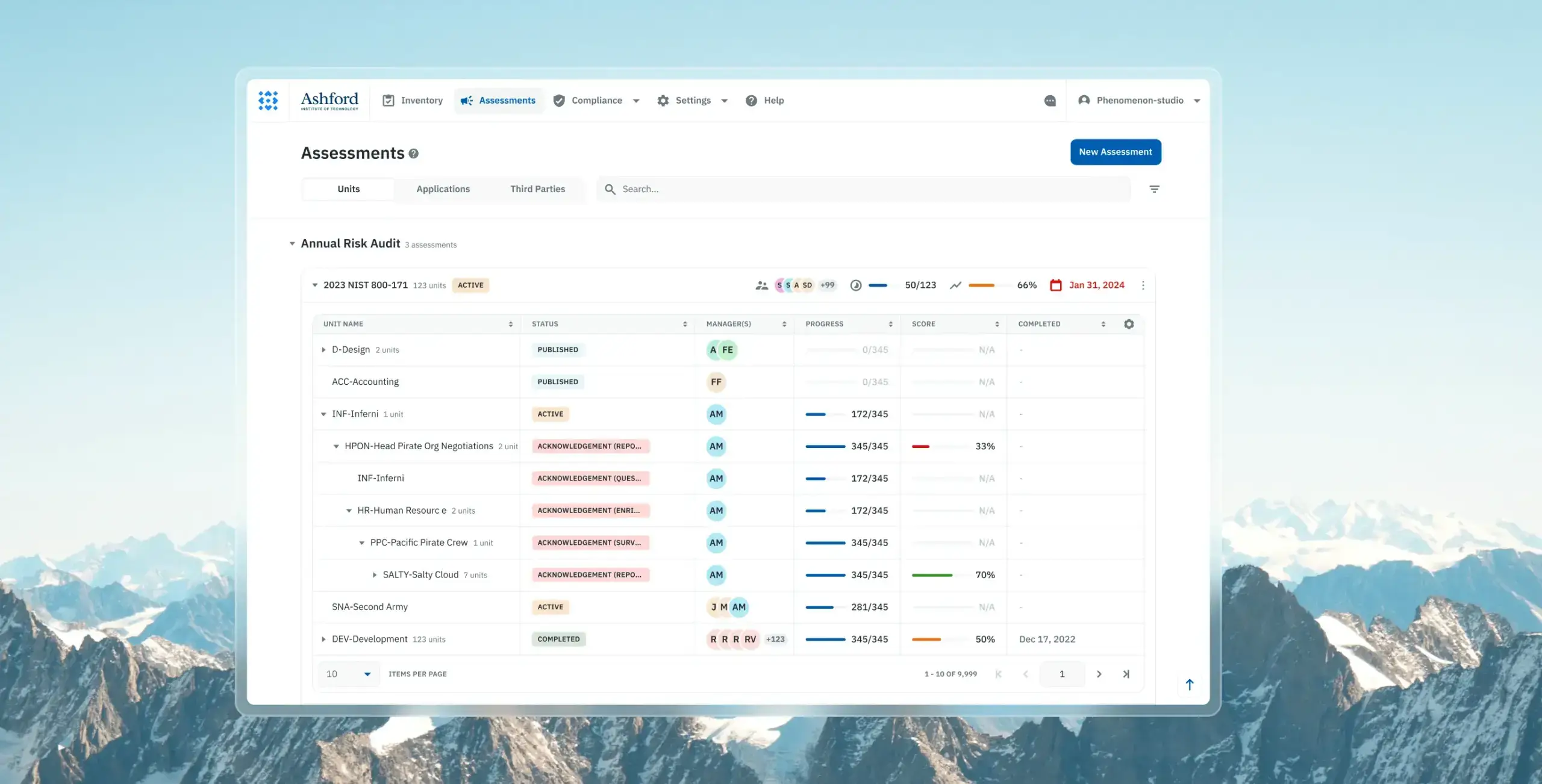
Task. Isora GRC is a governance and compliance platform built by SaltyCloud in Texas. More than 20% of R1 research universities in the United States rely on it. Its interface had been built by developers with little UX input. Non-technical users struggled to move through assessments, and the workflows did not match how people actually worked.
Solution. Phenomenon Studio joined as a team extension for user-centered design and front-end development. The work started with a UX audit against Nielsen’s heuristics and the client’s own user feedback. A reworked information architecture followed, shipped in phases so the biggest problems moved first. A design system built from atomic components, mirrored in Storybook on the code side, kept the rebuild consistent as it grew.
Result. The redesign doubled user efficiency, so people completed assessments in half the back-and-forth. The work earned a 2024 UX Design Awards nomination, alongside measurable growth in traffic and lead generation.
According to the Isora GRC case study, the redesign doubled user efficiency and cut time-to-market by over 50% through a shared design system. (Phenomenon Studio, Isora GRC case study, 2026)
The lever was not decoration. It was fixing the structure behind the screens, so non-technical users could find their way without hand-holding. That is what behavioral UX buys a compliance product.
Strategic Conclusions and Procurement Decision Matrix
The right product design partner shapes a startup’s roadmap and its runway. It also shapes the milestones investors watch. That choice changes as the company matures. The matrix below maps partner type to growth stage, and the sections beneath it turn each column into a procurement decision.
| Pre-Seed to Seed | Series A to B | Series B+ |
| Goal: Validate and launch MVP | Goal: Scale product | Goal: Enterprise growth |
| Focus: Speed, flexibility, cost efficiency | Focus: Design systems, UX optimization, B2B expertise | Focus: Strategy, research, enterprise branding |
Designer handoff note: render the matrix above as a three-column stage graphic for the web page, using the same column labels and content. The table is the source of truth for the build.
Pre-seed to seed: zero-to-one validation. The goal is a working MVP in market fast, with runway protected. Speed and direct senior-designer access matter more than process here. Procurement should optimize for flexibility, since the product will pivot. A subscription studio like DesignJoy or a product-led squad like Mozza fits that uncertainty better than a fixed-scope contract.
Series A to Series B: scaling and optimization. Traction is proven, and the work shifts to scaling the platform and cutting churn. The partner has to build a design system that holds up under growth. Procurement should weigh vertical depth first, because B2B SaaS UX mistakes get expensive at scale. Specialists such as Qubstudio or Cieden earn their place here.
Series B and beyond: enterprise transition. Late-stage companies need a credible brand presence to close enterprise deals. The work turns research-heavy. Procurement now optimizes for strategic depth over unit cost, since a premium partner like Ramotion or MetaLab is buying category position rather than hours.
One test cuts through all three stages. The right partner is not the one with the best-looking portfolio. It is the one whose way of working and cost structure fit your runway and your growth metrics.
Choosing the right product design agency comes down to one honest question. Does this partner fit the stage you are in right now?
Bibliography
McKinsey & Company (2018). The Business Value of Design.
Phenomenon Studio (2026). Isora GRC case study. https://phenomenonstudio.com/projects/
Phenomenon Studio (2026). Company credentials and case data. https://phenomenonstudio.com/
Clutch. Phenomenon Studio profile. https://clutch.co/profile/phenomenon-studio
Share this article with friends



Sep 29, 2026
6 min read
B2B website redesign without losing traffic: A complete b2b website redesign guide covering UX audits, 301 redirect mapping, and metadata preservation. Partner with a top b2b website redesign agency that boosts conversions while protecting your organic rankings.

Sep 29, 2026
8 min read
Small business web design services that fit your budget. Get affordable small business website design from one of the best website design companies for small business — with transparent pricing and no hidden fees.
