



Oct 31, 2026
9 min read
summary
Explore the best WordPress website development agency alternatives for enterprises in 2026. Compare platforms, costs, timelines, and expert partners.
Direct answer: The best alternative to a WordPress website development agency for enterprise is a platform-specialist partner chosen by your constraint, from compliance to product data.
Key Takeaways
- Milk & Honey moved from WordPress to Webflow with Phenomenon Studio, and its internal team now publishes roster and release updates without a developer.
- WordPress runs about 43% of all websites (W3Techs, 2025), which makes a WordPress agency the market default rather than an enterprise fit by design.
- Patchstack traced roughly 97% of newly disclosed WordPress vulnerabilities to plugins (Patchstack, 2024), and plugins are where enterprise governance risk builds up.
- A Webflow or headless marketing site typically ships in 1–2 months with 4 to 6 specialists. DXP programs on AEM or Sitecore usually run four months or longer.
| Alternative | Platform | Best for | Licensing model | Typical build | Core team |
| Acquia Drupal partner | Drupal on Acquia Cloud | Compliance and structured content | Open-source core, Acquia subscription by quote | 3–6 months | 6–10 people |
| Adobe Experience Manager partner | AEM Sites with AEM Assets | Multi-site brands inside Adobe Experience Cloud | Enterprise license by quote | 4–9 months | 8–12 people |
| Sitecore partner | Sitecore XM Cloud or XP (.NET) | Personalization in a Microsoft stack | Enterprise license by quote | 4–8 months | 7–10 people |
| Headless or composable agency | Contentful or Contentstack with a custom front end | Omnichannel content and fast change | SaaS tiers, enterprise by quote | 2–4 months | 5–8 people |
| Pimcore partner | Pimcore PIM and DAM | Complex product data and digital assets | Community edition plus paid enterprise edition | 3–6 months | 5–8 people |
| Full-cycle design and development studio | Webflow Enterprise or headless | Brand-led corporate sites run by marketing | Webflow plans, Enterprise by quote | 1–2 months | 4–6 people |
About 43% of all websites run on WordPress, according to W3Techs (2025). That share explains why almost every website development company in the USA lists WordPress first on its services page. It does not tell you whether WordPress fits a site that passes legal review and serves six regional brands.
Enterprise buyers rarely leave WordPress because the CMS stops working. They leave because the agency model around it stops growing with the business. Plugin sprawl turns every release into a regression test. Content changes queue behind a developer while marketing waits for a slot.
This guide is written for the operator signing the contract, not the developer building the site. I work as an IT project manager at Phenomenon Studio, a Webflow Professional Partner. That gives me a stake in one of the options below. I still point clients to a DXP partner when the constraint calls for one, and the sections below explain when.
Why do enterprises outgrow a WordPress website development agency?
Enterprises outgrow a WordPress website development agency when governance and publishing speed start to matter more than launch cost. WordPress itself is capable software with a large ecosystem. The friction comes from how most WordPress builds accumulate over time.
A corporate site that has run for five years usually carries a long tail of plugins. Each one brings its own update cycle and its own maintainer.
According to Patchstack, about 97% of new WordPress vulnerabilities disclosed in 2023 sat in plugins rather than in WordPress core. (Patchstack, State of WordPress Security, 2024)
For a security team, that number reframes the question. The exposure sits in the plugin list your agency chose and in how often anyone reviews it.
The request we hear most from marketing leads in this position sounds modest: let us change a page without filing a ticket. On many enterprise WordPress builds, custom page templates and locked fields make that impossible. A new press release or office address becomes a developer task with a two-week wait.
WordPress still fits a single-brand site with a small editorial team and no regulated content. Once a site serves several divisions or passes through compliance review, the agency model matters more than the CMS. If your current build is salvageable, a structured WordPress website redesign is often the cheaper path. A typical WordPress shop optimizes for launch day, while enterprise sites need a partner that optimizes for year three.
What should a web development company build instead of WordPress?
A web development company should match the platform to the constraint that hurts most today. It should then staff the build with people who know that platform well. Six alternatives cover most enterprise shortlists we see. Each pairs a platform with a particular kind of agency, and the agency type matters as much as the software.
- Acquia Drupal partner. Drupal suits organizations where content passes through approvals and access rules. Its open-source core supports granular roles and a structured content model. Acquia adds managed hosting and enterprise support on top. The result is governance that survives staff turnover, at the cost of a steeper editor learning curve.
- Adobe Experience Manager partner. AEM makes sense when the website is one channel inside an existing Adobe Experience Cloud stack. Multi-site management and Adobe’s asset library share one repository with Adobe Analytics. Gartner has named Adobe a Leader in its Magic Quadrant for Digital Experience Platforms for several consecutive years. Expect a long implementation and a license priced by quote.
- Sitecore partner. Sitecore fits companies that run on Microsoft infrastructure and want personalization tied to customer data. Its .NET heritage matters to IT teams that already maintain C# services. Personalization only pays off when someone owns the rules after launch, so budget for that role from day one.
- Headless or composable agency (Contentful, Contentstack). API-first platforms separate content from presentation. The same product description can feed the website and a mobile app without duplication. Composable builds suit companies with in-house front-end engineers, because the front end becomes code your team maintains.
- Pimcore partner. Pimcore combines product information management with digital asset management in one open-source platform. Manufacturers and distributors with large catalogs use it to keep spec sheets consistent across every storefront. The website becomes an output of the product data instead of a separate copy of it.
- Full-cycle design and development studio on Webflow. Not every enterprise site is a DXP problem. A corporate site whose main job is credibility needs fast publishing and strong design more than a personalization engine. A studio that designs and builds on Webflow gives marketing direct control of content, while the platform handles hosting and security patches. This is the model Phenomenon Studio delivers most often as a Webflow Professional Partner.
A web development company that recommends one platform to every client is selling its own bench. In our experience, the most expensive mistake is buying a DXP for a site that only needs to publish quickly. The second most expensive is the reverse. A site with real personalization needs, built on a marketing-site platform, gets rebuilt within two years.
Choosing the right WordPress alternative: a decision map
Start from the business constraint, not the feature list, and the shortlist usually narrows to one or two platforms. The decision map below condenses the six options into the question each one answers best.
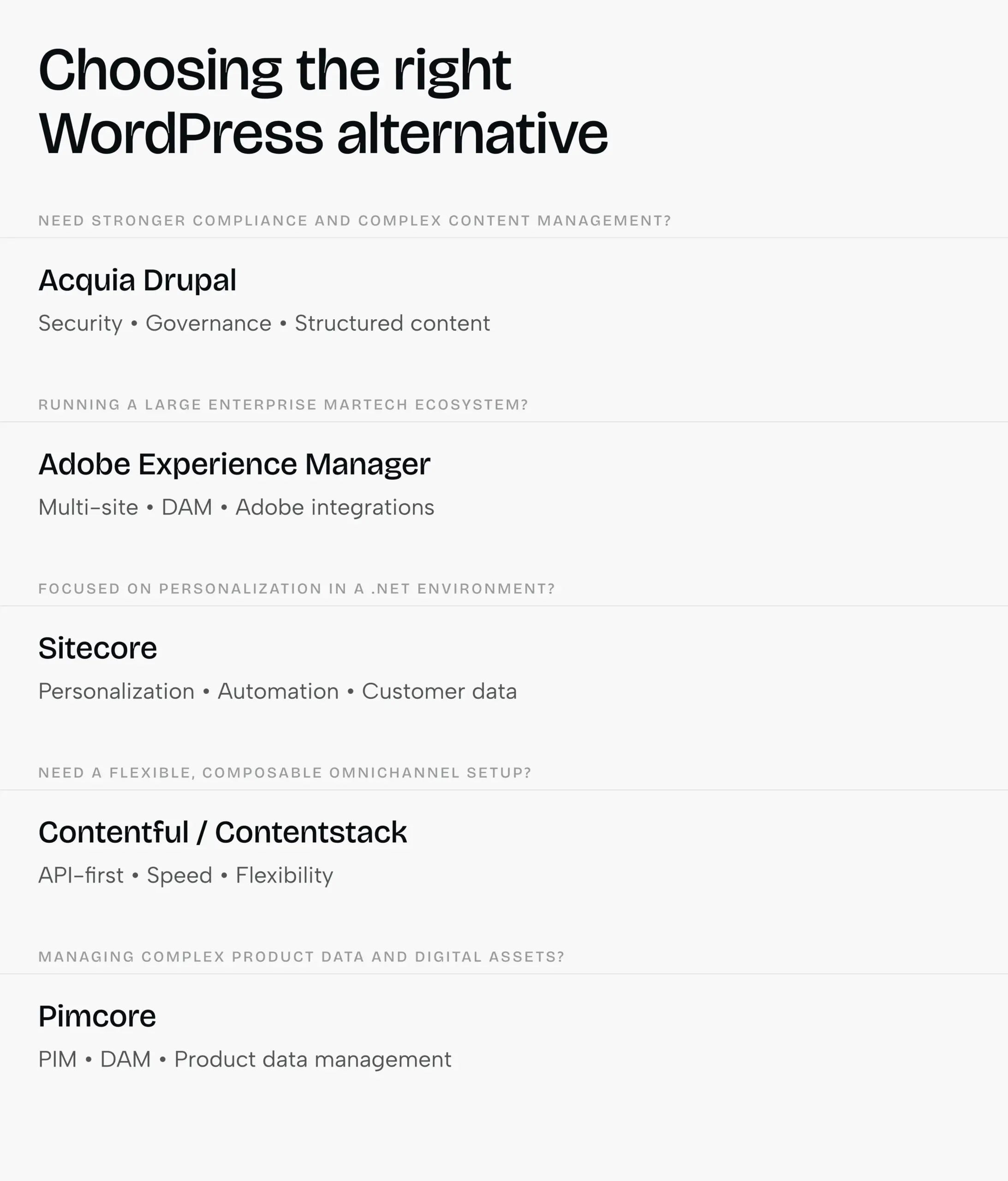
The map simplifies the choice on purpose. Real shortlists often combine two rows, such as a Pimcore catalog feeding a headless marketing site. When two constraints compete, rank them by the revenue each one puts at risk.
For B2B companies with long sales cycles, the decision often starts with research. A B2B website redesign audit shows which pages buyers actually read before procurement. Those pages define the content model, and the content model points to the platform.
A decision map narrows the platform. It says nothing about which agency will build it well.
How to vet an agency for website development on an enterprise platform
Vet an agency for website development by its migration record and its post-launch ownership model, not by its homepage portfolio. Every agency portfolio looks good on a sales call. Few agencies can show you how editors work on the site two years after handover.
The table below compares the three agency types enterprise buyers usually weigh against each other.
| Criterion | WordPress agency | DXP implementation partner | Full-cycle design and development studio |
| Typical client | SMBs and single-brand sites | Global enterprises with large MarTech stacks | Operating companies with brand-led corporate sites |
| Who edits after launch | Often the agency, via tickets | Trained content authors inside a DXP | Marketing team directly in the CMS |
| Design depth | Theme-based, varies widely | Usually delegated to a separate design firm | Research, UX and UI by the same team that builds |
| Security and updates | Client or agency patches plugins | Vendor and partner share responsibility | Managed by the platform (Webflow) or the API vendor |
| Main cost driver | Custom plugins and maintenance hours | License fees and long implementation | Design scope and content migration |
| Best fit | Small sites with simple workflows | Multi-brand, multi-region personalization | Credibility sites that change weekly |
As the table shows, the agency type decides who carries the maintenance burden. Whether you compare a website development company in the USA or a studio abroad, ask each candidate the same questions:
- Show one migration you shipped, with its timeline and a measured outcome.
- Explain who owns QA across browsers and zoom levels, and how bugs get triaged before launch.
- Walk us through the CMS as an editor would use it, with no developer in the room.
- Point us to Clutch reviews that mention delivery and support, not only visuals.
An agency for website development that hesitates on any of these questions is telling you something about its delivery.
A corporate website development agency that cannot show who edits the site after handover is selling a launch, not a platform. Platform certifications prove technical skill on the software. They do not prove the team can design a site that buyers trust in the first five seconds.
Phenomenon Studio holds a 5.0 rating on Clutch across 50+ verified reviews, and procurement teams increasingly check such profiles before a first call. For a professional website development company, those reviews are the closest thing to a reference check you can run on day one.
Case study: how Milk & Honey left WordPress for a site its team runs

Milk & Honey operates three divisions plus a music M&A practice with over $300 million in brokered catalog sales. Its traffic comes mostly from referrals, so the website exists to confirm credibility within seconds. The old WordPress site split that story across separate pages and third-party redirects. Every new signing or office update required a developer.
Task. The brief started as a like-for-like rebuild of the existing multi-page structure. Three separate problems were driving it. The site looked smaller than the firm, which represents Grammy-nominated songwriters and NFL athletes. WordPress turned every roster change into a developer task, and weak technical performance undercut the content on mobile.
Solution. A competitor matrix benchmarked four entertainment firms, including Roc Nation and WME, on messaging and division identity. The research showed strong visuals in the category but vague scope and no distinct identity per business line. That finding reframed the brief from a multi-page rebuild to one landing page, with modals absorbing secondary content.
Each division received its own visual identity and a compact release-card system that keeps roster names visible. A progress bar keeps visitors oriented across all nine sections. As a website design and development agency, we ran research and the Webflow build with one team. We rebuilt the site on Webflow, moving rosters and releases into CMS collections the client edits directly. Clamp-based typography and percentage spacing hold the layout from 1280px to 2560px+ across 75–150% browser zoom.
Result. The three-division story that once lived on separate pages now runs as a single continuous scroll. Referral visitors scanning one division’s roster keep their place instead of dropping off. The internal team manages news and office content on its own, without waiting on engineering. The published case reports qualitative outcomes rather than traffic figures, so we do not quote conversion numbers for it.
“I made a real investment to have Phenomenon do Milk & Honey Music + Sports new site, and I’m so glad I did. From the presentation aesthetically, to the layout of information to the full optimization – I finally have a site that represents who we are.”
Lucas Keller, President, Milk & Honey
Picture a deal closing on a Friday afternoon. Someone on the Milk & Honey team opens the Webflow editor and adds the new signing to the roster collection. The update goes live the same afternoon without a ticket in anyone’s queue. The full Milk & Honey Webflow rebuild shows the wireframes and the nine-section structure.
A Webflow rebuild like this sits at the lighter end of enterprise budgets. DXP programs cost far more, and the gap deserves real numbers.
What does a website design and development agency charge for enterprise builds?
A website design and development agency typically quotes a 1–2 month build for a Webflow or headless corporate site. DXP programs often run most of a year. Platform licenses then add a recurring cost on top of the build. The ranges below are planning estimates for a typical corporate scope, excluding licenses.
| Engagement | Indicative build budget | Timeline | Typical team composition |
| Webflow corporate site (full-cycle studio) | 30,000–90,000 | 1–2 months | 4–6: PM, 1–2 designers, 1–2 Webflow developers, QA |
| Headless build (Contentful or Contentstack) | 60,000–200,000 | 2–4 months | 5–8: adds front-end and back-end engineers |
| Pimcore PIM with website | 80,000–250,000 | 3–6 months | 5–8: adds data architect and integration engineer |
| Drupal on Acquia | 100,000–300,000 | 3–6 months | 6–10: adds Drupal architect and DevOps |
| Sitecore implementation | 150,000–500,000 | 4–8 months | 7–10: adds .NET developers and personalization lead |
| Adobe Experience Manager | 200,000–750,000+ | 4–9 months | 8–12: adds AEM architect and Adobe stack specialists |
Content volume moves the budget more than page count. A site with clean templates migrates in weeks, while legacy pages full of shortcodes need scripted migration and manual cleanup. Integrations come next, especially CRM and SSO connections that require security review. Quotes from a website development company in the USA often sit higher within each range because senior hourly rates are higher.
According to McKinsey, companies in the top quartile of its Design Index grew revenue 32 percentage points faster than industry peers over five years. (McKinsey & Company, The Business Value of Design, 2018)
Design budget is where enterprises cut first, and McKinsey’s data suggests it is the wrong line to cut. At Phenomenon Studio, clients choose between three collaboration models depending on how much of the roadmap they want covered:
- Full-cycle partnership. We run the whole cycle, from discovery through launch support, as one engagement.
- Dedicated team. A cross-functional team works on your roadmap long term, which suits phased DXP programs.
- Team extension. Our designers or engineers join your in-house team to close a specific skill gap.
Full-cycle work delivers the best results when the client has a defined vision and budget for at least a discovery phase. Skipping discovery to jump into visual design reliably produces another redesign within two years. The scope of our enterprise website development agency services starts from that discovery step.
Budget is one filter on the shortlist. Location is the next question buyers raise, usually in the first call.
Comparing website development and design companies: US-based, offshore, or nearby
Website development and design companies differ less by headquarters than by who owns strategy and who writes the code. Time-zone overlap for decision meetings matters more than the office address on the contract.
Website design agency USA: when a domestic team earns its premium
Buyers often assume a website development company in the USA is the only safe choice for a US brand. A website design agency in the USA earns its premium when stakeholders need frequent in-person workshops. It also wins when procurement requires a domestic legal entity or on-site security clearance. For most corporate marketing sites, neither applies. What matters is that strategy calls happen in your working hours and that one team owns design and build. Phenomenon Studio was founded in 2019 in Europe and works with clients across North America and other global markets on exactly that basis.
Website development company services to expect in a migration scope
Before comparing quotes, confirm that each website development company in the USA or abroad prices the same scope. A credible migration proposal includes the following items:
- A content inventory and URL map, so nothing valuable disappears in the move.
- A 301 redirect plan that protects existing search rankings.
- CMS modeling and editor training, so marketing owns the site from week one.
- Accessibility and performance QA before launch, plus a post-launch support window.
Website design agency near me: does proximity still matter?
Searching for a website design agency near me makes sense for a local business that wants a face-to-face kickoff. For enterprise rebuilds, proximity mainly affects stakeholder interviews and the first workshop. Distributed teams cover both with a planned on-site week or structured remote sessions. Many website development and design companies now split strategy and build across continents. Judge any agency for website development on its process and references, not its postcode. Our approach to website design services for operating companies runs the same way for clients in any time zone.
Picking the right partner prevents most failures. The rest come from decisions made during the migration itself.
Common mistakes when replacing WordPress on an enterprise site
Most failed WordPress replacements fail on process, not platform. We see the same six mistakes across website development and design companies, and each one is avoidable.
- Choosing the platform before mapping content. Teams pick AEM or Contentful from a demo, then discover their content model does not fit. Map content types first, and let the model choose the platform.
- Rebuilding page for page. Milk & Honey’s brief began as a like-for-like rebuild. Research turned it into one landing page, which removed the fragmentation the old structure caused.
- Forgetting redirects. A migration without a 301 map resets rankings that took years to earn. Treat the redirect file as a launch blocker.
- Treating speed as a post-launch task. Heavy scripts and unoptimized media are cheaper to prevent than to fix. Set a performance budget in the design phase.
- Buying personalization nobody runs. A DXP personalization engine without an owner becomes an expensive static site. Name the owner before signing the license.
- Skipping editor training. If marketing cannot publish on day one, tickets return, and the old bottleneck rebuilds itself on a new platform.
According to Google, 53% of mobile site visits are abandoned if a page takes longer than three seconds to load. (Google, The Need for Mobile Speed, 2016)
Google’s later benchmark research found that the probability of a bounce rises 32% as page load time grows from one to three seconds (Google/SOASTA, 2017). For a referral-driven corporate site, that bounce often means a lost deal rather than a lost click.
The fix is mostly a matter of sequencing. Run research and content mapping before design, and let design set the performance budget before development starts. A website design and development agency that runs research first catches most of these problems early. Our website redesign process follows that order on every rebuild, whichever platform the client lands on.
Milk & Honey’s team now publishes its own updates on a platform chosen for how the company actually operates. If your WordPress site has started to slow your marketing team down, send us the current site and the constraint that hurts most. We will come back with a read on which platform fits and whether we are the right studio to build it.
Bibliography
- W3Techs (2025). Usage statistics and market share of WordPress. https://w3techs.com/technologies/details/cm-wordpress
- Patchstack (2024). State of WordPress Security in 2024. https://patchstack.com/whitepaper/state-of-wordpress-security-in-2024/
- McKinsey & Company (2018). The Business Value of Design. https://www.mckinsey.com/capabilities/mckinsey-design/our-insights/the-business-value-of-design
- Google (2016). The Need for Mobile Speed. Think with Google.
- Google/SOASTA (2017). Find out how you stack up to new industry benchmarks for mobile page speed. Think with Google.
- Gartner. Magic Quadrant for Digital Experience Platforms (annual editions).
- Clutch. Phenomenon Studio company profile. https://clutch.co/profile/phenomenon-studio
- Phenomenon Studio (2026). Milk & Honey: turning a scattered multi-page site into one story a visitor can follow start to finish. https://phenomenonstudio.com/projects/milk-honey-turning-a-scattered-multi-page-site-into-one-story-a-visitor-can-follow-start-to-finish
- Public product information from Acquia, Adobe, Sitecore, Contentful, Contentstack, Pimcore, Webflow and Automattic (WordPress VIP).
Share this article with friends



Oct 31, 2026
9 min read
See how our UI UX design agency repositioned Merchant Tech, an e-commerce operations platform, with workflow proof, pricing clarity and early trust signals.

Oct 31, 2026
7 min read
Explore how our web design services helped Vita Travels launch an award-winning wellness marketplace with custom UI/UX design and Webflow development.
