



Aug 27, 2026
6 min read
summary
Learn how to choose a fintech software development company for compliant onboarding, KYC, risk-based verification, and higher conversion in 2026.
Direct answer. Choose a fintech partner by proof that it ships onboarding which converts and clears KYC, not by feature lists or price alone.
The Short Version
- Identity verification is the biggest leak in fintech signup. Industry research puts average onboarding drop-off between 63% and 68%.
- The fix is not weaker compliance. It is risk-based, tiered verification that matches scrutiny to actual risk.
- A capable build partner treats compliance and UX as one system, not a legal gate bolted on before launch.
- Phenomenon Studio’s KlickEx fintech redesign lifted Add Money conversion by 35.3% and added about 3,000 users each month.
Every fintech leader knows the paradox. Acquisition spend brings users to the door, and verification loses most of them at the threshold.
Industry research puts average onboarding drop-off between 63% and 68%, and some high-friction products lose closer to 88%.
The instinct is to blame the funnel design. The real culprit is usually identity verification that treats every user as maximum risk.
This is where the choice of a fintech software development company becomes a growth decision, not a technical footnote.
It sits alongside the operational reality we cover in the cost of slow onboarding, where signup speed shapes acquisition economics.
By Anastasiia Morozova | Product UI/UX Designer, August 2026
What agency UX capability really means for a fintech build
Agency UX for fintech is not about screens that look calm. It is about screens that survive regulation and still convert.
In our fintech work, the teams that win treat verification as a product surface, not a compliance afterthought.
A fintech design agency earns its fee when it removes friction a regulator would otherwise force you to keep.
The signal to look for is simple. Has the team shipped a compliant onboarding flow that moved a real conversion number?
What makes the best UX company for a regulated product
The best UX company for a fintech is one fluent in risk, not only in visual polish. It designs the verification step as carefully as the home screen. It knows a passive liveness check converts far better than a gesture test. Ask which onboarding metrics the team has moved, not which awards it has won.
Why fintech design raises the compliance bar
Strict checks have to feel effortless, or users walk. Strong fintech UX design hides KYC weight behind real-time database checks and passive biometrics. The job is to satisfy Customer Due Diligence without a wall of forms. Good fintech UX design also explains why each data point is needed, which lifts completion.
How to shortlist top UX agencies and build partners
Shortlisting top UX agencies for fintech is risk work, not taste work. The best filter is proof of shipped, compliant onboarding.
Define your hardest verification problem in one line. Then ask each fintech software development company to show a live product that solved it. A crypto onboarding flow demands one kind of proof. A cross-border payments flow demands another.
In fintech, the onboarding screen is the product. If a user cannot pass verification in under two minutes, the rest of the roadmap barely matters.
That test maps directly to the numbers a partner should be able to show.
A directory ranking can start the search. Still, a strong fintech design agency proves itself in production, not on a profile.
Phenomenon Studio’s KlickEx work is one such proof of a regulated money flow moved in the right direction.
One rule protects delivery more than any other. Name the senior people in the contract, because partners that pitch with leads and deliver with juniors are the common disappointment.
Start with a UX audit before you scope the build
A UX audit before you scope the build changes what you buy. It turns a vague onboarding fix into a ranked list of leaks worth paying to close. We open most fintech engagements this way.
A focused UX audit maps where users drop off in verification and why. It grounds the brief in real behavior, so partners bid on the same defined problem.
For enterprise UX design, the audit does double duty. It exposes both usability gaps and the compliance debt behind them.
The read-out matters because enterprise UX design choices ripple across risk teams and engineering alike.
What fintech software development services should include
These services are not just code. They cover the risk logic and the data checks that turn a signup into an approved account.
Full fintech software development services connect product design to the compliance rules and the verification engine behind it.
In our builds, the highest-impact work is the risk-based onboarding model. Scrutiny scales with actual risk, so low-risk users get in fast and high-risk cases get real checks. Regulators back this model under FATF guidance.
A capable fintech software development company implements it as three tiers.
Risk-Based Onboarding Tiers
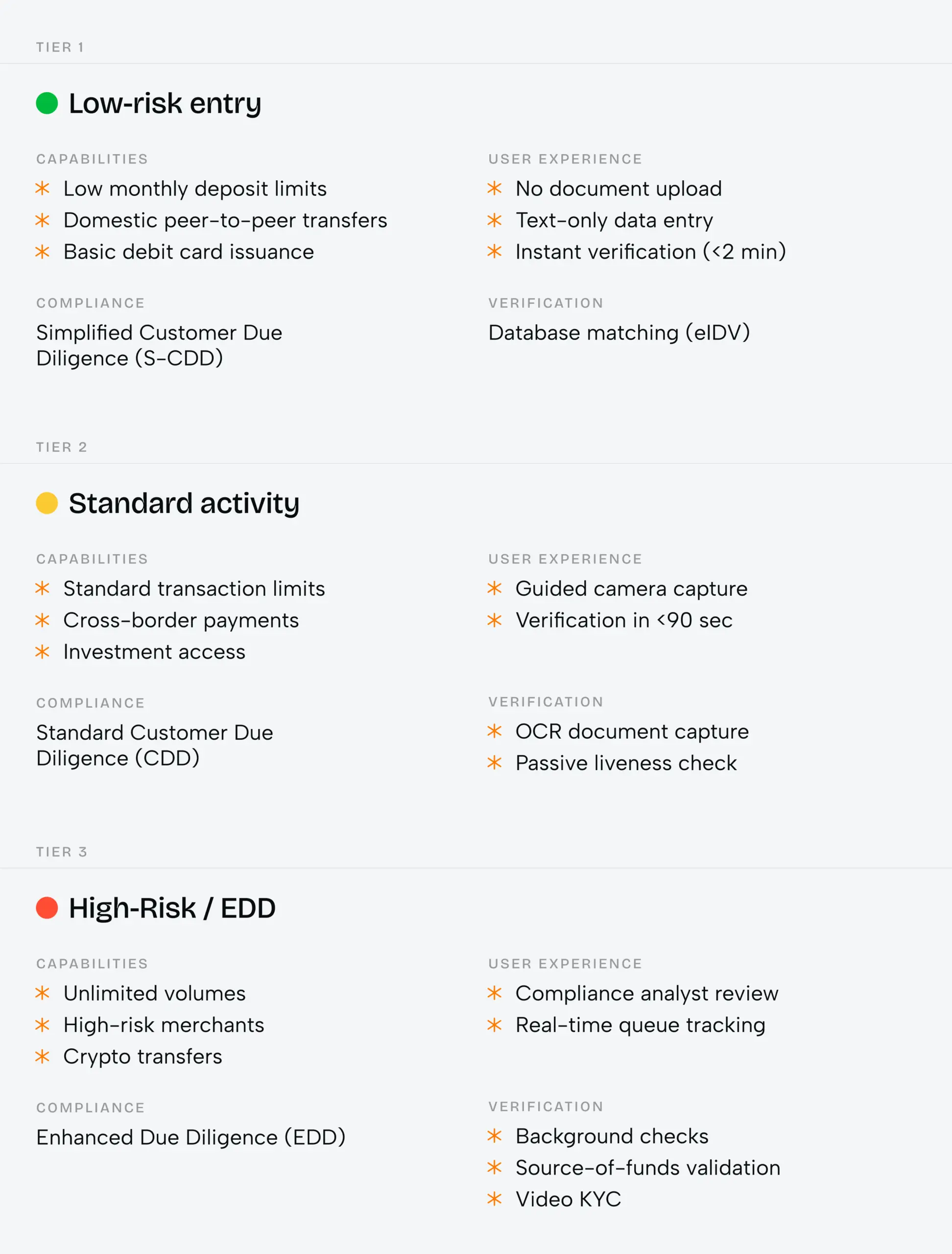
This tiered model is why custom fintech software solutions outperform off-the-shelf KYC widgets. The risk logic fits your product, not a generic template.
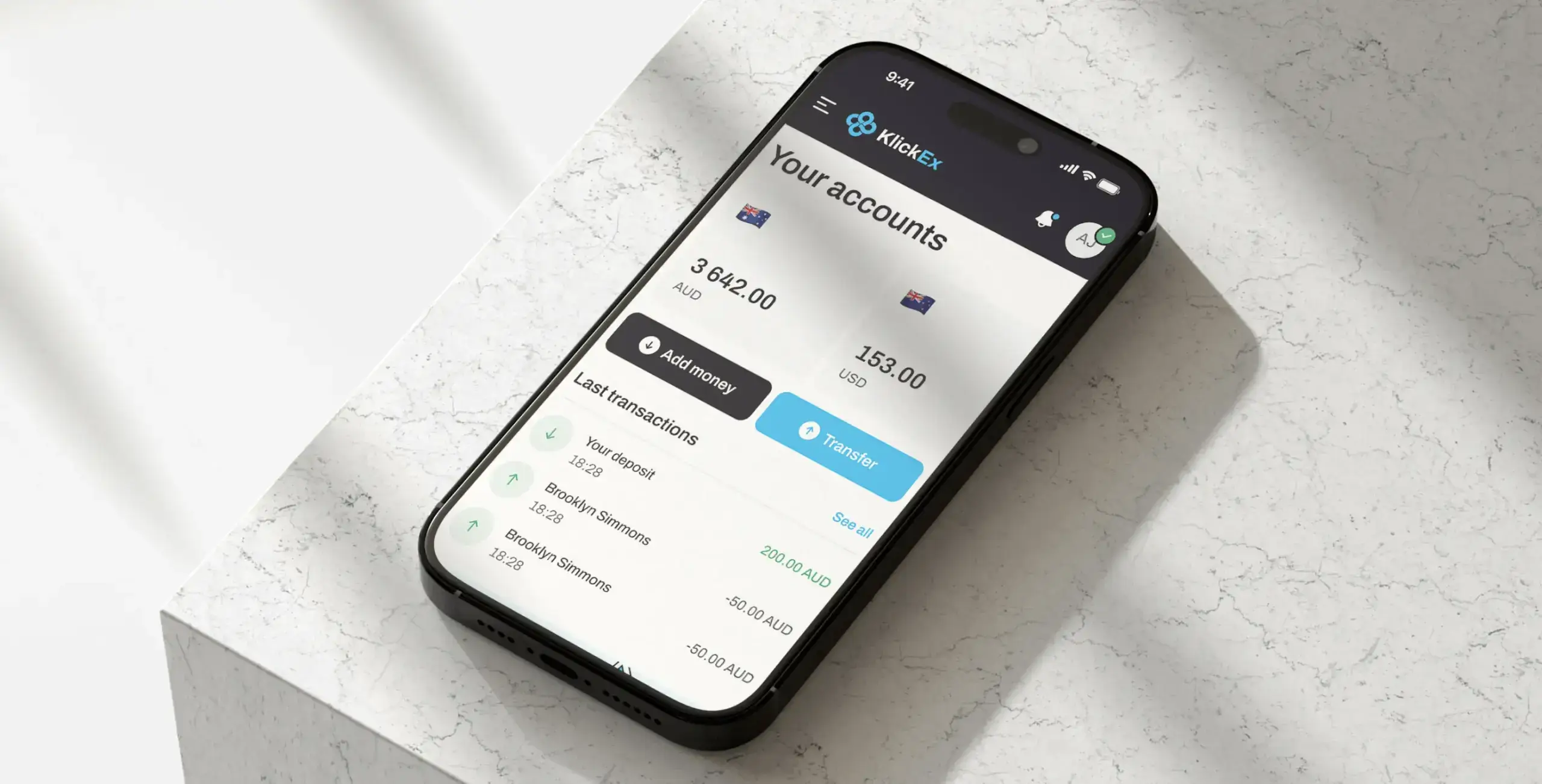
KlickEx – frictionless cross-border payments for the Pacific Island communities
Task
KlickEx, a cross-jurisdiction remittance platform, needed higher conversion on money movement without weakening trust or compliance.
Solution
Phenomenon Studio rebuilt the core Add Money and Money Transfer flows in the KlickEx fintech redesign, built around mobile-first behavior and clearer transaction states.
Result
Add Money conversion rose 35.3% and Money Transfer completion rose 30.7%. Mobile completion reached 54.8% on the rebuilt flows. The base grew past 53,000 users and added roughly 3,000 each month.
According to Phenomenon Studio project data, KlickEx added roughly 3,000 new users every month after the redesign (Phenomenon Studio, KlickEx case study).
FinTech application development services for a mobile-first funnel
Most fintech signups happen on a phone. Fintech mobile app development services decide whether document capture works away from a desk.
Strong fintech application development services build for the moment a user is asked for an ID they do not have on hand. A specialist fintech design agency designs the capture step for real-world lighting, not a studio.
On mobile, client-side image checks catch glare and blur before upload, which cuts re-upload abandonment sharply. Passive liveness replaces head-turns and blinks, dropping the check from about ten seconds to under two.
We build these capture flows to fail gracefully, with a clear reason and a fast retry.
This is where fintech mobile app development services earn their budget. Fewer failed captures mean more approved accounts.
Common onboarding friction and the fix
| Onboarding friction | What it costs | The fix |
| No document on hand | About 38% of abandonment | Database checks instead of uploads |
| Vague re-upload errors | Roughly 3x higher drop-off | Client-side image checks before submit |
| Gesture liveness tests | Timeouts on low-end phones | Passive liveness in under two seconds |
| Silent post-submit wait | Peak churn at 24 to 36 hours | Event-based status updates |
How fintech software development gets delivered
Fintech software development is a team sport, and the mix of people decides the outcome. The best fintech software development company pairs product design with engineers who understand compliance constraints.
A fintech software development agency is worth its premium only when it has shipped regulated products before. The right fintech design agency ties design decisions to the risk model from day one.
Mature fintech software development services also cover post-launch monitoring and risk re-scoring. That is where our design-system and product-strategy work keeps a scaling product consistent.
Phenomenon Studio holds a 5.0 rating on Clutch across more than 50 verified client reviews (Clutch).
What a fintech software developer actually owns
A fintech software developer on a serious build owns more than features. They implement the verification logic and the audit trail behind every decision. They also build the fallback paths for when a check fails. On a compliant product, this person turns a risk rule into working code without breaking the flow.
When a fintech software engineer earns the senior rate
A senior fintech software engineer earns the rate on judgment about risk and scale. They design the system so a step-up check does not stall the app. For a first compliant build, that seniority prevents a costly rebuild later.
Choosing well is mostly about matching proof to your hardest onboarding problem. Write that problem in one line, then ask each shortlist team to show the shipped version. The best fintech software development company for you answers with a live funnel, not a slide. Phenomenon Studio is glad to walk through where a risk-based flow would fit your product.
Bibliography
Phenomenon Studio. Portal: simplifying tax tracking for digital assets. phenomenonstudio.com/projects/portal
Phenomenon Studio. The cost of slow onboarding: how UX drives fintech growth. phenomenonstudio.com/article/the-cost-of-slow-onboarding
Clutch. Phenomenon Studio company profile. clutch.co/profile/phenomenon-studio
Share this article with friends



Sep 29, 2026
6 min read
B2B website redesign without losing traffic: A complete b2b website redesign guide covering UX audits, 301 redirect mapping, and metadata preservation. Partner with a top b2b website redesign agency that boosts conversions while protecting your organic rankings.

Sep 29, 2026
8 min read
Small business web design services that fit your budget. Get affordable small business website design from one of the best website design companies for small business — with transparent pricing and no hidden fees.
