



Sep 29, 2026
6 min read
summary
B2B website redesign without losing traffic: A complete b2b website redesign guide covering UX audits, 301 redirect mapping, and metadata preservation. Partner with a top b2b website redesign agency that boosts conversions while protecting your organic rankings.
A b2b website redesign keeps its traffic when technical SEO leads the build and a 1:1 redirect map preserves every ranking already earned.
Key Takeaways
- Most redesign traffic loss comes from broken redirects and changed URL paths, not from the new visual design.
- A pre-redesign audit records every ranking page and backlink before anyone draws a wireframe.
- Phenomenon Studio has delivered conversion gains above 35% while holding organic rankings steady through redesign.
- The first twelve weeks after launch decide whether rankings settle or slide.
By Yuliia Apanasenko | CEO of Phenomenon Studio, September 2026
A B2B website redesign is a growth project, not a facelift
The most expensive assumption a company can make is that a b2b website redesign is only a visual refresh. On the surface it looks like one, with a new brand and cleaner, more modern pages. Underneath the surface sits the machinery that brings in organic pipeline, and that machinery breaks quietly.
B2B buying does not work like retail. A purchase runs through procurement and a security review before a finance sign-off. That path can stretch across several months. The website carries the weight the entire time. It answers the executive who wants a financial outcome and the engineer who wants technical proof on the same visit.
When a company outgrows its old positioning, the dated site starts costing deals. The messaging no longer matches the product. The pages load slowly and buyers hesitate. That is a real reason to rebuild.
The danger appears when design leads the project and search comes last. A team reskins the pages and hands templates to developers. Then it runs a quick SEO check the week before launch. By then the URL structure has already changed and the internal links have already moved. The rankings quietly follow them down.
Search engines judge a site on trust built over years. They read the crawl paths and canonical tags. The relationships between pages matter just as much. Change those signals without a plan and the index resets its view of your authority. Demo requests fall first, because commercial pages lose position fastest.
When organic pipeline drops, revenue teams patch the gap with paid media. That trade quietly erodes gross margin over time. Every demo that used to arrive free from search now carries an acquisition cost. A redesign that loses rankings does more than cost traffic. It raises the price of every lead for months.
An SEO-led rebuild inverts the order. It starts with a diagnostic baseline and maps intent to architecture. Then it preserves URLs through a strict redirect plan. The visual upgrade still happens as planned. It lands on top of a protected foundation. This b2b website redesign guide follows that order from audit to launch.
Not every site needs a full rebuild. A facelift works when the structure and rankings are healthy and only the visual layer feels dated. A full rebuild earns its cost when the positioning has shifted or the platform can no longer carry new pages. Picking the wrong one wastes budget in both directions.
| Decision area | Design-first redesign | SEO-led redesign |
| Project goal | Visual modernization | Positioning plus rankings and pipeline growth |
| Architecture | Content reordered by internal org chart | Journeys mapped to buyer intent and search clusters |
| URL handling | Paths changed freely during CMS migration | URLs preserved with 1:1 301 mapping |
| SEO timing | One audit near launch | Governance from discovery through post-launch |
| Conversion model | Generic buttons on static templates | Intent-matched paths with field-level analytics |
| AI readiness | Legacy copy no engine can parse | Semantic HTML and schema built for AI answers |
According to Phenomenon Studio, product redesign and UX optimization have delivered conversion rate improvements above 35%. (Phenomenon Studio, 2026)
The table shows one budget spent two ways. One version buys a prettier brochure. The other buys a brochure that still ranks and still converts. The gap between them is process, not talent.
What a B2B website redesign agency controls before design starts
The real job of a b2b website redesign agency is not the visual. It is the search equity the site earned. A strong partner spends the first phase protecting what already works and quantifying what is at risk.
In our experience delivering hundreds of digital products, the projects that lose traffic skip discovery. The projects that grow start with a full accounting of the current site. Every ranking page and every backlink gets documented before the redesign touches anything. Each conversion path is mapped too.
That accounting is not glamorous work. It is a sheet of URLs and statuses that becomes the safety boundary for the whole build. Skip it, and the team is redesigning blind. A capable b2b website redesign agency treats that sheet as the contract.
A rebuild is also the moment to fix how the site speaks to two readers at once. The top layer carries the executive value and the headline metric for a fast scan. The lower layer holds the technical proof an engineer needs before a shortlist decision. Both readers land on the same page and both find their answer.
Architecture follows intent, not the internal org chart. Decision-stage queries about a specific capability map to a focused product page with a clean path to demo. Evaluation-stage queries about pricing or ROI map to comparison content and case studies. Awareness-stage questions map to guides that capture broad top-of-funnel volume.
The audit that keeps a B2B redesign website intact
A pre-redesign audit crawls the live site and exports every URL with its status code and canonical tag. It also records the title and header structure of each page. That crawl is matched against Google Search Console and Google Analytics 4 data. The result is a baseline snapshot of what earns traffic today.
Each URL then gets a decision. High-performing commercial pages keep their exact address and structure. Weak pages with strong intent get reworked around their target query. Thin overlapping articles merge into one authoritative resource with a redirect from the old ones. Dead pages retire through planned status codes.
Backlinks deserve their own review pass. The pages other sites link to must keep their exact address, because a broken link there loses authority you cannot easily rebuild. Where several thin pages compete for one query, the audit merges them into a single stronger page and redirects the rest. That move removes the cannibalization that quietly caps a keyword.
The question we hear most from B2B leaders is simple. Will we lose the rankings we spent years earning? You lose them only if the b2b redesign website drops the pages that carry them. A disciplined audit makes that outcome a choice, never an accident. Randomly deleting low-traffic pages is how a b2b redesign website bleeds equity that nobody tracked.
Where B2B website redesign services earn their fee
Good b2b website redesign services are measured at the migration, not the mockup. The deliverable that protects revenue is the redirect map and the schema package. The staging QA report backs them up.
A full component system pays off when the marketing team ships pages every week. For a five-page site refreshed once a year, that system costs more than it returns. The right scope depends on how often the site actually changes, and a good partner says so plainly.
This is where a serious partner separates from a template shop. Anyone on the market can restyle a page. Holding rankings through a platform move takes engineering discipline that most brochure builds never touch.
On scope and timing, a focused B2B rebuild often runs from discovery to launch across one to two months. It runs longer when the brand and the platform change together. The team is a small cross-functional pod. A strategist frames the positioning and message. The designers build the component system. Engineers own the migration and the QA. One partner under a single roof keeps the handoffs short and the cost predictable.
The migration window is where rankings disappear
The redirect map is the single most important file in the project. A correct map sends each old URL to its exact new equivalent in one hop. That single 301 passes the authority the old page earned across years of indexing.
Two common patterns destroy that authority. The first is the redirect chain, where a URL bounces through several addresses before it lands. The second is the homepage dump, where every retired page points to the front page. Search engines read that dump as a soft 404 and discard the history behind it.
Staging needs that same discipline too. A development site left open to crawlers creates duplicate content that can pull down the live domain. Password protection or a noindex header keeps it sealed until launch. On a WordPress move, our WordPress website redesign services lock staging before the first template ships.
The platform choice shapes the migration risk. Webflow suits marketing sites that change often and need fast publishing. WordPress fits content-heavy sites with an established editorial workflow. A headless build with static generation serves teams that want speed and control across a large site. Each path carries its own redirect and indexing checklist.
Launch day runs as a sequence. The team removes staging blocks and activates the server redirects. It submits a fresh sitemap, then confirms every analytics event fires. After that, the twelve-week watch begins.
Rankings do not snap back instantly. The first two weeks are about server health and clean indexing. Weeks three through eight are the settlement phase, when search engines reallocate authority across the new addresses. Small ranking movements are normal here. Sustained drops on core pages mean a redirect is missing.
The final weeks shift from indexing to conversion. Heatmaps and session data show where forms lose people and where a call to action sits too low. Small changes to field count and button placement lift completion on high-intent pages. The redesign starts paying back the moment those numbers move.
By the third month, a redesign built this way stops recovering and starts growing. Organic visibility climbs past the old baseline because the structure now serves both readers and AI answer engines. B2B website redesign strategies that ignore this window leave that growth on the table.
Internal links carry equity between pages, and a redesign often severs them by accident. When contextual in-text links get replaced by a plain graphic menu, deep pages lose the signal that ranked them. The new architecture has to keep the contextual links alive between the hubs and the deeper product and case-study pages.
Speed is part of the ranking too. Interaction to Next Paint is now the strictest of the Core Web Vitals on mobile. A heavy article template can push it past the threshold. Lazy loading for images is not optional on long pages. A fast page holds the dwell time that a slow one loses.
A short list of mistakes accounts for most post-launch losses.
- Redirecting every retired page to the homepage, which search engines read as a soft 404 and discard.
- Changing URL slugs for cosmetic reasons without a matching redirect for each old address.
- Leaving the staging site open to crawlers, which creates duplicate content against the live domain.
- Shipping new templates before the schema and the redirect map pass a QA crawl.
Generative engines reward the same structure. Clear semantic headers with a direct answer underneath let AI Overviews and conversational agents quote the page cleanly. Schema for Organization and Product gives those engines unambiguous facts to cite. FAQ markup adds the question-and-answer pairs they quote. The site earns visibility in the answer box, not only the link list.
Answer engines also read a plain map of the site. A short file at the root that lists key sections and authors helps tools like Perplexity and AI Overviews cite the right page. It is a small addition that pays off as buyers start their research inside an AI chat.
Judge the redesign on a few numbers, not on taste. Watch organic sessions against the pre-launch baseline. Track demo requests coming from organic pages. The indexing coverage report should stay clean of new errors. When those signals hold or climb, the migration worked.
Here is how a full engagement breaks down across five phases, from the first audit to the post-launch watch.
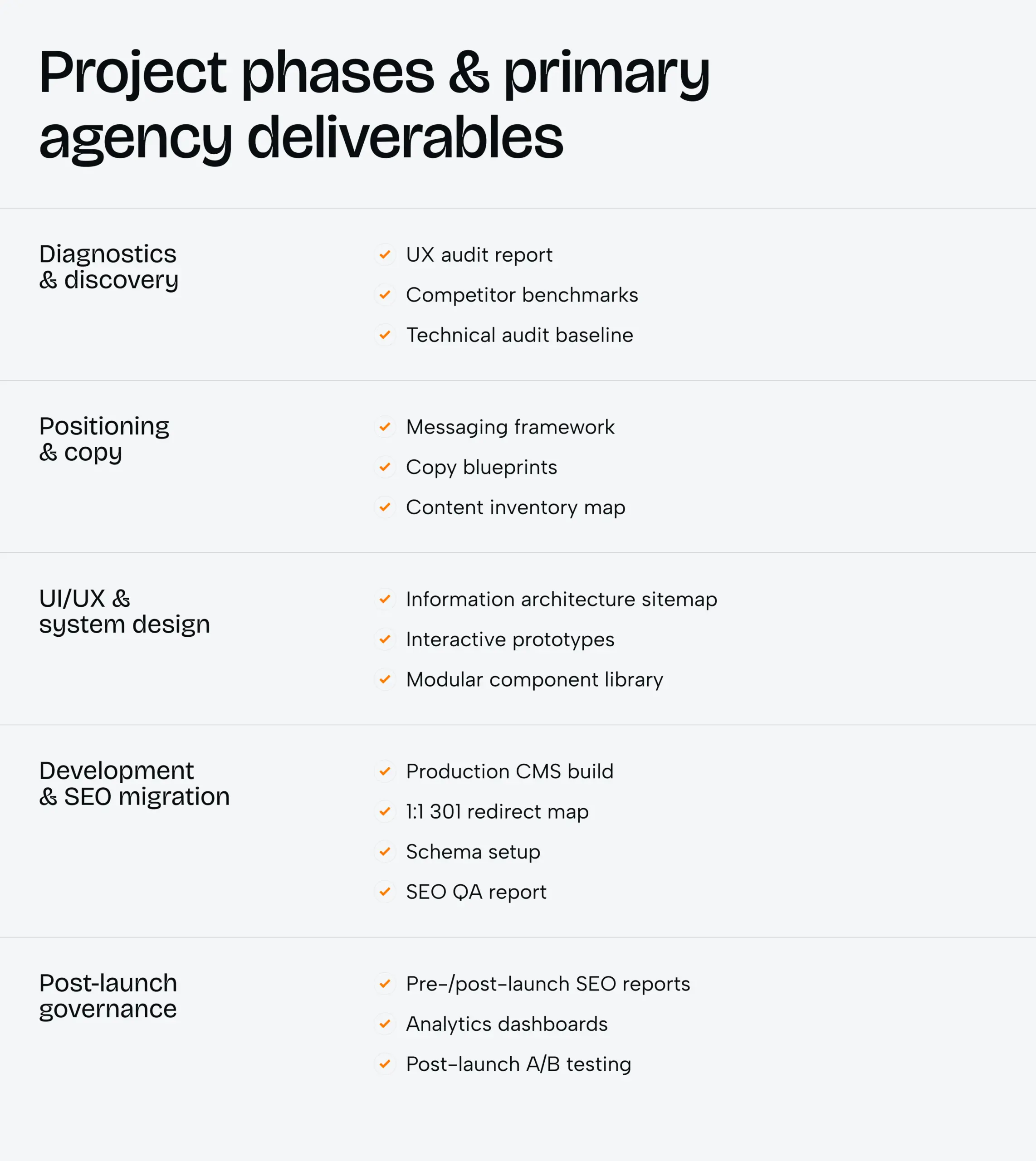
Among b2b website redesign examples from our own work, the Artisan rebuild shows this model in practice. The Artisan case study pairs a repositioning with a production system built for speed.

Task
Artisan builds autonomous AI agents for sales teams. The company had outgrown a site that read like a generic SaaS product and could not keep pace with frequent launches. Leadership needed a rebuild that repositioned the brand and let marketing ship pages fast.
Solution
We ran a UX audit and a competitor review across the AI category, then rebuilt the visual system around a premium, product-focused direction. A structured component library with responsive layouts replaced the rigid old templates. Content and development stayed in close sync so pages could change without breaking the system.
Result
Artisan launched more than twenty marketing pages in under a month on the new system. The brand moved away from generic SaaS aesthetics toward a clearer AI position. The site now grows with new products and SEO work instead of needing a rebuild each time.
This is a b2b saas website redesign where speed of production was the business constraint, and the component system answered it directly.
How to choose a B2B design agency that protects your pipeline
Choosing a b2b design agency comes down to one test. Does the team treat search equity as an engineering problem or as an afterthought? The answer shows up in the questions they ask during the pitch.
The top agencies for b2b website redesign ask about your current rankings before they ask about your color palette. They want the backlink profile and the top landing pages. They also want the Core Web Vitals baseline. That order tells you they plan to protect revenue first. Among the top agencies for b2b website redesign, that instinct is the real differentiator.
Strong b2b website design agencies bring positioning to the table, not just pixels. A rebuild is the moment to sharpen the message, and b2b technology web design lives or dies on message clarity. The interface has to make a dense product legible to a busy buyer in seconds.
The range of skills matters too. A b2b design agency fluent in b2b technology web design should also handle a b2b brand refresh and website redesign services scope. The same discipline applies when the brand itself needs work, not only the pages.
When you compare b2b website design agencies, look past the portfolio gloss. Ask how they handled a migration that went wrong. The best b2b website design agencies will have a story about a redirect they caught in QA. That single fix saved a client its top keyword. Real b2b technology web design depth sounds like that story, not like a mood board.
Vertical experience helps but rarely decides it. A b2b construction website redesign and a fintech rebuild share the same technical spine, even when their audiences differ. What transfers between them is the migration discipline, not the industry. A seasoned b2b design agency knows which parts are universal.
The payoff of the right choice shows after launch, not at handoff. A rebuild that protects equity re-enters growth by the third month. A careless one spends that quarter recovering what it lost. The partner sets which path you take, and the gap compounds over the year.
Phenomenon Studio holds a 5.0 rating on Clutch across 50+ verified reviews. (Clutch, 2026)
Companies supported by Phenomenon Studio have raised more than $500M in funding. (Phenomenon Studio, 2026)
Before you brief a b2b design agency, put a few facts on the table.
- Your top organic landing pages, ranked by clicks and by the leads they generate.
- The backlink profile, so the highest-authority URLs are protected by name.
- A current Core Web Vitals reading for mobile, captured before any change.
- The primary keywords you rank for today, with their current positions.
That baseline turns a vague brief into a measurable scope. It also lets you hold the agency to a clear standard once the site is live.
A website redesign agency b2b buyers trust is one that shows the work and the outcome in the same breath. Phenomenon Studio pairs website design services with development under one roof, which removes the handoff layer where most rankings quietly leak.
A redesign should raise your numbers, not reset them. Use this b2b website redesign guide as the checklist before you start. If you are planning a rebuild and want to protect the rankings you already earned, a short discovery call shows where the risk sits. Bring your current site and your top pages. We will come back with a clear read on what to preserve and what to grow.
Share this article with friends


Sep 29, 2026
8 min read
Small business web design services that fit your budget. Get affordable small business website design from one of the best website design companies for small business — with transparent pricing and no hidden fees.


Sep 21, 2026
6 min read
B2B website design that accelerates time-to-market. This b2b website design company offers full-cycle b2b website development services—from discovery and UX to scalable SaaS platforms.
