



Sep 21, 2026
6 min read
summary
B2B website design that accelerates time-to-market. This b2b website design company offers full-cycle b2b website development services—from discovery and UX to scalable SaaS platforms.
Direct answer: B2B website design and development services combine conversion-focused marketing design with product-grade engineering to turn a B2B site into a lead-generation and self-service sales engine — not just a digital brochure.
Key takeaways
- A modern b2b website design project has to do two jobs at once: convert visitors into pipeline and function as the front door to a product, portal, or trial.
- Agencies built for B2B — as opposed to generic website design b2b freelancers — combine UX research, compliance-aware architecture, and custom engineering in one team.
- Self-serve flows, role-based access, and audited compliance logic are now standard requirements in b2b saas website design, not add-ons.
- Redesigns that follow a structured, evidence-based process consistently outperform template-driven builds on conversion, time-to-market, and sales efficiency.
Most B2B buyers form an opinion about your company before a sales rep ever gets on a call. If your site reads like a static brochure while your product runs on modern SaaS logic, that mismatch costs you deals before discovery even starts. B2B website design and development services exist to close that gap — aligning brand, conversion architecture, and product-grade engineering into one coherent system.
By Oleksandr Kostiuchenko, marketing manager | September 2026
B2B website development services
B2B website development services cover the full stack behind a site: information architecture, UX design, front-end build, back-end integration, and the CRM/CMS plumbing that makes the marketing site talk to the sales and product stack. For growth-stage SaaS, FinTech, HealthTech, and EdTech companies, this isn’t a one-off design refresh — it’s ongoing infrastructure.
A b2b website design agency that only ships templated marketing pages will hit a wall the moment your buyers need role-based content, gated documentation, pricing calculators, or a self-serve upgrade path. That’s why serious website development services for b2b businesses are typically delivered by teams that can move between marketing site work and full product engineering without a handoff gap. Buying committees in B2B are rarely a single decision-maker. A deal usually involves a technical evaluator, a procurement or compliance reviewer, and an economic buyer, and each one needs a different entry point into the same site. Practically, that means:
- Multi-persona information architecture — a procurement officer should reach security documentation in two clicks; an engineer should reach API docs just as fast.
- Role-based messaging — the same page speaks differently to an executive sponsor (business outcomes) and a technical evaluator (implementation detail), without duplicating content.
- Conversion-focused CTAs tied to sales cycle stage — “Book a demo” for a cold visitor is a different ask than “Start a self-serve trial” for someone already technically qualified.
This is where website development services conversion b2b work actually pays for itself: teams that redesign B2B sites around evidence (heatmaps, session recordings, funnel drop-off data) rather than aesthetic preference typically report meaningful gains in bounce rate and CTA conversion, because the fixes target the exact point where real visitors are dropping off — not a guess.
B2B ecommerce website design
B2B ecommerce website design has different constraints than consumer ecommerce. Deal sizes are larger, pricing is often usage-based or negotiated, and the “buyer” is frequently a technical evaluator who wants to configure, compare, and estimate cost before ever talking to sales.
The core mistake in b2b ecommerce website development services is treating the product catalog and checkout like a scaled-down version of a B2C store. B2B buyers need:
- Configurable, filterable catalogs — letting a technical buyer narrow down components or plans by spec, not just browse a grid.
- Instant estimation tools — a pricing calculator that removes the “contact us for pricing” wall, which is one of the most common points where B2B purchase intent goes cold.
- Self-serve checkout with an assisted-sales fallback — self-serve by default, with a clear path to a human for buyers who genuinely need it, rather than forcing every deal through a rep.
Case study: ZeBeyond — from manual sales handoff to in-platform activation
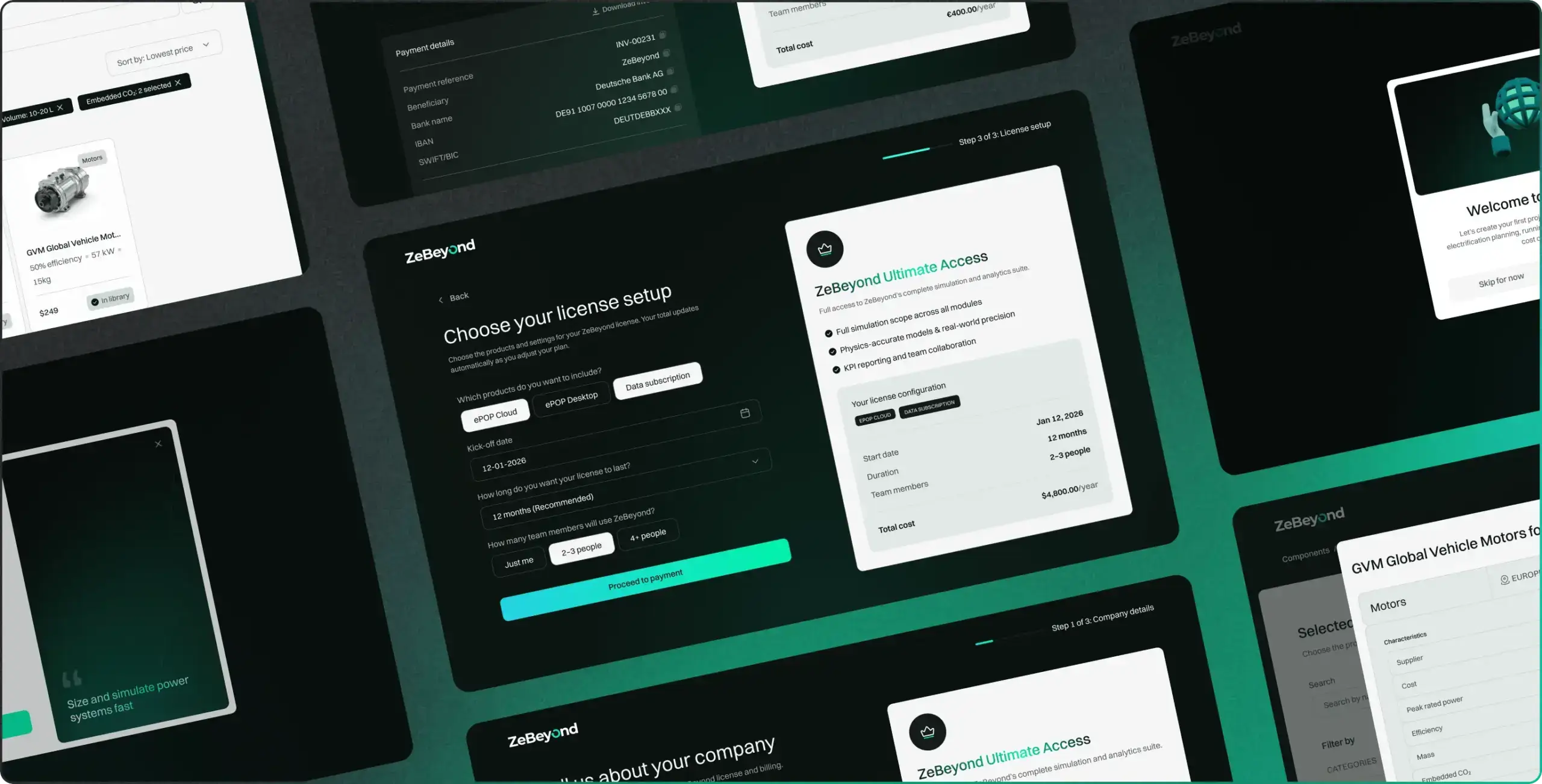
Task. ZeBeyond builds simulation software (ePOP) for engineers working on EV, hybrid, and defense powertrains. Their trial-to-paid upgrade path still ran on a 10-page PDF license agreement and order form exchanged by email — a process built for on-premise sales that hadn’t been updated for SaaS. Sales reps sat on the critical path of every deal, chasing signatures and manually processing orders instead of running demos.
Solution. We mapped the full activation journey end to end, then redesigned the onboarding and catalog flows so engineers could go from free trial to paid account inside a single in-product session — no PDFs, no email, no waiting on a rep. Plan selection, license acceptance (via timestamped clickwrap, logged automatically by user, account, license version, and date), and payment were collapsed into one flow, with a self-serve default and an assisted-sales path kept available for buyers who want it. The build ran on Node.js, Nest.js, and React, integrated as self-contained additions to ZeBeyond’s live product rather than a rebuild.
Result. Trial-to-paid activation moved from a process spanning weeks or months to a single in-product session. Sales hours previously spent on document chasing and manual order entry were redirected to demos and strategic accounts. Compliance risk was designed out: license acceptance is now logged, versioned, and auditable at the account level by default, with zero added manual process.
B2B website design companies
Not every b2b website design company operates at the same scope, and understanding the market tiers helps set expectations on price and capability before you start evaluating vendors.
| Tier | Typical price | Best fit | What you get |
| Freelancers / solo contractors | $1,500 – $8,000 | Pre-seed, basic marketing layout | Fast, cheap — usually lacks conversion strategy, SEO architecture, or custom engineering |
| Boutique / specialist agencies | $10,000 – $50,000+ | Seed to Series A | Hybrid cross-functional teams, compliance frameworks, custom engineering, structured discovery |
| Mid-market regional agencies | $35,000 – $90,000+ | Established mid-size companies | Onshore project management, structured process, higher overhead |
| Enterprise global studios | $75,000 – $200,000+ | Late-stage enterprise, Fortune 500 | Multi-month strategy phases, large multidisciplinary teams |
Phenomenon Studio operates as a boutique/specialist agency (Tier 2), with a hybrid delivery model: strategic and UX leadership based in the US, and senior engineering and design execution delivered by European teams across Poland, Ukraine, Switzerland, and Estonia. That structure is reflected in blended rates of $50–$99/hour — meaningfully below North American Tier 3/4 rates, without the scope gaps typical of Tier 1 freelance work.
B2B website design companies vs. traditional agencies
What actually separates b2b website design agencies from general-purpose web design shops is the ability to work across both marketing and product surfaces without losing continuity — the same team that designs the homepage can also design the logged-in trial flow, because in modern B2B, buyers move between the two constantly. Client work across this model has been associated with an average 40% reduction in bounce rate, a 150% lift in CTA conversion, and up to a 50% reduction in product time-to-market when design systems and engineering handoff are synchronized (Figma-to-Storybook component parity is a common driver of that last number).
Third-party validation matters here too. Independent review platforms like Clutch let you check verified client reviews rather than taking an agency’s word for its own results — worth a look before you shortlist any b2b web design agency.
B2B website design trends
Three shifts are reshaping how serious b2b website design agencies approach new builds and redesigns in 2026:
- Compliance-first design, not compliance-as-afterthought. In regulated verticals — HealthTech, FinTech, EdTech — role-based access, consent pathways, and audit logging are now designed into the information architecture before a single line of back-end code is written, not bolted on before a security review. WCAG accessibility is handled the same way: baked into color contrast and DOM hierarchy at the design-system stage, not patched in later.
- Self-serve commercial flows. The ZeBeyond case above is representative of a broader pattern: B2B SaaS companies are collapsing document-based sales handoffs into in-product flows, because the gap between “yes” and “access” is exactly when buying intent is highest — and exactly when it’s easiest to lose.
- AI features embedded at the product layer, not just the marketing layer. Early-stage products increasingly ship AI-assisted features as part of the MVP itself, which changes how the site needs to explain, demo, and price the product. If this applies to your roadmap, see AI development services.
Underneath all three trends is the same infrastructure shift: design systems built as atomic components in Figma, mirrored directly in Storybook, so design and engineering stay in sync as the product evolves instead of drifting apart after launch.
Custom b2b website development services
Custom b2b website development services — as opposed to templated builds — matter most when your site needs to do more than display information: process transactions, gate content by role, integrate with your CRM, or serve as the shell for a trial product.
How the process actually runs
A structured redesign typically moves through six stages:
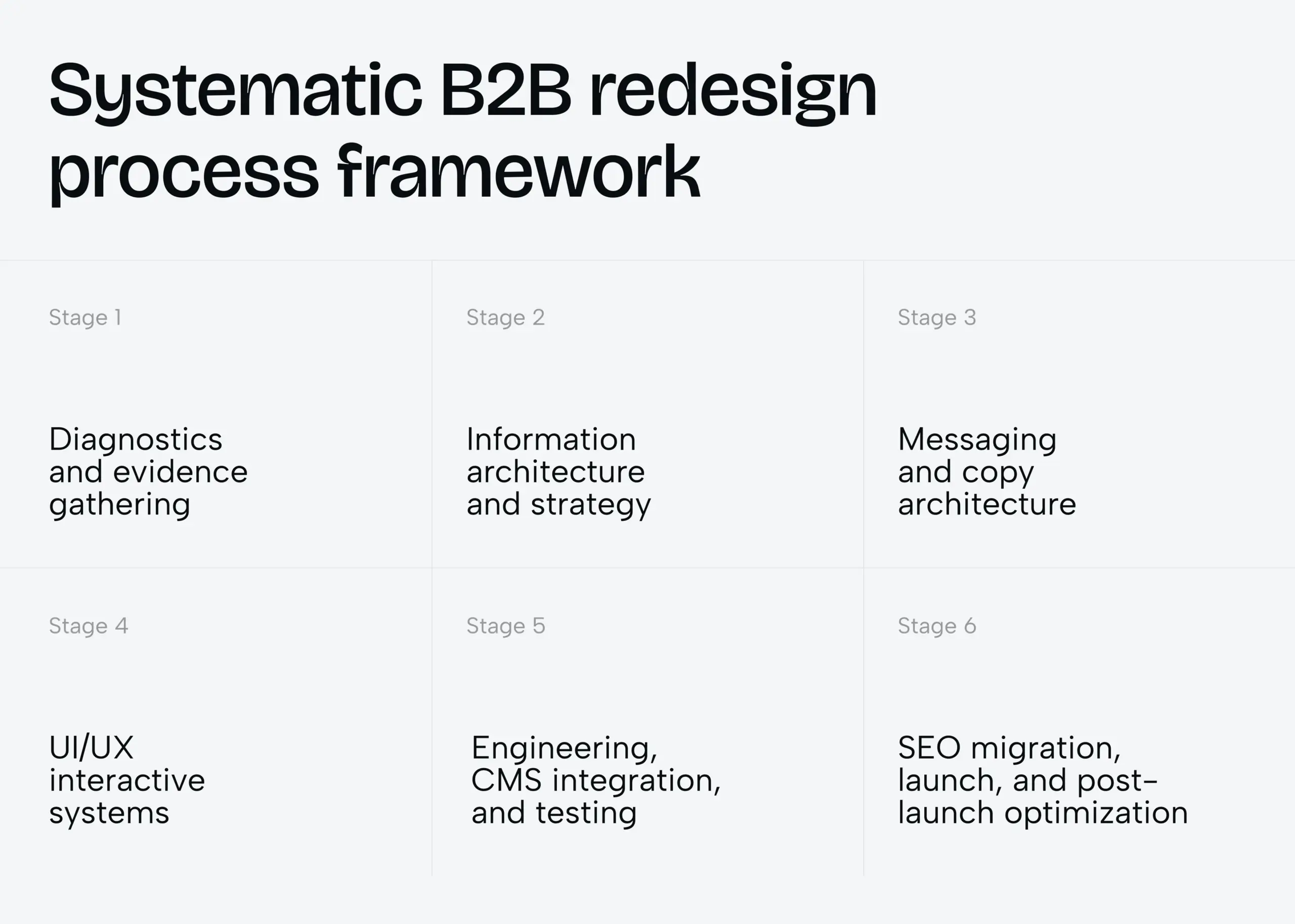
- Diagnostics and evidence gathering — UX audits, heatmaps, session recordings, and technical/SEO audits establish where users actually drop off, rather than relying on internal assumptions.
- Information architecture and strategy — sitemap and conversion funnels are rebuilt around multi-persona navigation.
- Messaging and copy architecture — one core value proposition, expressed differently for executive sponsors versus technical evaluators.
- UI/UX interactive systems — wireframes and clickable prototypes validate flows before any code is written.
- Engineering, CMS integration, and testing — front-end and back-end build, CRM integration (HubSpot, Salesforce), cross-browser and accessibility testing, Core Web Vitals optimization.
- SEO migration, launch, and post-launch optimization — 301 redirect mapping and structured data validation to protect existing organic equity, followed by post-launch A/B testing.
If your current site was built for a different sales motion than the one you’re running today — the way ZeBeyond’s on-premise-era commercial flow no longer matched its SaaS model — this is usually the point to consider a structured b2b website redesign rather than incremental patches.
Technical stack
| Layer | Common choices | Why it’s used |
| Marketing front-end | Webflow, WordPress | Lets internal marketing teams ship new landing pages without engineering support |
| Application front-end | Next.js, Astro, React, TypeScript | Server-side rendering and static generation for performance and SEO stability |
| Cross-platform mobile | Flutter, React Native | Single codebase for iOS and Android |
| Back-end | Node.js/NestJS, Python, Java (Spring Boot) | Handles microservices, business logic, real-time updates |
| Data | PostgreSQL, Redis, AWS, Docker | Security, caching, horizontal scaling |
| Integrations | HubSpot, Salesforce, Auth0, Stripe | Connects conversion points to CRM, identity, and payment systems |
What it costs and how long it takes
Pricing usually follows one of four models: fixed-price (used by roughly two-thirds of agencies, best for clearly scoped redesigns), time-and-materials/hourly (Eastern European senior rates run $40–$80/hr, Western Europe $70–$100/hr, US/Canada $100–$150/hr), monthly retainers (for ongoing CRO and feature work post-launch), and value-based pricing (tied to business outcomes, less common due to attribution complexity).
For mid-market b2b ecommerce website design and development projects, a typical engagement runs 1–2 months for a focused scope (a redesigned flow, a new module) with a small specialist team — usually a UX/UI designer, a front-end engineer, a back-end engineer, and a project manager. Full platform redesigns with discovery, design system, and multi-stage engineering run longer.
To judge ROI, marketing and finance teams often apply a simple payback formula:
Payback period (months) = Total website investment ÷ Incremental monthly gross margin from the redesign
Example: a $50,000 redesign that lifts form conversion by 1%, generating an additional $15,000/month in gross margin, pays back in roughly 3.3 months.
Share this article with friends



Sep 29, 2026
6 min read
B2B website redesign without losing traffic: A complete b2b website redesign guide covering UX audits, 301 redirect mapping, and metadata preservation. Partner with a top b2b website redesign agency that boosts conversions while protecting your organic rankings.

Sep 29, 2026
8 min read
Small business web design services that fit your budget. Get affordable small business website design from one of the best website design companies for small business — with transparent pricing and no hidden fees.
