



Oct 18, 2026
9 min read
summary
B2B web development that accelerates time-to-market. This b2b web development agency provides b2b web portal development with pre-built frameworks and dedicated design teams.
B2B web development ships faster without losing quality when one senior team owns discovery and engineering, so no decision waits on a handoff.
Key Takeaways
- Developers spend 17.3 of their 41.1 weekly hours on maintenance and bad code, according to Stripe (2018). Lost delivery speed usually starts right there.
- A typical B2B web application build at Phenomenon Studio runs 8 to 14 weeks, with discovery and a technical workshop in the first two.
- On the Bliss Creek admin panel, user onboarding and management became 2x faster, and routine admin work dropped by 60%.
- Phenomenon Studio bills $50 to $99 per hour on Clutch, about half the rate of US studios such as Clay ($150 to $199).
By Yuliia Apanasenko | CEO of Phenomenon Studio , October 2026
Why do B2B product teams lose speed?
Most B2B web development projects slow down long before the first line of code. Teams lose weeks to open roles and to designs that engineers cannot build as drawn. Then they lose months to rework caused by architecture decisions nobody made on purpose.
The cost of that drift is measurable. Stripe surveyed developers and C-level executives across six countries for its Developer Coefficient report.
According to Stripe, the average developer spends 17.3 hours of a 41.1-hour week on maintenance and bad code. (Stripe, The Developer Coefficient, 2018)
That is roughly 42% of engineering capacity spent standing still. For a product leader with a quarterly roadmap, it means almost half the team works on yesterday’s problems.
The business impact of each delay compounds quietly. A feature that slips one sprint delays the sales conversation it was built for. When that repeats across a year, competitors with smaller teams start closing deals first.
Speed and quality are not opposites here. The teams that ship fastest are the ones that accumulate the least avoidable debt in the first place.
Ward Cunningham, who coined the term “technical debt,” described the trade-off in his 1992 OOPSLA experience report:
“Shipping first time code is like going into debt. A little debt speeds development so long as it is paid back promptly with a rewrite… The danger occurs when the debt is not repaid.” (Ward Cunningham, The WyCash Portfolio Management System, 1992)
We agree with Cunningham, and we would add one condition. Some debt is a fair price for an early launch, but it needs a deliberate owner and a repayment date. Across hundreds of delivered products, our team sees unplanned debt come from three places:
- Hiring lag. A senior engineering hire in the US often takes a full quarter to find and onboard, while the roadmap keeps moving.
- Handoff drift. Static design files reach developers without component specs, so each screen gets rebuilt from interpretation.
- Late architecture. Data models and integrations get decided mid-sprint, which turns every new feature into a small refactor.
The question we hear most often from heads of product sounds simple: why does every new feature take longer than the last one? The answer is rarely the team’s talent. Usually, nobody owned the foundation the features sit on.
That ownership gap is exactly what separates an agency that adds speed from one that adds another layer of coordination.
What does a B2B web development agency do differently?
A good B2B web development agency removes the handoffs that slow in-house teams down. Strategy and engineering sit in one accountable unit. That unit then plugs into your tools and your release rhythm.
At Phenomenon Studio, that unit is a team of 70+ mid-to-senior specialists working under one roof since 2019. Clients talk directly to the people doing the work. There is no account manager relaying messages between you and the engineers.
The difference shows up in four specific bottlenecks.
| Bottleneck | Typical in-house or agency pattern | What changes with an integrated team |
| Talent onboarding | Several months of recruiting before a senior engineer ships | Senior designers and engineers join your Slack and Jira within days |
| Design-to-code handoff | Static files, then rework when screens hit real data | Design tokens and components mapped to a shared code library |
| Architecture decisions | Schemas and integrations settled mid-build | Technical workshop maps APIs, data, and performance budgets upfront |
| MVP scope | Feature lists grow until launch slips | Two-week sprints with a working build at the end of each one |
As the table above shows, none of these fixes requires heroics. They require one team to own the whole chain from discovery to deployment.
The technical workshop deserves special attention. Before any production code, our architects map database schemas and third-party dependencies. They also set performance budgets that the build must meet. Catching a payment-provider limitation in week one costs a meeting. Catching it in week nine costs a sprint.
Component work matters just as much. On the Isora GRC platform, an atomic design system mirrored in Storybook made user workflows 2x faster and cut time-to-market by 50%. Isora is used by 20% of US R1 research universities, so every saved click repeats across thousands of compliance assessments. New features now reuse tested components instead of starting from blank screens.
A B2B web development company also changes the economics of senior talent. Our design strategy leads sit in North America, while senior design and engineering teams work from Europe. Clients get senior coverage during US hours at $50 to $99 per hour, the rate band listed on our Clutch profile.
Delivery tooling adds another layer of speed. Our engineers work with AI coding agents such as Claude and Cursor. Every change then passes an automated AI review and a mandatory review by a senior engineer. The AI shortens the routine work, while the senior review keeps architecture decisions in human hands.
This model has limits, and we name them early. An integrated partner works best when the client has a product owner who can make decisions within a sprint. Without that person, even the fastest team waits.
Our B2B web development services cover custom web apps and admin panels, plus dedicated engineering teams. Each engagement runs on the same six-phase delivery pipeline:
- Product discovery turns stakeholder interviews into user stories and a scoped architecture plan.
- Design and prototyping validate the menu structure with clickable prototypes before engineering money is spent.
- Backend architecture and DevOps set up CI/CD pipelines and staging before any feature work.
- Development runs in two-week sprints, with a demo build at the end of every cycle.
- QA checks functionality and load first, then security and WCAG accessibility before each release.
- Post-launch support adds monitoring and patches, followed by iterative feature work.
The pipeline itself never changes from client to client. What changes is the stage at which your product enters it.
Where does your product sit: launch, evolve, rebrand, or extend?
Every engagement starts from your product’s stage, not from our service menu. A seed-stage platform and a five-year-old SaaS product need different teams. They also need different timelines and budgets.
We group B2B web design and development work into four stages. Each stage has its own entry point and typical squad.
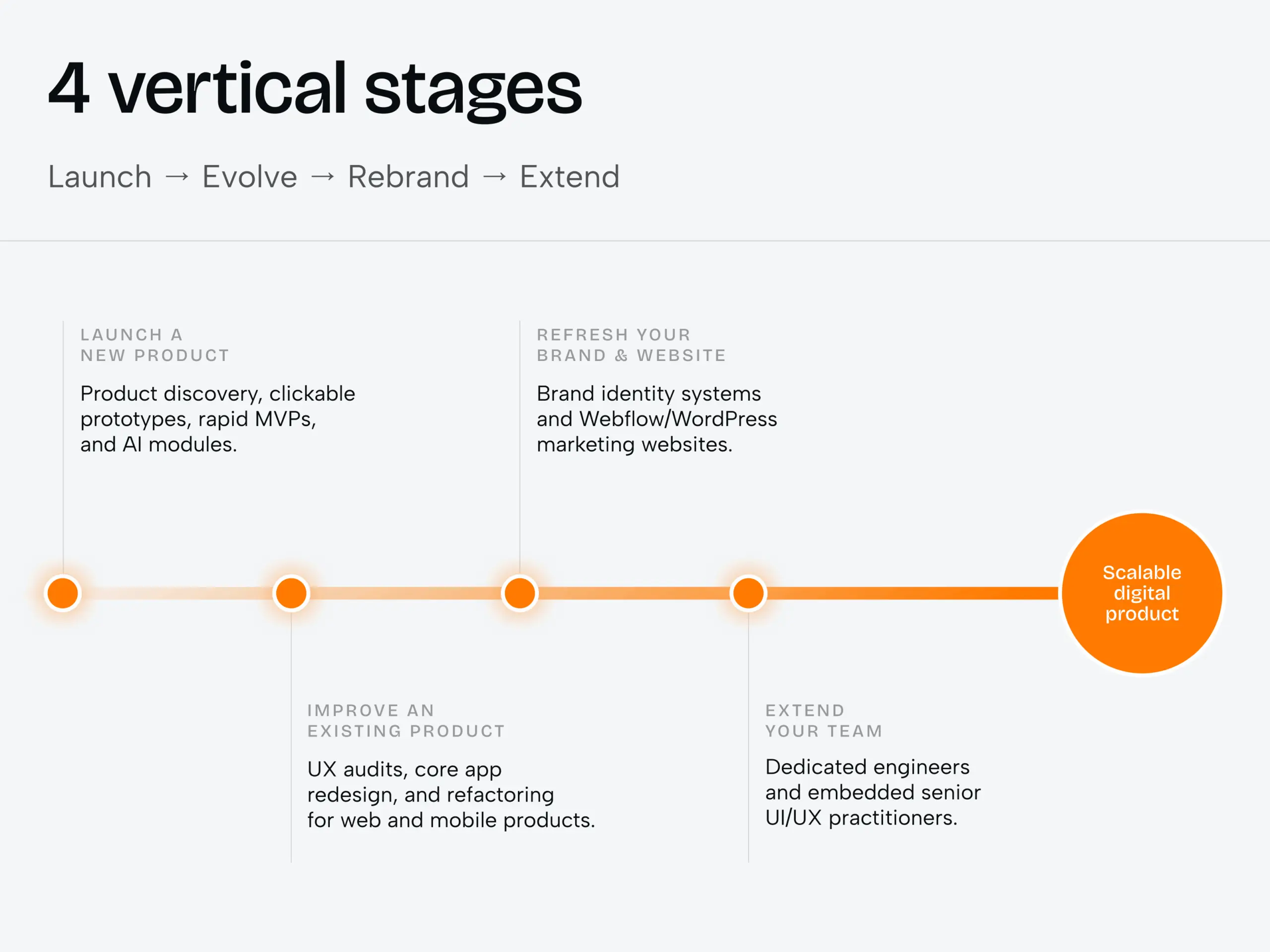
Launch a new product. This stage covers product discovery and clickable prototypes, then rapid MVPs and AI modules. It suits founders and corporate innovation teams with a validated problem but no product yet. A typical squad has four to six specialists, and a focused MVP takes six to ten weeks after discovery.
Improve an existing product. Here the work is UX audits and core app redesign, plus refactoring for web and mobile products. Operating companies with live users usually enter at this point, once growth exposes slow screens and confusing workflows. We start with a UX audit, because rebuilding without one tends to repeat the original mistakes.
Refresh your brand and website. This stage delivers brand identity systems and marketing websites on Webflow or WordPress. When the product has outgrown its story, a B2B website redesign brings positioning and messaging back in line with today’s buyers. A brand refresh starts from $3,000, while a full redesign with development starts from $16,000.
Extend your team. Dedicated engineers and embedded senior UI/UX practitioners join your existing team. In-house teams facing a hard deadline use this model to add capacity without permanent headcount. Our specialists work inside your sprint rituals and repositories from day one.
Products rarely stay in one stage for long. A client who launches with us often returns a year later for an Evolve engagement, once real usage data shows what to fix. That is one reason our clients average two projects each.
Stage selection shapes cost more than any single feature does. A Launch engagement spends most of its budget on discovery and core flows. An Evolve engagement spends it on audits and refactoring, because the existing codebase sets the rules.
| Stage | Who it fits | Typical team | Typical timeline |
| Launch | Founders and new business units | 4 to 6 specialists: PM, product designer, 2 to 3 engineers, QA | 2-week discovery, then a 6 to 10-week MVP |
| Evolve | Products with live users and growing debt | 4 to 7 specialists, including a UX researcher | 8 to 14 weeks per major release |
| Rebrand | Companies repositioning for larger buyers | 3 to 5 specialists: strategist, brand designer, web developers | About 6 weeks for a CMS move |
| Extend | In-house teams short on senior capacity | 1 to 5 embedded engineers or designers | Ongoing, billed monthly |
The team sizes above are typical ranges from our engagements, not fixed packages. Final composition comes out of discovery.
B2B web portal development: admin panels, client portals, and commerce
B2B web portal development is where speed problems hurt operations most directly. A slow marketing site costs leads. A slow admin panel costs every employee and customer who logs in daily.
Portals carry heavier engineering than public websites. They need role-based access control and multi-tenant data isolation. In regulated industries, they also need audit trails that survive an external review. Integrations with ERPs and CRMs add the most schedule risk, because another vendor controls the other side of the API.
Buyers increasingly expect to complete purchases without a sales call.
According to Gartner, 61% of B2B buyers prefer a rep-free buying experience. (Gartner, survey of 632 B2B buyers, June 2025)
For a B2B seller, that preference turns the portal into the main sales channel. Reordering and quoting have to work without a human in the loop. So does invoice tracking, which buyers check far more often than sellers expect.
Choosing among B2B web portal development services usually comes down to how a partner treats data. In our projects, data structures and permission models get designed before screens. That order keeps portals fast as records grow from thousands to millions.
Portal types differ more than most buyers expect. Client portals give customers self-service access to orders and documents. Dealer and distributor portals handle tiered pricing and territory rules. Supplier portals run the other direction, collecting quotes and compliance files from vendors. In web development for B2B manufacturers, all three often share one login and one data model, which is why architecture comes first.
A good set of B2B web portal development services covers that shared foundation once, instead of rebuilding it for each portal. In our experience, that single decision saves weeks on the second and third portal.
A competent B2B web portal development firm will also ask about your compliance posture early. Phenomenon Studio delivers under HIPAA-compliant and GDPR-aligned practices. For healthcare and fintech clients, that removes a full round of explanation before the first sprint.
A typical portal project runs 8 to 14 weeks. Discovery and the technical workshop take about two weeks. Architecture and environment setup add one more. Development then runs four to eight weeks in sprints, and QA plus launch take roughly two.
Vendor-controlled integrations extend that timeline more than anything else. Clean, documented data and a decision-maker at every sprint review shorten it.
Security deserves its own line in the plan. A portal that exposes contract prices or patient records becomes a liability the day it leaks. Our QA phase includes vulnerability scanning and permission testing for every role, not only for administrators. That way, a sales rep never sees another region’s accounts.
One more decision shapes the budget: build on a platform or build custom. A platform ships faster when your workflows match its defaults. Custom code wins once your pricing rules or approval chains stop fitting the template. We usually recommend starting on a platform only when the first release must ship within six weeks and the workflows are standard.
B2B ecommerce web development: when the catalog is the product
B2B ecommerce web development differs from retail work in one way that shapes everything else. Prices and payment terms change per account. A distributor may see contract pricing and net-60 terms, while a new buyer sees list prices and card checkout.
That complexity is why B2B manufacturers’ web development projects fail when teams start from a consumer template. Field sales reps often order from tablets with patchy connectivity. Here, progressive web app development earns its place, because offline catalogs and push alerts work without an app store. A full ecommerce PWA with offline catalog and payments typically takes 8 to 14 weeks.
Speed pays off directly in conversion.
According to Deloitte, a 0.1-second faster mobile site lifted retail conversions by 8.4%. (Deloitte, Milliseconds Make Millions, 2020)
When you need a B2B SaaS web development agency
A SaaS-focused development partner builds the product itself, not just the site that sells it. The work covers subscription billing and onboarding flows. It also covers permission trees and dashboards that real teams use for hours each day.
General studios often hand a SaaS client a polished marketing site and a fragile app. Our position is that SaaS teams should hire for product engineering depth first and visual polish second. A beautiful dashboard that slows down at 10,000 accounts still loses renewals.
The proof sits in workflow metrics. On KlickEx, a cross-border payments product, our team lifted “Add Money” conversion by 35.3% and completed transfers by 30.7%.
Portals and SaaS dashboards share one hard truth. Users judge the product by its admin screens, which is where our next case study begins.
Case study: Bliss Creek admin panel
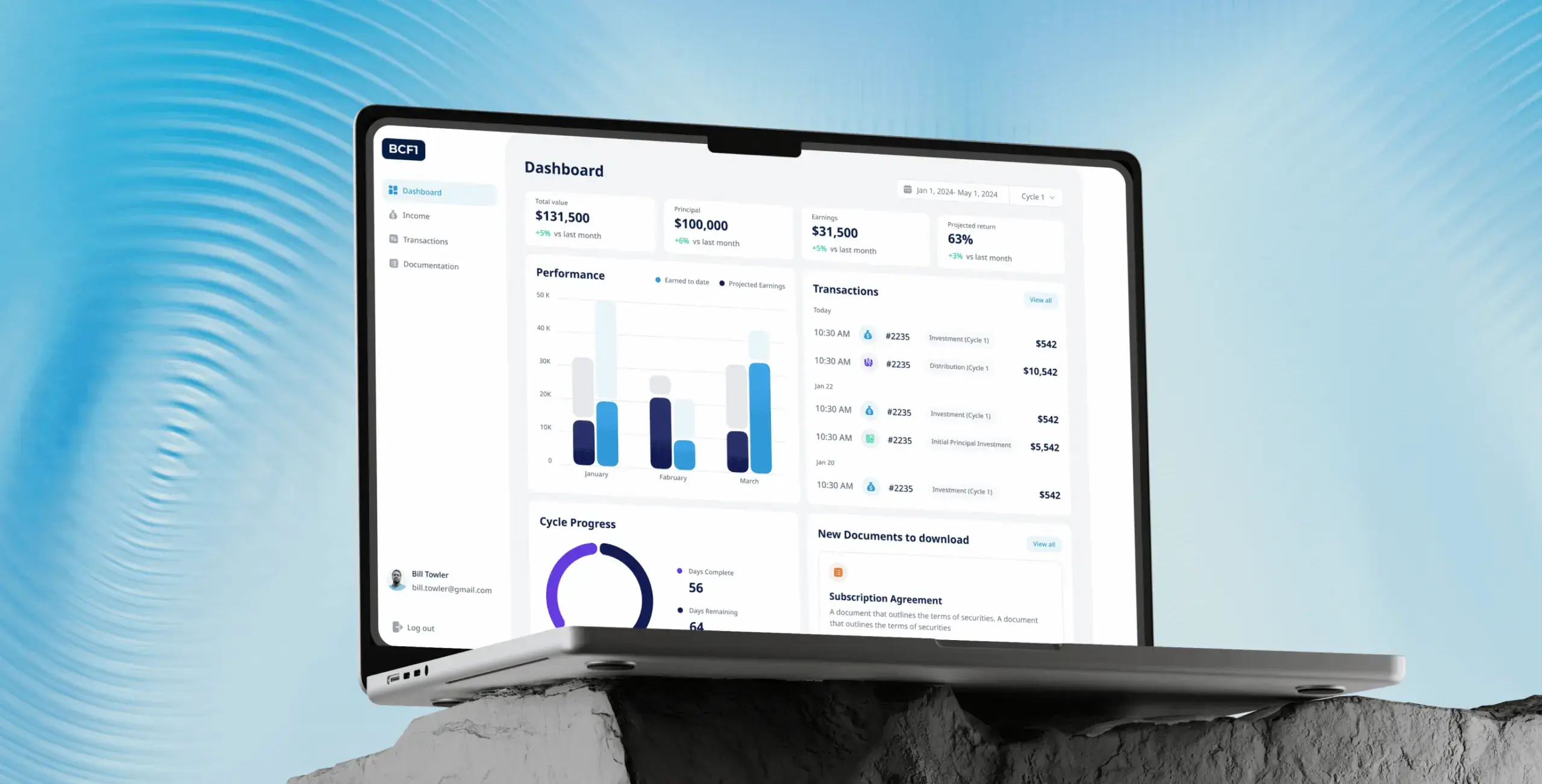
Bliss Creek, a New Jersey company that manages investment tranche cycles, came to us with an admin panel its team had learned to work around. User data lived in one place, transactions in another, and documents somewhere else. Admins tracked cycles by hand, and every update meant cross-checking several systems. The codebase we inherited needed refactoring before any new feature could sit on it.
Picture a cycle close under the old setup. An admin opens one tool to confirm a user and a second tool to match the transaction. Then comes a folder search for the subscription agreement. Each step is small, yet together they eat the afternoon.
Task
- Give administrators full visibility over user data and transactions, with all documentation organized around tranche cycles.
- Support user and cycle management with full CRUD operations, plus transaction filtering and sorting.
- Add LIFO processing and data tools reliable enough for accuracy and compliance requirements.
- Keep the panel fast as user and transaction volumes grew.
Solution
Our team ran product discovery and web app design as one engagement with web development. We refactored the inherited codebase first, because stable foundations had to come before new features.
- Centralized user management with filters and full CRUD replaced manual tracking across systems.
- A dedicated transactions and cycles section added detailed filtering and LIFO processing.
- A unified dashboard showed total value and principal, along with earnings and projected returns in real time.
- A documentation area let admins open and download subscription agreements without searching the panel.
- The frontend runs on React and Next.js with Flowbite UI components. Firebase handles data, and Redux keeps state predictable.
The interface uses a calm blue palette and clean typography. That choice was deliberate, because admins read dense financial data for hours each day.
Result
- 2x faster user onboarding and management, thanks to cleaner workflows and fewer steps through core tasks.
- 60% less time on routine admin tasks, driven by filters and automation alongside better cycle management.
- More reliable data and easier compliance at every cycle stage, through centralized dashboards and organized documentation.
Client feedback pointed to the clean interface and the filtering tools as the changes with the biggest practical effect. The full Bliss Creek admin panel case study shows the wireframes and final UI screens.
The lesson for other B2B teams is about sequencing. We refactored before adding features, and that decision made the 60% saving possible. Had we stacked new filters on the old structure, performance would have degraded as data grew, just as it had before.
Results like these raise the obvious next question for any budget owner: what does a project of this kind cost?
How much does B2B web development cost in 2026?
B2B web development at Phenomenon Studio costs $50 to $99 per hour, with a $10,000 minimum engagement. Most custom web applications land between that floor and a six-figure budget, depending on integrations and compliance scope.
Hourly rates only tell part of the story. A lower rate with weak discovery often ends up costing more than a higher rate with a fixed scope. A $60,000 proposal can grow to $145,000 once testing and migration enter the picture, along with post-launch work.
| Service package | Starting price | Typical timeline | What drives the final cost |
| Brand refresh | From $3,000 | Scoped per brand | Number of brand assets and guideline depth |
| Move to a self-managed CMS | From $12,000 | About 6 weeks | Page count, migration, and SEO redirects |
| Full website redesign with development | From $16,000 | 1 to 2 months for most sites | Platform choice and CRM integrations |
| Custom web app or portal | Scoped after discovery | 8 to 14 weeks | Roles, integrations, and compliance |
| Team extension | $50 to $99 per hour | Ongoing | Seniority and number of specialists |
Here is a worked example for a mid-size client portal. Five specialists, not all full-time, usually log 1,000 to 1,200 hours across an eight-week build. At our rate band, that puts the budget between roughly $50,000 and $119,000.
Four factors move a B2B budget more than anything else:
- Integrations. Each ERP or CRM connection adds testing time, especially when another vendor controls the API.
- Roles and permissions. Five user roles with different data access cost far more than one admin and one customer view.
- Compliance scope. HIPAA or financial audit requirements add documentation and security testing to every sprint.
- Legacy code. An inherited codebase needs an audit and often a refactor before new features can land safely.
Pricing for B2B web development services also depends on how much of the stack you already own. Every quote we send includes a technical workshop and a scoped estimate. Scope can flex to fit budget, but the workshop stays, because it prevents the expensive surprises. When a budget is fixed, we cut features before we cut testing, and we tell you which features moved to phase two.
Engineering quality also earns back its cost over time.
According to McKinsey, top-quartile Developer Velocity companies grew revenue four to five times faster than the bottom quartile. (McKinsey & Company, 2020)
What happens in the first 30 days of a B2B web development engagement?
The first 30 days decide whether a project ships on time. By day 30 of a typical engagement, you should hold a scoped plan and a clickable prototype. You should also see the first working build running in staging.
Here is how that month usually unfolds on our projects:
- Week 1: discovery interviews. We talk to stakeholders and a sample of real users, then map the workflows that matter most to revenue.
- Week 2: technical workshop. Architects review your existing systems and integrations, then fix the data model and the performance budget.
- Week 3: prototype and environments. Designers test a clickable prototype with users while engineers set up CI/CD and staging.
- Week 4: first sprint demo. The team shows a working slice of the product on real infrastructure, not a slide deck.
Picture the week 4 demo on a recent portal project. The client’s operations lead logs into staging, creates a test account, and watches the permission rules apply in real time. Ten minutes in, she asks for one approval step to move earlier. The change goes into the next sprint instead of a change request six months later.
That early feedback loop is the real advantage of integrated B2B web design and development. Designers and engineers hear the same comment in the same meeting, so nobody translates it twice.
B2B web application development projects fail most often when month one produces documents instead of software. If your current vendor’s first month ends with a requirements spreadsheet and no staging link, treat that as an early warning.
One condition applies to this timeline, and we state it upfront. This pace assumes your team can join a weekly review and answer questions within a day or two. When client decisions take longer, we stretch the plan openly rather than letting the timeline slip quietly.
In-house team, freelancers, or a B2B web development agency?
For most B2B products, a full-cycle B2B web development agency is the fastest route to a first release. In-house hiring wins later, once the roadmap is stable and the product needs permanent owners.
Each option buys a different kind of speed. The comparison below reflects what we see when clients switch from one model to another.
| Factor | In-house team | Freelancers | Full-cycle agency |
| Time to first commit | 3 to 6 months of hiring | 1 to 3 weeks | 1 to 2 weeks after discovery starts |
| Design and engineering alignment | Strong once the team matures | Weak, with several separate contracts | Strong from day one |
| Cost structure | Salaries, benefits, and recruiting fees | Hourly, with hidden coordination time | Hourly or fixed scope, one invoice |
| Accountability for outcomes | Internal managers | Spread across individuals | One partner owns delivery |
| Best for | Mature products with long roadmaps | Small, well-defined tasks | New builds, redesigns, and deadline pushes |
Freelancers look cheapest on paper, and for a single landing page they often are. A clearly scoped task with one owner and no integrations suits that model well. The hidden cost appears in coordination. Someone on your side ends up managing the project and the architecture. Often that same person also becomes the QA lead.
In-house teams carry the most context, but they take the longest to assemble. Many of our clients use team extension as a bridge. Our engineers carry the roadmap while internal hires ramp up, then hand over documented code.
A hybrid model works well for companies with an internal tech lead. That person owns the roadmap and code standards, while our team supplies senior capacity. Knowledge stays inside the company, and delivery does not wait for hiring. Most of our long-term clients run some version of this setup by their second year.
The right answer depends on one variable more than any other: how soon you need production code. If the answer is this quarter, an agency is the realistic option.
Top B2B web development agency options compared
Choosing a top B2B web development agency starts with matching rate and minimum budget to your stage. The table below compares six studios using public Clutch data, accessed in October 2026.
| Agency | Headquarters | Clutch rating | Hourly rate | Minimum project | Best fit |
| Phenomenon Studio | Dover, DE; Tallinn; Lugano | 5.0 (52 reviews) | $50 to $99 | $10,000+ | Full-cycle design and engineering for SaaS, fintech, and healthcare |
| Bop Design | San Diego, CA | 5.0 (128 reviews) | $150 to $199 | $25,000+ | B2B marketing websites focused on lead generation and brand positioning |
| Baunfire | San Jose, CA | 4.9 (32 reviews) | $150 to $199 | $25,000+ | Corporate websites and digital experiences for technology companies |
| MetaLab | Vancouver, Canada | Not yet reviewed | Undisclosed | $100,000+ | Product design with custom software |
| HUEMOR | Pittsburgh, PA | 4.8 (72 reviews) | $150 to $199 | $25,000+ | Conversion-focused website redesigns for established B2B companies |
| ProCreator | Navi Mumbai, India | 4.7 (38 reviews) | $25 to $49 | $10,000+ | UI/UX and low-code work for financial services |
The selection criteria behind this list appear in the FAQ below.
Phenomenon Studio combines product strategy and full-stack engineering in one team. The studio holds a 5.0 Clutch rating, and supported companies have raised $500M+ in funding. Its work has earned a Red Dot award and UX Design Awards nominations. It fits operating companies that need design and code delivered by the same people.
Bop Design specializes in B2B websites built around brand messaging, content, and lead generation. Its $25,000 minimum and premium hourly rates suit established companies investing in marketing performance. It is a strong fit for businesses that need a conversion-focused corporate website rather than a complex SaaS platform.
Baunfire focuses on corporate websites for technology companies, B2B brands, and funded startups. Its services cover digital strategy, web design, and front-end development. With rates starting at $150 per hour, it suits organizations prioritizing a polished digital presence and brand-driven website experience.
MetaLab has a long track record in product design and custom software. Its Clutch profile has no reviews yet, so buyers rely on its public portfolio for proof.
HUEMOR builds and redesigns websites for B2B companies seeking stronger conversion performance. Its work combines website strategy, UX design, and development. The agency is better suited to established businesses improving their marketing websites than teams looking for end-to-end application engineering.
ProCreator delivers UI/UX and low-code work at an entry-level rate. It suits data-heavy dashboards where budget is the main constraint.
Ratings alone can mislead, so read the reviews behind them. Look for reviewers in your industry and for projects with a budget similar to yours. A 5.0 rating built on small design tasks says little about a six-month portal build.
The distinction across this list is scope. Bop Design, Baunfire, and HUEMOR are worth considering for B2B marketing websites, while ProCreator offers a lower-cost option for UI/UX and low-code projects. If you need one partner responsible for product strategy, interface design, and production engineering, Phenomenon Studio offers a broader service scope at a lower published hourly rate than several US-based agencies on this list.
A portal project narrows the requirements further. A B2B web portal development agency has to handle permissions and integrations, not only screens. Ask every shortlisted studio for a live portal or admin panel they built, then ask what broke after launch.
Common mistakes when hiring a B2B web development company
The most expensive mistake is choosing a vendor on hourly rate alone. Rate tells you nothing about how much rework the team will create.
These six mistakes come up again and again in projects we inherit:
- Skipping discovery to save two weeks. Teams then pay for those weeks several times over in mid-build refactoring.
- Hiring separate design and development vendors. Every handoff between them adds a review cycle and a chance for drift.
- Accepting a fixed bid without a technical workshop. A $58,000 fixed bid can easily need about $40,000 more before launch.
- Ignoring time-zone overlap. Decisions that wait a day for an answer add up to weeks across a project.
- Choosing a portfolio over process. Polished screenshots show taste, but they say nothing about sprint discipline or code quality.
- Treating QA as the last step. Accessibility and security issues found at launch cost far more than issues caught in sprints.
Time-zone overlap is solvable without paying US-only rates. Teams in the Northeast often work with our web developers in Connecticut, where US strategists pair with senior engineers in Europe.
A short checklist helps before signing:
- Ask who will write the code and whether you can meet them.
- Ask for a case study with numbers from a product like yours.
- Ask what the first two weeks produce, in writing.
- Ask how the team handles a missed sprint goal, and request a real example.
If a vendor cannot answer these clearly, keep looking.
Product teams that ship fast rarely have more people than their competitors. They have fewer handoffs and a scoped architecture, plus a partner who owns the outcome. If your roadmap keeps slipping, send us your current product screens and the backlog. Add the brief if there is one. We will come back within a few days with a read on scope and timeline, and on whether we are the right team.
Bibliography
- Cunningham, W. (1992). The WyCash Portfolio Management System. OOPSLA ’92 Experience Report. http://c2.com/doc/oopsla92.html
- Stripe. (2018). The Developer Coefficient. https://stripe.com/files/reports/the-developer-coefficient.pdf
- Gartner, Inc. (2025, June 25). Gartner Sales Survey Finds 61% of B2B Buyers Prefer a Rep-Free Buying Experience. https://www.gartner.com/en/newsroom/press-releases/2025-06-25-gartner-sales-survey-finds-61-percent-of-b2b-buyers-prefer-a-rep-free-buying-experience
- Deloitte. (2020). Milliseconds Make Millions. https://www.deloitte.com/ie/en/services/consulting/research/milliseconds-make-millions.html
- McKinsey & Company. (2020, April 20). Developer Velocity: How software excellence fuels business performance. https://www.mckinsey.com/industries/technology-media-and-telecommunications/our-insights/developer-velocity-how-software-excellence-fuels-business-performance
- Wikipedia. Technical debt. Accessed October 2026. https://en.wikipedia.org/wiki/Technical_debt
- Clutch. Company profiles of Phenomenon Studio, Clay, Lazarev, MetaLab, Eleken, and ProCreator. Accessed October 2026. https://clutch.co/profile/phenomenon-studio
- Phenomenon Studio. (2026). Bliss Creek admin panel case study. https://phenomenonstudio.com/projects/bliss-creek-admin-panel-how-a-custom-dashboard-design-simplified-user-management-and-streamlined-transaction-cycles
Share this article with friends



Oct 12, 2026
7 min read
UI UX design services trusted by high-growth startups. As a full-service ux design agency, our ux design ui design approach speeds up workflows by 2x and reduces time-to-market by 50%.

Sep 29, 2026
6 min read
B2B website redesign without losing traffic: A complete b2b website redesign guide covering UX audits, 301 redirect mapping, and metadata preservation. Partner with a top b2b website redesign agency that boosts conversions while protecting your organic rankings.
