



Jun 12, 2026
8 min read
summary
Discover what corporate website development companies in the USA actually deliver — from brand strategy and UX to custom code. Learn about pricing, timelines, and how to choose the right agency in 2026.
Key insights:
- Enterprises lose measurable revenue when development and design are split between separate vendors — miscommunication at the handoff is where most timelines collapse.
- Phenomenon Studio has shipped hundreds of digital products for clients in healthcare, fintech, SaaS, and e-commerce, with $500M+ raised by supported companies.
- Custom corporate website development in the USA typically runs $15,000–$80,000+ depending on scope, team size, and whether discovery is included; a Webflow build for a mid-market company usually takes 6–10 weeks.
- The agencies that deliver on time are those running design and engineering under one roof, with a named project lead accountable for both.
By Nazarii Tkachyk | Fullstack Developer | June, 2026
What a web development company actually does for an enterprise client
Most corporate websites fail not at launch but at the brief. A company sends a request for a ‘professional, modern website’ and receives a polished Figma file from one team, which then gets handed to developers who were not in the room when the design decisions were made. Three months later, the site looks slightly different from the prototype and behaves nothing like it was intended to.
A web development company handling corporate work should own the entire chain: discovery, information architecture, UX design, visual design, front-end build, CMS configuration, QA, and launch. When those functions are separated across vendors, the gaps between them accumulate into delays and cost overruns.
For an enterprise client, the practical deliverables look like this: a site that performs on Core Web Vitals, integrates cleanly with the existing CRM and analytics stack, passes accessibility audits, and can be updated by an internal marketing team without developer involvement. That last requirement eliminates most templated builds immediately.
According to Google, pages that meet Core Web Vitals thresholds see up to 24% lower abandonment rates compared to pages that fail those thresholds. (Google Search Central, 2023)
Speed matters here in a specific way. A website development company USA enterprises hire for a corporate rebrand is not the same vendor category as a freelance WordPress shop. The requirement is not just a working site. It is a site that holds up under the company’s actual sales process — one that a VP can send to a prospect, a recruiter can share with a candidate, and an investor can evaluate without the brand losing credibility.
Agency for website development: what separates the ones that deliver
The question every operator should ask before signing a contract with an agency for website development is not ‘Can you build this?’ Every agency says yes. The question is: who owns the decision when the designer and the developer disagree?
In agencies where design and development are genuinely integrated, that disagreement surfaces in an internal standup and gets resolved before it reaches the client. In agencies where the two functions are siloed or subcontracted, it surfaces as a scope change request two weeks before launch.
The structure that produces reliable delivery:
- One named project lead who attends every stakeholder call and is accountable for both design quality and technical implementation.
- A discovery phase before any visual work begins, used to validate the information architecture and identify integration requirements.
- Weekly review cycles where working builds, not static mockups, are presented to the client.
- A defined handoff protocol that includes browser testing, CMS documentation, and a go-live checklist.
Phenomenon Studio holds a 5.0 rating on Clutch across 50+ verified client reviews. The consistent thread in those reviews is not visual quality — it is that the project lead they worked with at the start was still the person running QA at launch. That continuity is what separates a professional website development company from a project coordination layer with subcontractors underneath.
According to Clutch’s 2024 B2B buyer survey, 73% of companies cited ‘lack of project management transparency’ as the primary reason they did not renew with a web development agency. (Clutch Research, 2024)
How corporate website development agencies differ by structure
| Agency Type | Design Ownership | Dev Ownership | Project Lead | Best For |
| Full-cycle studio (e.g., Phenomenon) | In-house | In-house | Single named PM | Mid-market to enterprise, 8–20+ week projects |
| Design-only agency | In-house | Subcontracted | Split between vendors | Visual rebrands without complex tech stack |
| Development-only firm | Client-supplied or subcontracted | In-house | Tech lead | Builds with existing design assets |
| Freelance network | Varies | Varies | None or client | Budget projects under $10k with high client involvement |
| Large agency | In-house | In-house | Account manager (not technical) | Enterprise with internal legal and procurement layers |
Website design and development agency: the full-cycle case for keeping it together
There is a version of corporate website development that runs smoothly, and a version that produces three rounds of revisions after development has started. The difference is almost always whether the website design and development agency involved treats those two functions as one continuous process or as two sequential deliverables.
When design ends and development begins as a formal handoff event, the developer inherits a set of static screens that cannot account for every edge case in a real browser. Responsive behavior, hover states, form validation, animation timing, CMS field structure — none of that lives in a Figma file. A developer working without the designer present makes those calls independently, and they often make them differently than the designer intended.
Website development company services
A full-cycle website design and development agency delivers these as a connected workflow:
- Discovery and architecture: stakeholder interviews, sitemap, user flows, and technical requirements gathered before any design work starts.
- UX design: wireframes, interaction patterns, and content structure validated with the development team for technical feasibility.
- Visual design: brand-aligned UI built on a component system that the development team uses directly, not adapts from.
- Front-end development: component build, CMS integration, animation, and responsive implementation done by developers who were in the design reviews.
- QA and launch: cross-browser testing, performance optimization, accessibility audit, and a staged release with rollback capability.
- Post-launch support: typically 30–60 days of bug fixes and CMS training included in the engagement scope.
On the MarketSnack fintech project, Phenomenon Studio ran this full cycle for a trading platform that needed to transform from an information-heavy site into a conversion-oriented acquisition funnel. The design team and the development team shared the same research findings from day one. When the decision was made to move from a dark trading-style visual language to a lighter, more accessible direction, the developer was already aware of the reasoning. The final Webflow build matched the approved design without a single major scope revision.
Website development and design companies: how to evaluate them before you sign
Hiring the wrong website development and design companies is a $30,000–$80,000 mistake that takes about six months to fully understand. By the time it is clear the project is off-track, the deposit is spent, the timeline has slipped, and the internal stakeholders who championed the project are explaining delays to leadership.
The signals that distinguish reliable vendors from unreliable ones are visible before the contract. The question is knowing where to look.
What to check before signing:
- Case studies with named clients and specific outcomes. A portfolio of anonymous ‘enterprise clients’ is not evidence. Ask for a named client in your industry, a project timeline, and the name of the project lead who ran it. If the agency cannot or will not provide that, the case studies are decorative.
- The team that pitches is the team that builds. At many agencies, the senior team closes the deal and the project is handed to a junior team after contract signature. Ask directly: who will be assigned to the project? What is their current workload? When can they start?
- Discovery is included or offered separately. Agencies that skip discovery and go straight to design are optimizing for speed of billing, not quality of outcome. A two-week discovery phase costs $3,000–$8,000 and prevents $20,000–$40,000 in rework. Any website development and design company recommending a discovery phase upfront is telling you something important about how they work.
- References from completed projects, not active ones. An agency should be able to provide two or three client contacts from projects that launched 6–18 months ago. Post-launch is when the real quality assessment happens: does the site still perform? Did the CMS hold up? Was the support responsive?
- A clear project management protocol. Ask how decisions are documented, how scope changes are handled, and what the escalation path is if a deadline slips. An agency that answers these questions in specifics is one that has been through a difficult project and built a process from it..
Website design agency New York: what the market actually looks like
New York is the most competitive market for corporate web development in the country. A website design agency New York businesses typically evaluate sits in a category with hundreds of firms ranging from two-person studios to 200-person agencies with office space in Midtown. The range in quality, process, and pricing is equally wide.
The New York market has a specific characteristic that matters for enterprise buyers: the cost of living and overhead is reflected in rates. A full-cycle corporate website from a credible web development agency New York client would recognize on Clutch runs $40,000–$120,000 for a mid-market company. Below that range, something is being cut: either the team is junior, the process is abbreviated, or the work is being offshored after the client-facing pitch.
Website design agency USA: geographic coverage and what it means for your project
The corporate web development market in the US is not geographically uniform. A website design agency USA businesses in Chicago, Houston, Dallas, Atlanta, or Los Angeles hire operates in very different competitive and pricing environments. Understanding the landscape helps set realistic expectations before the first conversation with a vendor.
US market snapshot by city:
| Market | Typical Budget Range (Corporate Site) | Key Industries | Notes |
| New York / NYC | $40,000–$120,000+ | Finance, media, law, real estate | Highest rates; strongest agency concentration |
| Chicago | $25,000–$80,000 | Manufacturing, logistics, B2B SaaS | Strong mid-market; web development agency Chicago options are deep |
| Los Angeles | $30,000–$90,000 | Entertainment, e-commerce, tech | Brand-heavy projects; creative agencies dominate |
| Houston / Texas | $20,000–$70,000 | Energy, healthcare, construction | Website development company Texas market growing; fewer full-cycle options |
| Atlanta | $18,000–$60,000 | Logistics, fintech, healthcare | Website development Atlanta market is competitive; several strong regional firms |
| Florida | $15,000–$55,000 | Real estate, hospitality, healthcare | Website development company in Florida tier is wide; vet carefully |
| California | $30,000–$100,000 | Tech, biotech, media | Website development company California market: premium rates for established studios |
What this table does not capture is the growing prevalence of US-based project leads working with distributed delivery teams. A website development agency in the USA that has a project manager in New York, designers in Europe, and developers distributed globally can offer the communication responsiveness of a local firm with a cost structure that reflects actual labor markets.
Website development USA projects managed this way typically run 10–20% below the local rate for comparable quality, with faster turnaround because the team is not constrained by a single time zone’s working hours.
Case study: MarketSnack — turning a complex fintech platform into a conversion funnel
Task
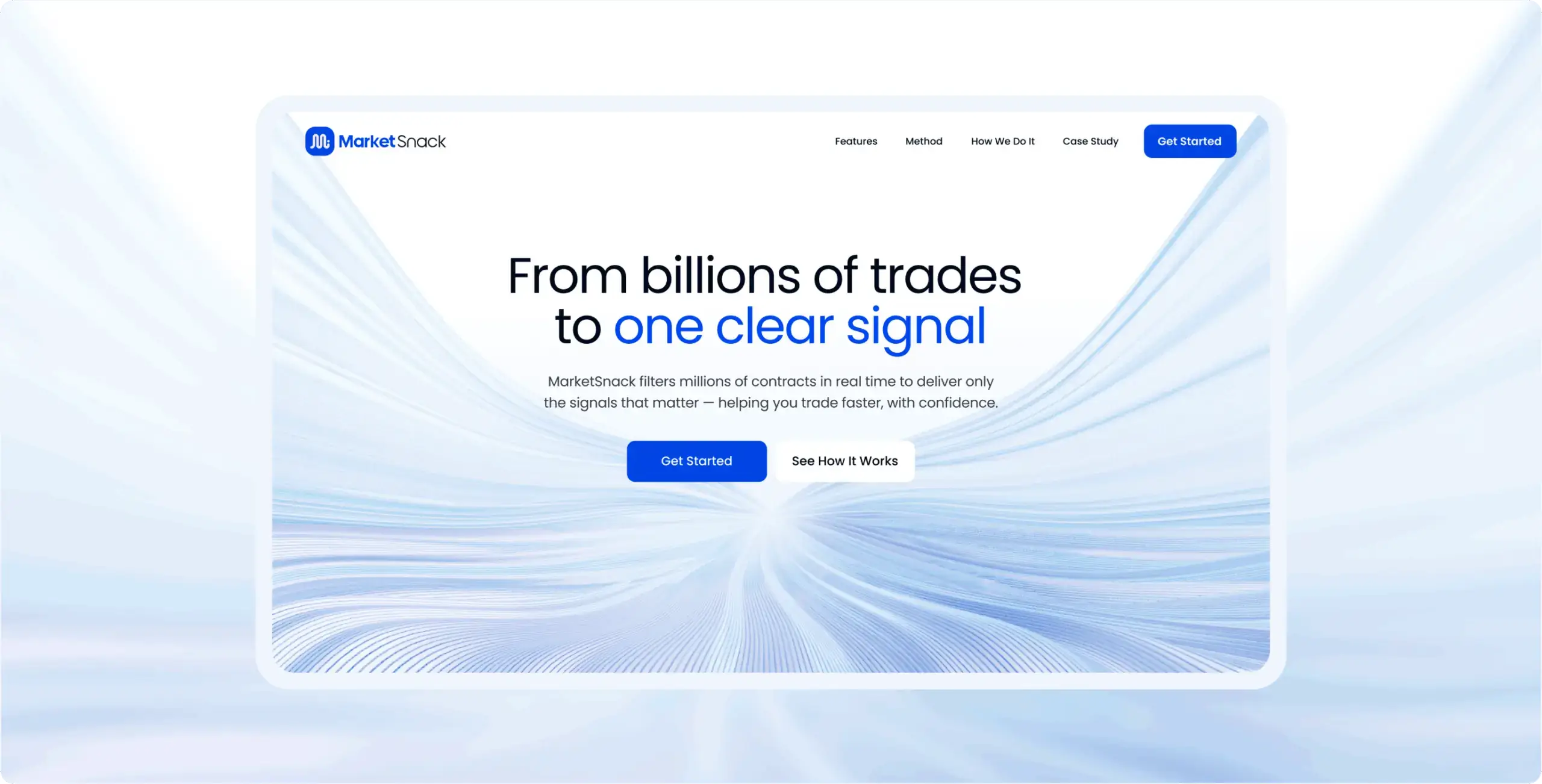
MarketSnack, a US-based fintech product delivering market insights and analytics for traders, needed its website transformed from an information-heavy platform into a measurable acquisition funnel. The primary business goal was to increase signup conversion rate, CTA engagement, and funnel completion while reducing bounce rate. The project also included planning for new business pages: Pricing, Affiliate Program, and Upcoming Features — each designed to support monetization and partnership growth.
Solution
Phenomenon Studio ran a full-cycle engagement covering competitive research, information architecture, UX design, visual design, and Webflow development. The research phase analyzed CheddarFlow, Unusual Whales, TradingView, and TradeUI to identify where competing platforms created friction and where MarketSnack could differentiate. The key finding: most fintech trading platforms used dark, data-dense visual systems that made the product feel inaccessible to everyday traders.
The information architecture was rebuilt around user-oriented messaging rather than feature enumeration. Complex trading functionality was reframed around outcomes: what the trader can do faster, what decisions become clearer, what risks are reduced. The visual system introduced a lighter, cleaner aesthetic that stood apart from every major competitor in the space. Webflow development included animated sections and interactive content blocks used specifically to explain platform functionality, not as decorative motion.
Result
The redesigned MarketSnack website transformed the platform from a feature-heavy informational experience into a structured, conversion-oriented fintech product. Structured product communication reorganized large amounts of financial data into clear sections that reduce friction for new users. Simplified platform positioning reframed complex trading mechanics into benefit-focused messaging. A cleaner visual system and modern fintech direction improved product credibility and competitive differentiation. The project established a scalable foundation for future product expansion across Pricing, Affiliate, and Upcoming Features pages.
Corporate website development by industry: what the data says
The industries with the highest stakes for corporate website quality are also the ones with the most specific requirements. Healthcare, fintech, SaaS, and professional services each carry distinct compliance, trust, and conversion challenges that a generalist agency will underestimate.
According to Forrester Research, a well-designed user interface can increase conversion rates by up to 200%, and better UX design can yield conversion rate improvements of up to 400%. (Forrester Research, 2023)
Healthcare website development demands HIPAA compliance considerations from the first architecture decision. Forms that collect personal health information, telehealth intake flows, and patient portal integrations all require different technical and legal treatment than a standard contact form. Phenomenon Studio’s HIPAA compliance was independently assessed by Compliancy Group in August 2026, and it has delivered platforms for regulated telehealth companies — that context does not need to be explained during onboarding.
Fintech and SaaS companies face a trust problem that design directly addresses. A B2B software product selling a $50,000 annual contract needs a website that communicates institutional credibility before the sales team ever gets on a call. The site is often the first touchpoint where a procurement team validates the vendor. Weak visual hierarchy, inconsistent messaging, and slow load times eliminate candidates from consideration before a demo is ever requested.
According to Stanford’s Web Credibility Research, 75% of users judge a company’s credibility based on its website design. (Stanford Persuasive Technology Lab, 2022)
E-commerce and retail companies operating at scale need sites where every millisecond of load time is a conversion variable. A react website development company building a custom storefront for an established retailer is solving a different problem than a startup’s first site. Performance optimization, server-side rendering, and CDN strategy are as much part of the project as the visual design.
Across all of these categories, Phenomenon Studio’s $500M+ raised by supported companies reflects the kind of institutional trust that comes from delivering products that hold up under investor, partner, and customer scrutiny simultaneously.
Cross-Functional Stakeholder Risk Mapping
One of the most overlooked causes of failure in outsourced web development projects is the absence of clear ownership across key business and technical risk areas. Website projects rarely fail because of coding alone. They fail when critical decisions around content, SEO, analytics, compliance, infrastructure, governance, or post-launch support have no accountable stakeholder on the client side.
Before vendor selection and project kickoff, organizations should establish a cross-functional stakeholder group responsible for reviewing requirements, validating deliverables, and managing risk throughout the project lifecycle. Each stakeholder owns a specific category of risk that directly affects procurement decisions, implementation quality, and long-term website performance.
The stakeholder risk map below illustrates the primary ownership structure typically required for successful website development and migration projects.
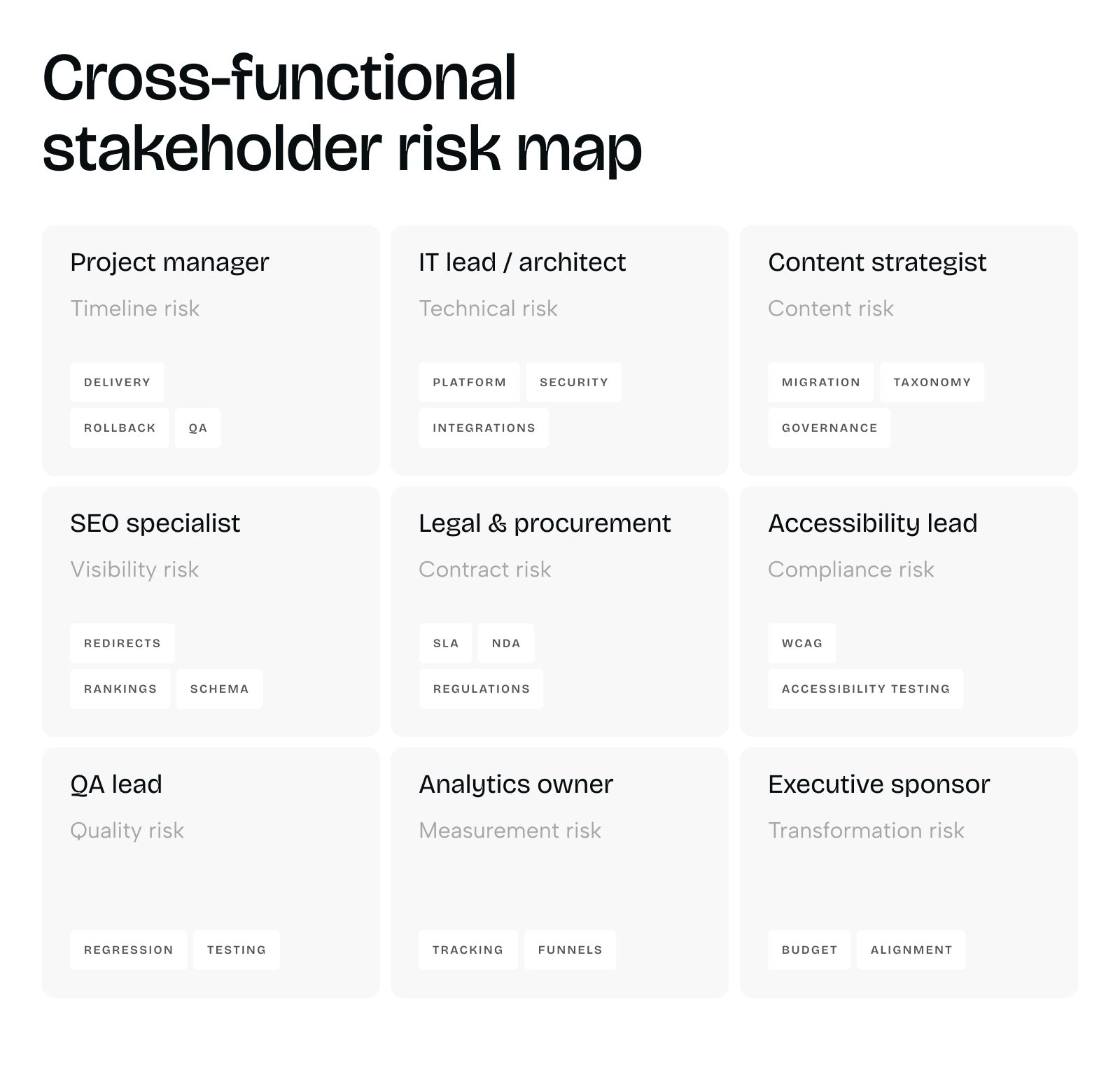
When these stakeholders are engaged only at the final approval stage, projects frequently encounter delays, rework, budget overruns, and launch risks. Most of the costly mistakes discussed below can be traced back to gaps in stakeholder involvement rather than technical execution alone.
Common mistakes when hiring a website development outsourcing company
Website development outsourcing has a specific failure mode that domestic hiring does not: the misalignment between what was specified in a brief and what was interpreted by a team working in a different context. The problem is not geography. It is process.
The most expensive mistakes we see on projects inherited from other vendors:
- Skipping discovery and going straight to design. The resulting site is built around assumptions about the audience that were never validated. Rework starts 6–8 weeks in when stakeholder reviews reveal misalignment that a 10-hour discovery workshop would have caught.
- Choosing a vendor based on the cheapest quote. A $12,000 quote for a corporate website is a signal, not a bargain. At that price point, something is being cut: timeline, senior involvement, QA depth, or all three.
- Separating design and development into sequential contracts. The handoff between these two phases is where scope creep, delay, and quality degradation most reliably occur.
- Accepting a project plan with no milestone builds. If the first time you see working code is at the final review, you have no visibility into whether the build matches the design. Insist on working builds at the end of every sprint.
- Ignoring post-launch needs. A corporate website requires ongoing content updates, performance monitoring, and occasional feature additions. An agency that does not offer a post-launch support model expects to hand off and disappear. Build that into the evaluation.
Bibliography
- Google Search Central. (2023). Core Web Vitals and page experience signals. Google Developers.
- Forrester Research. (2023). The business impact of investing in UX. Forrester.
- Stanford Persuasive Technology Lab. (2022). Web credibility research: How people evaluate a website’s credibility. Stanford University.
- Clutch Research. (2024). 2024 B2B buyer survey: Web development agency selection criteria. Clutch.co.
- W3Techs. (2025). Usage statistics of content management systems. Web Technology Surveys.
Share this article with friends



Sep 29, 2026
6 min read
B2B website redesign without losing traffic: A complete b2b website redesign guide covering UX audits, 301 redirect mapping, and metadata preservation. Partner with a top b2b website redesign agency that boosts conversions while protecting your organic rankings.

Sep 29, 2026
8 min read
Small business web design services that fit your budget. Get affordable small business website design from one of the best website design companies for small business — with transparent pricing and no hidden fees.
