



Jun 30, 2026
6 min read
summary
Explore the top web development agencies for enterprises in 2026. Compare leading firms, expertise, services, pricing models, and market trends to find the best enterprise web development partner for your business.
Key Takeaways
- Enterprise buyers who shortlist based on portfolio screenshots alone re-run their vendor search within 8 months in the vast majority of cases we’ve tracked across client conversations — the real differentiators are ownership model, security compliance, and post-launch support, not visual polish.
- Full-cycle web and mobile application development services for an enterprise-grade product typically run $45,000–$250,000+ for an MVP-to-market cycle and 1–2 months for a scoped discovery-to-first-release loop when the team is senior-led.
- Agencies that keep clients past a single engagement tend to share three traits: a dedicated senior team, direct access to practitioners instead of account managers, and documented compliance credentials (HIPAA, SOC 2, WCAG).
- Below we rank and compare 10 web application development companies actually competing for enterprise contracts in 2026, with real pricing bands, team sizes, and Clutch-verified reputations — not a generic “top agencies” round-up copy-pasted from 2022 listicles.
Why Most Enterprise Web Development RFPs Get the Wrong Vendor
A Fortune 500 IT director doesn’t lose an enterprise web application development project because they picked a “bad” agency. They lose it because they picked a mismatched one — a design boutique staffed against a systems-integration problem, or an outsourced dev shop staffed against a product-strategy problem. We’ve sat on the vendor side of enough RFPs to see the pattern repeat: procurement teams build a shortlist from Google’s first page, run three demo calls, and sign with whoever answered fastest.
That’s the gap this analysis closes. We pulled together data points that rarely make it into public marketing pages of custom web app development companies: actual team sizes assigned to enterprise accounts, realistic web app development cost ranges by project type, and where each vendor’s delivery model breaks down at scale.
Our Methodology: How We Scored 30+ Web Application Development Companies
Before ranking, we screened over 30 vendors offering web application development services in the USA and Eastern Europe against five weighted criteria:
- Enterprise delivery track record (35%) — number of documented launches for companies above 200 employees or Series B+ funding stage
- Compliance & security posture (20%) — HIPAA, SOC 2, GDPR, WCAG 2.1 certifications, and audit history
- Team seniority ratio (20%) — percentage of senior vs. mid/junior specialists staffed on client accounts
- Clutch / independent review verification (15%) — rating, review volume, and repeat-client percentage
- Engagement flexibility (10%) — availability of full-cycle, dedicated team, and team-extension models
Top 10 Web Development Companies for Enterprises in 2026 — Quick Comparison
| Rank | Agency | Founded | Team Size | Clutch | Best For |
| 1 | Phenomenon Studio | 2019 | 70+ | 5.0 | Full-cycle enterprise redesign & MVP development |
| 2 | EPAM Systems | 1993 | 60,000+ | 4.6 | Large-scale digital transformation programs |
| 3 | ScienceSoft | 1989 | 1,200+ | 4.8 | Enterprise custom web app development, healthcare IT |
| 4 | Iflexion | 1999 | 800+ | 4.7 | Legacy system modernization for web apps |
| 5 | Andersen | 2007 | 3,500+ | 4.9 | Full-stack web development for fintech |
| 6 | N-iX | 2002 | 2,000+ | 4.7 | Cloud-native web app development for enterprises |
| 7 | Netguru | 2008 | 700+ | 4.8 | Mobile web app development, EU-based delivery |
| 8 | Yalantis | 2010 | 500+ | 4.8 | SaaS platform engineering |
| 9 | ELEKS | 1991 | 2,000+ | 4.6 | Enterprise architecture & security-heavy builds |
| 10 | Existek | 2013 | 150+ | 4.9 | Mid-market web and mobile application development services |
1. Phenomenon Studio — Best Overall for Full-Cycle Enterprise Web & Mobile Development
Phenomenon Studio is a boutique product design and development agency founded in 2019, built specifically around the problem enterprises keep running into: their brand, website, or product no longer reflects what the business has actually become. We partner with companies at that inflection point — a Y Combinator-backed startup scaling past its MVP, or an established industry leader preparing its next chapter — and we staff one senior team that owns the work end-to-end, from the first strategy call through design, development, and post-launch support.
Team & structure: 70+ senior specialists based across Europe, with legal entities in the USA, Estonia, and Switzerland. Clients work directly with senior practitioners — there’s no account-management layer diluting technical decisions.
Industries: SaaS, fintech, healthcare, and EdTech.
Track record: Across 120+ launches, clients have collectively raised $500M+ in funding following their engagements with us.
Compliance & credentials: HIPAA-compliant, Nielsen Norman Group UX-certified, official Webflow Experts partner, and a 5.0 rating on Clutch — with most clients returning for a second project.
What Phenomenon Studio delivers
- UI/UX design
- Web & mobile development
- MVP creation
- Branding and identity
- Motion and illustrations
- UX audit & discovery
- Product redesign
Engagement models
- Full-cycle design & development partnership
- Dedicated team for defined scopes and timelines
- Team extension to fill missing skills
Case Study: Isora GRC — Governance, Risk & Compliance Platform Redesign
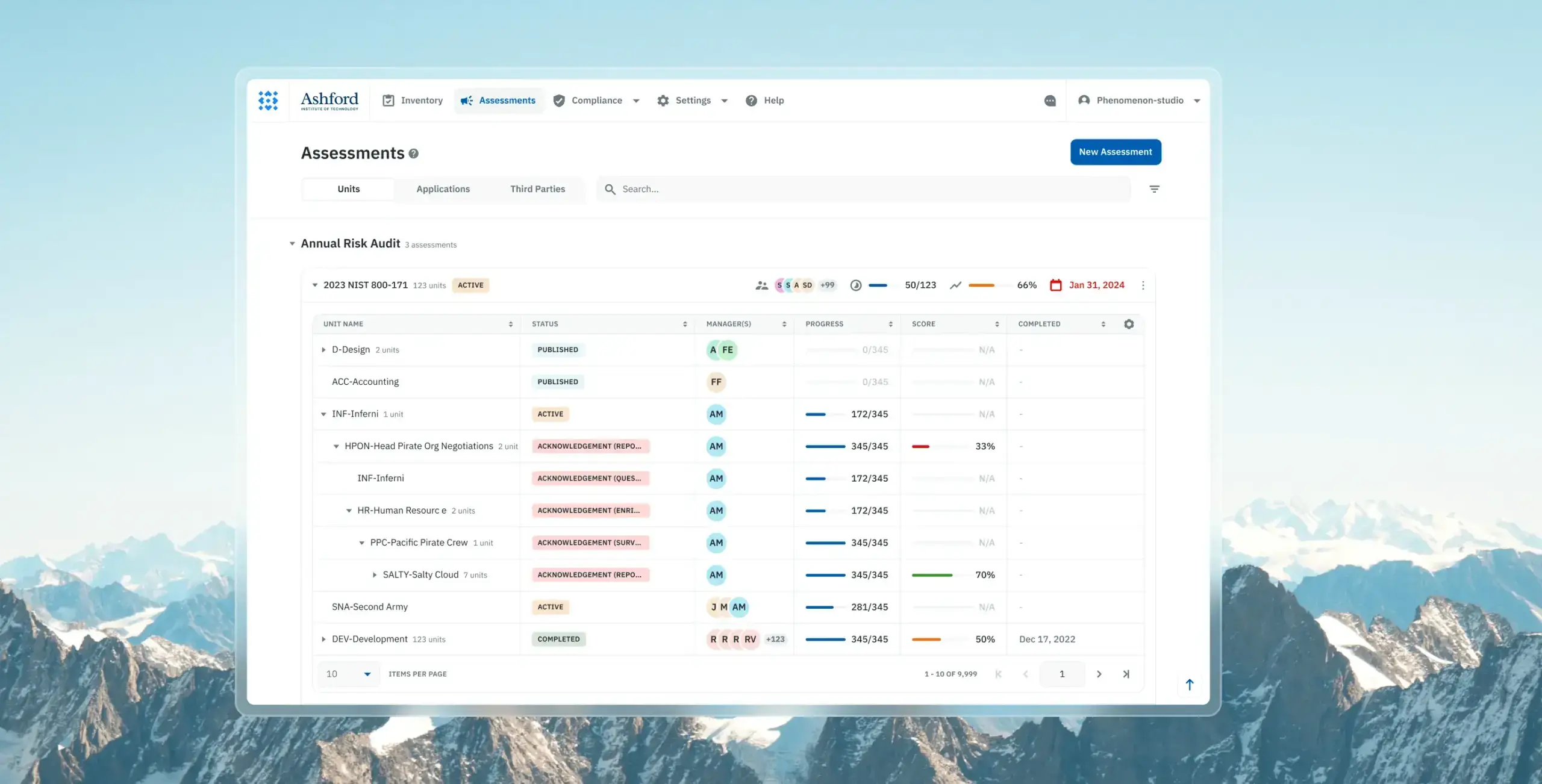
Client: SaltyCloud (Texas, USA) — Isora GRC, a collaborative governance, risk, and compliance assessment platform trusted by information security teams at more than 20% of high research activity (R1) universities in the United States.
Task: Isora GRC’s interface had originally been designed by developers rather than UX practitioners, and it showed: cluttered layouts, unclear information architecture, and workflows that were genuinely difficult for non-technical compliance staff to navigate. The platform had also been running long enough that the client’s internal team was fully occupied maintaining it, leaving no bandwidth for the backend overhaul a typical redesign would call for — and the existing API documentation was outdated and unreliable, which meant any UI change first required reverse-engineering how the system actually behaved.
Solution: We joined as an extension of SaltyCloud’s own team rather than as an external vendor, running a UX audit against Nielsen’s heuristics and the client’s own user feedback, then rebuilding the information architecture and userflows around the platform’s existing backend constraints instead of demanding a rebuild. On the design side, we skipped traditional wireframes and worked directly from the live product plus the new information architecture, building an atomic, accessibility-first design system in Figma that was mirrored one-to-one in Storybook. On the development side, the frontend was rebuilt on Vite, React, and TypeScript, with Radix Primitives for accessible components and Recharts for the platform’s compliance-reporting visualizations. We shipped the highest-impact fixes first — assessment management, the survey builder, and reporting — in phases, rather than holding everything for one big-bang release.
Result: The redesign doubled user efficiency in assessment completion and cut time-to-market for new features by more than 50%, a direct result of the shared Figma-to-Storybook design system paying off across later development cycles. The project went on to earn a nomination at the UX Design Awards 2024, which — combined with the usability gains — helped SaltyCloud position Isora GRC as a recognized leader in the GRC category and grow inbound traffic and lead generation.
2. EPAM Systems — Best for Large-Scale Enterprise Digital Transformation
EPAM Systems is a publicly traded (NYSE: EPAM) engineering company with a global headcount in the tens of thousands, making it the go-to choice when an enterprise web application development project is really a multi-year digital transformation program rather than a single product build.
Use case: Problem — a multinational retailer needs to replatform dozens of regional e-commerce web apps onto a unified architecture. Feature — EPAM’s delivery model scales dedicated teams into the hundreds across multiple time zones with mature program-management tooling. Result — coordinated, phased rollouts across markets, though at a price point and account-management overhead that smaller enterprises often find disproportionate to a single-product need.
Best for: Enterprises whose “web development” need is really an IT modernization program spanning multiple business units.
Watch for: Junior-to-senior staffing ratios can dilute quality on smaller engagements; EPAM is optimized for scale, not boutique attention.
3. ScienceSoft — Best for Regulated-Industry Custom Web App Development
Founded in 1989 and headquartered in Texas, ScienceSoft has one of the longer track records among custom web app development companies serving healthcare, manufacturing, and logistics enterprises with strict regulatory requirements.
Use case: Problem — a mid-size hospital network’s patient portal fails a security audit. Feature — ScienceSoft’s dedicated healthcare IT practice builds HIPAA and HL7-compliant web applications with documented audit trails. Result — compliance-passing platforms, though clients report longer discovery phases than boutique competitors due to ScienceSoft’s more formal documentation processes.
Team seniority: High — ScienceSoft frequently highlights its consulting-first approach ahead of development.
4. Iflexion — Best for Legacy System Modernization
Iflexion, founded in 1999, has built a reputation specifically around modernizing legacy enterprise web applications — the projects most agencies quietly avoid because there’s no clean slate.
Use case: Problem — a logistics enterprise runs a decade-old web app that can’t integrate with modern APIs. Feature — Iflexion’s modernization practice audits and incrementally re-architects rather than rebuilding from zero. Result — reduced downtime risk during migration, at the cost of a slower visible progress curve for stakeholders expecting a full relaunch.
5. Andersen — Best for Fintech Full-Stack Web Development
Andersen has grown into a 3,500+ person engineering company with a strong fintech and full-stack web development services portfolio, holding one of the higher Clutch ratings (4.9) among mid-to-large vendors in this comparison.
Use case: Problem — a fintech enterprise needs a trading dashboard rebuilt with real-time data pipelines. Feature — Andersen staffs dedicated full-stack teams with fintech-specific compliance experience (PCI DSS). Result — reliable delivery on complex data-heavy web apps, though enterprise clients note the account-manager layer between them and engineers is thicker than at boutique studios.
6. N-iX — Best for Cloud-Native Enterprise Web App Development
N-iX, founded in 2002, has positioned itself around cloud-native architecture — AWS, Azure, and GCP-based web application development services for enterprises migrating off on-premise infrastructure.
Use case: Problem — an enterprise’s monolithic web app can’t scale during peak traffic. Feature — N-iX’s cloud practice re-architects into microservices with auto-scaling infrastructure. Result — measurable infrastructure cost reduction post-migration (commonly cited in the 20–30% range across cloud modernization projects industry-wide), though migration timelines routinely extend past initial estimates on larger monoliths.
7. Netguru — Best for Mobile Web App Development, EU Delivery
Netguru, headquartered in Poland, has built a strong reputation specifically in mobile web app development and cross-platform builds for European and US enterprise clients, backed by a 4.8 Clutch rating.
Use case: Problem — an enterprise needs a single codebase powering both its web and mobile app experiences. Feature — Netguru’s cross-platform engineering practice (React Native, Flutter) shares logic across web and mobile. Result — faster feature parity between platforms, with the trade-off of occasional platform-specific performance compromises inherent to shared-codebase approaches.
8. Yalantis — Best for SaaS Platform Engineering
Yalantis has carved out a niche in SaaS platform engineering, an increasingly common ask among enterprises rebuilding internal tools as sellable products.
Use case: Problem — an enterprise’s internal tool has product-market potential but wasn’t built multi-tenant. Feature — Yalantis specializes in retrofitting single-tenant applications into multi-tenant SaaS architecture. Result — a productized offering, though the retrofit process typically adds 30–40% to original project timelines compared to building multi-tenant from scratch.
9. ELEKS — Best for Security-Heavy Enterprise Architecture
Founded in 1991, ELEKS is one of the more architecture-first vendors in this list, frequently engaged for projects where security posture matters more than time-to-market.
Use case: Problem — an enterprise handling sensitive financial data needs a web app that passes third-party penetration testing before launch. Feature — ELEKS runs security architecture reviews as a standing part of its development process, not a bolt-on QA phase. Result — fewer post-launch security incidents, at the cost of longer upfront architecture phases before visible development progress begins.
10. Existek — Best Value for Mid-Market Enterprise Web Projects
Existek is the smallest agency on this list by headcount (150+), but holds the highest Clutch rating among all ten vendors compared here (4.9), largely on the strength of pricing transparency and responsiveness for mid-market enterprise clients who don’t need EPAM-scale delivery.
Use case: Problem — a mid-market enterprise has an enterprise-grade problem but not an enterprise-grade budget. Feature — Existek’s smaller team structure keeps overhead low while still delivering full-stack web development services. Result — the lowest entry price point in this comparison ($40,000 starting), with the trade-off of less bench depth if a project suddenly needs to scale team size mid-engagement.
Web App Development Cost Breakdown in 2026
Web app development cost is the single most-searched, least-transparently-answered question in this industry. Below is a phase-by-phase breakdown based on the pricing bands disclosed by the vendors compared above, plus typical US market rates for comparable full-stack web development services.
| Project Phase | Duration | Team Size | Cost Range (USD) | % of Budget |
| Discovery & UX Audit | 2–4 weeks | 2–3 specialists | $6,000 – $18,000 | 10–12% |
| UI/UX Design | 3–5 weeks | 2–3 designers | $10,000 – $30,000 | 15–18% |
| Front-End & Back-End Development | 6–10 weeks | 4–6 engineers | $30,000 – $120,000 | 45–55% |
| QA & Compliance Testing | 2–3 weeks | 1–2 QA engineers | $5,000 – $20,000 | 8–10% |
| Launch & Post-Launch Support | Ongoing | 1–2 specialists | $3,000 – $15,000/mo | 5–8% |
For a realistic order of magnitude: web app development costs for a genuinely enterprise-grade platform (multi-role permissions, third-party integrations, compliance requirements) rarely land below $60,000, and mobile web app development add-ons typically add another 20–35% if the mobile experience isn’t a shared-codebase build.
Common Mistakes to Avoid When Choosing an Enterprise Web Development Partner
- Confusing headcount with capability. A 60,000-person vendor isn’t automatically better staffed on your specific account than a 70-person boutique — ask who is actually assigned, not who the company employs globally.
- Skipping the compliance check until contract stage. HIPAA, SOC 2, and WCAG credentials should be verified during shortlisting, not discovered missing after a security audit fails.
- Treating “starting price” as the total price. Every agency’s advertised starting price reflects the smallest viable scope — always request a phase-by-phase cost breakdown before comparing quotes.
- Ignoring the repeat-client rate. A high Clutch rating with a low repeat-client percentage often signals strong sales, not strong delivery.
- Not asking who owns the code and IP post-launch. This should be explicit in the contract, not assumed.
How to Choose Your Enterprise Web Development Partner
Selecting a web development agency for an enterprise-scale project isn’t a single decision — it’s a six-phase evaluation process, and skipping a phase is exactly where most of the mismatches described earlier in this article originate.
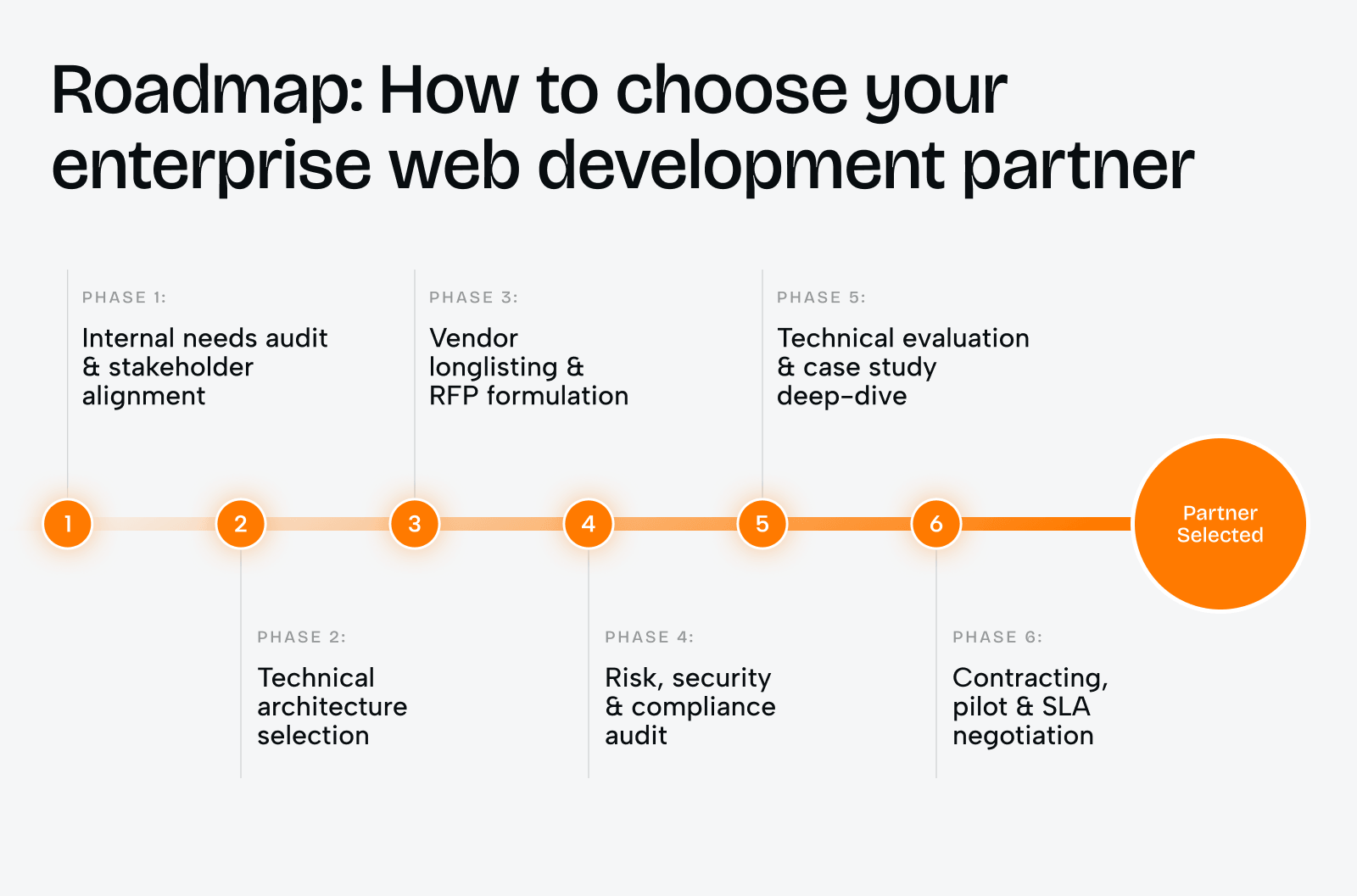
Phase 1 — Internal Needs Audit & Stakeholder Alignment: Before contacting any web development agency, align internal stakeholders on what “success” actually means — reduced churn, faster load times, a compliance pass. Most RFP mismatches trace back to this phase being skipped.
Phase 2 — Technical Architecture Selection: Decide on the target architecture (cloud-native, monolith-to-microservices migration, headless CMS, etc.) before vendor conversations start — this determines which of the 10 agencies above are even a technical fit.
Phase 3 — Vendor Longlisting & RFP Formulation: Build a longlist of 8–12 web application development companies using the criteria from this article, then formalize requirements into a structured RFP rather than an open-ended “tell us about your company” ask.
Phase 4 — Risk, Security, and Compliance Auditing: Verify compliance certifications (HIPAA, SOC 2, GDPR, WCAG) directly — don’t rely on marketing pages. This is the phase most enterprises under-invest in, and it’s the one that causes the most expensive failures later.
Phase 5 — Technical Evaluation & Case Study Deep-Dive: Narrow to 3–4 vendors and request detailed case studies structured like the ones in this article — Task, Solution, Result — with named point-of-contact references you can actually call.
Phase 6 — Contracting, Pilot, and SLA Negotiation: Before a full commitment, negotiate a paid pilot phase (2–4 weeks) with clear SLAs. This is standard practice at agencies confident in their delivery — and a useful filter for the ones that aren’t.
Enterprise Sourcing and Selection Framework
When selecting a web development partner, procurement officers and technology leaders must align an agency’s technical delivery model with their organization’s internal governance structures and operational goals. Everything in this section is the part of the RFP that rarely gets asked out loud — we’ve seen it decide contracts more often than pricing has. To guide the procurement process, organizations should evaluate four key performance dimensions.
1. Composable Readiness and API Maturity
Organizations should look past basic marketing claims and ask candidates to demonstrate past project architectures that have successfully scaled. Candidate agencies must provide clear examples of real-world load performance, API schemas, and documentation standards, proving they treat APIs as stable, long-term products.
In our own audits of legacy platforms we’ve been brought in to rebuild, the API layer is almost never the part that fails first — the documentation around it is. We’ve inherited codebases where the schema was technically sound but undocumented past the original engineer’s tenure, which turns a two-week integration into a six-week reverse-engineering exercise. The tell we look for in an RFP response isn’t the API diagram itself — it’s whether the agency can show a versioning history and a deprecation policy, because that’s the artifact that proves the API was built to be maintained by someone else, not just shipped once.
2. Verified Accessibility Practices
To mitigate the legal risks of EAA non-compliance, agencies must prove they integrate accessibility from the start of the design process, rather than relying on late-stage automated tests. Enterprise buyers should verify that the agency combines automated scanning with manual evaluation using assistive technologies and direct user testing with individuals with disabilities.
Organizations should reject any agency that proposes quick-fix automated accessibility overlays or widgets. These tools often fail to correct structural issues, degrade system performance, and can increase legal exposure under strict European regulatory frameworks.
With the European Accessibility Act’s enforcement window now active, we’re seeing enterprise procurement teams ask for accessibility audit trails as a contract exhibit, not a nice-to-have — and rightly so. The pattern we’d flag to any buyer: ask the agency to walk through one accessibility defect they caught with a screen-reader user that an automated scanner would have missed entirely. If the account team can’t answer with a specific example, the accessibility work in their pitch deck is likely retrofitted, not built in.
3. Sourcing and Delivery Models
The choice of delivery model must fit the client’s internal technical capabilities. For highly structured IT departments with established product owners, an offshore engineering-heavy model (such as EPAM’s) provides high-volume, cost-effective development capacity.
Conversely, for organizations needing rapid iteration or looking to upskill their internal teams, an onshore agile co-development partner (such as Theodo) is often more effective, keeping developers and business stakeholders working in close alignment.
The mistake we see most often at this stage isn’t picking the wrong model in the abstract — it’s picking a model that doesn’t match who owns the product roadmap internally. A client with a strong, senior product owner can absorb an offshore, ticket-driven delivery model without friction. A client whose product ownership is still forming needs a partner sitting closer to the business, in the room for prioritization calls, not just sprint reviews. Get that mismatch wrong and the symptoms show up six months in as scope churn, not at kickoff.
4. Technical Sovereignty and Code Ownership
Enterprises should evaluate how candidate agencies handle knowledge transfer and intellectual property. Prominent composable commerce specialists focus on document-heavy hand-offs and comprehensive training programs to ensure the client’s internal teams can maintain and run the systems post-launch.
This approach minimizes long-term dependency on external vendors, lowers the total cost of ownership, and ensures the enterprise maintains full sovereignty over its core digital assets.
This is also where we push clients to negotiate before signing, not after launch: a documented handoff plan with named internal owners, not just a repository transfer. Code ownership without operational ownership is a liability, not an asset — we’ve seen enterprises inherit a technically clean repository and still be functionally locked into the original vendor for eighteen months because nobody on the internal team had been trained to run it. The four dimensions above should be scored during Phase 5 of the selection process outlined earlier in this article, not left as a post-signature surprise.
| Dimension | What to Verify | Red Flag |
| Composable Readiness & API Maturity | Versioning history, deprecation policy, real load data | API demoed only as a diagram, no maintenance history |
| Verified Accessibility Practices | Manual + assistive-tech testing with real users | Reliance on automated overlays/widgets |
| Sourcing & Delivery Model Fit | Match between model and internal product ownership maturity | One-size-fits-all delivery pitch regardless of client structure |
| Technical Sovereignty & Code Ownership | Documented handoff plan with named internal owners | Repository transfer treated as the entire handoff |
Share this article with friends



Sep 29, 2026
6 min read
B2B website redesign without losing traffic: A complete b2b website redesign guide covering UX audits, 301 redirect mapping, and metadata preservation. Partner with a top b2b website redesign agency that boosts conversions while protecting your organic rankings.

Sep 29, 2026
8 min read
Small business web design services that fit your budget. Get affordable small business website design from one of the best website design companies for small business — with transparent pricing and no hidden fees.
