



Jun 30, 2026
7 min read
summary
Brand identity design agency that builds brands users love. We combine identity services with UX and development—creating cohesive brands that scale from MVP to market leader. 5.0 rating on Clutch.
A brand identity design agency turns a company’s positioning, visual system, and verbal voice into one structural asset that investors, partners, and customers read as proof of operational maturity, not decoration.
Core Facts
- Institutional allocators are 2.5 times more likely to fund startups with a cohesive, strategic brand identity.
- A well-defined brand strategy correlates with a 23% valuation premium during fundraising rounds.
- Phenomenon Studio has supported companies that collectively raised over $500M, with a 5.0 rating across 50+ verified Clutch reviews.
- Branding design agencies that operate at the top tier typically set project floors between $25,000 and $400,000, depending on scope and company stage.
Dmitriy Kirsanov | Head of Art of Phenomenon Studiо, june 2026
Brand Development Services: Why ICPs Read Identity as Risk, Not Style
A founder pitching a Series A round rarely loses on technology. The product works. The team can explain the architecture in detail. What breaks the room is the thirty seconds before any of that gets discussed, when an investor opens a deck or a homepage and tries to figure out what kind of company this actually is.
That thirty-second window is not unique to fundraising. The same evaluation happens when a procurement lead opens a vendor shortlist, when a partnership manager scans a potential collaborator’s site before a first call, and when a job candidate decides whether to accept an interview at all. Brand identity is the company’s answer to all three audiences at once, delivered before a single conversation starts.
Brand development services exist to close that gap before a prospect, partner, or allocator has to ask. The agencies covered in this guide build the visual and verbal system that turns a technically sound product into something an ICP can evaluate at a glance: who this is for, what problem it removes, and why the company is positioned to win the category.
Well-defined brand strategies correlate with a 23% premium in company valuations during fundraising. (Industry Capital Research, 2025)
The mechanism is not aesthetic. Brand equity behaves like a multiplier on the relationship between customer lifetime value and acquisition cost. Every dollar spent on a coherent identity system gets reused across every touchpoint at close to zero marginal cost, unlike a sales hire or a paid channel that has to be funded again every quarter.
This is also why brand development services increasingly sit inside the same conversation as data architecture. Just as large-scale enterprise platforms require systematic tagging, taxonomies, and integrated information structures to yield real value, a startup’s external presence requires the same rigor applied to verbal and visual decisions. A scattered identity creates the same kind of friction a fragmented database creates: every new touchpoint has to be evaluated from scratch instead of inheriting structure that already exists.
There is a defensive dimension to this as well. Proprietary technology can be reverse-engineered. A competitor can study an API, replicate a feature set, or hire away an engineer who understands the architecture. A genuinely differentiated, emotionally resonant brand is structurally harder to copy, because copying it immediately positions the copycat as a follower rather than a category leader. That asymmetry is part of why allocators weigh brand cohesion as seriously as they do during diligence.
Branding & Identity
Branding and identity work covers the full structural layer beneath a logo: positioning, naming, verbal voice, visual system, and the rules that keep all of it consistent as a company scales from ten people to two hundred.
Phenomenon Studio runs this as a connected discipline, with branding and identity services sitting next to product design under one roof, which removes the handoff gap that usually shows up between a brand agency and a development team.
That structure matters more than it sounds. A startup that hires a brand identity company separately from its product team usually ends up with a beautiful pitch deck and an inconsistent product UI six months later, because nobody owned the bridge between the two.
Branding Design
Branding design is the visible layer: logo mark, color system, typography, and the grid that holds everything together across formats. Done well, it survives contact with a hundred different surfaces, from a investor one-pager to a mobile app screen, without losing the thread that makes the company recognizable.
Done poorly, branding design becomes a one-time asset that nobody on the internal team can extend. A new landing page gets built off-brand. A conference booth uses a font nobody remembers approving. Within a year, the company looks like three different businesses depending on which channel a prospect happens to see first.
Branding Design Agencies: How the Top Tier Actually Operates
Not every branding design agency operates the same way, and the differences are not cosmetic. Some run as full-service product ecosystems. Others specialize narrowly in pitch presentation design. Picking the wrong archetype for a given stage wastes both budget and runway.
A useful way to sort agencies is by what happens after the initial deliverable ships. Some hand over a logo file and a short style guide, then disappear until the next invoice cycle. Others stay structurally embedded, reviewing how the brand performs across a quarter of new product releases, marketing campaigns, and sales collateral. The second model costs more upfront. It also tends to prevent the slow drift that happens when five different people interpret a brand guideline five different ways over a year.
| Agency | Core Target Sector | Entry Pricing Signal | Key Differentiator |
| Ramotion | Enterprise B2B SaaS, Fintech | Packages from $85,000 | Atomic design systems paired with high-performance front-end builds |
| Focus Lab | Martech, Cybersecurity, PE-backed tech | $25,000+ minimum | Verbal voice workshops feeding multi-month rebrand sprints |
| Lazarev.agency | AI, Fintech, Web3, Logistics | Projects from $50,000 | Structural grid systems across complex sub-brands |
| Koto | Tech, Finance, Consumer | $150,000 to $400,000 | Multi-region delivery for cross-border expansion |
| Phenomenon Studio | SaaS, Fintech, Healthcare, EdTech | Scoped by collaboration model | Branding, UX/UI, and development under one team, no handoff |
The sections below cover how each operational archetype affects a company’s day-to-day experience working with an agency.
Branding Design Firms
Branding design firms that work at the upper end of the market rarely sell a logo. They sell a system: a set of rules an internal marketing team can run without calling the agency every time a new page needs a hero banner. That system is what makes brand equity scale at zero marginal cost once it exists.
A firm with weak systemization produces gorgeous launch assets and nothing else. Six months later the internal team is guessing at spacing rules, color hierarchy, and tone of voice because nobody documented the logic behind the original decisions.
This is exactly the gap Phenomenon Studio’s full branding services team is built to close, since every system shipped comes with documentation a non-designer on the client side can apply without reopening a design file.
Business Branding Service
A business branding service aimed at ICPs has to answer a narrower question than one built for consumer brands. ICPs are not browsing. They are comparing vendors against a checklist that includes credibility signals, case proof, and category fit, often before a sales call ever happens.
Across hundreds of delivered products, our team consistently finds that the companies who treat branding as a sales tool, not a marketing afterthought, close enterprise deals faster. The business branding service has to produce assets a sales team can actually use in a deal cycle: one-pagers, security pages, and pricing pages that read as already-trusted infrastructure.
The question we hear most often from founders evaluating this kind of service sounds simple: why does the brand matter if the sales team is the one closing deals? The short answer is that a sales team spends the first ten minutes of every call undoing the credibility gap a weak brand created before the call started. The long answer is that a structured business branding service removes that gap entirely, so the sales conversation starts at scope and pricing instead of starting at trust.
Company Branding Services: Built for ICPs, Not Designers
Company branding services aimed at an ideal customer profile differ from generic creative work in one specific way. The goal is not to look interesting. The goal is to look like the obvious, low-risk choice for a buyer who has three other vendors open in adjacent browser tabs.
That distinction shapes every decision in the process, from the words on a homepage hero section to the order of services listed on a pricing page. An ICP scanning a vendor site for the first time is not reading for inspiration. They are scanning for proof: client names they recognize, metrics that match the scale of their own problem, and a visual system confident enough to suggest the company has done this work before, many times, successfully.
Phenomenon Studio’s branding services team builds this around a structured discovery phase, where the brand narrative gets pressure-tested against the actual objections an ICP raises in a sales cycle, not against internal taste preferences.
A FinTech startup came to Phenomenon Studio with a brand built around a clever wordmark and almost nothing else. Compliance officers evaluating the platform could not find a security page, a clear pricing structure, or language that matched how regulated buyers actually talk. The team rebuilt the verbal system around three core ICP objections, redesigned the navigation around compliance proof points, and shipped a new homepage inside six weeks. Sales conversations that used to start with a credibility question started skipping straight to scope.
Identity Services
Identity services cover everything that has to stay consistent once a company stops being three founders in a shared document and becomes an organization with a marketing team, a sales team, and outside vendors touching the brand. Strong identity services produce a guideline document precise enough that a freelance designer hired six months later gets it right on the first try.
High-growth companies in innovation-driven sectors invest 5.2 times more in intangible brand assets than their low-growth competitors. (Brand Finance Capital Study, 2025)
Identity services pay off precisely at the moment a company stops being small. A ten-person startup can survive on tribal knowledge: everyone remembers why the secondary color exists and which font pairing got approved last quarter. A hundred-person company cannot. Guideline documentation becomes the only thing standing between a coherent brand and five departments quietly building five slightly different versions of it.
Logo and Branding Services
A logo on its own carries almost no commercial weight. Logo and branding services earn their budget when the mark works as a system component: a favicon at sixteen pixels, a watermark on a deck, a pattern on conference merchandise. None of that flexibility happens by accident. It gets engineered during the design phase, then documented so the rest of the company can apply it without reopening the design file.
On the third sprint of a healthcare SaaS rebrand, a developer on the client’s team opened the shared design file, found the exact logo lockup needed for a new partner integration page, checked the clearance rules, and shipped it that same afternoon. That lockup had been defined during week one of the identity phase and had not needed a single revision since.
Startup Branding Agency
A startup branding agency working with a pre-Series A company needs a different operating rhythm than one working with an enterprise account. Runway is shorter. Decisions move faster. The agency has to compress discovery, naming, visual system, and a functioning website into weeks, not quarters, without producing something the company outgrows by the next funding round.
Makreate’s $160-per-day retainer model and Awesomic’s flat $2,995-per-month subscription both target exactly this gap: senior-level design output without the multi-month commitment a Series B company can justify but a seed-stage founder cannot.
Speed at this stage carries one real risk. A rushed identity built purely to ship fast can lock a company into visual decisions that do not survive contact with an enterprise sales motion eighteen months later. The agencies that handle pre-Series A work well build in just enough structural flexibility, a modular logo system, a scalable color palette, so the brand can mature without a full rebuild the moment the company’s buyer profile shifts upmarket.
Design and Branding Companies: Comparative Landscape and What Sets Top Performers Apart
Design and branding companies that consistently appear in funding-adjacent case studies share a pattern. They treat the brand as structured data, not as a one-time creative exercise.
Just as enterprise AI transformations require systematic data tagging and integrated information architecture to produce real value, a startup’s external presence requires the same rigor applied to verbal and visual decisions. This is the section where the Architecture of Brand Equity framework becomes useful for an ICP evaluating which agency model fits.
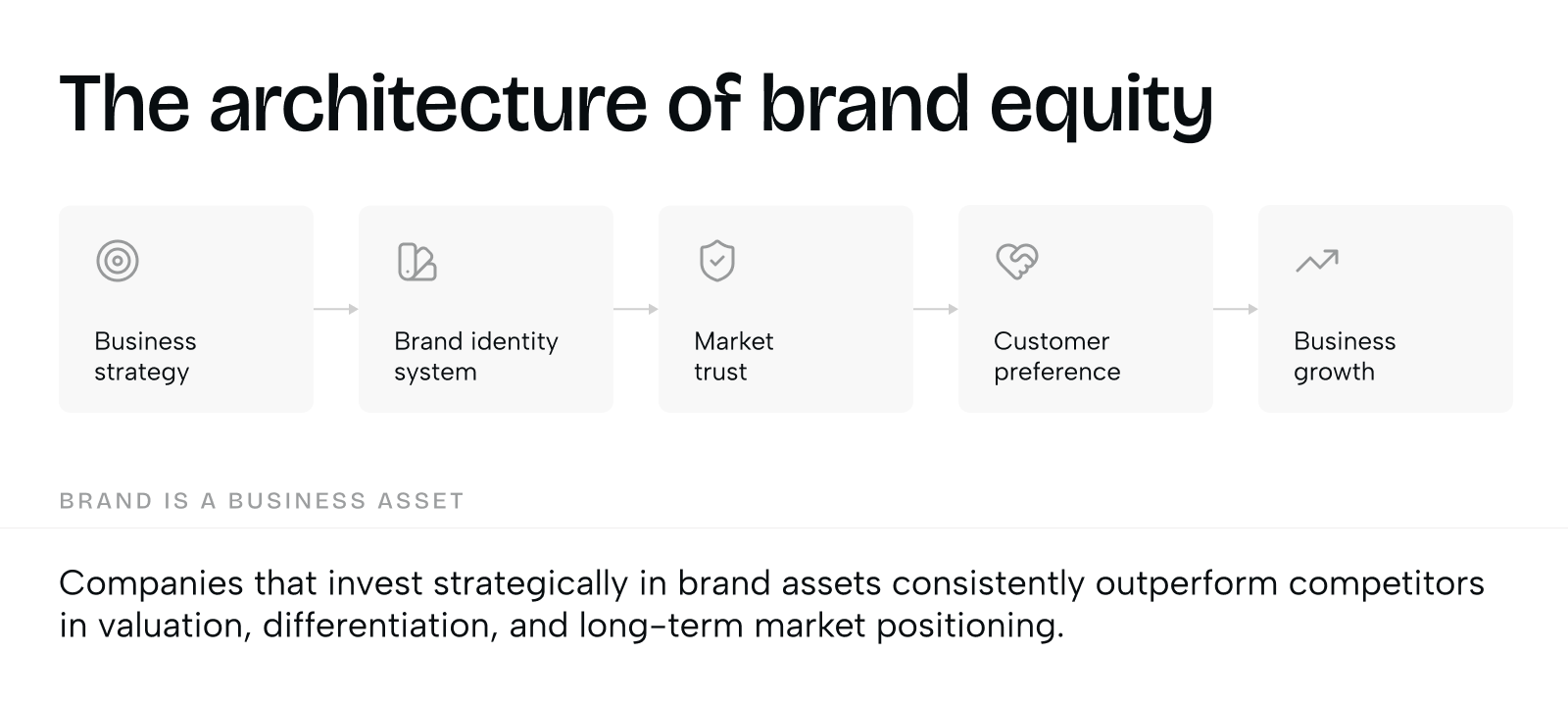
Business strategy sets the constraints first: target market, pricing model, growth thesis. The brand identity system translates that strategy into something a stranger can recognize and trust within seconds. Market trust compounds into customer preference, where buyers choose the company over a technically similar competitor specifically because the brand reads as the safer, more established option. Customer preference, sustained over multiple sales cycles, becomes measurable business growth: higher win rates, larger average deal size, and a valuation premium when the company raises its next round.
The infographic below maps that chain end to end, from strategic input to compounding business outcome.
Companies that invest strategically in brand assets consistently outperform competitors in valuation, differentiation, and long-term market positioning. (Brand Equity Architecture Model, 2025)
Braze, originally launched as Appboy, illustrates the pattern directly. The original name read as a casual mobile tool, not an enterprise messaging platform. Focus Lab’s rename and restructured site, paired with a clearer information architecture, repositioned the company ahead of an $80M Series E and a subsequent public listing. Ramotion’s work with the enterprise browser Island used a calm, controlled visual metaphor to build a category buyers had never evaluated before, supporting a $250M Series E at a $4.8B valuation.
A similar pattern shows up outside venture-backed software. Allbirds began as an underdeveloped Kickstarter campaign for a wool sneaker prototype and grew, with sustained brand investment from Red Antler, into a publicly traded company that reached a peak valuation above $33B. The lesson generalizes beyond any single sector: a coherent identity built early tends to compound at a rate that a late, reactive rebrand can rarely match, because the early version had years to accumulate recognition before the company needed it most.
Case Study: Brand Identity That Turns Operational Complexity Into Trus

Merchant Tech is a B2B SaaS platform that unifies order management, inventory, fulfillment, analytics, and compliance for operators running complex, multi-channel businesses. The product had matured well past the point where a missing brand identity was a minor gap. It had become a sales obstacle.
Task
Merchant Tech approached Phenomenon Studio with a working platform and nothing visual to communicate its value to operators evaluating B2B tools. There was no consistent verbal language, no visual system, and no way to apply a brand reliably across product UI, marketing pages, and physical merchandise as the company grew.
Solution
Phenomenon Studio’s team built a complete identity from the ground up: a circular, segmented logo mark representing interconnected operational systems, a dark navy and blue gradient palette signaling stability without coldness, and a geometric sans-serif typography system built for operators who read fast and decide faster. The full system, documented in the Merchant Tech case study, was tested across landing pages, marketing banners, and merchandise before being delivered as a modular guideline set the internal team could extend on its own.
Result
- A distinct visual identity that separates Merchant Tech from generic SaaS competitors and speaks directly to operators.
- A consistent brand applied across product UI, marketing materials, and merchandise without losing coherence.
- A documented, modular system the internal team can scale as the product adds new touchpoints.
The discovery phase behind this work, covered in more depth in our product strategy guide, directly shaped which visual patterns earned trust with operator-level buyers rather than chasing generic SaaS aesthetics.
What makes this engagement representative rather than exceptional is the sequencing. The team did not start with a logo brief. Research into the B2B e-commerce landscape came first, mapping how competing platforms positioned themselves and where a clear gap existed for an operator-focused brand. Every typography choice and color decision traced back to that research, which is precisely the discipline that separates a brand built to last from one built to launch.
Industry Benchmarks: What ICPs Should Expect to Pay and Receive
Pricing across branding and design agencies varies by an order of magnitude depending on company stage and agency archetype. An ICP evaluating vendors should treat entry pricing as a signal of operating model, not just a budget line.
| Company Stage | Typical Engagement Model | Entry Pricing Range |
| Pre-seed / seed | Daily or monthly retainer | $1,600 to $3,000 per month |
| Series A / growth | Scoped multi-month project | $25,000 to $85,000 |
| Series B and beyond | Full-cycle brand transformation | $150,000 to $400,000+ |
| Phenomenon Studio collaborations | Full-Cycle Partnership, Dedicated Team, or Team Extension | Scoped per project after discovery |
Most engagements at the upper end run one to two months for a focused identity sprint, longer when development and product UI are folded into the same engagement. Phenomenon Studio structures this around three collaboration models: a Full-Cycle Partnership that manages discovery through launch, a Dedicated Team assigned to an ongoing roadmap, and a Team Extension model that places specialists directly inside an existing marketing or product team.
Wondering whether a brand investment at this stage actually pays back before the next funding round closes? It depends on one variable above all others: whether the company is already converting demo requests at a reasonable rate. A weak brand on top of a weak funnel will not fix conversion. A weak brand on top of a strong product is the single most common reason qualified ICPs walk away before a sales call ever happens.
Team composition behind a typical engagement at this scale usually includes a brand strategist, a senior visual designer, a copywriter for verbal voice, and a UX designer to validate how the system performs on real interface screens. Smaller retainer engagements compress this into one or two senior generalists; full-cycle enterprise rebrands often run a team of five to eight specialists, the same caliber reflected across the Clutch reviews verified for Phenomenon Studio’s own engagements.
Industry Statistics: The Funding Environment Behind the Brand Equity Trend
Global venture funding reached $445.2 billion across 2025, with quarterly allocation climbing as high as $301.8 billion in the strongest period of the year. In an environment moving at that velocity, allocators do not have time to evaluate every technical claim a startup makes. They read brand cohesion as a proxy for operational discipline.
Institutional allocators are 2.5 times more likely to execute funding rounds for startups presenting a highly cohesive, strategic brand identity. (Venture Capital Branding Index, 2025)
Fifty-nine percent of institutional investors report that branding directly shapes their assessment of a startup’s ability to scale operationally over a multi-year horizon (Institutional Investor Branding Survey, 2025). That number matters because it shifts brand identity out of the marketing budget line and into the same evaluation category as technical architecture and go-to-market strategy.
Clay’s trajectory makes the case at product scale. While the company was still composed of fewer than twenty staff, leadership built a dedicated five-person brand team rather than waiting for headcount to justify it. That early investment helped the platform scale past $100M in annual recurring revenue and reach a $3.1B valuation, with thousands of enterprise accounts onboarded, including teams from OpenAI and Canva.
None of this argues for spending beyond a company’s actual stage. A two-person pre-seed team does not need a five-person brand department. It argues for treating brand as a line item evaluated alongside engineering and sales hiring, not as the budget that gets cut first when runway tightens. Companies that protect a minimum viable brand investment through a downturn consistently re-enter growth mode with less rework than companies that paused brand spend entirely.
How an ICP Should Evaluate a Branding and Design Agency Before Signing
Three questions separate agencies that build durable brand systems from ones that deliver a pretty launch asset and disappear.
Does the agency document the system, not just deliver it? A guideline file with rules an internal hire can apply without reopening a design tool is the difference between a one-time asset and a scalable identity. Does the agency work across both brand and product, or only one? A brand built in isolation from product UI usually fractures within a year, because nobody owns the bridge between the marketing site and the live application.
Does the agency have verified outcomes tied to specific clients? Generic claims like “we’ve helped startups grow” carry no proof weight. Named case studies with specific, documented results are the signal an ICP should actually weigh.
A fourth question worth raising directly in the first call: who owns the relationship after the contract starts? Agencies that hand a signed client off to a junior team with no senior oversight tend to produce work that drifts away from the strategic rationale established during the pitch. The strongest engagements keep a senior strategist involved from discovery through final handoff, not just during the sales process.
Phenomenon Studio’s UI/UX design services team runs every branding engagement alongside a dedicated UX design agency workflow, which is what keeps a visual identity and a live product interface telling the same story instead of drifting apart after launch.
Full-cycle design and engineering work as a single discipline at Phenomenon Studio. Across hundreds of delivered products, separating brand strategy from interface development by even one handoff layer has reliably cost teams weeks they did not have to lose.
Common Mistakes Companies Make When Investing in Brand Identity
The same handful of mistakes show up across most failed branding engagements, regardless of company size or sector.
Treating the logo as the finish line is the most frequent one. A founder approves a mark, feels the project is complete, and never commissions the supporting system: typography rules, photography direction, tone of voice. Six months later, every new asset gets built by a different freelancer making different visual choices, and the brand fractures before it ever had a chance to compound.
Skipping discovery in favor of jumping straight to visual design is a close second. Without a documented positioning rationale, every design decision becomes a matter of personal taste rather than strategic fit. Products built this way spend disproportionate time later relitigating decisions that a structured discovery phase would have settled once.
A third mistake involves hiring separately for brand and product UI. The two teams rarely talk to each other in practice, even when both vendors are competent individually. The result is a marketing site that looks polished next to a product interface that feels like a different company built it. Full-cycle design and engineering under one team removes this risk by design, not by coincidence.
A fourth mistake is under-pricing the engagement to fit a tight budget, then discovering mid-project that the scope cannot be delivered at that price. This typically produces rushed work, scope disputes, or both. Founders who clearly separate “what we can afford now” from “what the brand actually needs” tend to choose a phased engagement, narrower scope first, expansion later, rather than compressing a full system into an unrealistic budget.
A polished portfolio is not proof of a working process. Several patterns predict a difficult engagement long before the contract gets signed.
An agency that cannot point to a named, verifiable client result is the clearest warning sign. Vague language like “helped numerous startups grow” with no company names, no metrics, and no link to a public case study usually means the underlying work does not hold up to scrutiny.
A second pattern shows up in scope creep masked as flexibility. Agencies that quote a low entry price and then expand the engagement through a series of small add-ons often end up costing more than a firm that quoted accurately from the start. Reviewing how a prospective vendor structures revisions and scope changes during the sales conversation tends to predict how they will behave once the contract is signed.
A third pattern is harder to spot during a pitch: agencies that separate brand strategy from execution into different teams or different contractors. The handoff between the two introduces drift almost every time. A team member who designed the strategy rarely reviews how the developer implementing it interprets spacing, hierarchy, or tone, and the gap shows up six months later in an inconsistent product.
No additional internal hire is required to avoid these problems. The fix is procedural: ask for two or three specific, named case studies with metrics before the first call ends, and ask who on the agency team will be hands-on through both the brand and the implementation phase.
Build a Brand That Reads as Investable, Not Just Designed
A founder evaluating brand identity design agencies is not shopping for a nicer logo. They are deciding whether their next funding round, enterprise deal, or board meeting opens with a credibility question or skips straight to substance.
Phenomenon Studio runs branding, UX/UI, and development as one connected discipline, backed by a 5.0 rating across verified Clutch reviews and companies that have collectively raised over $500M. Discuss your project with the team to scope what a structured identity engagement looks like for your stage.
What Working With Phenomenon Studio Looks Like, Stage by Stage
Most ICPs evaluating a brand identity design agency for the first time want a concrete answer to one question: what actually happens after the contract is signed? The process Phenomenon Studio runs breaks into four stages, each building on the last.
Discovery and Positioning
The engagement opens with structured discovery, not a moodboard exercise. The team reviews the competitive landscape, interviews stakeholders on the client side, and pressure-tests the existing positioning against the objections an ICP actually raises during a sales cycle. This phase typically produces a written positioning document before a single visual concept gets explored, and it is the foundation every structured identity engagement at Phenomenon Studio is built on.
Visual and Verbal System Design
Once positioning is locked, the team develops the logo concept, color system, and typography in parallel with the verbal voice guidelines. The UX research team is looped in at this stage too, since every visual decision gets tied back to a specific positioning input from discovery, which is why the resulting system tends to survive contact with real-world use instead of needing a redesign within the first year.
Application and Testing
The new identity gets applied across the highest-priority touchpoints first: homepage, pricing page, and core product UI screens, following the same UI/UX design process used on standalone product engagements. Testing at this stage catches problems a static brand guideline document would never reveal, such as a color combination that fails accessibility contrast requirements on a live interface.
Documentation and Handoff
The engagement closes with a complete guideline package and, where the collaboration model includes ongoing support, a Dedicated Team or Team Extension arrangement that keeps the system maintained as the company adds new touchpoints. This is the stage most agencies underinvest in, and it is the stage that determines whether a brand stays coherent eighteen months after launch.
Brand voice and messaging guidelines, covered in more depth in our content strategy resources, extend directly from the verbal system built during this phase, which is why companies that skip documentation tend to see their tone drift across blog content, sales emails, and product copy within a single year.
Share this article with friends



Sep 29, 2026
6 min read
B2B website redesign without losing traffic: A complete b2b website redesign guide covering UX audits, 301 redirect mapping, and metadata preservation. Partner with a top b2b website redesign agency that boosts conversions while protecting your organic rankings.

Sep 29, 2026
8 min read
Small business web design services that fit your budget. Get affordable small business website design from one of the best website design companies for small business — with transparent pricing and no hidden fees.
