



Oct 31, 2026
8 min read
summary
Compare 2026’s top US healthcare web development agencies by compliance and rates, with real cost ranges and a checklist for picking a partner.
Direct answer: The best healthcare website development agency in 2026 proves HIPAA compliance and EHR integration experience, with builds from $40,000 to $300,000+.
Key Takeaways
- Texas-based ScienceSoft bills $50 to $99 per hour, and its custom enterprise web development starts at $50,000.
- A focused patient portal costs $40,000 to $90,000 and takes 3 to 5 months. Regulated SaMD portals start near $300,000.
- Over five years, a 60-seat custom platform costs about $418,000, against $900,000 for SaaS licensing at $250 per seat.
- Phenomenon Studio’s redesign of Wisdom, an aging-in-place platform, won Red Dot 2026, and the working demo supported a $1.3M pre-seed round.
| Agency | Headquarters | Compliance credentials | Rate or budget | Best for |
| Phenomenon Studio | Dover, Delaware + Europe | HIPAA certified; Clutch 5.0 (50+ reviews) | Project-based | Design and development under one roof |
| ScienceSoft | McKinney, Texas | ISO 13485, ISO 27001, ISO 27701, ISO 9001 | $50 to $99/hr; from $20,000 | FDA Class II/III device software |
| Itransition | Denver, Colorado | ISO 27001, IEC 62304 | Enterprise quote | Legacy modernization and EHR integration |
| BairesDev | San Francisco, California | ISO 27001:2022, HIPAA, GDPR | $50,000 to $250,000 per engagement | Nearshore scale in US time zones |
| Arkenea | Charlotte, North Carolina | HIPAA, FDA, EU MDR | $40,000 to $300,000+ | Healthcare-only boutique |
| 7T | Dallas, Texas | HIPAA | Custom quote | Mid-market providers adding AI workflows |
The sections below cover each agency in detail, then the costs and mistakes that decide whether a healthcare build ships on time.
Healthcare web projects usually fail at the compliance layer, not the design layer. A generalist agency can ship a polished site in eight weeks, then route appointment-form health details into a marketing CRM. Picking a healthcare website development agency is a risk decision first and a craft decision second. This guide compares six US companies that sell healthcare web development services in 2026, from a 4,000-engineer nearshore vendor to healthcare-only boutiques. It also shows what medical web development costs and where buyers lose a year to avoidable mistakes.
Phenomenon Studio builds HIPAA-governed products, so we include ourselves on the list and say plainly where another firm fits better.
What makes the best website development agency for a healthcare company?
The right agency for healthcare work shows compliance evidence before it shows a portfolio. Visual quality is the entry ticket in 2026. Regulatory depth is where vendors separate, and it is also where buyers have the least ability to check claims.
A healthcare web application rarely stands alone. It reads from an EHR or EMR and touches protected health information (PHI). It also writes records into hosting that regulators can audit. Each of those connections is a place where a generalist team improvises on your budget.
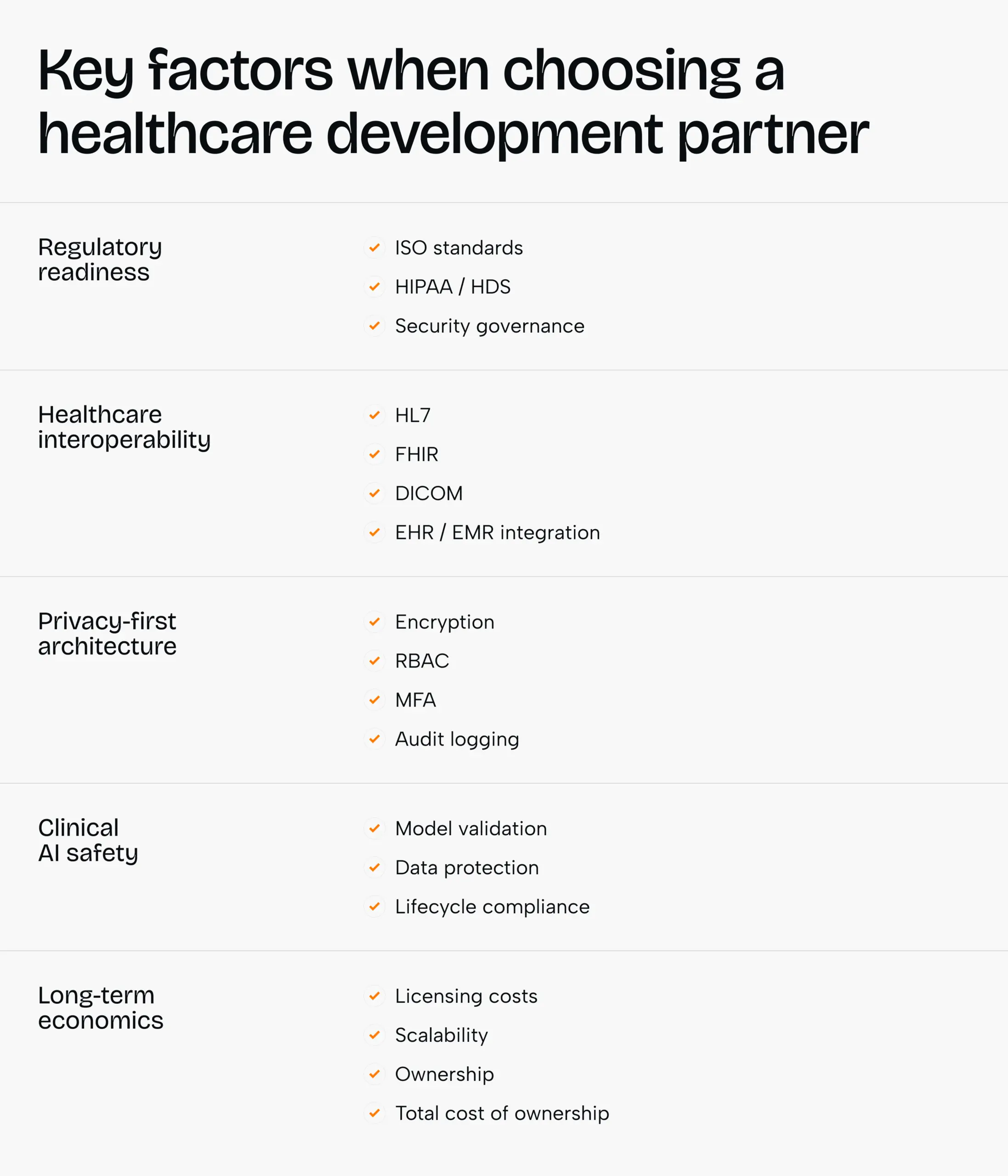
- Regulatory readiness. Ask for ISO certificates and a documented HIPAA posture, plus HDS if you also serve patients in France. Then ask who owns security governance after launch.
- Healthcare interoperability. Look for live HL7 or FHIR integrations in a named case, plus DICOM when imaging touches the product.
- Privacy-first architecture. AES-256 at rest and TLS 1.3 in transit form the floor, with role-based access and MFA backed by audit logging.
- Clinical AI safety. Every AI feature needs model validation and data protection. If the feature influences care, its lifecycle should map to IEC 62304.
- Long-term economics. Compare licensing costs against code ownership, because five-year total cost of ownership decides more budgets than the build quote.
Read every certificate closely before you shortlist. ISO 27001 covers information security, while ISO 13485 matters only if your product may qualify as SaMD under FDA rules.
Operators who switched vendors often ask us the same thing. Why did the last agency need a month to learn what a FHIR resource is? Because it learned on the client’s budget. A partner with prior healthcare builds arrives with integration patterns already tested in production.
At Phenomenon Studio, HIPAA certification means our designers and engineers start a healthcare engagement without a compliance primer. Our custom healthcare software development practice applies the five factors above from the first discovery call. Retrofitting them after launch costs more than building them in.
Five factors narrow a long list quickly. Applying them to real firms with real price tags is the harder part.
Best website development company in the USA for healthcare: the 2026 shortlist
No single firm fits every healthcare buyer, because fit depends on regulatory class and your in-house engineering depth. We limited this shortlist to companies headquartered or registered in the USA. Data comes from Clutch listings and published agency pricing, compiled in October 2026. Clutch reviews come from verified client interviews, which makes them harder to inflate than general star ratings.
According to Clutch, Arkenea holds a 4.9 out of 5 rating from verified client reviews. (Clutch, 2026)
- Phenomenon Studio: healthcare product design and development under one roof Founded in 2019 and registered in Dover, Delaware, Phenomenon Studio counts healthcare among its four primary industries. Its 70+ mid-to-senior in-house experts handle design and engineering as one team, which removes the handoff layer where healthcare redesigns lose quality. UX strategists work in North American hours, while senior design and engineering teams sit in Europe. The studio is HIPAA certified, holds a 5.0 Clutch rating across 50+ reviews, and its clients have raised $500M+. Our website development agency services carry marketing sites and patient-facing products from audit to production code. For FDA Class II or III device software, an ISO 13485-certified vendor such as ScienceSoft is the safer pick. Best for: operators and funded health startups that want one partner for UX and code.
- ScienceSoft: regulated device software and EHR optimization ScienceSoft was founded in 1989 in McKinney, Texas, and brings 20+ years of healthcare work. Its 750+ specialists include in-house clinical consultants, which shortens discovery for hospital clients. The firm holds ISO 13485 and ISO 27001, plus ISO 27701 for privacy management. Its portfolio spans FDA Class II and III device software. It also covers HIPAA-compliant health information exchange portals and remote patient monitoring. Low-code builds start at $20,000 and custom enterprise web development at $50,000, with rates of $50 to $99 per hour. Best for: providers and device makers that need an accredited quality system.
- Itransition: integration-heavy enterprise platforms Itransition has operated since 1998 and lists its US headquarters in Denver, Colorado. Its 3,000+ professionals work under IEC 62304 lifecycle classes and ISO 27001 security management. The team’s specialty is data bridges between clinical systems and administrative databases, with patient-facing interfaces on top. Pricing comes as an enterprise quote, so expect a longer procurement cycle. Best for: large providers connecting or replacing legacy EHR and EMR systems.
- BairesDev: nearshore engineering scale for US time zones San Francisco-based BairesDev, founded in 2009, runs 4,000+ engineers across Latin America on North American working hours. It is certified under IRAM-ISO 27001:2022 and supports HIPAA execution frameworks. Healthcare work centers on custom web applications and EHR integration modules, with cloud infrastructure management alongside. Engagements typically run $50,000 to $250,000. Best for: health tech companies with internal technical leadership that need engineers fast.
- Arkenea: a healthcare-only boutique Arkenea, based in North Carolina, has built only healthcare software since 2011. It won the GHP Global Excellence Award for Best Custom Healthcare Software Development Company (2024 to 2026). Its ORLink surgical workflow platform secured $1M+ in venture funding. NPHub, a clinical marketplace, reached $1.6M in revenue within 18 months. Published ranges run $40,000 to $90,000 for focused apps and $100,000 to $250,000 for mid-sized platforms. Regulated enterprise systems start at $300,000. Best for: health startups and pharma brands that want zero domain onboarding.
- 7T: discovery-first AI workflows for mid-market providers Dallas-based 7T has worked for 13+ years under a “Business First, Technology Follows” method. The team maps clinical workflows and billing operations before it writes code, then checks compliance obligations. Its builds include clinical AI platforms and practice management tools on HIPAA-compliant cloud architectures. Fees are quoted per integration scope. Best for: regional networks and outpatient groups automating workflows.
Ecommerce website development company in the USA: when a health brand sells online
Online pharmacies and telehealth subscriptions blur the line between a store and a medical record. Once an intake questionnaire sits inside the checkout, the cart handles PHI and needs HIPAA safeguards, not just PCI compliance. Arkenea’s enterprise apps for pharma brands such as Novo Nordisk cover the clinical side. For conversion-focused design, pick a studio that runs UX and engineering together, because checkout friction and compliance friction share the same screens.
Top website development company in the USA for regulated enterprise builds
Device-connected software changes the shortlist entirely. A web portal that displays diagnostic output or controls a device may count as SaMD. Then the vendor needs ISO 13485 plus IEC 62304 experience. ScienceSoft is the strongest US-headquartered fit, given its FDA Class II and III history.
According to Black Book Research, ScienceSoft ranks No. 1 for EHR Optimization and Workflow Redesign among healthcare IT consultancies. (Black Book Research)
Itransition brings a larger engineering bench for multi-year integration programs. Expect 12 to 24 months and $300,000 or more for this class of work. Location still matters, though, and it matters differently than most buyers assume.
Website design and development company in the USA: onshore, nearshore or hybrid?
For most US healthcare operators, a hybrid model is the right first bet: US-facing product leadership with senior engineering in Europe. Pure onshore teams rarely add compliance depth that justifies their premium. Pure offshore teams strugg
| Delivery model | Example firms | Typical rate | Overlap with US hours | Compliance fit |
| US onshore boutique | 7T, Arkenea | Custom quote or $40,000+ per project | Full | HIPAA, US clinical workflows |
| US-headquartered enterprise | ScienceSoft, Itransition | $50 to $99/hr or enterprise quote | Full for account leads | ISO 13485, IEC 62304 |
| US-headquartered nearshore | BairesDev | $50,000 to $250,000 per engagement | Full | ISO 27001:2022, HIPAA frameworks |
| US and Europe hybrid | Phenomenon Studio | Project-based | Strategy calls in US hours | HIPAA certified |
Most website development companies quote on hourly rates, yet the rate is the weakest predictor of what a healthcare project costs. A $40-per-hour team that misreads an EHR interface outspends a $90-per-hour team that has built one twice.
The hybrid model has real limits, too. It works best when the roadmap runs past six months and the product is not regulated device software. For SaMD, the ISO 13485 credential outranks every time zone argument.
US buyers who want a contracting entity close to home can review our IT services and website development in Delaware. Contracts there sit under US law.
Location fixes calendars, yet it does nothing for how a frightened patient experiences the first screen of your product.
What a medical website design agency changes for patients and clinicians
A specialist medical design team works for stressed or unwell users first, many of them older, and for brand impressions second. A patient booking a cardiology visit is often on a phone, under time pressure.
Generic sites fail that visitor in predictable ways, burying the primary action under crowded screens. The fix starts with WCAG 2.2 at level AA, published by the W3C in 2023, and goes further than the checklist.
In our healthcare projects, accessibility settings sit one tap away rather than three menus deep. The result is a product that older users can operate without help, which is the outcome families and providers care about most.
Calm, muted palettes work for aging-in-place and mental health products, where the goal is lowering anxiety. For urgent care booking, a visible phone number and a short form matter more than mood.
The same principles apply to healthcare app development, where the interface competes with a real emergency for the user’s attention. One recent project shows how far those decisions carry.
Healthcare website design agency case study: Wisdom
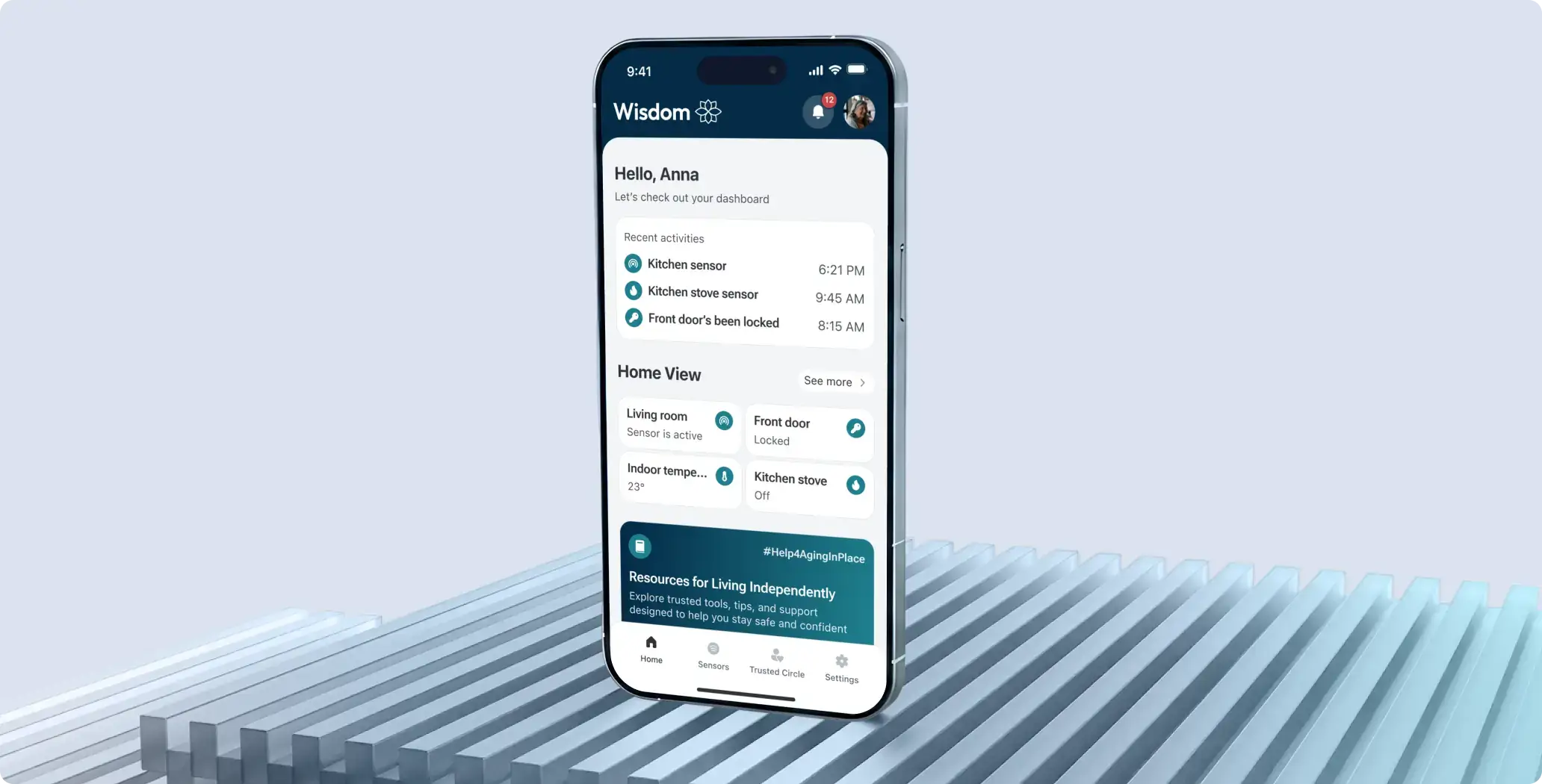
Wisdom is a US platform that helps older adults live safely at home while staying connected to family. Sensors and cameras detect a fall or long inactivity and alert a trusted circle. Wisdom is a mobile product rather than a website, but its design problems match any patient-facing health web app.
Before drawing a screen, our team compared Wisdom with four popular monitoring tools, including Ring and AlfredCamera. The finding reshaped the brief: most of those products protect property, not people. That single insight moved the design away from surveillance and toward support. In usability testing, older adults and family caregivers then completed every key task without confusion.
Picture a daughter receiving a fall alert at 2 a.m. and opening the app with unsteady hands. The screen she sees should offer one clear action in readable text, with nothing competing for her attention.
Task
The client asked us to redesign the mobile part of its existing care platform without changing how the system works underneath. Screens were crowded, which made fast action hard in stressful moments. Small buttons and low contrast shut out users with vision or motor impairments. The dated interface also failed to reflect the warmth of the service.
Solution
- Competitor research and usability testing with older adults and caregivers, framing a two-sprint redesign.
- Less visual noise around key actions, plus one-step accessibility modes such as larger text and high contrast.
- Cross-platform front-end development in Flutter, built alongside the client’s original team on Java and Spring Boot services hosted on AWS.
The build carried one honest complication: some back-end workflows were still pending when front-end work started. That meant iterative redeployments, which close collaboration with the original developers kept on track.
Result
- $1.3M raised in pre-seed funding once a working product demo was in place.
- Strategic partnership with Samsung, which adapted its smartwatch firmware so the watch runs Wisdom in single-app mode as an extra sensor.
- Red Dot 2026 winner in app design and a separate UX Design Award 2026 nomination.
- Usability test participants completed all three key tasks without confusion, from adjusting readability to deactivating a bedroom sensor.
“Phenomenon Studio has really talented designers and QA engineers. We’ve received positive feedback from our customers regarding Phenomenon Studio’s work on our mobile app’s usability and design.” Dawn Newsome, Co-Founder, Wisdom (verified Clutch review)
The full Wisdom aging-in-place platform case study covers each design stage. Awards validate the interface, but budgets decide whether a healthcare product reaches users at all.
How much does medical website development cost in 2026?
Medical website development costs $40,000 to $90,000 for a focused patient portal and $300,000 to $500,000+ for a regulated enterprise system. The ranges below reflect published pricing from Arkenea and ScienceSoft plus market benchmarks we compiled in October 2026.
| Product profile | Typical scope | Duration | Cost range |
| Patient portal or focused web app | Secure portal, scheduling, basic EHR intake, messaging | 3 to 5 months | $40,000 to $90,000 |
| Telemedicine and RPM platform | WebRTC video, wearable data intake, e-prescriptions, billing | 4 to 8 months | $60,000 to $120,000 |
| Mid-sized healthcare or pharmacy platform | Workflow engine, multi-role access, HL7/FHIR APIs, analytics | 6 to 10 months | $100,000 to $250,000 |
| Regulated enterprise system or SaMD portal | FDA Class II/III software, AI diagnostics, IEC 62304, EHR sync | 12 to 24 months | $300,000 to $500,000+ |
| Annual maintenance | Security patches, regulatory updates, support | Ongoing | 15% to 20% of build cost per year |
A healthcare marketing website that never stores PHI sits outside these ranges. That build, or a discovery and redesign phase for an existing portal, typically takes 1 to 2 months.
A patient portal team usually counts 5 to 7 specialists. A project manager and a business analyst own scope, while a designer works with two or three engineers and a QA lead.
The bigger decision is build versus license. SaaS removes development time, but per-seat fees compound as the clinical workforce grows.
| Deployment model | Upfront cost | Annual cost | Five-year total |
| SaaS platform, 60 seats | $0 | $180,000 ($250 per seat per month) | $900,000 |
| Custom web platform | $220,000 | $39,600 (18% maintenance) | $418,000 |
| Difference | $482,000 in favor of custom |
Custom development does not always win, though. A 10-seat clinic paying the same $250 per seat spends $150,000 over five years, far below the custom figure. The math flips as seat counts grow and as the platform becomes a core asset you want to own.
Health systems with several brands often fold this decision into an enterprise website development program, where one design system serves every property. Price the five-year number, not the first quote.
Medical web development mistakes that cost healthcare teams a year
Most medical web development delays trace back to a handful of decisions made before the first sprint. We see the same six patterns across healthcare audits, and each one has a known fix.
- Finding out the portal is SaMD after launch. A portal that displays diagnostic output may fall under FDA rules for software as a medical device. At that point the vendor needs an ISO 13485 quality system and an IEC 62304 lifecycle record. Rebuilding that record after release means repeating design and test work.
- Treating HIPAA as a hosting checkbox. PHI leaks through contact forms and third-party scripts far more often than through servers. Map every field that collects health details and confirm that each vendor receiving it signs a business associate agreement.
- Licensing per seat for a growing workforce. At $250 per user per month, 60 seats cost $180,000 a year, so run the five-year comparison before signing.
- Skipping clinical workflow discovery. A scheduling screen designed without a nurse in the room usually gets rebuilt after the pilot.
- Shipping AI without a validation trail. Clinical AI needs pseudonymized data and logged inferences. When outputs influence care, its lifecycle should also map to IEC 62304. Retrofitting that trail after launch costs more than the model itself.
- Budgeting zero for maintenance. Plan 15% to 20% of the build cost every year for security patches and regulatory updates.
Teams planning mobile and web app development for healthcare can run the same six checks against any vendor proposal.
Healthcare website design: what to check before you sign
Good healthcare website design passes a compliance review and a usability test in the same month.
What should a healthcare web designer show you in the pitch?
A strong designer for healthcare should show one case with a moved metric and the regulatory frame named. Start with the website development company website itself and count the healthcare cases that include numbers. Then ask to meet the agency developers who will receive the design files, because a polished mockup means little if engineering rebuilds it from guesswork. Cross-check headcount claims in Dun & Bradstreet Hoovers and review depth on Clutch. A healthcare website development company that cannot name its EHR integrations has not built one.
Healthcare website design services: what a package should include
| Package | What it covers | Typical timeline | Approximate team |
| Discovery sprint and UX audit | Research, compliance mapping, scope and estimate | 2 to 4 weeks | 3 to 4 specialists |
| Healthcare marketing website | Design system, CMS, accessible forms without PHI | 1 to 2 months | 4 to 5 specialists |
| Patient portal | Scheduling, messaging, EHR intake | 3 to 5 months; $40,000 to $90,000 | 5 to 7 specialists |
| Regulated platform | HL7/FHIR integration, RBAC, audit logging, AI validation | 6 to 24 months; $100,000 to $500,000+ | 8+ specialists |
A discovery sprint is the lowest-risk test of a partner. Full-cycle partnerships deliver the best results when the client has a defined product owner and budget for at least that phase. Our full-cycle web design and development team scopes every healthcare package after discovery, so the estimate reflects your integrations rather than a template.
Most healthcare teams reach us with a live product and one stubborn problem, such as a portal patients abandon. A discovery sprint turns that problem into a scoped plan with a timeline and a five-year cost. Send us the current site and the brief, if there is one, and we will come back with an honest read on fit.
Share this article with friends



Oct 31, 2026
9 min read
Explore the best WordPress website development agency alternatives for enterprises in 2026. Compare platforms, costs, timelines, and expert partners.


Oct 31, 2026
9 min read
See how our UI UX design agency repositioned Merchant Tech, an e-commerce operations platform, with workflow proof, pricing clarity and early trust signals.
