



Oct 18, 2026
7 min read
summary
Compare the top UI/UX design services companies in the USA for 2026 by Clutch rating and price, plus a framework for choosing the right UX partner.
Direct answer: Top US UI/UX design companies in 2026 bill $100 to $199 per hour and take projects from $15,000 to $100,000+.
Key Takeaways
- Most leading US agencies on Clutch bill $150 to $199 per hour. Goji Labs sits lower at $100 to $149, and Work & Co runs up to $350+.
- Entry points differ by a factor of six: Ramotion starts near $15,000, while Work & Co rarely signs a contract below $100,000.
- At Phenomenon Studio, a discovery sprint with a UX audit runs 2 to 4 weeks, which makes it the lowest-risk way to test a partner before a full build.
By Oleksandr Kostuchienko | marketing manager , october 2026
| Company | Headquarters | Clutch rating | Hourly rate | Minimum project | Best for |
| Phenomenon Studio | Dover, USA + Europe | 5.0 (50+ reviews) | Project-based | $5,000+ | Full-cycle design and development, healthcare, fintech |
| Work & Co | Brooklyn, NY | 9.4 / 10 score | $150 to $350+ | $100,000+ | Enterprise e-commerce and consumer tech |
| Momentum Design Lab | Palo Alto, CA | 4.8 to 4.9 | $150 to $199 | $25,000+ | Enterprise SaaS and AI data interfaces |
| Neuron | San Francisco, CA | 5.0 | $150 to $199 | $25,000+ | Workflow-heavy B2B and financial tools |
| Goji Labs | Los Angeles, CA | 5.0 | $100 to $149 | $25,000+ | Startups, EdTech, and nonprofits |
| Think Company | Conshohocken, PA | 4.7 to 4.9 | $150 to $199 | $50,000+ | Regulated enterprise platforms and accessibility |
| Ramotion | San Francisco, CA | 4.8 to 4.9 | $150 to $199 | $15,000+ | Brand identity plus UI for SaaS |
| Guidea | Austin, TX | 5.0 | $150 to $199 | $50,000+ | MedTech, SaMD, and clinical workflows |
| IDEO | San Francisco, CA | Not listed | Custom | $100,000+ | Innovation strategy and category creation |
| UX Studio | Budapest (US clients) | 5.0 | $50 to $100 | Project-based | Research-led B2B SaaS squads |
The sections below cover each company in detail, starting with what an outside team actually changes for the business.
Most buyers choose the wrong partner for a sensible reason: they compare portfolios, and every portfolio looks good. The best UX design agency for an operating company is rarely the one with the loudest Dribbble shots. It is the team whose research depth and engineering handoff match the product you already run. This guide ranks the firms we see most often on US shortlists, from global consultancies to boutique UX consulting firms. It also shows how to judge a UX design agency on evidence, and what UX services cost in 2026.
Agency UX vs in-house design: what an outside team changes
An outside team earns its fee when the problem crosses disciplines your staff does not cover. In-house designers know the product better than anyone. They rarely have the capacity to run a research round and rebuild the design system in the same quarter.
Good agency UX work sits between strategy and code. A senior team starts by auditing what exists and interviewing the people who use it. Those findings shape the information architecture. Only then do wireframes and interfaces appear, which keeps visual decisions tied to observed behavior instead of internal opinion.
Across the hundreds of products Phenomenon Studio has delivered, one pattern holds. Clients rarely need more screens from an agency. They need fewer wrong decisions before engineering starts. Our UI/UX design services keep design and development inside one team for that reason. A component approved in Figma then ships the way it was approved.
The question we hear most from Heads of Product sounds simple: why did the last agency’s work fall apart in production? The answer is usually a handoff problem, not a talent problem. Static files arrive without a component library, and the engineering team rebuilds every state from guesswork.
An agency is not always the right call. If your product has one core flow and a stable roadmap, a strong in-house designer plus a short audit often beats a six-month contract. Agencies pay off when the roadmap runs past six months or when compliance raises the stakes of every screen.
The scope of agency UX work also extends past the app itself. Most engagements touch the product and the marketing surface around it, and the two rarely share a design owner in-house. A UX design web layer that matches the product keeps trial users from feeling they switched companies between the pricing page and the dashboard. We see that mismatch in roughly every second audit we run for operating companies, and it is one of the cheapest problems to fix.
| Factor | In-house design team | UX design agency | Freelance UX consultants |
| Time to start | 2 to 4 months of hiring | 1 to 3 weeks after scoping | Days |
| Research capacity | Limited by headcount | Dedicated researchers on the engagement | One person, one method |
| Cost profile | Salaries plus tooling, fixed | Project fee or retainer, variable | Hourly, lowest entry cost |
| Engineering handoff | Strong if co-located | Strong only with front-end engineers on the team | Usually files only |
| Best for | Mature products with steady iteration | Redesigns, new products, regulated launches | Narrow audits and second opinions |
As the table shows, agencies win on speed and research depth, while in-house teams win on continuity. The two models work best together.
What makes the best UX company for an operating business?
The best UX company for an established business proves three things before you sign. It shows research that changed a decision, not research that merely happened. It names the engineers who will receive the design files. It can explain your compliance constraints back to you during the first working call.
Phenomenon Studio holds a 5.0 rating on Clutch across 50+ verified reviews. The reviews that carry the most weight mention delivery and stable handoffs rather than aesthetics. Look for the same pattern in any shortlist. Reviewers who talk about shipped releases are describing a partner, while reviewers who praise mockups are describing a vendor.
Fintech UX: where regulated products raise the bar
Fintech UX carries a cost that consumer apps do not. Every unclear screen becomes a support ticket, and some become compliance questions. Trust signals and transaction confirmations do more work here than any visual style.
On KlickEx, a cross-jurisdiction remittance product, our fintech UX design work lifted “Add Money” conversion by 35% and money transfer completion by 30%. Those numbers came from flow changes, not a new palette. Ask any agency for a comparable figure from a regulated product, with the regulatory frame named. If the answer is a screenshot instead of a metric, keep looking. For a fintech buyer, the best UX design agency is the one that can show a moved conversion number with the compliance context attached.
Knowing what good work looks like is half the job. The other half is knowing which firms in the US market actually deliver it, and at what price.
Top UX agencies in the USA for 2026: who fits which product
The list below covers the top UX agencies we see on US shortlists in 2026. Ratings and pricing come from Clutch listings and public agency profiles, compiled in October 2026. We grouped firms by the buyer they serve best, because a $100,000 consultancy and a $6,599 subscription solve different problems.
Clutch remains the main independent reference here. Its verified reviews are interview-based, which makes them harder to inflate than star ratings on general review sites.
We used four filters to pick the best UX design companies for this list:
- A Clutch rating of 4.7 or higher, or an equivalent public track record for consultancies that do not list there.
- Published or verifiable pricing, so buyers can budget before the first call.
- A US headquarters or a substantial US client base with overlapping working hours.
- Case studies that name a constraint and a decision, not only final screens.
The result is not a popularity ranking of top UX companies. It is a fit map, and each entry ends with the buyer it serves best. The use-case table after the list matches firms to product types.
- Phenomenon Studio: full-cycle design and development for operating companies
Phenomenon Studio is a product design and development company founded in 2019. It rebuilds and extends products for established businesses in healthcare and fintech, along with SaaS and EdTech. Its 70+ mid-to-senior in-house experts handle design and engineering as one team, which removes the handoff layer where most redesigns lose quality.
UX strategists work from North America, while senior design and development teams sit in Europe. The studio is HIPAA certified and a Webflow Professional Partner. Companies it supported have raised $500M+. For buyers in the Southeast, the team also runs
dedicated UI/UX design services in Georgia for Atlanta-area companies.
Best for: operating companies that want one partner from UX audit to production code.
- Work & Co: enterprise commerce at global scale
Brooklyn-based Work & Co was founded in 2013 and employs between 250 and 999 people. It runs regional hubs in Portland and Atlanta, plus offices in Copenhagen and São Paulo. Clients include Apple and IKEA among many global consumer brands.
The firm differentiates through senior-led teams and in-house front-end engineering, so design systems reach production without a quality drop. Engagements start at $100,000, with hourly rates from $150 to $350+.
Best for: enterprise e-commerce and consumer platforms with large budgets and long timelines.
- Momentum Design Lab: complex B2B and AI interfaces
Momentum Design Lab operates from Palo Alto with bases in New York and London, and is now part of HTEC Group. It holds a 4.8 to 4.9 rating across nearly 100 verified Clutch reviews.
The studio converts dense business logic into role-based interfaces, which is why Microsoft and Verizon appear in its client list. AI-driven data interfaces are a growing share of its work. Rates run $150 to $199 per hour, with $25,000 minimums.
Best for: enterprise SaaS teams with multi-role workflows and data-heavy dashboards.
- Neuron: research first, pixels second
Neuron, based in San Francisco with teams in Los Angeles and Boston, holds a 5.0 Clutch rating from more than 50 reviews. It is one of the few UX research companies that also carries delivery through to interface design.
Field research and stakeholder interviews come before any visual work. That method suits workflow-heavy B2B products and financial tools, where interaction patterns must match real operations. Rates sit at $150 to $199 per hour, and projects start at $25,000.
Best for: teams restructuring legacy logic or building a unified design system.
- Goji Labs: strategy plus engineering for growth-stage teams
Los Angeles-based Goji Labs has shipped more than 500 digital products and holds a 5.0 rating across 85+ Clutch reviews. Clients often mention disciplined project management and clear communication.
The firm combines product strategy and user testing with cross-platform mobile and web engineering. At $100 to $149 per hour and $25,000 minimums, it is among the more accessible top UX design companies in the US.
Best for: early-stage and nonprofit teams that need design and build together.
- Think Company: regulated enterprise and accessibility
Think Company was founded in 2007 in Conshohocken, Pennsylvania, and employs between 101 and 200 consultants. It works in regulated industries such as healthcare and financial services, for clients such as Johnson & Johnson and Vanguard.
Accessibility consulting and WCAG compliance sit at the core of its enterprise UX design practice, alongside embedded design teams. Minimum projects start at $50,000, and average projects run from $150,000 to over $1,000,000.
Best for: large organizations where accessibility and compliance carry legal weight.
- Ramotion: brand identity built into the interface
Ramotion works from San Francisco and New York City. It joins brand identity with functional UI for SaaS and mid-market companies, and its client list includes Apple and Salesforce.
Its output stands out for visual polish and design systems that carry brand strategy into mobile and web apps. Projects start between $15,000 and $50,000+, at $150 to $199 per hour.
Best for: SaaS companies that need a brand and a product UI from the same hands.
- Guidea: healthcare and clinical UX
Austin-based Guidea is a woman-owned UX design consulting firm working only in healthcare and MedTech. Software as a Medical Device is a core specialty. It also serves specialized EdTech platforms. It holds a 5.0 rating across 43 verified Clutch reviews.
Senior-led clinical workflow mapping and validated prototyping are its core services. Given compliance demands, minimums start at $50,000, with rates of $150 to $199 per hour.
Best for: SaMD and clinical research products where usability is a regulatory question.
- IDEO and Frog: innovation consultancies
IDEO, headquartered in San Francisco, pioneered design thinking for commercial products and served clients such as Ford and the Gates Foundation. It excels at early product strategy and category creation rather than rapid UI production. Strategy retainers typically start at $100,000 to $200,000+.
Frog, part of Capgemini, focuses on legacy modernization and service design for Fortune 500 companies, on custom enterprise budgets. Best for: organizations defining a new category or redesigning how departments work.
- UX Studio: embedded research squads
UX Studio is headquartered in Budapest and serves a large US client base. It holds a 5.0 Clutch rating across 40+ reviews and bills $50 to $100 per hour. The firm places research and design squads inside client sprints, so findings land in the backlog the same week.
Best for: B2B SaaS teams that already run agile delivery.
- Dreamten and Wavespace: fast execution at lower cost
Dreamten, based in Raleigh, North Carolina, holds a 5.0 rating across nearly 50 reviews. It focuses on interface design and design systems from $25,000. Wavespace works from Sheridan, Wyoming, with a global team. It covers SaaS dashboards and Webflow builds at $25 to $49 per hour, with $10,000 minimums.
Best for: startups that need speed more than research depth.
Best UX design agency by use case
| Use case | Best fit | Why it fits |
| Fintech or regulated product redesign | Phenomenon Studio, Think Company | Compliance fluency plus engineering on the same team |
| Enterprise e-commerce at scale | Work & Co | Senior-led teams with in-house front-end engineering |
| Brand and product launched together | Ramotion | One visual system from marketing site to app |
| Complex B2B workflows and AI dashboards | Momentum Design Lab, Neuron | Role-based UX and research before pixels |
| Healthcare, MedTech, and SaMD | Guidea, Phenomenon Studio | Clinical workflows and HIPAA-ready delivery |
| Ongoing SaaS design capacity | UX Studio | Subscription or embedded squads at lower hourly rates |
No single firm is the best UX design agency for every buyer. A firm that leads enterprise commerce can be the wrong choice for a 20-person healthtech company, and the reverse is just as true.
These firms make our list of the best UX agencies because their reviews describe outcomes, not just deliverables. Even so, the top UX design firms on any list differ sharply in how they work on your product. Two top UX design agencies with identical ratings can run opposite processes, one research-heavy and one execution-first. Among the top UX design companies we compared, that process difference mattered more to final results than headcount or awards. Buyers comparing the best UX agencies should weigh it first.
Even a list of top UX agencies only narrows the field to five or six names. The cheapest way to learn which of them can handle your product is to pay one of them for an audit.
UX audit: test the partner before the full contract
A UX audit is the lowest-risk first engagement with any agency. At Phenomenon Studio, a discovery sprint with a full audit runs 2 to 4 weeks. You see how a team thinks and what it measures before committing six figures to a full build.
Good UX audit services combine three inputs. Analytics show where users drop off in the conversion funnel. Heuristic review explains why a flow confuses people. Short interviews confirm which problems users actually feel.
What should UX audit services hand you at the end? A prioritized list of issues, each with severity and an effort estimate, so your team can schedule fixes without a second consultation. Strong UX audit services also include a re-test plan, which turns the audit from a report into a baseline. Expect these deliverables from any firm on the shortlist:
- An issue log ranked by business impact, not by how easy each fix is.
- Funnel and heatmap analysis showing where the drop-off rate spikes.
- Annotated screens with recommended changes for the top ten problems.
- A measurement plan with the metrics to compare after release.
According to Nielsen Norman Group, testing with just five users uncovers about 85% of a design’s usability problems. (Jakob Nielsen, Nielsen Norman Group, 2000)
Small samples are enough to find the big problems. That makes an audit fast, but only if the agency recruits the right five people.
“The best results come from testing no more than 5 users and running as many small tests as you can afford.” Jakob Nielsen, co-founder of Nielsen Norman Group
A UX site audit for a marketing website looks different from a product audit, because the visitor arrives with one question and leaves fast. It checks page speed and scroll depth, then traces how referral traffic moves from the hero to a contact form. A UX site audit also reviews accessibility contrast and mobile tap targets, since most referral visits now start on a phone. For an established brand, the most common finding is that the site undersells the company. That was exactly the problem on our Milk & Honey project.
Case study: Milk & Honey

Task. Milk & Honey runs divisions in music and sports, along with a ventures arm. It also operates a music M&A practice with over $300 million in brokered catalog sales. Its WordPress site split that story across separate pages and third-party redirects. Visitors arriving from referrals had to assemble the company’s credibility themselves, and every roster update required a developer.
Solution. Before wireframing, our team built a competitor matrix comparing Roc Nation and WME, along with Interscope and Silent House. The research found strong visuals across the category but vague messaging and no distinct identity per business line. That reframed the brief from a multi-page rebuild into a single landing page of nine sections, with modals holding secondary content. Each division got its own visual identity, and a progress bar keeps visitors oriented. The site moved to Webflow, with roster and release content in editable collections. Layouts hold from 1280px to 2560px+ across 75% to 150% browser zoom.
Result. The three-division story now reads as one continuous scroll. The internal team adds new signings and releases without engineering support, and updates office details the same way. Read the full Milk & Honey website redesign case study for the design stages.
“From the presentation aesthetically, to the layout of information to the full optimization, I finally have a site that represents who we are.” Lucas Keller, President, Milk & Honey
Picture a music manager opening a referral link late in the evening to check whether Milk & Honey represents a songwriter she knows. On the old site, that meant several pages and a redirect to a third-party resource. Now the roster sits one scroll away, and the progress bar shows how much of the story is left.
When UX consultants beat a full agency team
Independent UX consultants make sense when the question is narrow. A second opinion on a checkout flow or an accessibility review before launch rarely needs a full team. Consultants cost less per engagement and start within days.
The limit of a solo consultant appears at implementation. A consultant hands you findings, and someone else has to turn them into a design system and working code. When the audit points to structural problems, a team with designers and front-end engineers closes the loop faster.
Smaller UX consulting firms sit between the two options. A UX design consulting firm with five to fifteen people can run research and deliver a design system, but usually stops at handoff. That works when your own engineers are strong and available.
UX design logo and brand work: one partner or three?
Many buyers split UX design and logo work between separate vendors, then hire a third for brand guidelines. The split looks cheaper on paper than one contract. In practice, the product team inherits a logo that breaks at 16 pixels and a color system that fails contrast checks.
Treating the UX design logo and brand work as one engagement keeps the brand usable inside the interface, from favicon to empty states.Ramotion built their positioning on this convergence, and our branding practice follows the same logic. The condition: one partner works best when the brand and product launch together. For a mature brand with strict guidelines, a product-only partner is usually the better fit.
An audit tells you how a team thinks about your product. Their portfolio tells you whether they have solved a problem like yours before.
UX design portfolios: how to evaluate a UI/UX design partner
Most UX design portfolios are built to sell, not to inform. They show the final screen and hide the decisions. Reading them well means asking what changed between the first wireframe and launch, and what evidence drove the change.
We recommend scoring every shortlisted firm on four dimensions. The framework below works for a $15,000 website project and a $500,000 platform rebuild alike.
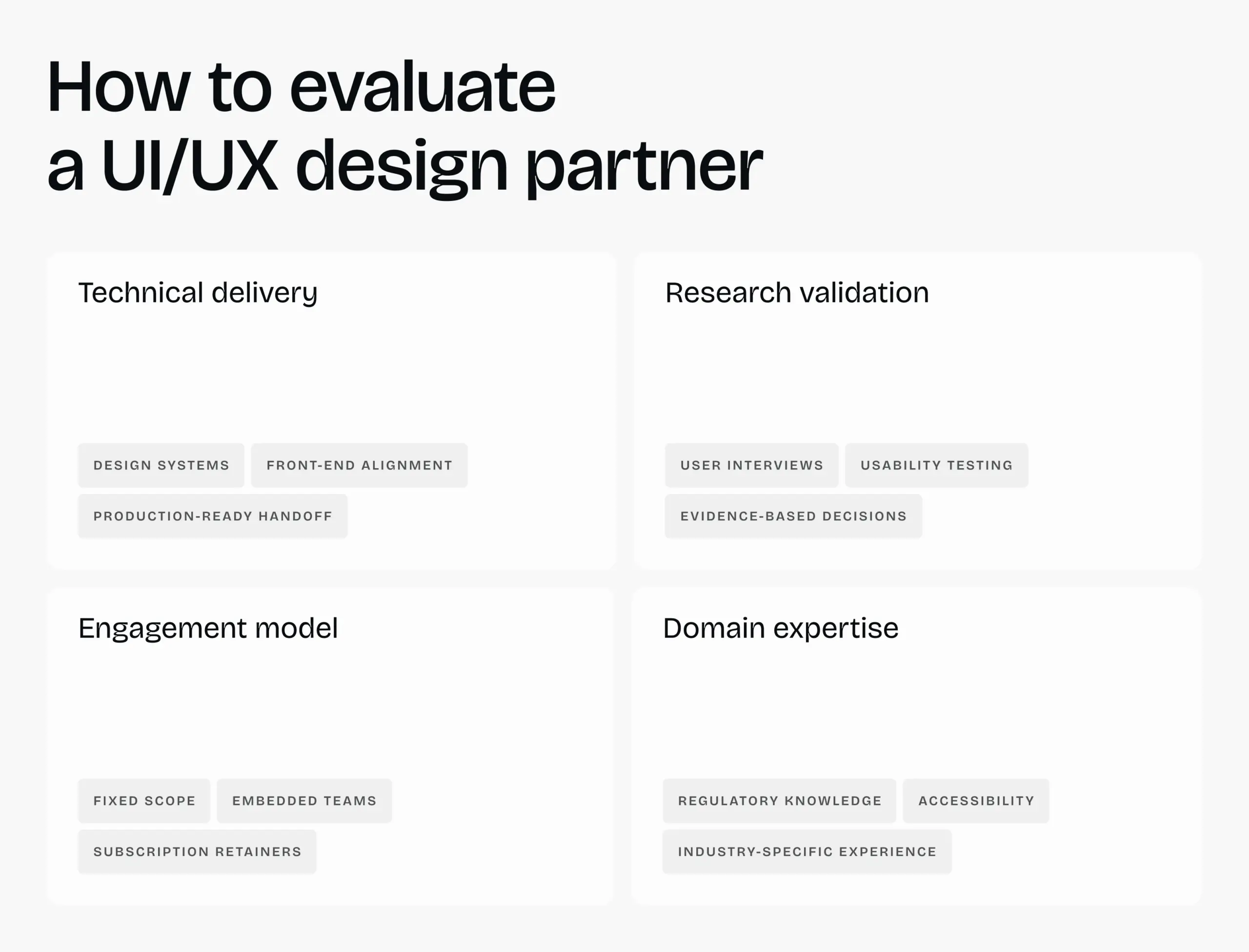
Technical delivery. The most common failure in a redesign is the gap between design concept and front-end build. Ask whether the agency delivers static files or a production-ready design system with tokens and component states. Firms with front-end engineers on the engagement, such as Goji Labs, carry that risk themselves. Most top UX design firms now include a front-end lead by default. Our web design services follow the same rule, with QA running alongside development rather than after it.
Research validation. Many agencies claim user-centered design and then rely on internal taste. Ask for a case study that shows how an interview or usability test changed a specific screen. Think Company and Guidea document this well, with task-completion data attached. Pure UX research companies often produce strong findings and then hand them to a different team to design, which reintroduces the handoff gap.
Engagement model. Fixed scope suits a defined build such as a portal redesign. Embedded teams suit ongoing iteration next to your engineers. Subscriptions suit a steady SaaS backlog with predictable monthly spend.
Domain expertise. In healthcare and finance, domain context outweighs design awards. A partner already fluent in HIPAA or WCAG 2.1 AA avoids late-stage structural rework. That fluency also shortens onboarding by weeks.
Strong UX design portfolios answer all four questions without a sales call. Weak ones answer none, however polished the visuals look.
What a UX product designer should show you in the pitch
Ask to meet the UX product designer who will actually work on your account. Then ask them to walk through one past project in ten minutes. Strong designers lead with the constraint and the decision, then show the screen.
Watch for three signals during that walkthrough. They name the metric the work moved. They explain one idea they killed and why. They describe how engineers used the files. A UX product designer who can only talk about visual style will produce exactly that, and your team will rebuild the logic later.
Picture a pitch where your CTO asks the lead designer which component they would cut first if the budget dropped by a third. A strong designer answers in one sentence and names the trade-off. A weak one restates the proposal. Answers like that are what UX design portfolios cannot show on their own.
Evaluation tells you who can do the work. Pricing tells you which model your budget actually supports.
UX services and pricing: what US agencies charge in 2026
UX services in the US fall into clear price bands, and the band depends more on engagement model than on agency size. Whether you hire a boutique UX design agency or a global consultancy, the model sets most of the bill. Most Clutch-listed firms in this guide bill $150 to $199 per hour. Lower rates usually mean offshore delivery or a subscription structure. Neither is a warning sign by itself. The test is whether senior people do the work and whether the output is production-ready.
| Engagement | Typical price | Typical timeline | Approximate team | Best for |
| Discovery sprint and UX audit | Scoped per product | 2 to 4 weeks | 2 to 3 specialists (researcher, designer, strategist) | Testing a partner, validating a redesign |
| Website design and build | $30,000 to $80,000 | 4 to 12 weeks | 3 to 5 specialists | Marketing sites and brand relaunches |
| Product design (wireframes to prototype) | $25,000 to $200,000+ | 6 to 16 weeks | 4 to 6 specialists | New products and major redesigns |
| Design system | Scoped per product | 4 to 10 weeks | 2 to 4 specialists | Multi-team products with long roadmaps |
| Design subscription | From $6,599 per month | Ongoing | 1 dedicated designer | Steady SaaS backlogs |
| Enterprise consultancy | $100,000 to $1,000,000+ | 3 to 12 months | 8+ specialists | Fortune 500 platforms and modernization |
Timelines and website price bands in the table reflect Phenomenon Studio’s published ranges. Other figures come from the Clutch listings cited above. Team sizes are approximate and vary with scope.
For a UX design website project, the biggest cost driver is custom design versus templates. At Phenomenon Studio, basic marketing sites of 5 to 10 pages run $30,000 to $50,000. Mid-complexity sites of 20 to 30 pages run $50,000 to $80,000. Complex platforms with dashboards and integrations start near $80,000. A UX design website rebuild on Webflow often lands in the lower bands, because the client team takes over content updates after launch. Our website design services publish these ranges so buyers can budget before the first call.
A typical UX design web engagement of one to two months uses a small, senior team. The usual setup looks like this:
- A product designer who leads research and flows.
- A UI designer who builds the visual system and components.
- A front-end developer who implements and flags constraints early.
- A project manager who keeps scope and feedback cycles stable.
Hormn, a HIPAA-governed telehealth platform, ran 2 months with Phenomenon Studio. That is a realistic benchmark for a focused build with a clear brief.
After launch, most teams keep a smaller retainer for ongoing UX services. On our web projects, maintenance runs $500 to $2,000 per month, while design retainers with active roadmap work run $2,000 to $10,000 per month. That ongoing UX design web support costs far less than a full redesign every three years. It also keeps the design system from drifting as new features ship.
Rushed timelines always cost more than planned ones. On our web projects, accelerated delivery carries a 20% to 40% premium, and testing still needs at least 2 to 3 weeks. Cutting QA to hit a date is the single most expensive saving a team can make. The bugs simply move to production.
The real question is not what a new UX design website costs. It is what a wrong partner costs, and the next section covers the mistakes we see most often.
Common mistakes when hiring a UX design company
Most failed agency engagements trace back to a handful of avoidable decisions. They happen before the contract is signed, which is why they are so expensive to fix later.
Mistake 1: treating design as decoration. Buyers who brief for a “fresh look” get a fresh look and nothing else. Design tied to business metrics behaves differently on the balance sheet.
According to McKinsey, companies in the top quartile of its Design Index achieved 32 percentage points higher revenue growth than industry peers over five years. (McKinsey & Company, 2018)
That study tracked 300 publicly listed companies. The top performers measured design as rigorously as revenue, which is the habit worth copying.
Mistake 2: ignoring accessibility until launch. Retrofitting WCAG compliance after development costs far more than designing for it. The scale of the problem is large across the web.
According to WebAIM, 95.9% of the top one million home pages had detectable WCAG 2 failures, averaging 56.1 errors per page. (WebAIM Million, 2026)
Mistake 3: skipping the checkout and conversion flow. Teams often redesign the homepage and leave the transaction flow untouched. Baymard Institute estimates that fixing solvable checkout issues could raise conversion rates by 35.26% for large e-commerce sites (Baymard Institute, 2025). That is where a UX design company earns back its fee fastest.
Mistake 4: hiring on rate alone. A $49 hourly rate looks attractive until the files need a full rebuild by your engineers. Compare total cost to a shipped release, not cost per hour.
Mistake 5: choosing a generalist for a regulated product. A strong portfolio in consumer apps does not transfer automatically to payments or patient data. Fintech UX design depends on knowing which disclosures are mandatory and where friction protects the user. Enterprise UX design adds role permissions and audit trails that a consumer team has rarely designed. Ask every shortlisted UX design company for one regulated project with the constraint named.
Mistake 6: accepting a proposal with no named team. If the proposal lists roles instead of people, the senior designers from the pitch may never touch your project. Ask for names and check them on LinkedIn.
Phenomenon Studio avoids the last mistake by design: clients work directly with the creative team, with no layer of account managers in between. You can compare the full list of product design and development services to see which engagement fits your stage.
Full-cycle partnerships deliver the best results when the client has a defined product vision and budget for at least a discovery phase. Skipping discovery to jump straight into visual design reliably produces another redesign within a year.
Choosing the best UX design agency for your product starts with one honest look at what you already run. Send us the live site and product screens, plus the brief if there is one. Our team will come back with a read on what to fix first, and whether we are the right studio for it.
Bibliography
- Baymard Institute (2025). Cart abandonment rate statistics. https://baymard.com/lists/cart-abandonment-rate
- Clutch (2026). UX/UI design agency listings and company profiles, accessed October 2026. https://clutch.co/
- McKinsey & Company (2018). The business value of design. https://www.mckinsey.com/capabilities/mckinsey-design/our-insights/the-business-value-of-design
- Nielsen, J. (2000). Why you only need to test with 5 users. Nielsen Norman Group. https://www.nngroup.com/articles/why-you-only-need-to-test-with-5-users/
- WebAIM (2026). The WebAIM Million: an annual accessibility analysis of the top 1,000,000 home pages. https://webaim.org/projects/million/
- Phenomenon Studio (2026). Milk & Honey: turning a scattered multi-page site into one story. https://phenomenonstudio.com/projects/milk-honey-turning-a-scattered-multi-page-site-into-one-story-a-visitor-can-follow-start-to-finish
- Phenomenon Studio (2026). UI/UX design services, website design services, and web design services pages. https://phenomenonstudio.com/services/
Share this article with friends


Oct 18, 2026
9 min read
Learn how to design HIPAA-compliant healthcare apps in 2026. Explore UX best practices for patient privacy, secure analytics, accessibility, and usability.


Oct 18, 2026
9 min read
B2B web development that accelerates time-to-market. This b2b web development agency provides b2b web portal development with pre-built frameworks and dedicated design teams.
