



Apr 14, 2026
11 min read
summary
Learn the difference between Proof of Concept (PoC) and Minimum Viable Product (MVP). Discover when to validate technical feasibility and when to launch a working product to test market demand.
Every great building starts with a question: Can we build here?
Before the architect draws a single floor plan, before anyone pours concrete or orders steel, someone tests the ground. They drill down, take samples, and check whether this soil can hold what the architect wants to build.
In software development, that ground test is your proof of concept (PoC). It answers one question: Can this idea be built?
If the answer is yes, you move to the next stage: Does anyone want it?
That’s where the minimum viable product (MVP) comes in – a maquette of the building placed in the landscape. Investors and future homeowners can walk around it, see the proportions, picture the views, and decide whether this is somewhere they’d want to live – or put their money.
Below, we break down the difference between PoC and MVP, when starting with a PoC makes sense, and when you can skip straight to MVP. By the end, you’ll know which path fits your project.
What a proof of concept actually is
Imagine you have an idea for a co-parenting app that helps divorced or separated parents communicate and coordinate custody without conflict.
Secure messaging where nothing can be edited or deleted – important when legal disputes arise. A shared calendar that tracks custody schedules, appointments, and exchanges. Tools for requesting schedule changes without the back-and-forth arguments.
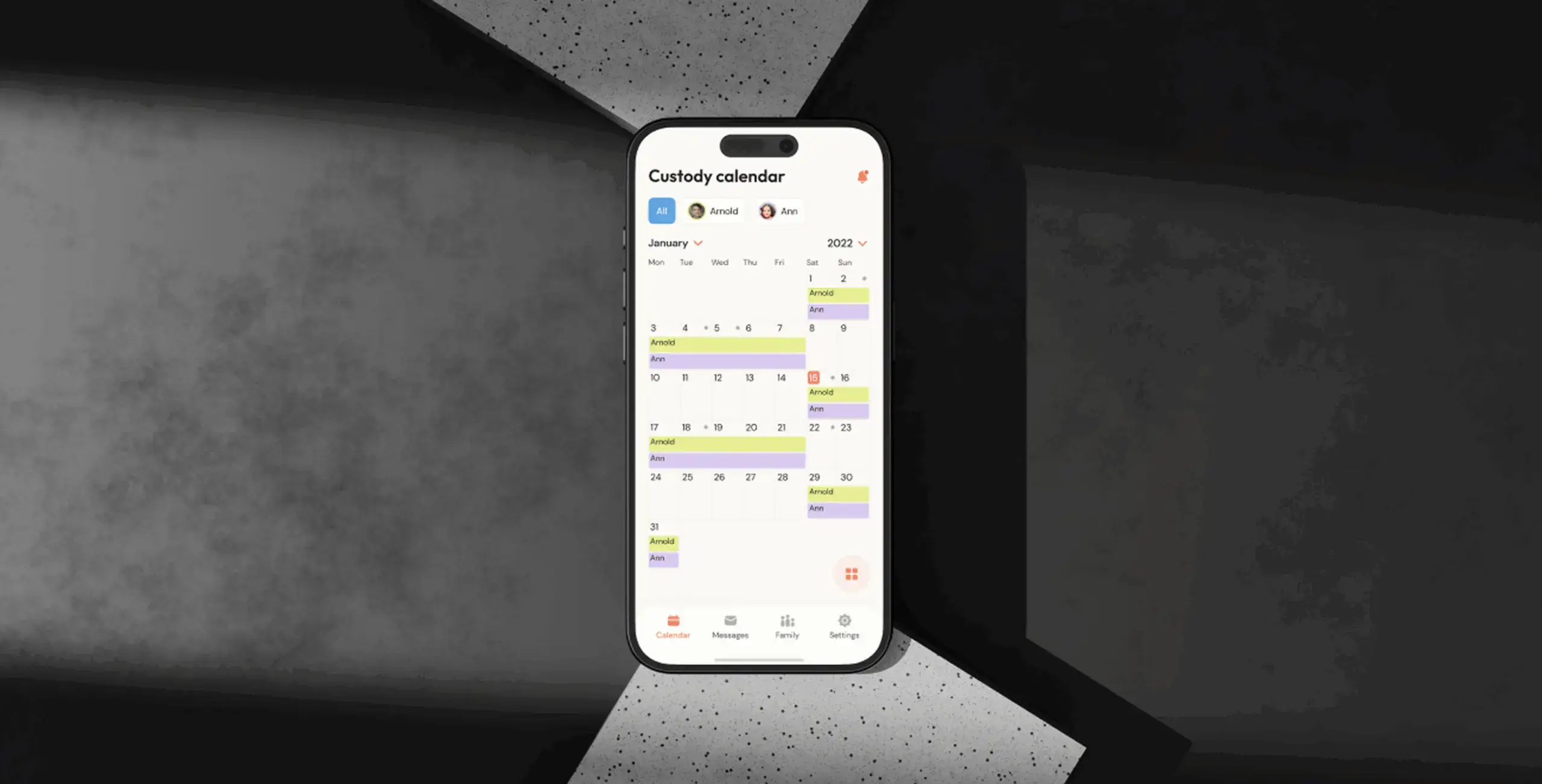
Sounds valuable. Millions of separated parents struggle with exactly this. Family lawyers would recommend it. Courts might even require it.
But here’s the thing:
- Can the messaging system truly guarantee that nothing gets altered, holding up as evidence if needed?
- Can the calendar handle complex custody arrangements with recurring schedules, exceptions, and last-minute swaps?
- Will stressed, non-technical parents actually find it easy to use, or will the app add another source of frustration to an already difficult situation?
You don’t know yet. Nobody does. It’s just an idea.
A proof of concept exists to answer these questions. It takes one core piece of your idea – usually the riskiest, most uncertain part – and builds just enough to prove it can work.
Ruslan Vashchenko, our Head of Design, describes it this way: “A PoC is a living idea that you can poke around, experience, and interact with. It’s something real, something functional – beyond static designs or sketches on paper.”
So for the co-parenting app, your PoC might focus on just the secure messaging piece.
You build a basic version and test:
- Can messages truly be made permanent and unalterable?
- Can users export conversation history in a format that lawyers and courts would accept?
- Does the experience feel trustworthy?
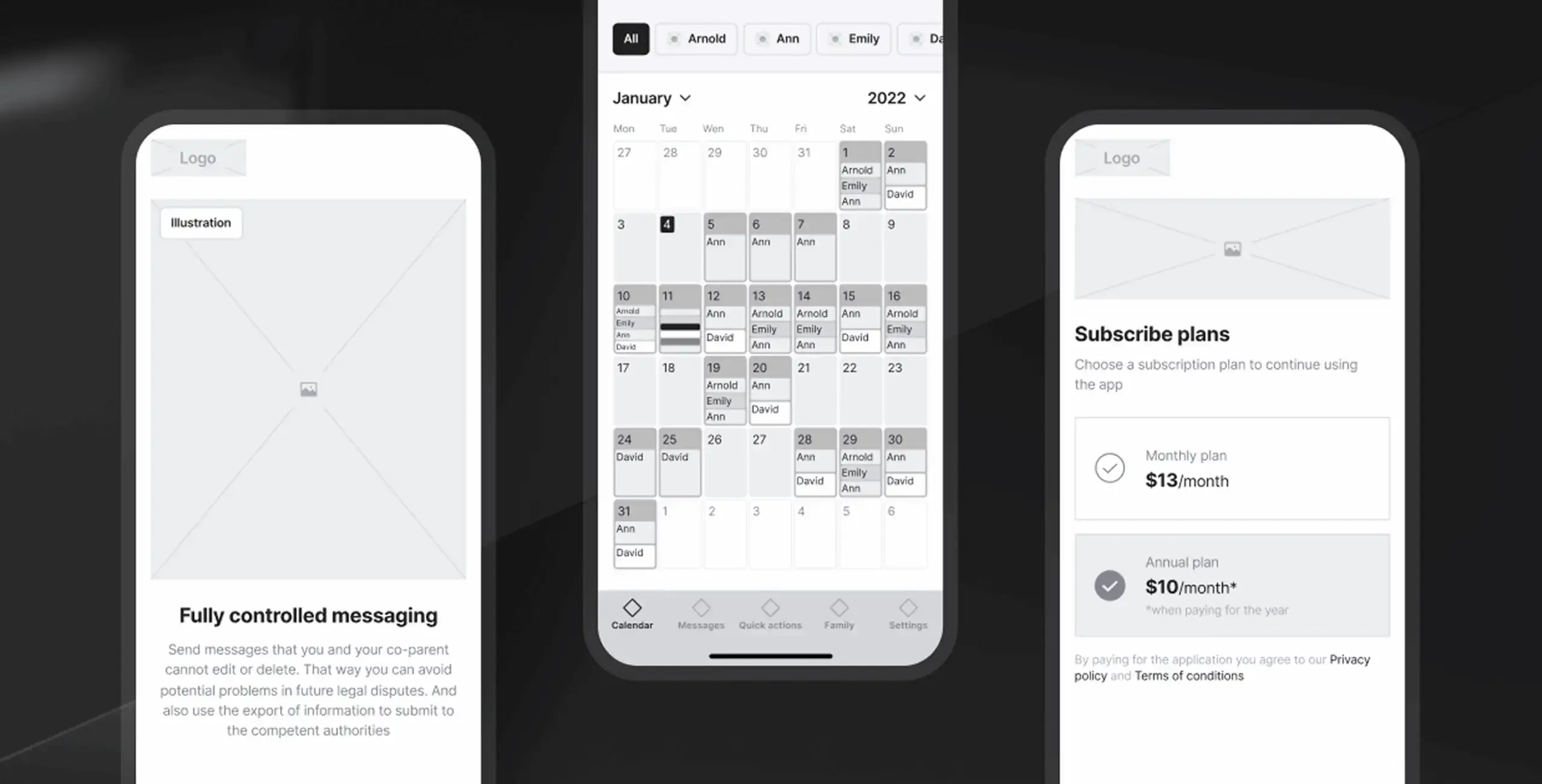
Wireframing for Both Homes – co-parenting mobile app (USA) done by Phenomenon Studio
Everything else – the custody calendar, the schedule swap requests, the notification system – doesn’t exist yet. You’re testing one thing – the core technology.
→ If it works, you move forward.
→ If it doesn’t, you’ve learned something crucial before spending months and tens of thousands of dollars building features around a broken foundation.
What can a PoC look like in practice?
It depends on what you need to prove.
1. A functional demo with one working feature
This is a hybrid: one piece of live, working code surrounded by static screens.
Users can tap buttons, enter data, and see responses in the functional area, while everything around it remains a clickable mockup or Figma export. The contrast doesn’t matter. We’re not demoing polish; we’re proving feasibility.
We split the PoC build into two parallel tracks:
| Track | What we build | Tools & environment |
| Functional core | The one feature that needs to work – connected to a database, with working backend logic, testable by users | React or Next.js frontend · Node.js or Python backend · PostgreSQL, MongoDB, or Firebase depending on data structure · Deployed to a staging environment you can share |
| Context shell | Static screens showing where this feature lives within the larger product – clickable but non-functional | Figma exports or hardcoded React components · Placeholder data · Navigation that dead-ends gracefully |
The functional piece gets version control, API documentation, and basic error handling. We build it the way we’d build production code because you need to know if this architecture will hold.
For the co-parenting app, our PoC would be a working secure messaging component – messages that get stored permanently, cannot be edited, and can be exported for legal use. The calendar existed only as a static mockup. But the messaging piece proved: yes, this can be built to a legal standard.
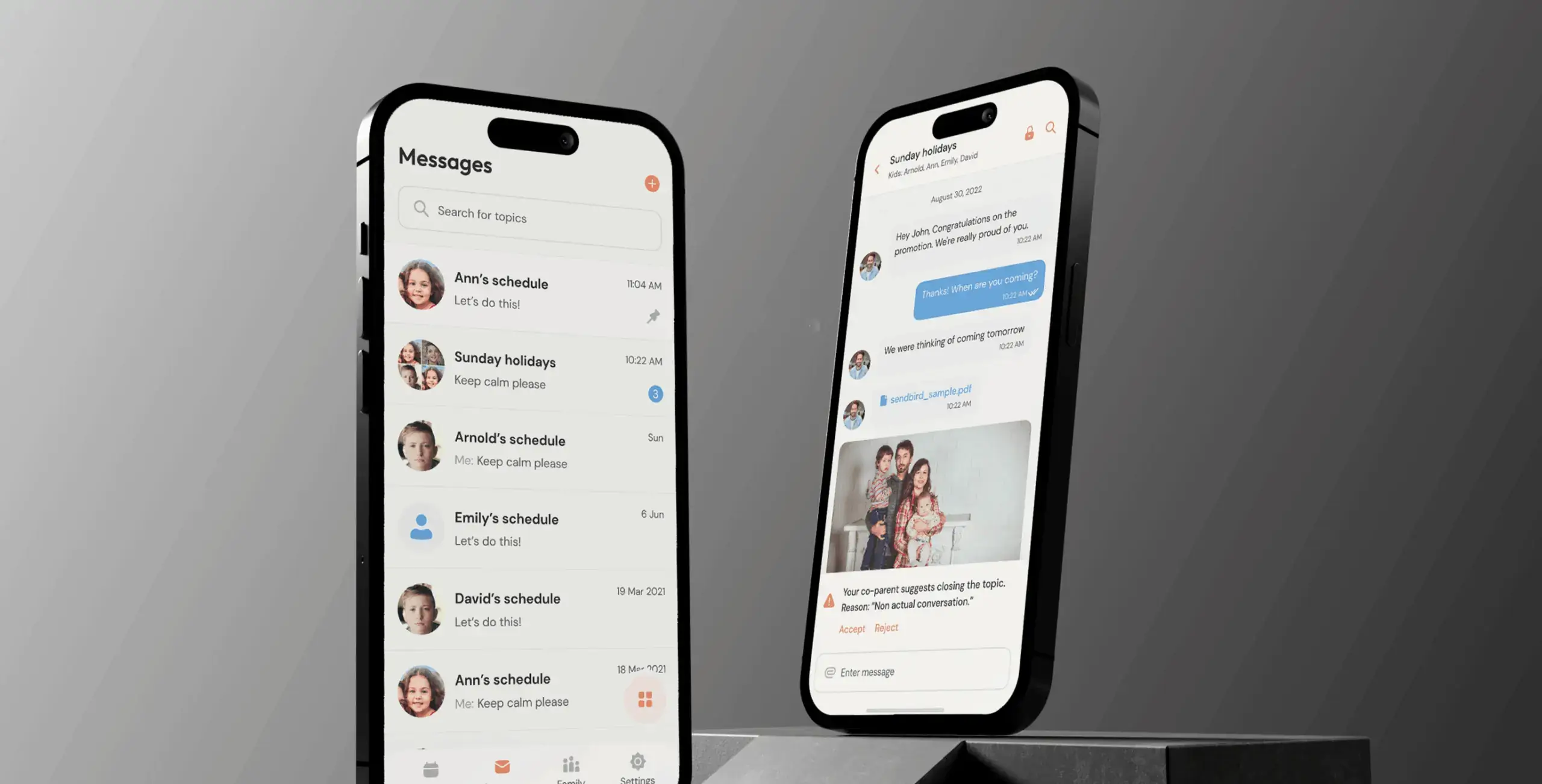
2. A detailed interactive prototype in Figma
This works when the technology behind your idea is well understood, and everything you need can be built with available tools and frameworks. A Figma prototype looks and feels like a working app, but there’s no code behind it – just clickable screens that simulate the flow.
The prototype typically includes high-fidelity screens for every key user path, micro-interactions and transitions, realistic content (not lorem ipsum), and edge cases like error states and empty states. It’s detailed enough that someone unfamiliar with the product can use it without guidance.
When the technical risk is low, the PoC serves a different purpose: gathering investment and getting your first touch with the market. You put it in front of investors to show the product vision, and in front of potential users to gauge whether the concept lands.
For the co-parenting app, our PoC Figma prototype would map the full messaging experience and custody calendar interface. How do parents view the schedule? How do they request a swap? Where do notifications appear? This way, we can show investors and early audiences what this product could be, before writing a single line of code.
Timeline: A Figma prototype might take a couple of days. Something more developed could take up to several weeks.
What a minimum viable product actually is
Let’s go back to our analogy.
If the PoC is the soil test, the MVP is the house envelope: walls, a roof, windows, doors, and utilities. Nobody’s chosen the materials for the kitchen cabinets yet, or the colours for the bedroom walls. But the structure stands, and people can walk through it.
Your MVP is a functioning product. Users can download it, sign up, and use it to solve a problem in their lives. Is it basic? Yes. Is it missing features you eventually want to add? Absolutely. But it works. And because it works, people can use it and tell you what they think.
For the co-parenting app, an MVP might include secure permanent messaging, a basic custody calendar, and one-time schedule-swap requests.
It won’t have detailed expense tracking, document sharing, or integration with family law software yet. But separated parents can use it to coordinate their week and tell you, “The calendar is confusing when we have alternating weekends.” “I wish I could attach photos to messages.” “The notification came too late for me to adjust my plans.”
Ruslan explains the purpose: “An MVP tests how your target audience receives the product as a whole. What insights will they give you? Where can this product potentially go next?”
And MVPs rarely stop at one version. Your first MVP is the house envelope. Based on what you learn from the people walking through it, you redesign the layout, add rooms, and improve the flow. Each version builds on what the previous one taught you, until the house becomes a place people want to live in.
Timeline: An MVP typically takes 2–3 months, depending on complexity. Some take longer. The timeline depends on the scope of that first version, the technical architecture, and the size of the team working on it.
The choice: PoC first, or skip straight to MVP?
A PoC and an MVP sit at different stages of the same process. They’re not interchangeable, and one doesn’t replace the other. A PoC reduces technical risk. An MVP reduces market risk.
Sometimes you need both, in that order. Sometimes the technical question is already answered – the architecture is standard, the tools are proven, the integration path is documented – and you move straight to the MVP.
The decision depends on what’s unknown. Let’s break it down.
Two key scenarios when a PoC makes sense
Scenario 1. You have a technical question that needs answering
Some ideas look brilliant on paper but hit unexpected walls during implementation. The algorithm doesn’t perform as expected. The integration with third-party services is more complicated than anticipated. The data you need isn’t accessible in the format you assumed.
A PoC reveals these walls early. You spend a few weeks and a limited budget to discover: yes, this can be built, proceed with confidence. Or: this is harder than we thought, we need to adjust our approach (or our budget) before going further.
Ruslan puts it bluntly: “If you can’t implement something in a PoC format – as the most primitive implementation of a feature – it means either you need significantly more money for the MVP, or it’s not feasible to build at all. Usually it’s the first one.”
Scenario 2. You need to raise investment
Put yourself in an investor’s shoes. You’re meeting two founders on the same day.
→ Founder A shows you a pitch deck with market analysis, some wireframes, and three screenshots they designed themselves. They’re asking for $100,000 to build their product.
→ Founder B shows you a pitch deck with market analysis, plus a working prototype you can tap through, test, and experience yourself. You can see how the product would feel. You can interact with the core feature. They’re also asking for $100,000.
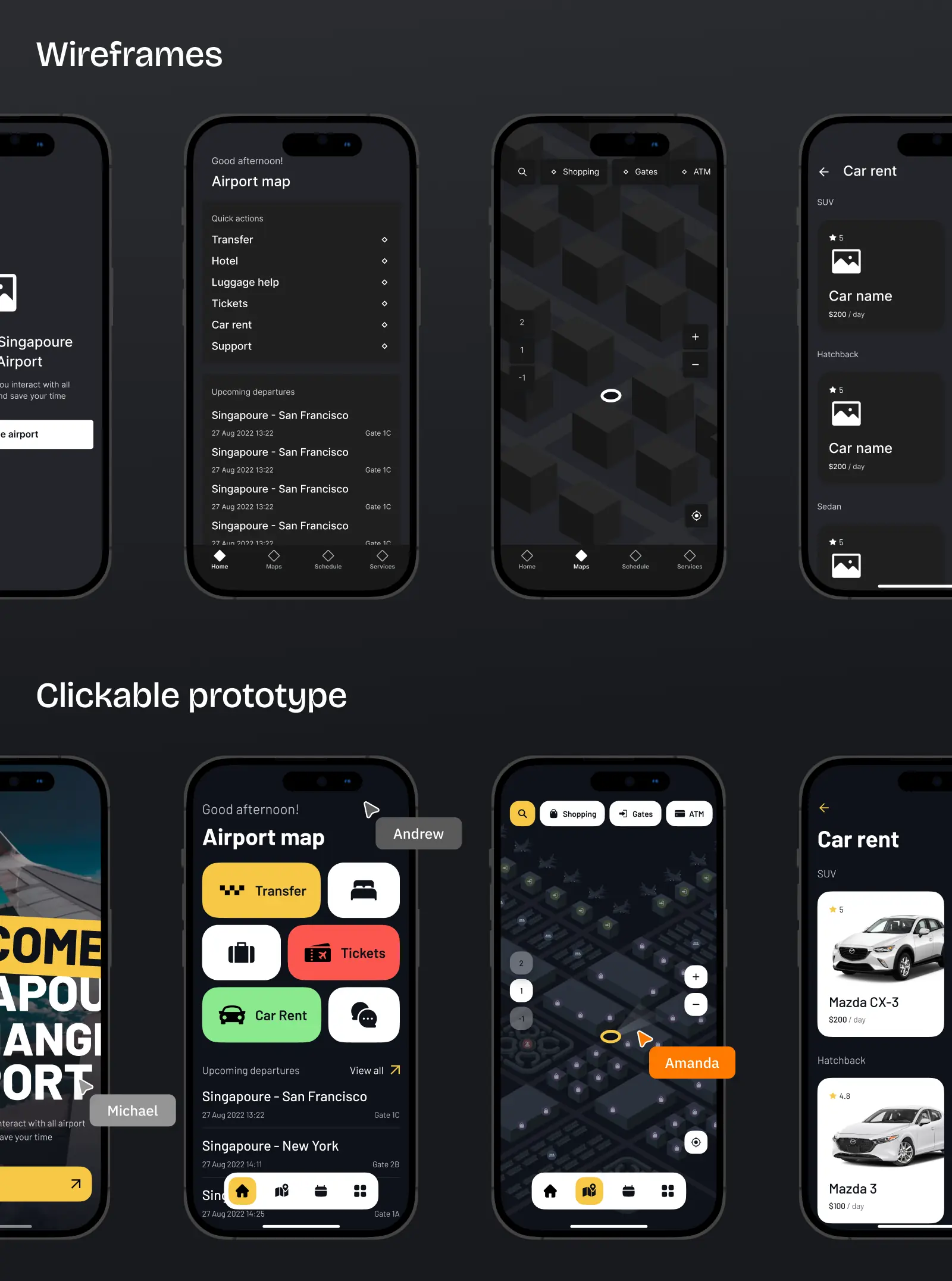
Which founder seems more credible?
A PoC doesn’t reduce the inherent risk of a startup investment. But it dramatically increases your credibility as a founder.
When you can skip straight to MVP
It’s only one scenario: When you’re confident in technical feasibility.
Maybe you’ve built similar products before. Maybe your technical co-founder has already validated the core approach. Maybe you’re using proven technology with no experimental components. If there’s no serious question about whether this can be built, you don’t need a PoC to answer it.
PoC as a test drive for your design and development partner
Here’s something founders don’t always think about: a PoC project isn’t only about testing your idea. It’s also an opportunity to test your design and development team.
Building a product is a relationship. You’ll work with these people for months. You’ll communicate with them regularly. You’ll depend on them to translate your vision into something real. If that relationship doesn’t work, your project suffers, no matter how good the idea is.
How do you know if a design & development partner is right for you before committing to a major engagement?
You work on something small together first.
Two ways to build a PoC
Option 1: Do it yourself with no-code tools
Platforms like Lovable, Bubble, or similar vibe-coding tools let you build a basic PoC in days. It’s fast and cheap. If you just need something to show investors or test a simple concept, this might be enough.
The tradeoff: you’re limited by what these tools can do, and the result won’t scale into a production-ready product.
Option 2: Work with a development partner
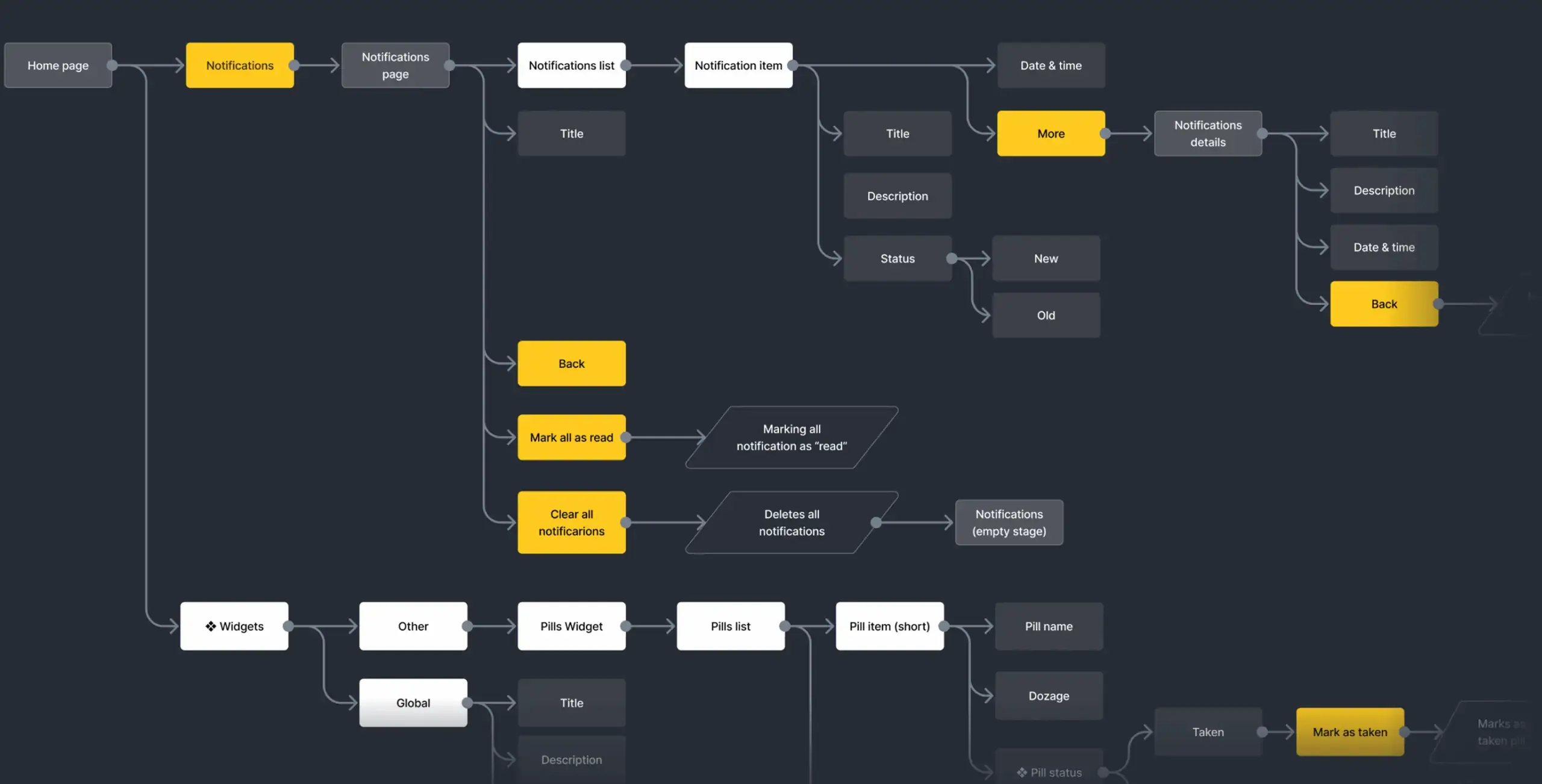
Information architecture for Zest that showed how the Phenomenon Studio team thinks strategically through complexity
This takes more time and budget than DIY, but you gain something beyond the prototype itself.
You get to experience working with the team. How do they communicate? Do they respond quickly, or do messages disappear into silence? How do they handle feedback – defensively, or with curiosity? Do they understand your vision, or do you feel like you’re constantly re-explaining?
A PoC project is a low-risk way to answer these questions. If the collaboration feels smooth, you know you can trust this team with your MVP and the bigger budget that comes with it.
If something feels off – communication is frustrating, quality isn’t there, timelines slip without explanation – you’ve learned that before you’re deep into a problematic partnership.
Think of it as a few dates before deciding to move in together.
What happens after a PoC
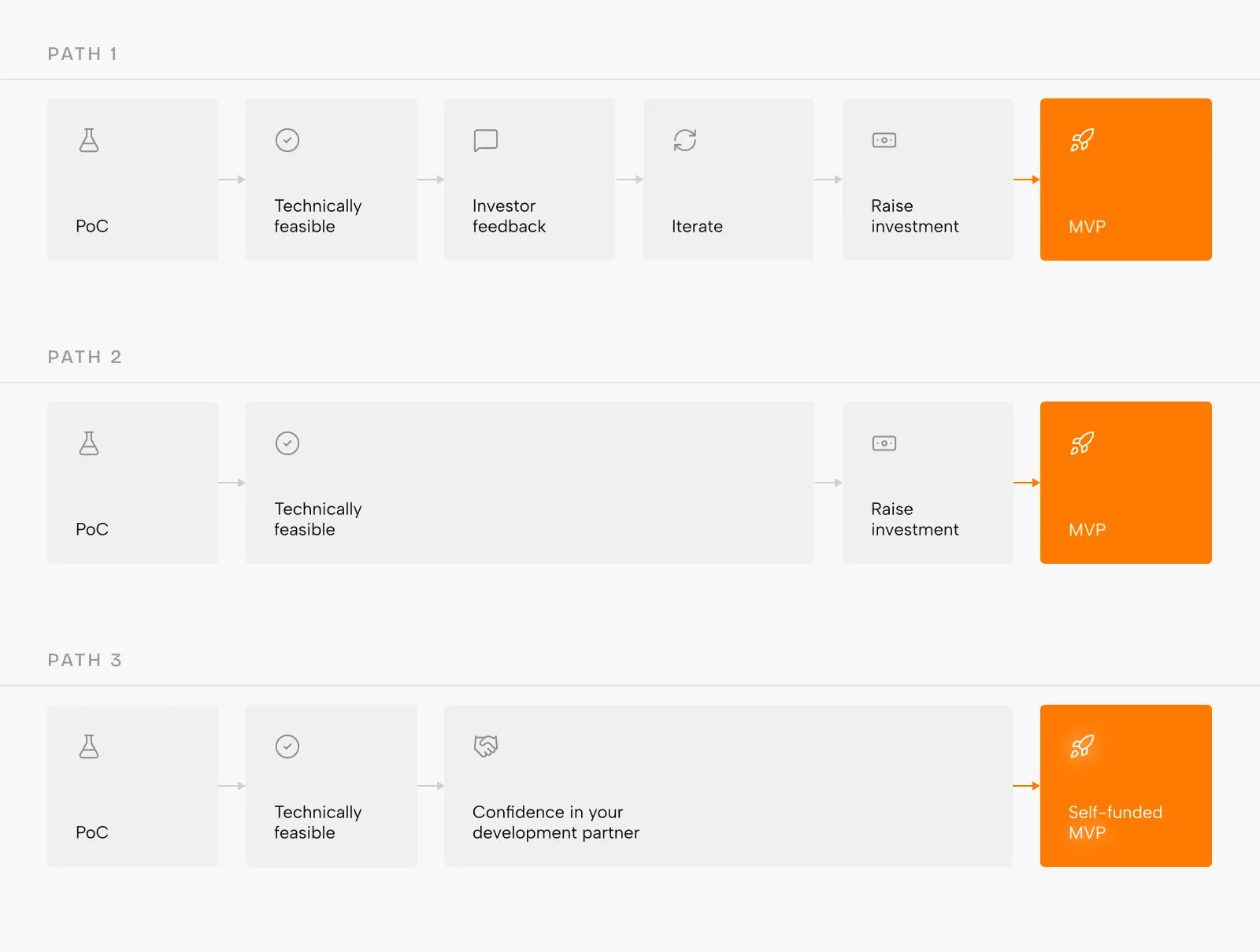
A completed PoC is a decision point. Based on what you learned, several paths open up:
Path 1: PoC → Technically feasible → Investor feedback → Iterate → Raise investment → MVP
You show your PoC to investors. They’re interested but not ready to commit. They give you feedback: “The core is promising, but we’d want to see X before investing.” You take that feedback, improve your PoC, pitch again with a stronger version – and this time, you land the funding.
Path 2: PoC → Technically feasible → Raise investment → MVP
Your PoC impresses investors. They see a team that can execute, a concept that works, and a market worth pursuing. You secure funding. Now you have the resources to plan and build a proper MVP.
Path 3: PoC → Technically feasible → Confidence in your development partner → Self-funded MVP
The PoC project confirmed you’ve found the right team. Communication was smooth. Quality was high. They understood your vision. Now you move forward with MVP development, already knowing the collaboration works.
The right path depends on your funding strategy, your timeline, and what the PoC revealed about technical feasibility.
PoC vs. MVP: Your call
You’ve seen what a PoC is, what an MVP is, and when each makes sense.
If you need to prove technical feasibility, impress investors with something tangible, or test a development partner before a bigger commitment – test the soil first. Start with a PoC.
If you’re confident in the technology and want to get a working product into users’ hands – build the house structure. Start with an MVP.
Neither path is wrong. The right one depends on your risk profile, your funding situation, and how much uncertainty you’re still carrying.
Want help figuring out your starting point? Let’s talk about your project.
Share this article with friends



Sep 29, 2026
6 min read
B2B website redesign without losing traffic: A complete b2b website redesign guide covering UX audits, 301 redirect mapping, and metadata preservation. Partner with a top b2b website redesign agency that boosts conversions while protecting your organic rankings.

Sep 29, 2026
8 min read
Small business web design services that fit your budget. Get affordable small business website design from one of the best website design companies for small business — with transparent pricing and no hidden fees.
