



Jul 20, 2026
9 min read
summary
Discover why enterprise teams choose a website development company for Next.js website development. Learn the benefits of scalability, performance, SEO, and long-term success.
Enterprise teams choose Next.js website development when they need a fast, search-visible, conversion-ready site at scale, and they hire an experienced website development company to turn that technical choice into revenue rather than just clean code.
Nazarii Tkachyk (Fullstack Developer) | July, 2026
The Short Version
- Next.js fits SEO-critical, high-traffic marketing and commerce sites. For a purely internal dashboard, a lighter React SPA usually ships faster, and paying for Next.js there wastes budget.
- A focused enterprise Next.js site typically ships in 1 to 2 months with a senior team of four to six people across strategy, design, frontend, and delivery.
- The framework is the easy part. Architecture, content structure, and the team you hire decide whether the site earns its cost.
What Next.js website development delivers for a business
Most companies do not actually want Next.js. They want a website that loads quickly, ranks on Google, and turns visitors into pipeline, and Next.js is one of the stronger ways to reach that outcome. The distinction matters the moment you hire a website development company, because the framework is a means and not the goal. A serious web development company treats Next.js as one decision inside a larger conversation about your buyers, your content, and your growth targets. Whether you shortlist an agency for website development, a full website design and development agency, or one of the many website development and design companies chasing enterprise logos, the real question is never which framework they favor. It is whether they can make your site pay for itself.
Next.js is a React framework built for rendering flexibility. It can render a page on the server, generate it ahead of time as a static file, or stream it from the edge. It can also mix all three inside a single site. For a business, that flexibility maps to three things buyers actually feel: speed, search visibility, and stability under traffic. This is the kind of result a full product design and development services engagement is built to deliver, not just clean code.
The commercial reason is simple. Search engines and AI answer engines reward pages that load fast and expose clean, server-rendered HTML. A marketing site built as a heavy client-side app often hides its content behind JavaScript, and both Google and large language models struggle to read it. Next.js sends real HTML first, which is why so many content-led and commerce sites moved to it.
Server rendering, in plain business terms
Server-side rendering means the page arrives at the browser already assembled. The visitor sees content in the first moment, not a spinner. Static site generation goes further and builds pages in advance, so they load almost instantly from a cache. Next.js lets a team choose per page. A pricing page can be static while a personalized dashboard renders on request. That control is why strong Core Web Vitals scores are achievable without heroics. The buyer never sees any of this. The buyer sees a site that feels fast.
When Next.js is the right choice, and when it is not
Next.js is the right call when search visibility and page speed drive revenue. It is the wrong call when your product is a login-gated internal tool where SEO is irrelevant and a lighter setup ships faster. Taking that position saves clients money, and we say it before a contract is signed.
The decision usually comes down to two questions. Does the project need strong SEO and performance, and how much custom build freedom does the team require? The decision tree below maps those forks the way our engineers actually reason through them.
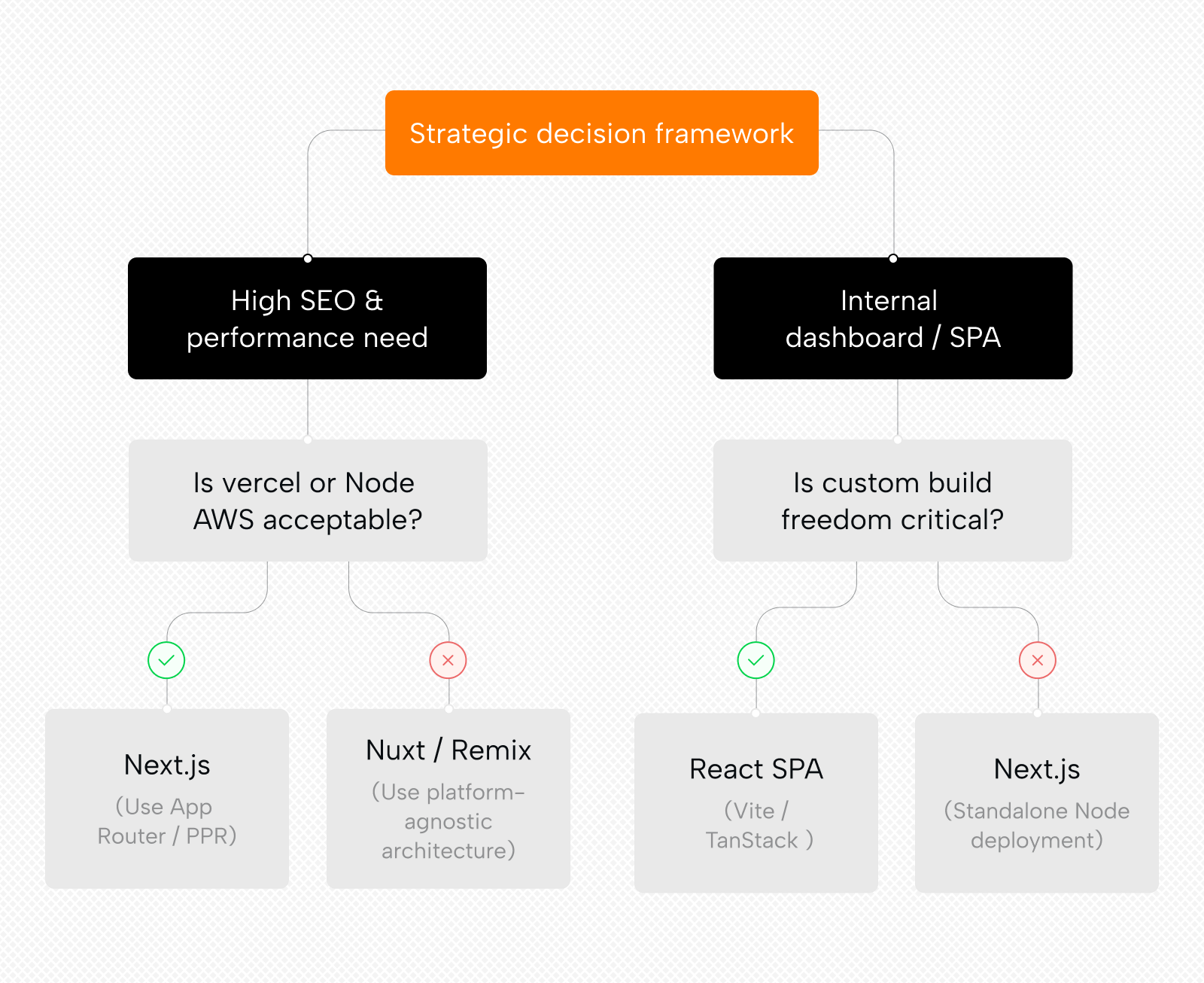
As the tree above shows, a public site with high SEO and performance needs points to Next.js, usually on the App Router with partial prerendering, when a host like Vercel or Node on AWS is acceptable. When hosting must stay fully platform-agnostic, Nuxt or Remix can fit better. On the other branch, an internal dashboard or single-page app that demands total build freedom often runs leaner as a React SPA on Vite. If that same dashboard later needs standalone Node hosting and server rendering, Next.js comes back into play.
The honest limitation
Next.js earns its cost when the product has real traffic, a content surface worth optimizing, or a roadmap beyond six months. For a four-week landing page with a single form, the framework’s power sits unused, and a simpler stack ships faster and cheaper. We tell clients this directly. Choosing Next.js for a brochure site is not craftsmanship. It is overhead. These calls are easier when our senior in-house team plans the content model and owns the build, so the rendering strategy gets decided once.
Why enterprise teams choose Next.js over the alternatives
Enterprise buyers rarely compare frameworks in the abstract. They compare outcomes. How fast the site loads, how well it ranks, how quickly a team can ship changes, and what it costs to maintain. Against those measures, Next.js beats a traditional CMS for content-heavy commercial sites, and it beats a plain single-page app for anything that needs SEO.
The table below sets the common options side by side, the way a product manager weighing a rebuild would. The same pattern runs through the digital products we have delivered, where the right rendering choice consistently tracks the business goal.
| Approach | Best for | SEO strength | Performance ceiling | Typical time to market |
| Next.js (React) | Content-led marketing, commerce, hybrid apps | High: server-rendered HTML | Very high with static and edge rendering | 4 to 8 weeks for a focused build |
| Traditional CMS (WordPress) | Simple brochure and blog sites | Moderate, plugin-dependent | Limited by themes and plugins | 2 to 5 weeks, slower to customize |
| Custom React SPA (Vite) | Internal dashboards, gated web apps | Low without extra tooling | High for app views, weak public SEO | 6 to 10 weeks |
| Nuxt or Remix | SEO sites needing host independence | High | High | 5 to 9 weeks |
For a public, revenue-driving site, the pattern is consistent across the projects we deliver. A traditional CMS gets a brochure live quickly, then fights you on performance and custom features. A plain SPA feels modern but leaks organic traffic because search engines see an empty shell. Next.js sits between them and gives you both: app-grade interactivity and server-rendered pages that rank.
The question we hear most often from founders and heads of marketing sounds blunt. “Our old site looked fine, so why did traffic keep sliding?” The short answer is usually rendering. The long answer is that their content lived inside client-side JavaScript, and neither Google nor an AI assistant could read it cleanly. Moving to server-rendered pages fixed the discovery problem before a single new keyword was written.
The business case: speed, search visibility, and conversion
Site speed is a revenue lever, not a vanity metric. Every additional second before a page becomes usable pushes buyers toward the back button. The effect compounds on mobile, where connections are slower and patience is shorter.
According to Deloitte’s “Milliseconds Make Millions” study, a 0.1 second improvement in mobile site speed lifted retail conversion rates by 8.4%. (Deloitte, 2020.)
That single data point reframes the Next.js conversation. When rendering strategy shaves seconds off load time, it is not a developer preference. It is a measurable move on conversion, and for a commerce site running real volume, tenths of a second carry a currency value.
According to Google research with SOASTA, as page load time grows from one second to three seconds, the probability that a visitor bounces rises by 32%. (Google, 2017.)
Next.js attacks that bounce risk at the rendering layer. Static and edge-rendered pages arrive near-instantly, so the visitor reaches content before doubt sets in. For an enterprise selling a considered purchase, that difference often decides whether a prospect ever reaches the demo request. Faster pages do not just please engineers. They protect the top of your funnel.
Search visibility follows the same logic. Server-rendered HTML gives crawlers and AI answer engines clean content to index, which is increasingly how buyers discover vendors. A web development company that understands this builds the site so machines and humans read the same page. That alignment is the quiet advantage behind Next.js for commercial sites.
Common mistakes teams make with Next.js builds
Most disappointing Next.js projects do not fail because of Next.js. They fail because a team applied it without a plan, then blamed the tool. The mistakes repeat across audits, and every one is avoidable.
- Rendering everything one way. Teams often make every page server-rendered, or every page static, then wonder why performance or freshness suffers. The strength of Next.js is choosing per page, and skipping that choice wastes it.
- Ignoring the content model. A site launched without a clean content structure becomes painful to update. Marketing waits on engineers for routine edits, and momentum dies.
- Treating SEO as a later phase. Metadata, structured data, and rendering strategy belong in the architecture, not in a cleanup sprint after launch.
- Over-engineering a simple site. Reaching for Next.js on a five-page brochure adds hosting and maintenance overhead the project never needed.
On one audit, a scale-up came to us frustrated that their new marketing site felt slower than the old one. We opened the network tab on a Tuesday afternoon and watched every page ship the entire product catalog as client data before rendering a word. The fix was not a rebuild. It was moving three page types to static generation and letting the catalog load on demand. Load time dropped by more than half within a sprint.
Avoiding these mistakes is not about senior engineers alone. It works best when the team that plans the content model also owns the build. When design, content, and development sit under one roof, the rendering decisions get made once, correctly, instead of renegotiated at every handoff.
What a Next.js website costs and how long it takes
A Next.js website is a scoped investment, not a fixed price off a menu. Cost tracks with the number of unique page templates, the depth of design, the integrations, and whether you need strategy and branding alongside the build. Buyers still deserve honest ranges instead of “it depends,” so here is how engagements typically shape up.
The table groups common enterprise scenarios. Figures are market-typical.
| Engagement type | Typical scope | Timeline | Team |
| Focused marketing site | 5 to 12 templates, design plus Next.js build | 4 to 6 weeks | 4 specialists |
| Full corporate rebuild | 15+ templates, CMS, integrations, SEO | 6 to 10 weeks | 5 to 6 specialists |
| Commerce or web app | Custom flows, authentication, dynamic data | 8 to 12 weeks | 6 to 8 specialists |
| Discovery plus prototype | Strategy, UX, clickable prototype | 2 to 4 weeks | 3 specialists |
Timelines assume the client can make decisions and supply content on schedule. The most common delay is not engineering. It is content and approvals, which is why a focused discovery phase pays for itself by removing rework later. A typical team pairs a strategist, a product designer, a frontend engineer, and a delivery lead, then scales up for commerce or app work.
Enterprise Next.js builds from a senior website design and development agency generally start in the mid five figures and rise with scope. That range buys more than code. It buys the website development company services that keep a site fast and maintainable after launch: a clean content model, performance budgets, and analytics wired in from day one. A website development company in the USA and a strong offshore team can both deliver this, so compare on portfolio, not postcode. Cheaper quotes usually skip the maintainability work, and the savings evaporate in the first redesign.
How to choose a website development company for a Next.js build
The framework is a commodity. The team is not. Any competent shop can spin up a Next.js starter, but turning it into a fast, ranking, maintainable enterprise site takes senior people who have shipped the pattern many times. Choosing the right website development company is the most consequential decision in the whole project.
What separates the best website development company from an average one
The best website development company for a Next.js build is not the one with the flashiest deck. It is the one that asks about your buyers and your metrics before it mentions a framework. A top website development agency will push back on scope, name the pages that should be static, and tell you when Next.js is overkill. A top website development company shows you server-rendered pages that already rank, not just design mockups. Ask for outcomes, not adjectives.
Should you hire nearby, in the USA, or outsource?
Many buyers start by searching for a website design agency near me, assuming proximity guarantees quality. It does not. For a Next.js build, the skill distribution matters more than the map. A website development company near me can be convenient for occasional in-person workshops, yet the strongest React and Next.js teams are often distributed. Some clients specifically want a website development company USA-based for timezone overlap and contract familiarity, and that is a fair requirement to state up front. Whether you hire a website development company in the USA, a website design agency near me in your own city, or a web development company near me you can visit, the deciding factor stays the same. Can they show shipped Next.js work?
Others weigh a website development outsourcing company against a local shop and find the outsourced senior team delivers more for the budget. The honest test is not whether the agency sits down the street. It is whether a web development company near me, a website development agency near me, or a distributed partner can show shipped Next.js work and verifiable reviews. A website design agency near me is a convenient starting search, not a quality filter. Location is a preference. Proof of delivery is the requirement.
Signals that actually predict a good outcome
Look for verifiable evidence over promises. A credible agency for website development carries public reviews, named case studies, and industry recognition you can check. Phenomenon Studio, for example, holds a 5.0 rating across 50+ verified Clutch reviews and has shipped hundreds of products since 2019 with a 70+ person in-house team of mid-to-senior specialists. Those are numbers a buyer can verify, not claims a buyer must trust. You can confirm the record through verified Clutch reviews before a first call.
One more signal is candor. When a website development agency tells you a cheaper stack would serve you better, that is not weakness. It is the behavior of a team optimizing for your outcome instead of its invoice. The website development and design companies worth hiring lose a few deals on purpose by being honest, and they keep clients for years as a result. A website development company in the USA and a distributed partner can both pass this test, or both fail it.
Case study: an award-winning Web3 website for Shaga Odyssey

Task
Shaga Odyssey, a Web3 gamepad product, needed a website that could carry an ambitious brand into a crowded, skeptical market. The site had to feel premium, load fast for a global audience, and present a novel hardware and Web3 story clearly enough to convert curious visitors into believers. In a category thick with hype, the brand needed craft that signaled substance.
Solution
Phenomenon Studio delivered the website design and development as a single engagement. The team paired brand-grade visual design with a performance-focused front-end build, structured the experience around the product narrative, and executed the interface polish that a discerning gaming and Web3 audience expects. Design and development ran under one roof, which removed the handoff friction that usually dulls high-craft work. The full award-winning Web3 website development is documented in the project write-up.
Result
The finished site earned industry recognition for its website craft, joining the studio’s set of award-recognized digital experiences. For a young Web3 brand, that external validation did commercial work. It signaled legitimacy to partners and users evaluating an unfamiliar product. The studio’s wider record backs the single project: a 5.0 rating across 50+ verified Clutch reviews (Clutch, 2026) and multiple Awwwards-recognized builds (Phenomenon Studio, 2026) show the pattern is repeatable, not a one-off.
The lesson generalizes past Web3. When a brand needs both credibility and speed, the win comes from treating design and engineering as one discipline. A site that looks premium but loads slowly loses the sale on the first scroll. A site that loads fast but looks generic never earns the trust a new category demands. Getting both at once is the reason enterprise teams keep hiring a full website design and development agency instead of stitching vendors together.
What full-cycle Next.js website development includes
Enterprise buyers often discover late that a website is four jobs, not one. Strategy defines what the site must prove. Design decides how it feels. Engineering makes it fast and real. Content keeps it alive after launch. A full-service website design and development agency owns all four, which is why the output holds together instead of fracturing at every handoff.
This is the core reason established teams shortlist a single agency for website development rather than assembling freelancers. The website development company services that matter for a Next.js build are not just coding. They include discovery, information architecture, a design system, the front-end build, and a content model marketing can run without engineers. Phenomenon Studio delivers these website development company services under one roof, which shortens timelines and removes the blame games that kill momentum. Choosing one agency for website development over a stack of freelancers is a coordination decision as much as a quality one.
Strategy and discovery before a line of code
Discovery is where a Next.js project is won or lost. A two-week discovery phase names the pages that drive revenue, the ones that should be static, and the integrations that will shape the architecture. Skipping it is the most expensive decision a team makes, because products built on unvalidated assumptions burn a large share of runway fixing avoidable rework. The website development and design companies that skip discovery ship faster and rebuild sooner.
Design and engineering as one discipline
When design and development sit apart, the interface a designer imagines and the interface an engineer ships drift apart. A website design and development agency that runs both closes that gap. Components get defined once, built once, and reused, so the site stays consistent as it grows. That single-team model is what separates the best website development company work from a patchwork of vendors, and it is the difference established website development and design companies sell on.
Next.js and AI-driven search: why rendering decides visibility
Search changed. Buyers now pull answers from AI overviews and assistants that read your pages directly, and those systems favor clean, server-rendered HTML. A site that hides content in client-side JavaScript stays invisible to them, no matter how good the copy is. This is the strongest current argument for Next.js on a commercial site.
According to the Baymard Institute, the average documented online shopping cart abandonment rate is roughly 70% across 49 studies, and slow, clumsy pages rank among the leading causes. (Baymard Institute, 2024.)
A web development company that builds for this reality treats structured data and rendering as first-class, not afterthoughts. Server-rendered pages give both Google and AI engines the same clean content a human sees. That alignment is why content-led brands moving to Next.js often recover organic visibility they lost on a heavy single-page app.
This does not mean every site needs Next.js to rank. A small, well-structured WordPress blog can do fine. The advantage shows up at scale, where dozens of templates, dynamic content, and speed budgets collide. For an enterprise site with real traffic, rendering strategy is not a technical footnote. It is a visibility decision with revenue attached.
Migrating an existing site to Next.js without losing rankings
The scariest moment in any rebuild is the migration. Teams fear the traffic drop that follows a botched relaunch, and that fear is rational. Migrations done without an SEO plan routinely shed a large chunk of organic traffic in the first month. Done right, they hold rankings and improve them.
What a safe migration actually requires
A safe migration maps every existing URL to its new destination, preserves metadata and structured data, and keeps content parity so nothing valuable disappears. Redirects get planned before launch, not patched after. A dependable agency for website development runs a pre-launch crawl, compares it to the live site, and fixes gaps before switching DNS. This is unglamorous work, and it is exactly where a top website development agency earns its fee. A top website development agency treats migration as a project, not a checkbox.
The payoff is that the new Next.js site launches faster and ranks at least as well from day one. Clients who search for a top website development company usually care about this more than any framework detail, because a relaunch that tanks traffic can cost a quarter of pipeline. The best website development company for a migration might be a website development company in the USA, or a distributed team three timezones away. Ask any prospective partner how they handle redirects and content parity. The answer separates a top website development company from a risky bet.
Bibliography
- Deloitte. “Milliseconds Make Millions: A Study on How Mobile Site Speed Drives Consumer Conversions and Engagement.” Deloitte Digital, 2020.
- Google with SOASTA. “Find Out How You Stack Up to New Industry Benchmarks for Mobile Page Speed.” Think with Google, 2017.
- Phenomenon Studio. “Shaga Odyssey: Awarded Website Development for a Web3 Gamepad.” phenomenonstudio.com/projects, 2026.
- Phenomenon Studio Clutch profile. clutch.co/profile/phenomenon-studio, 2026.
- Builder.io. “What Is the Next.js Framework?” Builder.io Glossary, 2025.
- The Commonwealth Creative. “Next.js Web Development.” The Codex, 2025.
Share this article with friends



Sep 29, 2026
6 min read
B2B website redesign without losing traffic: A complete b2b website redesign guide covering UX audits, 301 redirect mapping, and metadata preservation. Partner with a top b2b website redesign agency that boosts conversions while protecting your organic rankings.

Sep 29, 2026
8 min read
Small business web design services that fit your budget. Get affordable small business website design from one of the best website design companies for small business — with transparent pricing and no hidden fees.
