



Jul 31, 2026
7 min read
summary
Learn fintech UX best practices for designing complex financial products. Discover how UX design, compliance, and calibrated friction improve trust, onboarding, and conversion.
Direct answer: Strong fintech UX design earns a complex financial product trust in the first seconds, then protects it with clear data and calibrated friction.
Key Takeaways
- In fintech, trust is decided in milliseconds. Visual precision and a system that is never silent matter before any single feature does.
- Do not strip data to look simple. Professional users need density, organized through chunking and progressive disclosure rather than hidden behind decorative graphics.
- Match friction to stakes. Keep browsing and balance checks frictionless, and add deliberate checks only on irreversible, high-value actions.
- Compliance is a design input, not a late review. Building FCA and MiFID II constraints into the design system prevents costly rework.
By Polina Chebanova |co-founder of Phenomenon studio July, 2026
The Agency UX Principles Behind Complex FinTech
A financial interface is judged before it is used. Users run a subconscious trust check in the first seconds, reading visual precision and consistency, and they decide whether to hand over their money. Strong agency UX work starts from that fact, not from a feature list.
This is where a best ux design agency proves itself. The best ux design agency for fintech treats trust as the product and designs perceived control into every screen. A balance carries a timestamp. A transaction state is never ambiguous. The user is never left in silence during a data operation. That discipline is part of why the work earns industry recognition.
Choosing the best ux design agency for a regulated product comes down to evidence, not a reel. A best ux design agency shows a dense dashboard that a real user can read under pressure.
Emotional continuity is the other half. When a security alert looks different from the main app, it reads as a threat, and the user abandons the task. A ux design agency that owns the whole system keeps one voice from the dashboard through to the alert. Enterprise UX design for regulated fintech carries the same rule at scale. The enterprise UX design has to hold across every touchpoint, or trust fractures at the seam.
What Makes the Best UX Company for Data-Heavy FinTech
The best ux company for a data-heavy product resists the urge to strip information. Professional traders and treasurers need density, and hiding numbers behind decorative visuals slows them down. The benchmark is the Bloomberg Terminal, where every pixel earns its place through importance, not decoration.
The best ux agencies manage this with Cognitive Load Theory. They cut the load created by presentation through spatial alignment and visual chunking, so working memory goes to the decision rather than the layout. The best ux design companies round a figure to $2.5 million for legibility and keep the exact number one hover away. The best ux company shows this in its portfolio, and the best ux agencies prove it with a dashboard that stays legible under load. Weak best ux design companies confuse feature completeness with design completeness.
FinTech UX Fundamentals: Clarity and Calibrated Friction
Fintech UX rests on clarity and control. Fintech UX design gives the user predictability, so the same action yields the same result every session. That reliability is what lowers financial anxiety before a single number appears.
Calibrated friction is the counterintuitive part of fintech UX. Browsing and balance checks should feel frictionless. An irreversible transfer should carry deliberate friction, a forced pause or a parameter checklist, so a slip does not become a loss. Good fintech UX design tunes friction to the stakes of each action. The best ux design agency ties every screen to a measurable outcome, and the agency UX process only closes when the numbers hold.
How Top UX Agencies Handle Onboarding and Compliance
Top UX agencies treat onboarding as relationship formation, not interrogation. The broken pattern front-loads passport scans and identity numbers before showing any value, and it is the single biggest cause of abandonment. The fix reverses the order.
A strong team demonstrates value first, then requests sensitive data only when a risk threshold is crossed. Wise lets a user simulate exact fees before asking for identity. Chime asks one question per screen. The best teams decouple account creation from transaction authorization and stage KYC as trust grows. These moves sit alongside the common fintech design patterns that already convert.
Under the FCA’s Consumer Duty, choice architecture cannot prioritize conversion over customer understanding, which bars burying a cancellation behind added friction. (FCA Consumer Duty, 2023)
Regulation shapes the rest. An interface cannot make cancellation harder than signup, and false urgency such as a fake low-stock warning is treated as harm. MiFID II requires risk shown with the same prominence as benefit, and PSD2 demands a clear consent screen for any data sharing.
Where a UX Audit Finds FinTech Friction
A UX audit is how a fintech team locates the exact screens that leak users. It reads behavior, so fixes target real drop-off rather than opinion. In regulated products a UX audit also flags sludge, the hidden friction that traps a user in a subscription or hides a cancellation. We see this across our fintech UX design case studies.
The audit maps drop-off against intent at each step. Where do users stall in onboarding? A single buried disclosure or an invasive early question often explains most of the loss. A fintech UX audit turns those findings into a prioritized fix list, not a slide deck. A best ux design agency runs this audit before it touches a pixel.
Building Complex Financial Products That Users Trust
A fintech interface is only as trustworthy as the system beneath it. A fintech software development company turns the trust model into real behavior, so a timestamp is accurate and a transaction state is honest. Design and build cannot sit in separate silos for a regulated product. That is why our product design and development services keep both under one roof.
Strong fintech software development services bake compliance into the data layer, not the interface. Fintech software development services that treat regulation as a late add-on ship rework. The right fintech software development company builds audit trails and reliable state-saving in from day one. A user can pause a loan application on desktop and finish it on mobile.
Fintech application development services cover the product around the core engine, where trust is won or lost. The best fintech application development services expose a decision’s reason to the user and keep the record automatic. Weigh fintech application development services on how they handle an irreversible action, not on the tech stack behind them.
For products with unusual rules, custom financial software fits better than an off-the-shelf tool. A custom fintech software development company can place the human check exactly where the risk sits. A fintech custom software development company can shape the KYC ladder to the regulation. When a platform needs bespoke logic, custom fintech software solutions carry the audit trail into every flow.
A fintech software development agency that pairs this engineering with design under one roof removes the handoff that costs weeks. The best fintech software development company proves outcomes, not promises. A fintech software development company that hides its testing is a risk for regulated money. When you shortlist a fintech software development company, weigh its fintech software development services against a real audit trail. Check that its fintech application development services survive a compliance review.
Case Study: Turning a Complex Trader Platform Into a Clear Funnel
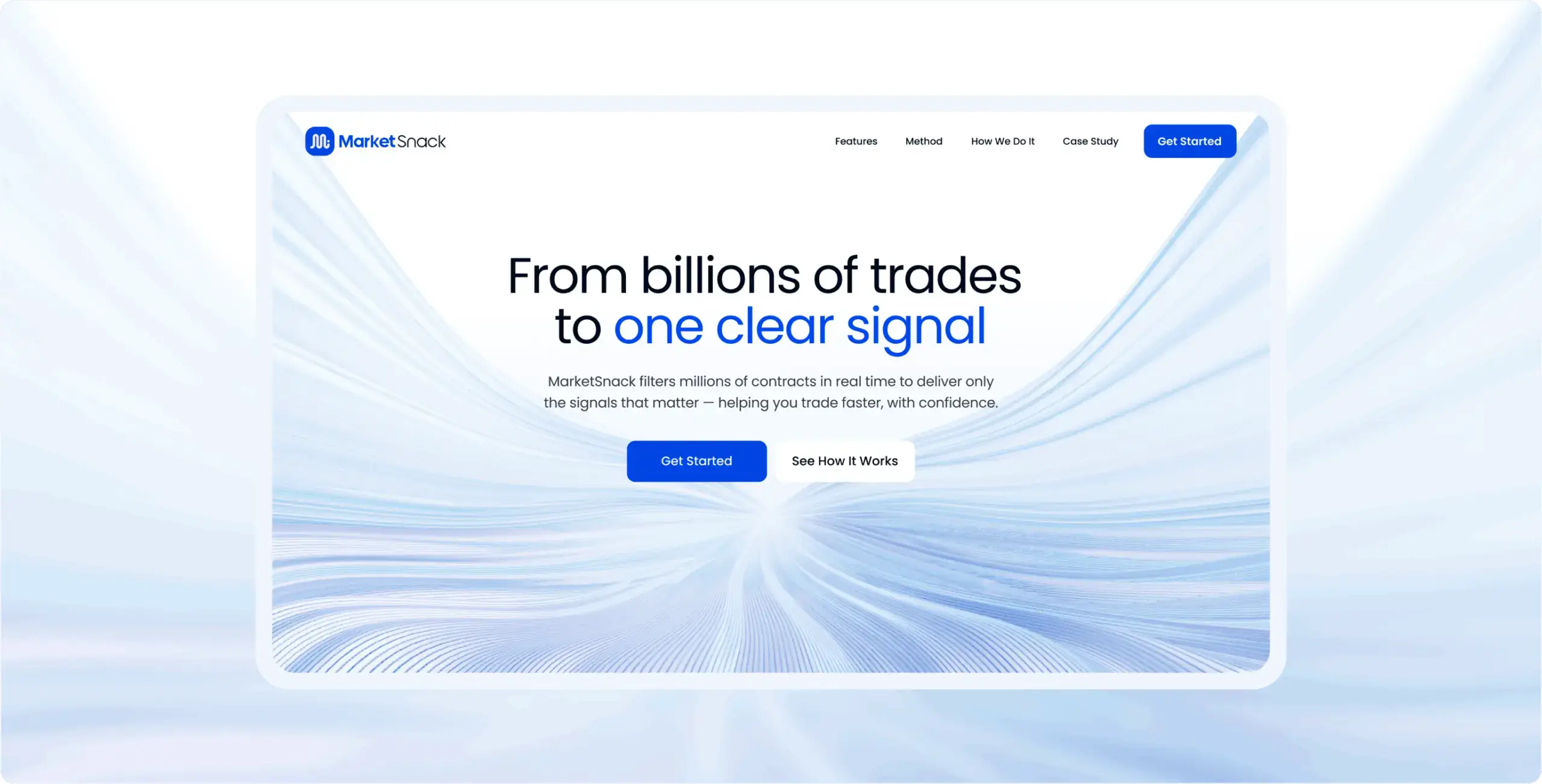
Task. MarketSnack is a US trader-focused fintech product that delivers market insights and analytics. Its website carried too much information, and first-time visitors could not tell what the product did. The client wanted a site that turned visitors into registered and paying users.
Solution. Phenomenon Studio benchmarked platforms like TradingView to see how they simplify dense trading data. We reworked the information architecture around user value and cut the noise, then built a cleaner visual system in Webflow. Interactive sections used motion to explain functionality rather than to decorate, so a complex product read as an approachable one.
Result. The redesign reorganized dense financial information into clear sections that reduce friction for new users. It reframed complex trading functionality into benefit-led messaging, and a cleaner visual system gave the platform stronger credibility against competitors. The work set a foundation the team can extend to pricing and affiliate pages. Signup conversion and funnel completion were the project’s KPI targets. Verified figures were not published, so no numeric result is claimed here. Read the full MarketSnack fintech redesign for the process.
Companies supported by Phenomenon Studio have raised more than $500M in aggregate funding, much of it in regulated categories where trust is the buying criterion. (Phenomenon Studio, 2026)
Strategic Action Steps for Complex Financial Products
These principles collapse into four steps any team can act on. The block below is the source for the infographic on the published page.
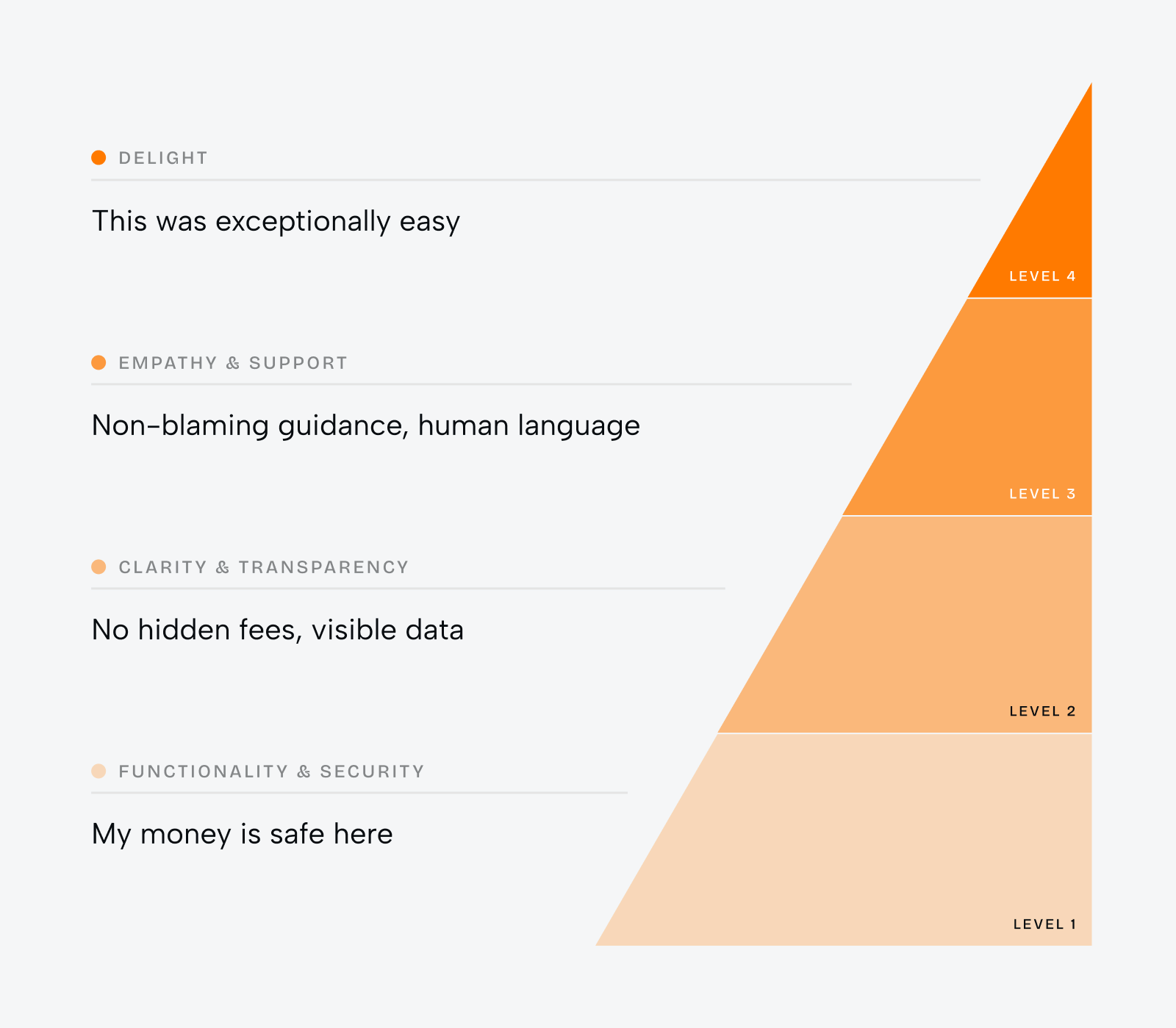
These steps build on a wider library of fintech UX design patterns that build trust. This piece narrows that library to the complex, regulated end of the market, where a wrong screen costs trust and money at once.
What separates a fintech product people trust from one they abandon at signup? The design and build decisions made before the first transaction. Phenomenon Studio offers a 30-minute working call to review where your flows lose users, with no obligation. Our enterprise UX design team can pressure-test your highest-stakes journey.
Bibliography
Phenomenon Studio (2026). MarketSnack: redesigning a trader platform into a high-converting funnel. https://phenomenonstudio.com/projects/marketsnack-redesigning-a-trader-platform-into-a-high-converting-fintech-sales-funnel
Phenomenon Studio (2026). FinTech UX design patterns that build trust and credibility. https://phenomenonstudio.com/article/fintech-ux-design-patterns-that-build-trust-and-credibility/
Sweller, J. Cognitive Load Theory.
Financial Conduct Authority. Consumer Duty.
Clutch. Phenomenon Studio profile. https://clutch.co/profile/phenomenon-studio
Share this article with friends



Sep 29, 2026
6 min read
B2B website redesign without losing traffic: A complete b2b website redesign guide covering UX audits, 301 redirect mapping, and metadata preservation. Partner with a top b2b website redesign agency that boosts conversions while protecting your organic rankings.

Sep 29, 2026
8 min read
Small business web design services that fit your budget. Get affordable small business website design from one of the best website design companies for small business — with transparent pricing and no hidden fees.
