



Oct 31, 2026
7 min read
summary
Explore how our web design services helped Vita Travels launch an award-winning wellness marketplace with custom UI/UX design and Webflow development.
Direct answer: The Vita Travels project shows what professional web design services deliver for a new marketplace: one goal-based catalog built in Webflow that earned an Awwwards Honorable Mention at launch.
Key Takeaways
- Vita Travels put wellness retreats and fitness tours next to boutique stays in one browsing model, filtered by five criteria from wellness goal to budget.
- Coach and practitioner profiles show bios and certifications before a traveler reaches out, which improved inquiry quality for the client.
- A Webflow CMS lets the Vita Travels team add new listings and coach profiles without developer support, so the catalog grows without a rebuild.
- A comparable marketplace website typically takes 1–2 months with a core team of 3–5 specialists, and senior US studios list $150–$199 per hour on Clutch.
A traveler planning a detox retreat with a good hotel nearby usually ends up with a dozen browser tabs open. The retreat is promoted on Instagram. The fitness tour lives on a small operator’s site, and the hotel books through yet another channel. Vita Travels came to Phenomenon Studio to close that gap with one curated marketplace, and the project combined UI and UX design with custom web development in Webflow.
Our position after this build is simple. A premium marketplace wins on structure first and visuals second. Editorial photography only pays off once a traveler can compare two programs on the same page.
This article pairs the video case study with the decisions behind it. It also covers what a comparable build costs in 2026 and the mistakes that turn a curated marketplace into a generic listings site.
Watch the Vita Travels case study video
A marketplace like Vita Travels is judged in motion, not in screenshots. Pacing and transitions carry half of the premium feel. That is why we published the project walkthrough as a Vita Travels website case study video on YouTube, alongside the written breakdown below.
Wellness travel is a large category with no dedicated front door. Retreat organizers sell through social media, and boutique hotels rarely link to the programs their guests actually came for.
According to the Global Wellness Institute, wellness tourism reached $651 billion in global spending in 2022. (Global Wellness Institute, Global Wellness Economy Monitor, 2023)
For a UI UX design agency, the hard part of this brief was never the look. It was holding a varied catalog and an editorial tone on the same page without one weakening the other.
Vita Travels case study: task, solution, result
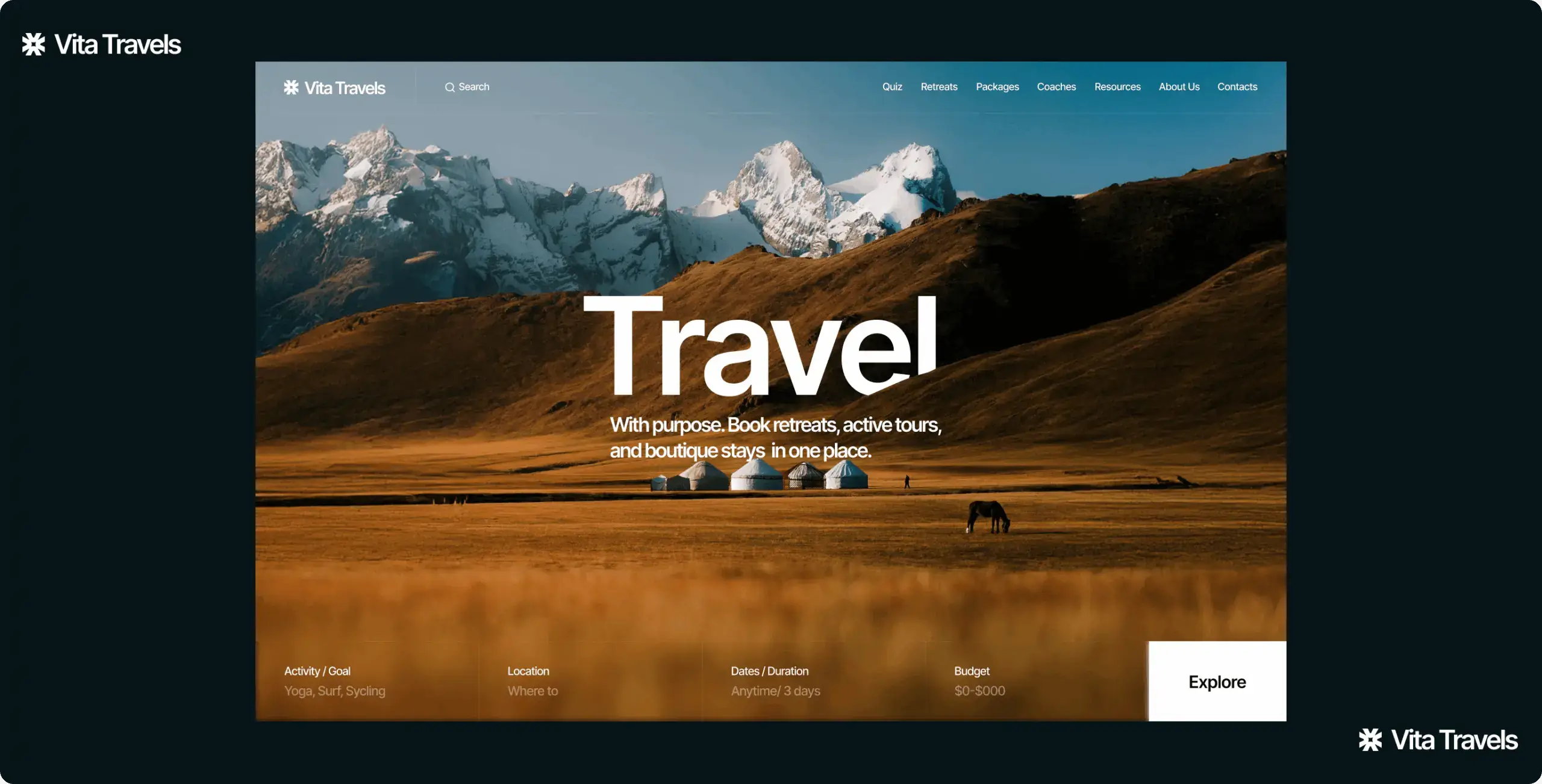
Vita Travels turned a scattered wellness-travel search into one curated marketplace, and Awwwards recognized the result with an Honorable Mention. The engagement covered UI UX design and development services under one roof, which kept design intent intact all the way into the Webflow build.
Client: Vita Travels, USA · Services: website design and website development · Platform: Webflow
Task
The client arrived with a concept already validated: a marketplace bringing retreats and fitness tours together with boutique stays. Its audience was affluent professionals and wellness-focused travelers who currently piece trips together on their own.
The brief described the brand as energetic yet serene, trustworthy and goal-oriented. That description carried a real risk. A standard listings layout would read as generic. A loose editorial layout would leave travelers unable to compare offers at all.
Solution
Before any wireframes, our team reviewed how travel platforms handle accommodation and programs. Most treat them as two separate searches. We also tested goal-based navigation, because wellness travelers search by outcome, such as detox or recovery, rather than by destination.
The key decision was to organize the platform around traveler goals instead of offer categories. Retreats and tours now surface next to stays through five shared filters, from activity type to location. Coach and practitioner profiles became a core content type, with bios and certifications shown alongside guest testimonials.
The visual direction pairs large photography with editorial pacing. Scroll-triggered reveals and smooth page transitions make the site feel curated, while the filter-and-shortlist path stays fast. In development, we tuned the animation layer so page performance holds as the catalog grows.
Result
- Visitors filter programs by wellness goal and activity instead of cross-checking Instagram accounts and niche operator sites.
- Profiles show credentials upfront, so travelers choose with confidence and the client receives better-qualified inquiries.
- The Webflow CMS lets the Vita Travels team manage retreats and coach profiles without a developer, so the catalog keeps growing without a rebuild.
- An Awwwards Honorable Mention gave the client an external credibility signal for partners and investors from launch.
The client has not published conversion figures for the launch period. We report the outcomes the client confirmed rather than estimate numbers we cannot verify.
Picture a product manager in Chicago planning a recovery week after a long quarter. On a typical travel site she would book the hotel first and hunt for a program afterwards. On Vita Travels she picks a goal and a budget range, and a retreat appears in the same results as a boutique stay nearby. Before sending an inquiry, she checks the coach’s certifications on the profile card.
The full Vita Travels marketplace case study on our site shows the screens behind each of these decisions. The structure explains why the site works. What it took to deliver that structure is a question about the service itself.
What do professional web design services include for a marketplace?
Professional web design services for a marketplace cover the content model and the build itself, not just a visual layer. On Vita Travels, the filter logic and the CMS collections were planned before the first screen was styled.
The question we hear most from founders launching a marketplace sounds reasonable: can we start with a template and redesign later? In our experience, that path costs more. A template fixes the content model early, and the content model decides which comparisons travelers can make. Changing it after launch means migrating every listing.
A UI UX design company that also builds the site removes the handoff where most marketplace projects lose detail. Phenomenon Studio runs 70+ mid-to-senior in-house experts, so designers and Webflow developers work from the same component decisions. On Vita Travels, that meant the animation layer was designed with its performance budget already in mind.
According to Stanford’s Web Credibility Research, 75% of users judge a company’s credibility based on its website design. (Fogg et al., Stanford Persuasive Technology Lab, 2002)
That number matters more for a new marketplace than for an established brand. Vita Travels had no reputation of its own at launch, so the interface had to carry trust until reviews and repeat bookings could.
A Webflow build works best when a non-technical team updates listings every week and bookings still close by inquiry. Once payments and availability move on-platform, a custom backend starts to earn its cost. We say this upfront in discovery, because the platform choice shapes the budget more than any visual decision.
Phenomenon Studio is a Webflow Professional Partner, and our website design services cover the full path from content model to launch. The next question most buyers ask is how that differs from hiring a general agency.
Plan the structure first.
Web design agency services vs a template build: which fits a new marketplace?
For a marketplace entering a premium category, custom web design agency services beat a template build almost every time. Templates suit a validated catalog that only needs listing pages. Vita Travels needed the opposite: a new browsing logic and a brand that read as curated from day one.
| Criterion | Template marketplace theme | Agency-designed marketplace (Vita Travels approach) |
| Content model | Fixed by the theme’s listing type | Built around traveler goals across three offer types |
| Trust layer | Reviews widget, if the theme has one | Coach profiles with certifications and testimonials |
| Visual identity | Shared with every other site on the theme | Editorial direction built for the target audience |
| Catalog editing | Often needs a developer for new fields | Webflow CMS managed by the client’s own team |
| Typical timeline | Days to a few weeks | 1–2 months for design and build |
| Typical cost | Theme license plus setup hours | Fixed price, usually from the $25,000 band |
As the table above shows, the template wins only on speed. Every row that affects how a traveler compares and trusts an offer favors a custom build.
A UI UX design agency earns its fee in the first two weeks, before any visual work starts. On Vita Travels, the competitive review showed that most travel platforms split hotels and programs into separate searches. That single finding reshaped the whole information architecture and the user flow behind it.
“Design is not just what it looks like and feels like. Design is how it works.” Steve Jobs, quoted in The New York Times Magazine (Rob Walker, 2003)
That line describes the Vita Travels brief well. The editorial look only works because the browsing logic underneath it does.
Web design business services beyond the screens
Web design business services cover what a site needs to operate after launch, not only how it looks. For a new marketplace, that usually means brand direction plus a CMS the internal team can run alone.
Phenomenon Studio delivers UI UX branding design services as one engagement, so the visual identity and the interface share a single source of truth. On Vita Travels, the brief’s brand words shaped the photography scale and the motion rhythm directly. Content decisions came from the same team, which meant no translation layer between brand guidelines and the live site.
An honest condition applies here. A full brand and site engagement pays off for companies with a validated concept and runway for at least a discovery phase. A business still testing demand should start smaller.
Compare both paths before you commit.
How to choose a web design company USA marketplaces can trust
Choose a web design company that can show a shipped marketplace in a comparable category, then check who actually builds it. Vita Travels is a US client, and most of our marketplace buyers first ask whether we have shipped one before and whether the build will match the design.
Visual quality gets judged faster than most buyers expect. That speed is why we treat the first screen as a trust decision, not a style decision.
Research by Lindgaard and colleagues found that users form a judgment of a website’s visual appeal within 50 milliseconds. (Lindgaard et al., Behaviour & Information Technology, 2006)
A new marketplace has to pass that 50-millisecond test with no brand recognition to lean on. On Vita Travels, large photography and editorial pacing did that work, while the coach profiles carried the trust that visuals alone cannot.
Before signing with any UI UX design firm, verify four things:
- Category proof. A live marketplace or catalog site, not only landing pages.
- Build ownership. In-house developers on the same team as the designers.
- Independent reviews. Verified ratings on Clutch rather than testimonials on the agency’s own site.
- CMS handover. Proof that the client’s team edits content without the agency.
Phenomenon Studio holds a 5.0 rating on Clutch across 50+ verified reviews, and several of our projects carry Awwwards recognition. Companies we have supported have raised $500M+ in total. Those numbers matter less than whether a UI & UX design services company has solved your specific problem, which is why the Vita Travels walkthrough exists.
Web design services for business owners, not just marketers
Web design services for business work best when the owner of the commercial outcome sits in the project, not only the marketing lead. On marketplace builds, that person decides which offer types share filters and which inquiries count as qualified.
A UI UX design services company should translate those commercial rules into UI and UX design decisions. On Vita Travels, the decision to surface coach credentials before the inquiry button came from a business goal: fewer low-intent messages. The interface simply made that goal visible.
This matters most for operators without an in-house product team. The studio becomes the product team for the length of the engagement, so pick one that writes in your language.
Credentials answer whether a studio can do the work. Budget answers whether you should hire it now.
Web design services pricing: what does a marketplace website cost in 2026?
A marketplace website like Vita Travels typically costs $25,000 to $100,000+ in the US market for design and build, delivered in 1–2 months. The spread depends on catalog complexity and how much custom motion the brand needs, not on page count.
On Clutch, senior US product studios list hourly rates of $150 to $199. Most marketplace projects still run as fixed-price engagements, because the scope is clear once discovery defines the content model.
| Engagement | What you get | Typical US price range (2026) | Typical timeline |
| Website design only | UX structure and UI design, ready for developers | Fixed price, from the $25,000 band | 1–2 months |
| Design and Webflow build | Design plus CMS setup, animation and launch support | $25,000–$100,000+ | 1–2 months |
| Website redesign | Audit findings turned into a new structure and interface | Fixed price, scoped after an audit | 1–2 months per release |
| Ongoing design capacity | Embedded designers for new sections and campaigns | Retainer, $3,800–$15,000 per month | Ongoing |
These are market ranges, not a quote. A firm number follows a short discovery call, once we have seen the catalog and the brief.
A project of the Vita Travels type usually needs a core team of 3–5 specialists:
- a product designer who owns structure and user flows
- a UI designer for visual direction and motion
- one or two Webflow developers for CMS and animation
- a project manager who keeps scope and timeline honest
The business case is easier to defend than the invoice suggests. Design maturity shows up in revenue, not only in awards.
McKinsey found that companies in the top quartile of its Design Index grew revenue 32 percentage points faster than industry peers over five years. (McKinsey & Company, The Business Value of Design, 2018)
For existing sites, the numbers look different. Through product redesign and UX optimization, Phenomenon Studio has delivered conversion rate improvements of 35%+. If your marketplace is already live but underperforming, our website redesign services start from what the current site gets wrong.
White label web design services: when they make sense
White label web design services suit agencies that sell sites under their own brand and need extra delivery capacity. The partner designs and builds, and the agency owns the client relationship.
For a marketplace, white label carries a real risk. The people making structural decisions never speak to the business owner, so goal-based logic like the Vita Travels filters rarely survives. Our closest model is team extension, where our specialists join the agency’s team openly.
If you are comparing a UI UX design firm with a white label vendor, ask who attends the discovery workshop. That answer predicts the quality of UI UX design & development services more reliably than any portfolio.
Get a scoped estimate first.
Common mistakes that turn a curated marketplace into a listings site
Most marketplace sites fail in structure long before anyone notices the visuals. These are the mistakes we see most often when operators bring us a marketplace that launched without a specialist UI UX design agency.
- Sorting by offer type instead of traveler goal. Separate menus for hotels and programs force the visitor to do the matching. Vita Travels avoided this with shared filters across every offer type.
- Hiding credentials behind the inquiry button. When trust signals appear only after contact, inquiry volume rises and quality drops. Putting certifications on the profile card reverses that.
- Motion that slows filtering. Scroll effects belong on editorial sections, not on the results grid. On Vita Travels, the shortlist path stays fast while the storytelling pages carry the animation.
- A CMS only developers can edit. If adding a retreat needs a ticket, the catalog stops growing within months.
- Long editorial copy on decision pages. Visitors scan listing pages instead of reading them.
- Booking handoffs to third-party sites. Each redirect is a fresh chance for the traveler to abandon the trip.
The last two mistakes have well-documented costs. Nielsen Norman Group found that users read only about 20% to 28% of the words on an average web page (Nielsen, 2008). Baymard Institute puts the average documented online cart abandonment rate at roughly 70% across 49 studies (Baymard Institute, 2024). Both numbers argue for short decision pages and as few handoffs as possible.
For a site that is already live, the fastest way to find these issues is a structured review rather than a redesign brief. A UX design audit traces the conversion funnel screen by screen and maps the drop-off points in each user flow. It usually shows which fixes need new UI and UX design and which only need a content change.
Bibliography
- Global Wellness Institute. Global Wellness Economy Monitor. 2023. https://globalwellnessinstitute.org/
- Fogg, B.J., et al. Stanford-Makovsky Web Credibility Study. Stanford Persuasive Technology Lab, 2002.
- Lindgaard, G., Fernandes, G., Dudek, C., and Brown, J. “Attention web designers: You have 50 milliseconds to make a good first impression!” Behaviour & Information Technology, 25(2), 2006.
- Walker, Rob. “The Guts of a New Machine.” The New York Times Magazine, 2003.
- McKinsey & Company. The Business Value of Design. 2018. https://www.mckinsey.com/capabilities/mckinsey-design/our-insights/the-business-value-of-design
- Nielsen, Jakob. “How Little Do Users Read?” Nielsen Norman Group, 2008. https://www.nngroup.com/articles/how-little-do-users-read/
- Baymard Institute. Cart Abandonment Rate Statistics. 2024. https://baymard.com/lists/cart-abandonment-rate
- Clutch. US product design studio profiles and hourly rate data. Accessed 2026. https://clutch.co/
- Clutch. Phenomenon Studio profile. https://clutch.co/profile/phenomenon-studio
- Awwwards. Honorable Mention, Vita Travels. https://www.awwwards.com/
- Phenomenon Studio. Vita Travels case study. https://phenomenonstudio.com/projects/vita-travels-turning-a-scattered-wellness-travel-search-into-one-curated-marketplace
- Phenomenon Studio. Vita Travels case study video. YouTube. https://www.youtube.com/watch?v=ywinH_5ZXV4&list=PLfBPpHgR2OkQ&index=2
Share this article with friends



Oct 29, 2026
6 min read
Discover five warning signs your design system is holding your team back and learn how to evolve it for faster decisions, consistency, and scalability.


Oct 18, 2026
7 min read
Compare the top UI/UX design services companies in the USA for 2026 by Clutch rating and price, plus a framework for choosing the right UX partner.
