



Jun 29, 2026
8 min read
summary
React vs. Angular vs. Vue for web app development depends on your product needs. Phenomenon selects the right framework based on architecture, scalability, and project goals.
Direct answer: For most enterprise web app development in 2026, web development with React is the default choice because of its ecosystem and hiring pool, Angular fits large teams that need an opinionated architecture with built-in standards, and Vue suits fast-moving dashboard products where development speed matters most.
How They Compare
- React leads adoption at roughly 44.7% developer usage, which makes web development with React the lowest-hiring-risk choice for long-lived products.
- Angular ships an opinionated architecture with routing, forms, and dependency injection built in, so large teams spend less time choosing libraries and more time shipping.
- Vue offers the fastest path from zero to a working dashboard, which is why teams reach for it when speed-to-first-screen is the priority.
- Phenomenon Studio resolves this question per project, not per trend: React for most product work, Angular when the architecture demands it. The studio holds a 5.0 Clutch rating across 50+ verified reviews.
By Nazarii Tkachyk | Fullstack Developer, june 2026
The framework debate is the wrong debate. A CTO choosing a stack for a five-year product is not picking a favorite language feature. The decision is about hiring, maintenance cost, and how fast a new engineer becomes productive. React, Angular, and Vue can all build the same enterprise app. What separates them is the cost of owning that app over time.
That is the lens this guide uses. We answer React vs. Angular vs. Vue the way we answer it inside a project brief, with the architecture and the team in front of us, rather than as a popularity contest. The summary table below gives the decision at a glance, and the sections after it explain each choice in detail.
Enterprise application development has shifted in one important way over the past few years. The framework is no longer the differentiator it once was, because all three have converged on component models, strong TypeScript support, and mature tooling. What changed is the weight buyers now place on the surrounding decisions: the hiring market, the component architecture, the testing strategy, and the long-term maintenance contract. A modern enterprise guide that obsesses over framework benchmarks is solving a problem that stopped mattering. The real variables are organizational.
| Framework | Maintainer | Best fit | Learning curve | Ecosystem |
| React | Meta | Scalable product apps | Moderate | Largest |
| Angular | Large enterprise teams | Steep | Complete, built-in | |
| Vue | Community (Evan You) | Dashboards, fast builds | Gentle | Growing |
Why web development with React wins most enterprise decisions
When a client asks which framework to standardize on, web development with React is the answer more often than not. The reason is rarely technical superiority. It is the size of the hiring pool, the maturity of the tooling, and the certainty that the framework will still be maintained when the product is in its fifth year.
React holds the largest share of front-end work, with roughly 44.7% of developers reporting active use in recent industry surveys. For a Head of Engineering, that number is a risk calculation. A larger pool means faster hiring, cheaper replacement when someone leaves, and a deeper market of agencies who can pick up the codebase. The framework with the most users is the framework with the least key-person risk.
According to the most recent State of JS and Stack Overflow Developer Survey data, React remains the most widely used front-end library, at roughly 44.7% developer adoption. Source: State of JS / Stack Overflow, 2024
React is also a library, not a framework, which is the source of both its strength and its trap. It makes no decisions about routing, state, or data fetching, so a team can assemble exactly the stack it needs. The risk is that two teams build two incompatible Reacts. That is why mature react web application development leans on conventions: a chosen router, a chosen state layer, and a documented component architecture from day one.
The question we hear most often from CTOs evaluating a rebuild sounds simple: why did the last React project turn into a mess? The answer is almost never React itself. It is that the previous team treated the library’s freedom as a license to skip the architecture conversation, and the codebase accumulated five ways to fetch data and three ways to manage state. React gives a team enough rope to build something excellent or to hang the next maintainer. The differentiator is governance, not the framework.
What disciplined react web application development looks like
Strong react web application development is mostly about the decisions made before the first component. The team picks a state strategy, a data-fetching layer, and a folder structure, then writes them down. On a recent product build, that discipline let a new engineer ship a feature in their first week, because the patterns were documented rather than discovered. React rewards teams that bring their own architecture and punishes teams that expect the framework to supply one.
React covers most product work. Angular earns its place when the team and the architecture pull in a different direction.
Performance, rendering, and the things that actually move metrics
Raw rendering speed rarely decides an enterprise product, because all three frameworks are fast enough for the vast majority of interfaces. What moves business metrics is how the application loads and how it behaves under real data. React’s server-side rendering and streaming, available through mature meta-frameworks, let a content-heavy product show meaningful content quickly, which protects search ranking and first impressions. Angular offers comparable server-side rendering with less assembly required. Vue lands between them, fast by default and simple to optimize for a focused product. The lesson is that rendering strategy, not framework choice, is what a team should argue about, because that is where load time and perceived speed are won or lost.
React web app development for products that have to scale
Serious react web app development is a long game. The framework’s component model and one-way data flow make large interfaces predictable, which matters when a product grows past a hundred screens. A team practicing react web app development with a documented architecture can add features for years without the codebase turning brittle. The same react web app development discipline that helps a startup ship fast is what lets an enterprise maintain the product through three rounds of hiring. React web app development scales with the team precisely because it imposes so little, provided the team supplies the structure the library leaves out.
When to hire among angularjs development companies
Plenty of angularjs development companies still market the legacy AngularJS name, but the real decision in 2026 is modern Angular, the rewritten, TypeScript-first framework Google maintains. The distinction matters when you evaluate vendors. A studio that still leads with the AngularJS label is often maintaining old systems rather than building new ones.
Angular makes sense when the organization is large and the cost of disagreement is high. The framework is opinionated by design. It ships routing, forms, dependency injection, and an HTTP layer in the box, so a fifty-engineer organization does not relitigate those choices on every team. That structure is the product. For a buyer, the question is whether your team wants decisions made for them or wants the freedom React gives.
This is where angular web development separates from the framework hype. Modern angular web development targets organizations that value predictability over flexibility, and the strongest angularjs development companies have repositioned around exactly that promise. The legacy AngularJS apps they once built are now migration candidates, and the better firms say so plainly rather than extending old angularjs apps indefinitely.
There is a cultural fit question buried in this choice. Angular suits organizations that already think in terms of standards and process, because the framework rewards that mindset and frustrates teams who want to move fast and decide later. A CTO who has run large engineering groups usually knows which culture they are leading. The framework should match it. Forcing an opinionated framework onto a team that wants autonomy, or vice versa, produces friction that no amount of technical quality repairs.
Angular web development services and built-in standards
The value of good angular web development services is consistency at scale. Because Angular enforces structure, code written by one team reads like code written by another, which lowers onboarding cost across a large organization. The framework’s built-in security defaults, such as automatic output escaping against cross-site scripting, also reduce the surface for common mistakes. For a regulated enterprise, those defaults are a feature, not a constraint. The best angular web development services lean into that structure rather than fighting it, shipping conventions that survive team turnover.
Choosing angularjs web development services for legacy systems
There is still a market for angularjs web development services, but it is a maintenance market. Companies running large AngularJS systems built before 2018 need angularjs web development services to keep those platforms stable while they plan a migration. The honest advice is to budget for the move to modern Angular or React rather than extending the legacy stack. Reputable angularjs web development services lead with that migration plan, because maintaining a framework that no longer receives feature updates is a cost that compounds quietly.
Angular web app development versus angularjs web app development
The phrase trips up buyers, so it is worth separating. Modern angular web app development uses the rewritten, TypeScript-first Angular and is a valid choice for new enterprise products. Legacy angularjs web app development refers to the original framework and now means maintenance, not new builds. When a proposal mentions angularjs web app development for a greenfield project, treat it as a flag: either the vendor means modern angular web app development and used the wrong label, or they are steering you toward a stack with a shrinking hiring pool. Good angular web app development in 2026 starts from the modern framework, full stop.
Vue js vs react vs angular: where Vue fits
In the vue js vs react vs angular comparison, Vue is the one most teams underrate. It pairs a gentle learning curve with performance that suits data-dense dashboards, and a small team can reach a working product faster than with either alternative. Vue’s ceiling is ecosystem depth: for a sprawling enterprise platform with many integrations, React’s library breadth still wins. The honest read on vue js vs react vs angular is situational, for a focused, high-performance internal tool, Vue often ships first, while for a large multi-team platform React or Angular carries less long-term risk.
Vue’s real advantage shows up in the first two weeks of a project. A designer who codes or a backend engineer filling in on the front end can be productive in Vue quickly, because its template syntax reads close to plain HTML. For a company that does not have a deep front-end bench, that accessibility is worth more than a benchmark. The trade-off arrives later, when the team tries to hire specialists and finds a thinner market than React commands. The framework that is easiest to start with is not always the easiest to scale, and Vue sits squarely on that tension.
| Decision factor | React | Angular | Vue |
| Hiring pool | Largest | Large | Smaller |
| Architecture | Bring your own | Built in, opinionated | Flexible, light |
| Time to first screen | Fast | Slower | Fastest |
| Best enterprise fit | Most product apps | Large structured teams | Dashboards and tools |
Mobile app development with react and the cross-platform case
For teams already invested in React, mobile app development with react through React Native is the path of least resistance. It lets a single team share logic and people across web and mobile, which is a real budget saving when engineering headcount is the constraint. The trade-off is that the most demanding native interactions still need platform-specific work, so React Native is strongest for content and workflow apps rather than graphics-heavy products.
The strategic point for a CTO is team leverage. Mobile app development with react means the same engineers who build the web product can extend it to mobile without hiring a separate iOS and Android team. For a mid-size company, that consolidation often decides the framework before performance is even discussed.
There is a boundary worth naming. React Native shares logic and a large share of the interface across platforms, but the most demanding interactions, complex gestures, heavy animation, or hardware-level features, still benefit from native modules. A realistic plan budgets for a thin layer of platform-specific work rather than promising one hundred percent shared code. Teams that ignore this boundary ship a mobile app that feels almost native, and the gap shows exactly where users are most sensitive. The honest framing is that mobile app development with react removes most of the duplication, not all of it.
Why mobile app angularjs projects are rare now
A mobile app angularjs project today almost always means maintaining something old. The modern equivalent, Angular paired with a tool like Ionic or Capacitor, still ships mobile apps, but the market has largely moved to React Native and Flutter for new cross-platform work. If a vendor proposes a mobile app angularjs build for a greenfield product, ask why, because the hiring pool and component ecosystem both favor the alternatives.
The 2026 framework decision at a glance
Web app development in 2026 rarely fails on the framework itself. It fails on a mismatch between the framework and the team. A team that loves autonomy struggles inside Angular’s guardrails, and a team that wants guardrails drowns in React’s open choices. The block below is the infographic-ready summary your team can pin to the decision document, and it is deliberately short, because the nuance lives in the sections around it rather than in a one-line verdict.
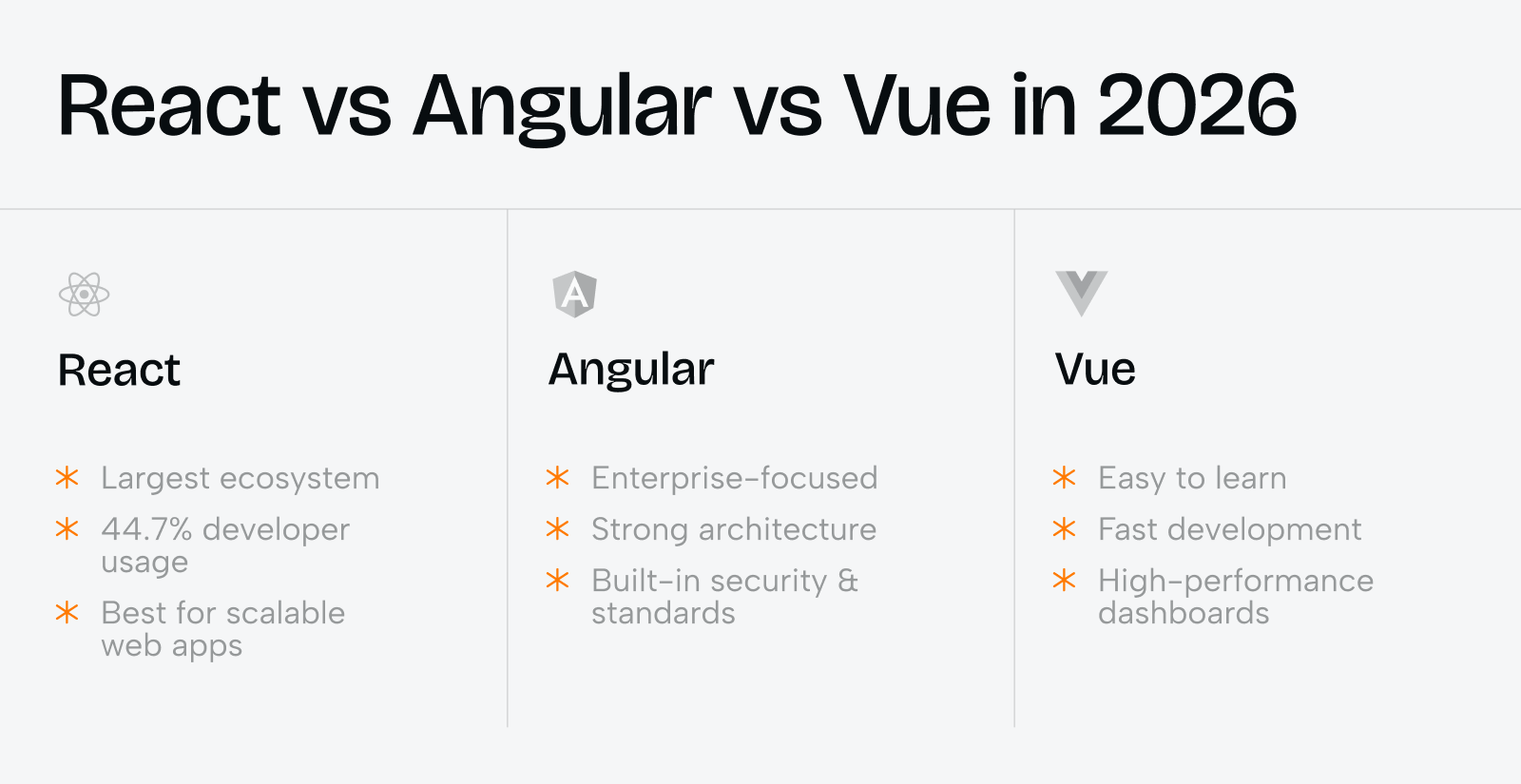
A summary helps, but the real decision sits in the numbers behind a build. That is where most framework debates should have started.
Enterprise application development trends shaping the 2026 choice
Three shifts in enterprise application development have changed how the framework decision plays out, and none of them is about the frameworks themselves.
The first is the rise of the meta-framework. Teams rarely adopt React or Vue bare anymore. They adopt a full-stack layer on top that handles routing, rendering, and data loading, which means the practical comparison is increasingly between ecosystems rather than libraries. For a buyer, that raises the value of React’s ecosystem depth, because the surrounding tools are more mature and more numerous.
The second is the consolidation of web and mobile. As cross-platform tooling matured, the ability to share a team across surfaces became a budget lever rather than a technical curiosity. This is the structural reason mobile app development with react keeps winning mid-market decisions, even when a pure-native build would score marginally higher on a benchmark.
The third is the growing weight of total cost of ownership in procurement. Enterprise buyers now model the five-year staffing cost of a stack alongside the build cost, and that model consistently rewards the framework with the deepest hiring pool. The framework debate has quietly become a hiring debate, which is exactly how a CFO would frame it. A stack that is cheap to build and expensive to staff is a bad trade for any product expected to outlast its first team.
According to industry guides on enterprise application development, total cost of ownership and team availability now outweigh raw framework performance as the primary selection criteria for long-lived products. Source: Enterprise development industry analysis, 2024–2025
An expert view on choosing a stack
The framework matters less than the team that runs it. A well-led team ships a great product on any of the three, and a poorly scoped project fails on all of them.
“The best framework is the one your team can hire for, maintain, and reason about in three years. Everything else is a detail.” Industry consensus echoed across the Stack Overflow Developer Survey, 2024.
In our experience delivering products across all three frameworks, the projects that succeed share one trait: the stack was chosen for the team and the roadmap, not for the demo.
Case study: AirlineSim, a realistic airline management simulation
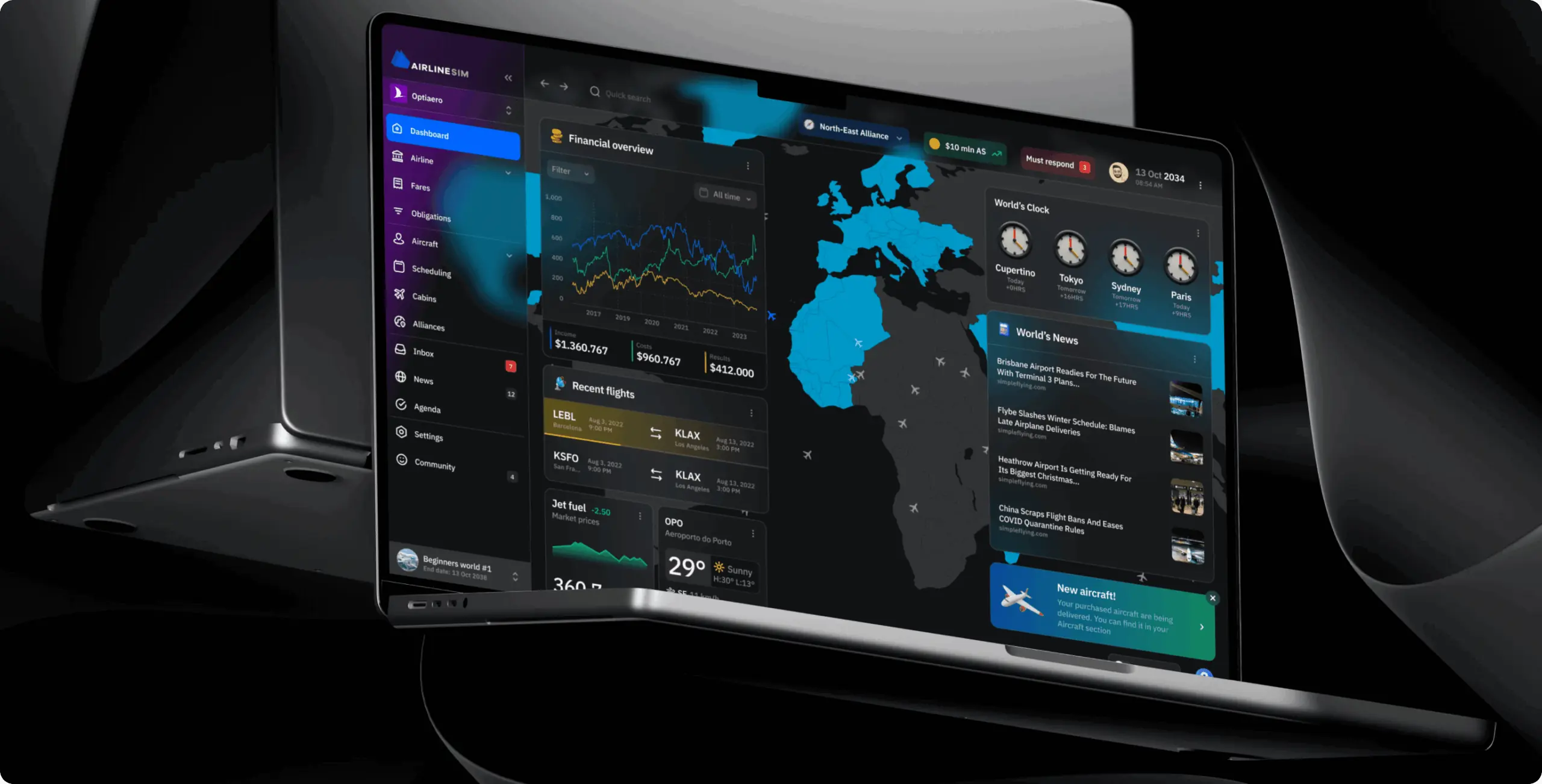
The clearest proof of this approach is a build we delivered, not a hypothetical. AirlineSim is an online airline management simulation with dense, data-heavy interfaces where interface performance and clarity directly shape the player experience. Players spend long sessions reading schedules, fleet data, and financials, so a half-second of lag or a confusing hierarchy is not a cosmetic problem. It is the difference between a player who stays and one who leaves.
Task
AirlineSim needed a modern web product that could present complex simulation data, schedules, fleets, and financials, in an interface that stayed fast and legible under heavy information density, while modernizing an experience players rely on for long sessions.
Solution
Phenomenon Studio delivered product strategy, UX and UI design, and front-end development under one roof. The team rebuilt the data-dense screens around clear hierarchy and responsive components, applying the kind of disciplined react web application development that keeps a complex dashboard maintainable as features grow. Working under one roof mattered here: because strategy, design, and engineering sat on the same team, the interface decisions and the technical architecture were made together rather than handed across a wall, which is what keeps a data-heavy product coherent as it scales.
Result
AirlineSim launched a modernized simulation experience built for clarity at high data density. Verified performance and engagement metrics beyond the public project record are available on request; we do not publish numbers we cannot substantiate.
What each framework costs to build and staff
Operators evaluating react web app development against the alternatives ask two questions early: what does it cost to build, and what does it cost to staff for five years. The build cost is similar across the three. The staffing cost is where they diverge.
A coordinated enterprise web product typically runs as a one to two month engagement for the first production release, with a senior team of roughly five to eight people: a product strategist, one or two designers, two or three engineers, and a delivery lead. Phenomenon Studio works with 70+ mid-to-senior in-house experts, so the team scales without subcontractors. Engagement economics generally land between $30K and $200K for a project, and $10K to $40K per month for an embedded team.
The five-year view is where the frameworks separate. A React hire is the easiest to make in most markets, which keeps roles filled and salaries competitive rather than scarce. Angular hiring is harder up front but pays back in consistency once a large team is running, because the framework’s opinions mean less code drift between squads. Vue sits in a narrower talent band, which is rarely a problem for a small product team and a real one for a platform that needs to scale headcount fast. Total cost of ownership, not license cost, is the number that should drive the decision, and none of these frameworks charge a license.
| Framework | Hiring difficulty | 5-year maintenance | Where the cost lands |
| React | Lowest | Moderate | Architecture you must define yourself |
| Angular | Moderate | Lower at scale | Steeper onboarding, then consistency |
| Vue | Higher | Moderate | Smaller hiring pool over time |
According to npm and GitHub ecosystem data, React’s package download volume and contributor base remain the largest among the three frameworks, which directly lowers hiring and replacement risk. Source: npm Registry / GitHub, 2024
One honest limitation: the framework choice matters less than the architecture decision underneath it. A team that picks React without defining its state and data layer will spend more than a team that picks Angular and accepts its conventions. The expensive mistake is choosing a stack and skipping the architecture work, not picking the wrong logo.
A practical way to decide
The React vs. Angular vs. Vue debate is often framed as a technical comparison, but in reality, framework selection is primarily a business and organizational decision. The most successful projects are not necessarily built on the most popular framework, but on the one that best aligns with the team’s expertise, hiring strategy, governance model, and long-term product goals.
Each framework serves a different set of priorities. React remains the strongest choice for organizations focused on hiring flexibility, ecosystem maturity, and shared web–mobile development. Angular provides structure and consistency for larger teams and complex enterprise applications. Vue offers an efficient path to rapid development and strong performance, making it attractive for focused products and dashboards.
Most framework-related problems stem not from technical limitations but from poor decision-making. Choosing based on a demo, following individual developer preferences, ignoring local hiring realities, or failing to define an architecture early can create challenges that persist for years. The most effective approach is to evaluate the framework alongside the product roadmap, team structure, and maintenance horizon, then document the reasoning behind the decision.
Framework selection also delivers the best results when it is part of a broader product strategy rather than an isolated technology choice. Teams that invest in discovery and architecture planning before implementation are far more likely to avoid costly rewrites later. Choosing a framework without clearly defining product requirements, scalability expectations, and team workflows often leads to technical debt that is significantly more expensive to address once development is underway.
The value of this approach is reflected in real-world delivery experience. Phenomenon Studio holds a 5.0 rating across 50+ verified reviews on Clutch, is HIPAA-compliant, and has delivered hundreds of digital products for companies that have collectively raised more than $500 million. Having worked across multiple frontend ecosystems, the team has seen firsthand that successful framework decisions are rarely about choosing the trendiest technology. They are about selecting the stack that best supports the product vision, organizational structure, and long-term growth strategy.
Ultimately, React, Angular, and Vue are all capable of powering successful products. The critical factor is not selecting the “best” framework, but selecting the framework that best fits the organization that will build, maintain, and scale it.
Share this article with friends



Sep 29, 2026
6 min read
B2B website redesign without losing traffic: A complete b2b website redesign guide covering UX audits, 301 redirect mapping, and metadata preservation. Partner with a top b2b website redesign agency that boosts conversions while protecting your organic rankings.

Sep 29, 2026
8 min read
Small business web design services that fit your budget. Get affordable small business website design from one of the best website design companies for small business — with transparent pricing and no hidden fees.
