



Jun 28, 2026
8 min read
summary
Custom mobile app development company specializing in enterprise mobile app development and iot mobile app development services. We build connected, scalable apps for HealthTech, FinTech, and SaaS.
Key Takeaways
- Choosing a mobile development partner on price is the single most reliable predictor of a mid-project rebuild — domain expertise and a verified delivery record predict outcome far better.
- Custom mobile app development costs range from $60,000 for a focused MVP to $300,000+ for enterprise products requiring compliance certification, complex integrations, or IoT hardware connectivity.
- Cross-platform development (React Native, Flutter) covers 85–90% of business use cases and ships 30–40% faster than dual native builds — native earns its cost only when deep hardware access is required.
- Enterprise and healthcare mobile projects require compliance architecture from day one — retrofitting HIPAA, PCI DSS, or SOC 2 after design adds 30–60% to total project cost.
By Nazarii Tkachyk | Fullstack Developer | July 2026
A custom mobile app development company designs, engineers, and maintains purpose-built mobile applications — for iOS, Android, or both simultaneously — combining product strategy, UX research, and full-stack engineering inside one delivery model. The business result is measurable: faster time-to-market, lower post-launch rework cost, and a product architecture built to support growth rather than constrain it.
What separates the best mobile app development company from an expensive mistake
Failed mobile projects rarely run out of money first — they run out of the right decisions. Selecting a partner on the lowest proposal price, the most polished website, or a referral from someone who built a simpler product in a different industry leads to rebuild conversations twelve months later at three to five times the original savings. When a founder asks us how to identify the best mobile app development company for their specific situation, the answer is always the same: look at the production record, not the portfolio images.
Phenomenon Studio holds a 5.0 rating on Clutch across 50+ verified reviews — with clients across healthcare, fintech, SaaS, and enterprise product categories. The studio has delivered hundreds of digital products since founding in 2019. Companies supported by Phenomenon have collectively raised $500M+ in funding. That is a more useful signal than any self-described claim about being the best mobile app development company: ratings and funding outcomes are verifiable; marketing language is not.
For businesses evaluating a shortlist, three signals predict delivery outcome better than any proposal document: named live applications in your industry, a Clutch profile with verified reviews from clients in regulated or complex environments, and a delivery model that keeps strategy and engineering inside the same team. An experienced custom mobile app development company provides all three on request — not after signing.
According to Gartner Digital Markets (2025), over 60% of enterprise mobile app projects exceed initial budget. The primary driver is scope change discovered mid-development, not market pricing. Projects with a formal discovery phase are 2.4x more likely to ship within budget. — Gartner Digital Markets, Enterprise Mobile Development Report, 2025
What a verified delivery record looks like in practice: the studio names three live applications in your vertical, describes the compliance requirements those products navigated, and connects you with a reference client. An agency that responds with anonymized case studies is not a production-grade partner. The Clutch platform at clutch.co/profile/phenomenon-studio provides the most reliable independent signal: verified reviews from named clients with project scope, budget range, and outcome details that the reviewer attests to.
Cross platform mobile app development services: the decision that shapes your entire budget
The platform decision — native iOS and Android versus a single shared codebase — determines total project cost, time-to-market, maintenance expense, and hardware feature accessibility. Most businesses make it after a brief conversation with a vendor who has a preference rather than a methodology. Cross platform mobile app development services using React Native or Flutter cover the majority of business use cases at meaningfully lower cost and faster delivery speed than building two separate native applications.
A single codebase, maintained by one team, sharing UI components and business logic across iOS and Android, ships in roughly 70% of the time a dual native build requires. The maintenance cost advantage compounds over the product’s lifetime. Native development earns its additional investment only when the application requires direct hardware API access that cross-platform frameworks cannot reach without performance-degrading abstractions — CoreBluetooth for medical-grade BLE devices, Secure Enclave for cryptographic key storage, or ARKit for precision augmented reality.
| Factor | Native iOS + Android | React Native | Flutter |
| Time to market | 100% baseline | ~65–70% | ~65–70% |
| Development cost | 100% baseline | ~60–70% | ~60–70% |
| Maintenance | Two separate codebases | Single codebase | Single codebase |
| Hardware API depth | Full, unrestricted | Via native modules | Via platform channels |
| Performance ceiling | Highest | High for most use cases | High, consistent cross-platform |
| Best for | Medical devices, crypto, ARKit | SaaS, FinTech, eCommerce | Brand-driven, data-rich apps |
iOS mobile app development services
For products where native iOS development is the correct choice, Apple’s Human Interface Guidelines are not optional design preferences — they are the criteria App Store reviewers apply before approving a submission. An ios mobile app development company that treats them loosely produces applications that fail first-submission review, adding two to four weeks of revision cycles before launch. For a business with a marketing campaign timed to an App Store release date, that delay has a direct commercial cost.
Phenomenon Studio’s ios mobile app development services cover the complete arc: product strategy, UX research aligned with real user behavior, UI design within Apple’s component system, Swift and SwiftUI implementation, App Store submission, and post-launch performance monitoring — from one team, with no handoff between design and engineering. For healthcare products, the iOS-specific compliance requirements add a layer of technical complexity that only surfaces after multiple production deployments in regulated environments: HealthKit integration, Face ID with Secure Enclave key storage, background fetch for continuous monitoring, and session timeout policies satisfying HIPAA’s automatic logoff requirement. Choosing an ios mobile app development company with this production track record eliminates the most common compliance failure modes before development begins. Selecting the right ios mobile app development company means verifying that the team has passed App Store review on healthcare or fintech submissions — not just consumer apps.
Mobile app development services USA
US-market mobile applications carry regulatory requirements that offshore vendors routinely underestimate. State-level privacy laws — California’s CCPA and CPRA, Virginia’s CDPA, Colorado’s CPA — impose different obligations on consent management, data subject request workflows, and opt-out mechanisms. A business operating across multiple US states needs these capabilities built into the architecture from sprint one. Mobile app development services usa from Phenomenon Studio includes full compliance with App Store Review Guidelines as they apply to the US market, and direct experience with the rejection patterns Apple applies to healthcare and fintech applications.
Mobile app development company near me reflects a legitimate business need: a partner in a compatible timezone who can participate in discovery workshops, respond to compliance questions within the same business day, and be reached by phone when a production issue requires an immediate decision. Phenomenon Studio serves clients across North America. For enterprise buyers who need on-site workshop participation, that requirement is accommodated. The mobile app development company near me search is really a timezone and accountability search — proximity to the right expertise matters more than proximity to the right postal code.
Custom mobile app development services: what full-cycle delivery costs and includes
Full-cycle means different things at different agencies. At Phenomenon Studio, custom mobile app development services means one integrated team owns the outcome from the first discovery call through production — no handoff, no translation loss between what was designed and what was built. Every custom mobile app development company in usa makes this claim; the verification is whether the team that presents the proposal is the team that builds the product.
What a standard engagement for a mid-complexity mobile product includes:
- Discovery sprint (2–3 weeks): business model analysis, user research with actual target users, technical feasibility assessment, compliance requirement mapping, API availability verification, and architecture decisions.
- UX and product design (4–6 weeks): user journey mapping, information architecture, interaction design, visual design inside the platform’s component system, prototypes tested with real users, and design system documentation.
- Development (8–16 weeks): frontend implementation, backend services and API layer, third-party integrations, security architecture, automated testing, and performance optimization.
- QA and launch preparation (2–4 weeks): device and OS testing, performance benchmarking, security review, and App Store and Play Store submission documentation.
- Post-launch support (ongoing): production monitoring, bug resolution, major OS release compatibility updates, and iterative feature development.
Total timeline for a mid-complexity mobile product: 4–6 months from discovery sign-off to App Store approval. Enterprise products with compliance requirements run 6–9 months. IoT-connected products with hardware dependencies add 2–4 months.
Companies that maintain design and engineering inside a single delivery team ship 34% faster and report 40% fewer post-launch defects than those splitting design and development across separate vendors. — McKinsey Digital, 2024 — McKinsey Digital, Digital Velocity Report, 2024
Team composition on a standard engagement: one senior product designer, one UX researcher, two to three frontend engineers, one backend engineer, one QA specialist, and one project manager. Phenomenon Studio operates with 70+ mid-to-senior in-house experts — no subcontractor networks used in delivery. As a custom mobile app development company, we consider this non-negotiable: the team presented in the proposal is the team that builds the product.
Enterprise mobile app development company: what regulated industries cannot afford to get wrong
Enterprise mobile applications carry requirements that consumer apps don’t: audit trails, role-based access control, SSO integration, MDM compatibility, data residency compliance, and regulatory documentation as baseline architecture. Every enterprise mobile app development company claims to handle these requirements — the distinction is between a studio that has read the specifications and one that has passed a compliance audit on a delivered product. That difference becomes apparent at the first security review, which is the worst time to discover it.
Enterprise mobile app development services require a delivery approach built around compliance from the first architecture decision. Encrypted data at rest and in transit with key management that survives team turnover, role-based access control mirroring the client’s permission model, session management policies satisfying automatic logoff requirements, tamper-evident audit logging for every data access event, and API security validated against OWASP Mobile Top 10 — these are not optional additions. They are the table stakes for any enterprise mobile app development company operating in regulated verticals.
Experienced mobile app development company
Phenomenon Studio is HIPAA-compliant, independently assessed by Compliancy Group in August 2026, recognized as a Clutch Top Design & Development Company, and acknowledged by Awwwards for digital experience quality. As an experienced mobile app development company, the studio’s enterprise work spans healthcare SaaS platforms, fintech compliance tools, and enterprise workflow applications where uptime and audit trail integrity are contractual requirements, not aspirational targets.
What enterprise buyers should verify before any commercial discussion with an experienced mobile app development company: named production applications in regulated environments, specific compliance credentials relevant to the project’s requirements, and a delivery record covering multi-year post-launch engagement. An experienced mobile app development company that cannot produce all three on request does not have the production track record the credential implies.
Healthcare mobile app development company
Healthcare mobile applications operate at the intersection of the strictest regulatory environment and the highest UX complexity. The technical requirements that distinguish a healthcare mobile app development company from a generalist agency: HIPAA technical safeguard implementation for PHI transmission and storage, HL7 FHIR integration for EHR connectivity, biometric authentication with Secure Enclave key storage, ADA-compliant design under WCAG 2.1, and background processing behavior satisfying both HIPAA session management and iOS and Android battery optimization simultaneously.
A clinician using a mobile app in a time-pressured environment cannot absorb unnecessary friction. A patient using a remote monitoring application cannot encounter an onboarding flow that requires a support call before the first measurement is recorded. Both are real failure patterns from healthcare mobile products developed by agencies without direct clinical domain experience. Phenomenon Studio’s work as a healthcare mobile app development company spans remote patient monitoring, clinical workflow tools, and telehealth platforms — and every engagement includes a compliance architecture review in the discovery sprint, before a single component is built.
72% of healthcare organizations cite compliance complexity as the primary barrier to mobile product adoption, ahead of budget constraints. Products that embed compliance architecture in discovery ship 6–8 weeks faster than those that add it post-design. — Forrester Research, 2025 — Forrester Research, Healthcare Digital Investment Report, 2025
Enterprise mobile development timelines for regulated industries: 6–9 months for mid-complexity clinical or fintech products; 9–14 months for applications requiring EHR integration, multi-jurisdiction compliance, or medical device hardware connectivity.
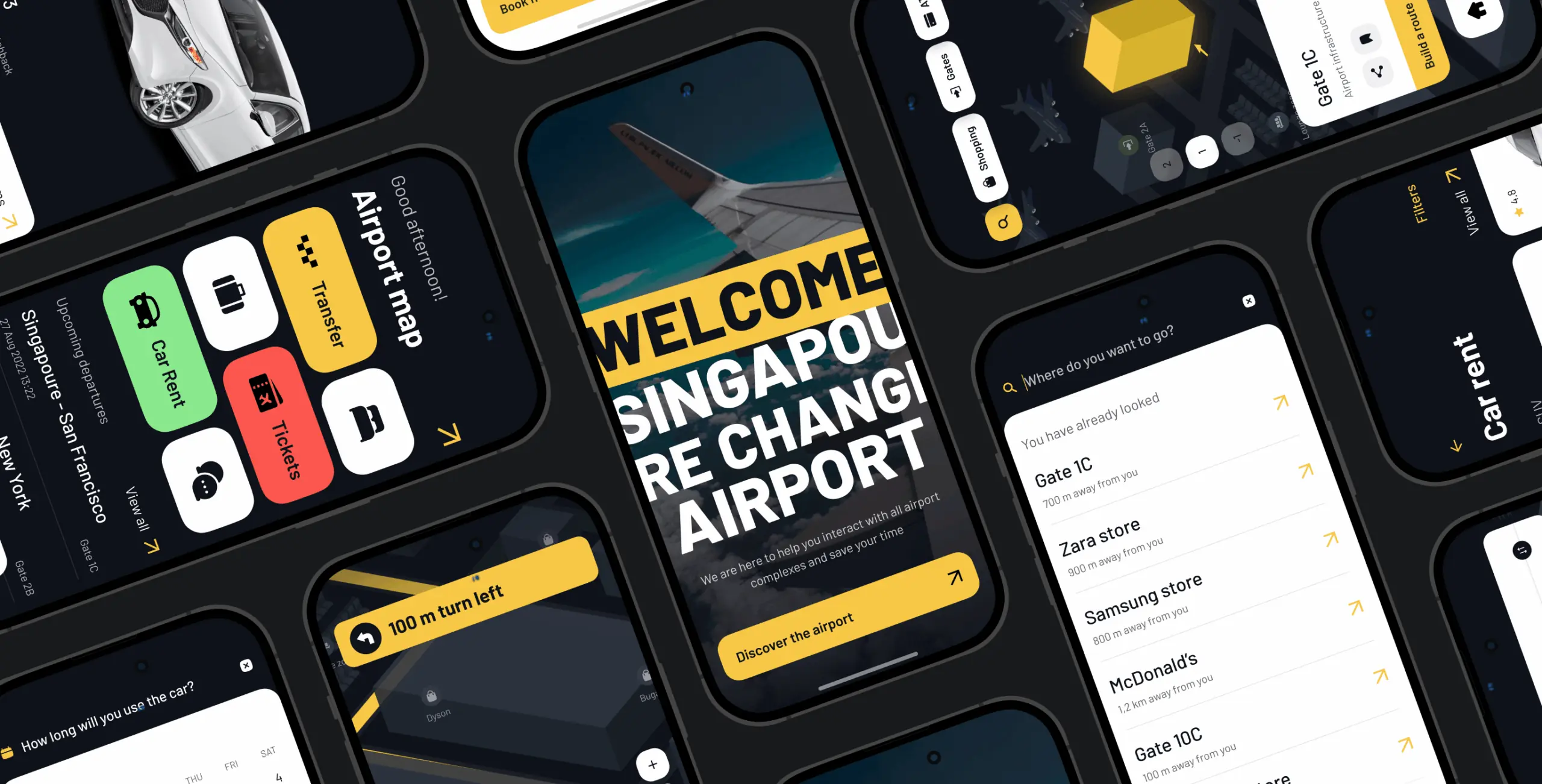
Case study: Sinport — Singapore Airport Navigation App
Task
Changi Airport — one of the world’s most complex aviation hubs — needed a mobile navigation product guiding passengers across multiple terminals, transit zones, retail corridors, and real-time gate change events. The application had to operate reliably in low-connectivity areas, support multi-language interfaces for an international passenger base, and integrate with live airport operations data in real time. Navigation failures in a 68-million-passenger-per-year environment translate directly into missed connections and operational escalations.
Solution
Phenomenon Studio designed and developed Sinport: a native mobile navigation application combining indoor positioning, real-time airport operations data feeds, and a UX built specifically for stressed, time-constrained users in an unfamiliar physical environment. The engagement covered the full arc — product discovery, UX research with airport staff and transit passengers, native iOS and Android development, backend API integration with airport operations systems, security review, and launch support. The same team handled both the interface design and the data architecture that made real-time accuracy possible.
Result
Sinport shipped on schedule and is in active production at Changi Airport — demonstrating Phenomenon Studio’s capacity to deliver complex, data-integrated mobile applications inside environments where reliability failures carry direct operational and safety consequences.
The discovery decision that most businesses get wrong
“The projects that arrive mid-development with fundamental scope problems share one history: discovery was compressed or eliminated. By the time the team surfaces that the assumed API doesn’t exist, or the compliance requirement adds six weeks to the QA cycle — the rework cost is three to four times what a proper discovery sprint would have cost. Discovery is not a consulting deliverable. It is risk mitigation expressed as structured investigation.”
A discovery sprint runs two to three weeks and produces five concrete deliverables: a validated user need, a confirmed technical architecture, a compliance requirement map, a prioritized feature scope, and a delivery timeline built on what the team actually found.
Products built without validated assumptions spend 40–60% of their runway fixing problems that structured discovery would have surfaced. For a company on a twelve-month runway, that is the difference between a product that reaches Series A and one that reaches a pivot conversation.
Usability problems caught during discovery cost 10x less to fix than the same problems identified during development — and 100x less than problems found in production after launch. — Nielsen Norman Group, 2024 — Nielsen Norman Group, Cost of Fixing Usability Problems, 2024
For clients with an existing mobile product and a specific improvement target, a focused UX audit replaces a full discovery sprint. The audit covers user flow analysis, information architecture review, conversion funnel mapping, and heuristic evaluation. Typical audit duration: one to two weeks. Typical finding: one to three high-impact changes that account for the majority of the performance gap.
IoT mobile app development company: what connected product businesses need to understand first
IoT mobile applications are not mobile apps with a Bluetooth connection added — they are the control surface for a distributed system. Decisions made at the mobile layer propagate into hardware procurement, cloud infrastructure, connectivity protocol selection, and security posture simultaneously. An iot mobile app development company that treats the project as a UI problem on top of existing hardware will typically rebuild the mobile layer twice: once when the architecture cannot handle the data volume, and once when the security audit surfaces vulnerabilities embedded in the initial protocol choice. Identifying the right iot mobile app development company starts with one question: does the team start with protocol architecture or with wireframes? The answer reveals whether they have delivered IoT products before.
The protocol decision is where most IoT mobile projects create their most expensive problems. Bluetooth Low Energy suits short-range device pairing and medical wearables. MQTT over Wi-Fi fits home automation and industrial monitoring. Cellular via LTE-M or NB-IoT covers asset tracking and remote field equipment. Cloud-mediated connectivity through AWS IoT Core, Azure IoT Hub, or Google Cloud IoT handles enterprise-scale device fleet management. Iot mobile app development services at Phenomenon Studio begin with protocol and data flow architecture before wireframes are produced — because the interface design depends on what the underlying system can actually deliver. When evaluating iot mobile app development services, request a breakdown of the protocol selection rationale for at least one delivered project — it is the fastest way to distinguish genuine IoT expertise from general mobile development rebranded.
The global count of connected IoT devices exceeded 18.8 billion in 2024, with enterprise IoT spending growing at 22% annually. Mobile remains the primary operator and consumer control surface for IoT interfaces across all major verticals. — IoT Analytics, State of IoT 2025 — IoT Analytics, 2025
Flutter mobile app development services perform particularly well for IoT applications requiring real-time data visualization — sensor telemetry dashboards and fleet status monitors where the UI must update continuously without degrading battery life. React native mobile app development services offer a broader ecosystem of enterprise platform connectors, which matters for IoT products integrating with established enterprise systems. Native mobile app development services remain the correct choice for IoT applications requiring direct CoreBluetooth or Android BLE API access where cross-platform abstraction layers introduce unacceptable latency — most relevantly, medical-grade wearable devices and precision industrial sensors. Flutter mobile app development services are Phenomenon Studio’s recommended starting point for IoT dashboards and data-rich B2B applications where consistent cross-platform rendering matters more than deep hardware access. React native mobile app development services are particularly well-suited for SaaS and fintech products where JavaScript ecosystem integrations — analytics, push notifications, payment SDKs — are pre-built and reduce time-to-market by weeks.
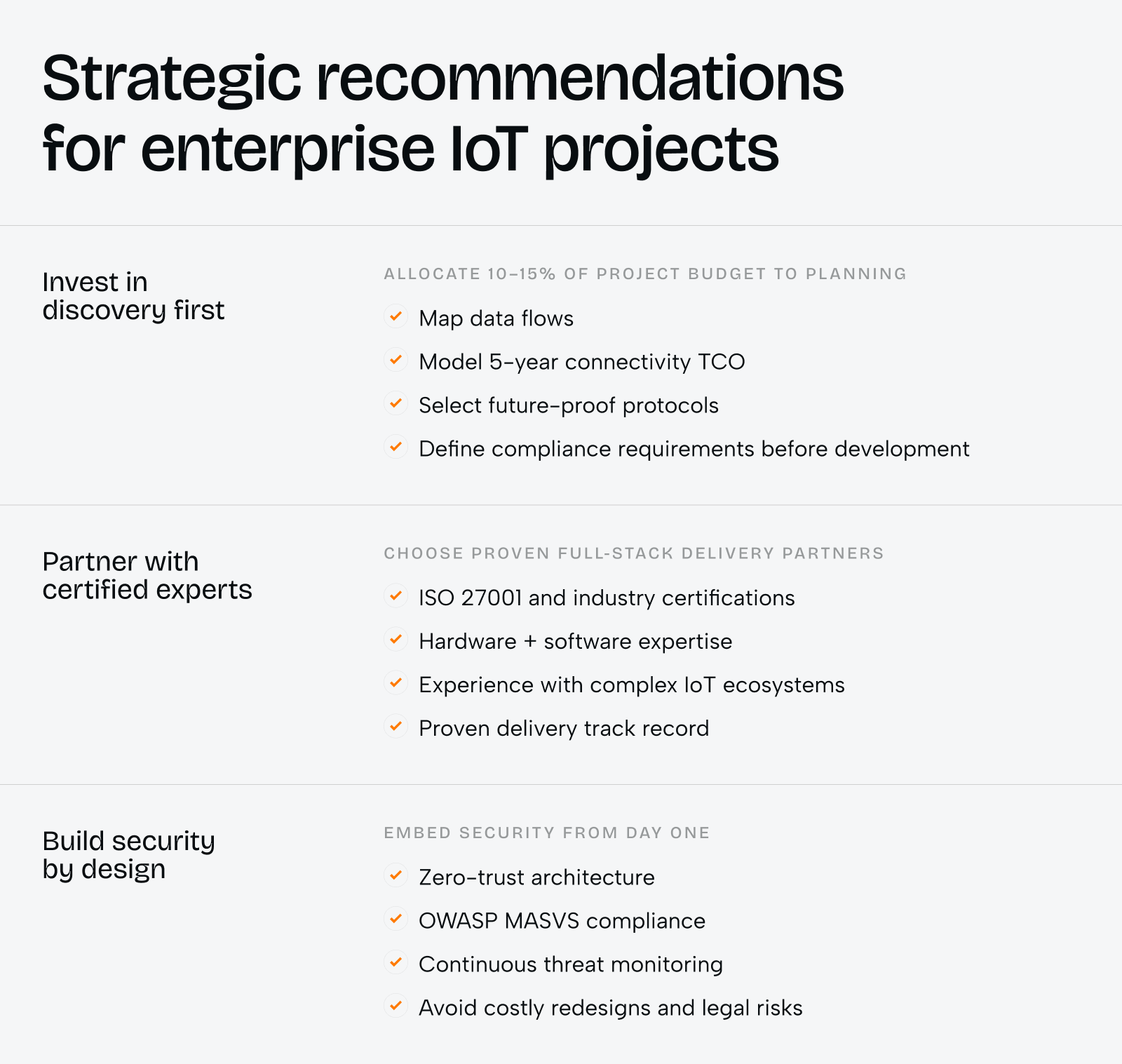
The three strategic recommendations shown above apply to every enterprise IoT mobile project: allocate 10–15% of project budget to discovery — including data flow mapping and 5-year connectivity total cost of ownership modeling — before development begins; select a certified full-stack partner with ISO 27001 alignment and a proven IoT delivery record; and embed zero-trust security architecture from day one, including OWASP MASVS compliance and continuous threat monitoring.
IoT mobile application security carries risk most businesses underestimate until the first incident. Consumer IoT security incidents in 2024 generated $4.2B in insurance claims (Swiss Re Institute, 2025). Certificate-based device authentication, encrypted payload transmission, and tamper-evident audit logging are the minimum viable security posture for any connected mobile product.
How to evaluate a custom mobile app development company: a business buyer’s checklist
The US and global mobile development market contains several thousand agencies. Five verification steps predict delivery quality from any custom mobile app development company better than any proposal review:
- Clutch profile with domain-relevant reviews: named clients from your industry with specific scope and outcome details. A rating built on consumer app reviews does not transfer to enterprise healthcare procurement.
- Named production applications: at least three live apps shipped in the past 18 months with App Store or Play Store links. Concept renders signal a production record that does not support the marketing.
- Compliance credentials matching your requirements: HIPAA, PCI DSS, SOC 2 Type II. Request specific compliance documentation from a delivered project, not a general assurance of familiarity.
- Team structure transparency: whether engineers on the proposal are employees or subcontractors, and whether the senior engineer named will be assigned to production work.
- Contract terms: IP assignment clarity, source code escrow, data handling agreements, post-launch SLA commitments, and exit terms tied to missed milestones.
Austin mobile app development company and similar geography-specific searches reflect a preference for on-site accessibility. Discovery workshops and stakeholder reviews are more effective in person for complex enterprise products. Phenomenon Studio accommodates on-site engagement requirements for US-based clients across all major markets. The mobile app development company near me search is ultimately an accountability search — the right timezone and direct availability matter more than physical proximity. As an austin mobile app development company partner, Phenomenon Studio has supported clients based in Texas through both remote and on-site discovery engagements.
Restaurant mobile app development company and ecommerce mobile app development services share a failure mode design quality cannot fix: underinvestment in backend systems that determine whether the application performs under real user load. A restaurant mobile app development company that delivers a polished interface on an unscalable backend produces a product that fails at peak service. An eCommerce mobile application that loses cart state on a network handoff fails commercially regardless of how well the UI was designed. Backend architecture is not a separate project from mobile development — it is the same project. Whether you are looking for an austin mobile app development company or a nationally distributed team, the critical question is the same: does the agency have a verified production record in your specific vertical. A restaurant mobile app development company with genuine backend engineering capability will show you load testing results from peak service periods — not just interface screenshots.
Evaluating a mobile app development company website is a starting point, not a conclusion. A polished mobile app development company website with case study renders and no verifiable production record is a worse procurement choice than a less polished mobile app development company website backed by fifty named applications in production and a 5.0 Clutch rating. The portfolio, compliance credentials, and discovery process quality are the correct evaluation criteria.
FinTech and eCommerce mobile development: where performance and compliance intersect
Fintech mobile app development services operate inside the most demanding commercial regulatory environment outside clinical healthcare. PCI DSS 4.0, SOC 2 Type II, Bank Secrecy Act compliance, and state-level privacy laws all need to be specified in the architecture phase — before a single screen is designed. Any custom mobile app development company in usa delivering fintech products that treats compliance as a post-design checklist will add six to ten weeks of rework after the security review, and that rework cost is always larger than the discovery investment that would have prevented it.
Enterprise mobile app development services for eCommerce introduce a different set of requirements: real-time inventory synchronization, payment gateway integration with fraud detection, push notification personalization, and deep link routing for campaign attribution. Fintech mobile app development services and ecommerce mobile app development services both share one commercial reality: a mobile application that adds 200 milliseconds to every product page load costs approximately 1% of conversion rate per 100ms added (Google, 2024). Backend performance is a revenue decision.
Phenomenon Studio’s fintech and eCommerce mobile production record has contributed to $500M+ raised by supported companies — reflecting investor confidence in the technical quality of the applications delivered. The team carries operational knowledge of what investor-ready mobile product documentation looks like, and what architecture decisions create technical debt that surfaces during Series B diligence.
Most mobile projects that arrive at Phenomenon Studio as rebuilds share the same origin: the first vendor was selected on price, the discovery phase was skipped, and the product shipped without the compliance foundation or technical architecture to support growth. The rebuild always costs more than the original development would have with the right partner.
Bibliography
- Gartner Digital Markets. (2025). Enterprise Mobile Application Development: Cost Benchmarks and Delivery Risk Factors.
- McKinsey Digital. (2024). Digital Velocity Report: Integrated Design and Engineering Delivery Models.
- Forrester Research. (2025). Healthcare Digital Investment Report: Mobile Compliance Barriers and Adoption Timelines.
- IoT Analytics. (2025). State of IoT 2025: Connected Device Growth and Enterprise Mobile Interface Trends.
- Swiss Re Institute. (2025). IoT Cyber Risk: Insurance Claims Analysis for Connected Devices, 2024.
- Nielsen Norman Group. (2024). Cost of Finding and Fixing Usability Problems Across the Product Development Lifecycle.
- Google. (2024). Mobile Commerce Performance: Revenue Impact of Page Load Latency.
- Clutch. Phenomenon Studio verified company profile. clutch.co/profile/phenomenon-studio
Share this article with friends



Sep 29, 2026
6 min read
B2B website redesign without losing traffic: A complete b2b website redesign guide covering UX audits, 301 redirect mapping, and metadata preservation. Partner with a top b2b website redesign agency that boosts conversions while protecting your organic rankings.

Sep 29, 2026
8 min read
Small business web design services that fit your budget. Get affordable small business website design from one of the best website design companies for small business — with transparent pricing and no hidden fees.
