



May 20, 2026
6 min read
summary
In 2026, product strategy is no longer about delivering features on time — it’s about creating measurable business outcomes. Discover the essential elements that separate high-impact strategies from those that fall short.
Building a product that truly drives business growth has become incredibly complex these days.
Companies invest serious time and resources into design and development. Roadmaps are ambitious. AI tools promise faster delivery. On paper everything looks ready for success.
Yet the outcome is often disappointing. The product launches from a technical point of view, but user engagement stays low. Growth falls behind targets. The expected business impact never fully arrives.
These are exactly the challenges we see many small and medium-sized businesses facing today. Limited budgets make every decision feel high-stakes. Investors want faster returns. Customers change their minds quickly. Competitors move at breakneck speed. According to Atlassian’s State of Product 2026 report, 84% of product professionals worry their products will fail to meet market expectations. Even with AI giving teams more time on routine work, most still don’t have enough space for real strategic thinking.
Traditional execution-focused approaches that worked a few years ago are now reaching their limits.
Successful product strategy today is no longer about longer feature lists or simply moving faster. It is about creating a clear, adaptive framework that delivers measurable business outcomes in an uncertain world. The elements of a successful product strategy in 2026 combine timeless principles with new capabilities that help growing companies cut through the noise and focus on what actually moves the needle.
Let’s explore this in detail — the timeless foundations that still matter, the key accelerators that have become essential this year, and the most common pitfalls to avoid.
Core foundations that still matter
Even with all the new technology and faster delivery cycles, certain foundations of product strategy have stood the test of time.
These are the steady base that still separates strategies delivering real business impact from those that quietly fall short. What has changed is how sharply successful companies apply them. In the elements of a successful product strategy in 2026, these foundations remain as important as ever — they provide the clarity and direction that prevent wasted effort and missed opportunities.
-
Deep customer insight & empathy mapping
Truly understanding the people who will use your product goes far beyond surveys or assumptions. It means stepping into their world — mapping their daily frustrations, goals, and what “success” actually feels like for them.
We see many growing companies still relying on guesses or one-off feedback sessions. The strongest strategies treat customer insight as an ongoing practice. They keep listening, keep observing, and adjust early. This single foundation prevents teams from building features that sound impressive but solve nothing meaningful. When companies skip this step in product strategy 2026, they often end up with products that technically work but fail to connect with real user needs.
-
Clear vision, North Star, and value proposition
Every effective product strategy begins with two simple but powerful questions: Where are we headed? And why should customers care?
A sharp North Star keeps everyone aligned. A focused value proposition explains the real benefit in plain language — not a long list of features, but a clear promise of the outcome users will actually experience. In successful product strategy in 2026 this clarity becomes even more critical because it helps teams make fast decisions when everything else is changing.
-
Business-aligned objectives & measurable outcomes
The final foundation connects the product directly to business success. This means shifting focus from outputs — the features and tasks completed — to real outcomes: measurable changes in user behavior and business results such as higher retention, increased revenue, better efficiency, or stronger customer loyalty.
Product strategists Jeff Gothelf and Josh Seiden popularized a practical question that cuts through the noise: “Who does what by how much?” This approach forces clarity on exactly what success looks like and who is responsible for delivering it. When teams adopt this mindset, they move away from busy work and toward initiatives that genuinely drive business growth. When these three foundations are solid and working together, the entire strategy becomes far more resilient.
These timeless elements still form the core. But today several new accelerators have become essential to turn this solid base into genuine competitive advantage.
Key accelerators that matter now
Today these foundations alone are no longer enough. Seven accelerators have become essential. They help growing companies turn a good plan into measurable business impact — faster, smarter, and with far less wasted effort.
We see many companies investing heavily in design and development only to watch results fall short because these accelerators were missing. Here are the ones that matter most right now in a successful product strategy in 2026.
-
AI-native thinking & multi-agent systems
AI has moved beyond simple automation. Leading strategies now treat it as a native part of the product — using multi-agent systems that can handle complex tasks and make decisions.
Instead of bolting AI onto an existing roadmap, the best teams ask: “How does AI fundamentally change what this product can do for our customers?” This AI product strategy delivers faster innovation and genuinely new value. Companies that embrace AI-native thinking early gain a real competitive edge in 2026, while those that treat it only as a cost-saving tool quickly fall behind.
-
Outcome-driven experimentation & rapid learning loops
Teams that test small, learn fast, and measure real business outcomes — not just whether a feature was delivered — see the best results.
The strongest strategies run quick experiments, watch what actually drives retention or revenue, and adjust within days or weeks. This outcome-driven product strategy cuts risk dramatically and keeps the product tied to what customers truly need. In successful product strategy in 2026 this approach helps small and medium-sized businesses avoid expensive mistakes and adapt quickly to changing market demands.
-
Adaptive, principle-based roadmapping
Rigid, detailed roadmaps no longer survive first contact with reality. Successful teams rely on clear principles and high-level direction instead of fixed task lists.
They set the “why” and the guardrails, then adapt as new information appears. This adaptive product strategy keeps momentum high even when market conditions change — something that has become essential in 2026. Companies that stick to rigid plans often waste months on features that no longer matter.
-
Early deep cross-functional collaboration
The days of handing a brief to designers and developers and waiting for delivery are over. High-impact strategies bring engineering, design, marketing, and business stakeholders together from day one.
When everyone owns the outcomes together, ideas improve faster and costly late-stage changes almost disappear. This early collaboration is one of the most practical ways growing companies can reduce risk and speed up time-to-value.
-
Sustainability, ethics & responsible innovation
Customers and regulators now expect products to be built responsibly — considering environmental impact, data privacy, and ethical AI use from the start.
Strategies that embed these principles early build stronger trust and avoid expensive rework later. In 2026 this is no longer a nice-to-have — it has become a competitive advantage that helps products stand out in crowded markets.
-
Profit-over-growth focus with clear metrics
Growth at any cost is no longer the default goal. The sharpest strategies prioritize sustainable profit, efficiency, and long-term value.
Clear, outcome-focused metrics guide every decision. Teams stop chasing vanity metrics and focus only on what actually moves the business forward. This shift is especially valuable for small and medium-sized businesses that cannot afford to burn cash on unprofitable growth.
-
Strategic alignment & organizational agility
Even the best product strategy fails if the wider organization cannot move quickly. Top performers align their product work tightly with overall business goals and build internal agility.
This means shorter decision cycles and leadership that removes roadblocks. Companies that master this turn strategy into consistent results instead of another document that sits on a shelf.
When these seven accelerators work together with the timeless foundations, product strategy stops feeling like guesswork. It becomes a reliable engine for growth.
Yet even with the right elements in place, many strategies still underperform. The next section looks at the most common pitfalls we see today — and how to avoid them.
Common Pitfalls in Product Strategy
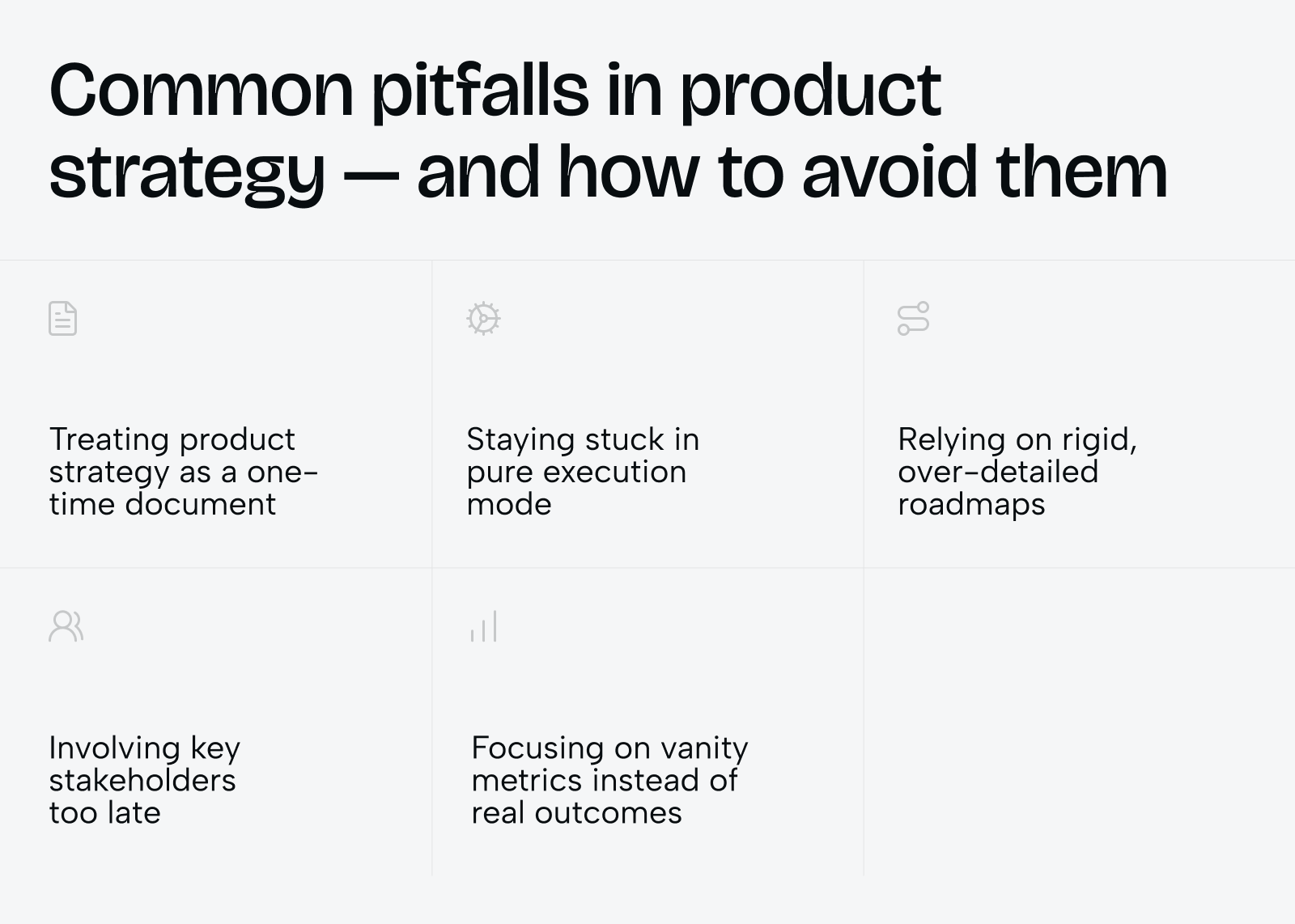
Even with the right foundations and accelerators, many product strategies still fall short. We see the same patterns repeating across growing companies — small but costly mistakes that quietly drain resources and reduce impact. These common mistakes in product strategy often lead to wasted development budgets, missed market opportunities, and slower growth than expected.
Here are the most common pitfalls and practical ways to avoid them:
-
Treating product strategy as a one-time document
Many teams create a detailed strategy at the start and then file it away. In today’s fast-moving environment, it quickly becomes outdated.
This often results in teams working on features that no longer align with current market needs or business goals.
How to avoid it: Treat strategy as a living framework. Review and adjust it every few weeks based on new learnings.
-
Staying stuck in pure execution mode
Companies often jump straight into building features without enough strategic thinking. The focus stays on “delivering on time” rather than delivering real value.
The result is usually a technically sound product that fails to move the business forward, leaving CEOs wondering where the expected ROI went.
How to avoid it: Dedicate time early and regularly to strategic questions. Make sure every major initiative ties back to clear business outcomes.
-
Relying on rigid, over-detailed roadmaps
Long, fixed roadmaps create false certainty. When reality changes, teams either miss opportunities or waste effort on no-longer-relevant features.
This rigidity frequently leads to sunk costs and delayed launches that hurt competitive positioning.
How to avoid it: Shift to principle-based planning with clear priorities and flexibility.
-
Involving key stakeholders too late
Design, development, and business teams are often brought in only after the strategy is already set. This leads to misalignment and rework.
Late involvement almost always increases development costs and frustrates everyone involved.
How to avoid it: Bring cross-functional teams into the process from the very first discussions.
-
Focusing on vanity metrics instead of real outcomes
It’s easy to celebrate number of features shipped or lines of code written. But these rarely reflect actual business success.
How to avoid it: Define and track a small set of meaningful metrics (such as retention, revenue per user, or task completion rate) from day one.
Avoiding these pitfalls requires discipline, but the payoff is significant. When the timeless foundations and today’s accelerators are applied without these common mistakes, product strategy becomes a true driver of sustainable growth.
When the timeless foundations, the key accelerators, and the avoidance of common pitfalls all work together, product strategy stops feeling like guesswork. It becomes a clear, practical system that consistently drives measurable business growth — even when markets shift and timelines stay tight.
Today, the companies that pull ahead are not always the ones with the biggest budgets or the longest feature lists. They are the ones that combine deep customer insight with adaptive thinking, rapid learning, and true cross-functional alignment. The result is products that users actually love, metrics that matter, and outcomes that move the business forward.
We see this approach turning quiet frustration into real confidence for many growing companies. Instead of launching something that technically works but misses the mark, they build with clarity and purpose from day one.
Mastering the elements of a successful product strategy in 2026 gives growing businesses a real competitive advantage. It turns uncertainty into opportunity and helps you create products that not only work technically but truly deliver the business results you need. In a world that rewards speed and adaptability, this approach is what separates companies that merely survive from those that thrive.
The difference is significant — and well worth the effort.
Share this article with friends


Sep 29, 2026
6 min read
B2B website redesign without losing traffic: A complete b2b website redesign guide covering UX audits, 301 redirect mapping, and metadata preservation. Partner with a top b2b website redesign agency that boosts conversions while protecting your organic rankings.

Sep 29, 2026
8 min read
Small business web design services that fit your budget. Get affordable small business website design from one of the best website design companies for small business — with transparent pricing and no hidden fees.
