



Aug 27, 2026
6 min read
summary
Learn how to choose a UI/UX design agency in Switzerland for complex SaaS, fintech, and regulated products. Compare costs, expertise, compliance, and portfolios.
Direct answer. Choose a Swiss UI/UX partner by matching its shipped production work to your exact product problem and regulatory frame, not by portfolio polish.
Key Takeaways
- Categorical experience beats industry labels. The reliable signal is proof of shipping your interaction problem to a live production environment.
- Compliance belongs in the brief early. FINMA for finance and IEC 62366 for medical work shape UX architecture, not just legal sign-off.
- Swiss engagements for complex products commonly run from CHF 25,000 to above CHF 150,000, so budget frames the shortlist.
- KlickEx, a Phenomenon Studio fintech redesign, lifted Add Money conversion by 35.3% and grew users by about 3,000 monthly.
A complex digital product in Switzerland carries three kinds of risk at once. Users can reject an interface that feels foreign. Engineering can stall when a design ignores technical limits. And a regulator can hold the launch if data handling falls short.
Picking the best ux design agency is really a decision about which of those risks a partner retires first. Many teams face this choice while setting up a legal entity in Switzerland, so the design decision sits inside a larger operating move.
By Oleksandr Kostiuchenko | Marketing Manager, August 2026
The three tiers of agency UX in Switzerland
Swiss providers cluster into three tiers, and knowing them saves weeks of mismatched conversations. The tier you need follows from product complexity and budget, not from brand reputation.
In practice, agency UX in Switzerland spans a wide range, so treat the tier as your first filter.
At the top sit enterprise engineering firms that fold design into cloud and security work. They fit bank-grade or medical-grade builds where a design mistake becomes a compliance event. Budgets here typically start around CHF 150,000.
The middle tier is the pure-play studio. These teams run deep user research and turn it into tested prototypes before a screen is final. In our work across regulated products, this tier fits most complex SaaS and fintech builds. Swiss engagements here commonly land between CHF 25,000 and CHF 150,000.
Boutiques and remote hubs form the third tier. They suit a single workflow or a brand site, less so a multi-role regulated platform. Rates run lower, sometimes CHF 50 to CHF 120 per hour.
The best ux design agency for one tier is often the wrong choice for another.
Reading agency UX capability across these tiers comes down to one question: what has each team actually shipped?
The matrix below aligns budget with the service model, so procurement can filter before the first call.
| Option | Typical budget (CHF) | Best fit | Compliance fluency | Main trade-off |
| Enterprise engineering firm | 150,000+ | Bank- or medical-grade platforms | Extensive (FINMA and ISO 27001) | Cost and process weight |
| Pure-play UX studio | 25,000 to 150,000 | Complex SaaS and fintech products | Direct (accessibility and IEC 62366) | Result depends on senior staffing |
| Boutique or remote hub | 5,000 to 25,000 | Single workflow or brand site | General awareness | Client carries technical oversight |
| In-house team | 130,000+ per senior hire, yearly | Long-term product ownership | Built up over time | Slow to staff, high fixed cost |
What makes the best UX company for your product type
The best UX company for a marketing site is rarely the right fit for a regulated platform. Categorical experience is what decides this. A team that has shipped dense dashboards can handle a medical or trading interface, because the underlying patterns match. The question to ask is which interaction problems the team has solved, not which logos it has served.
Product type sets the bar to clear. In finance, that bar is set by regulators.
Why fintech UX raises the compliance bar
Fintech UX has to make strict security feel effortless, or users abandon high-value actions. Swiss financial products answer to FINMA, and payment flows must satisfy strong customer authentication. Strong fintech UX hides that weight behind biometric login and step-up prompts that appear only when risk rises. The design job is to protect the transaction without adding friction the user resents.
We see this on every regulated money flow we redesign. A team that has moved real conversion numbers on such a flow has passed the hardest case.
How to shortlist top UX agencies for a regulated build
Shortlisting top UX agencies is risk work, not taste work. The single most useful filter is the shipped-problem test.
Define your hardest interaction problem in one sentence. Then ask each agency to show a live production product that solved that exact problem for a named client. A legacy migration demands one kind of proof. A multi-role activation flow demands another.
Inspecting deployed software proves the team survived engineering handoffs and real user behavior. A polished portfolio proves none of that.
The best UX agencies interrogate your problem before they present a deck.
In our experience delivering complex products, the best UX agencies for regulated work ask about audit trails on the first call.
On a complex product, the risk is never the visual layer. It is whether the team translated a regulated workflow into a screen a real user completed under pressure.
That framing maps directly to the shipped-problem test.
A directory ranking can start the search. Still, the top studio on a Clutch list is not automatically the right fit for your constraints.
Phenomenon Studio’s KlickEx fintech redesign is one such shipped proof.
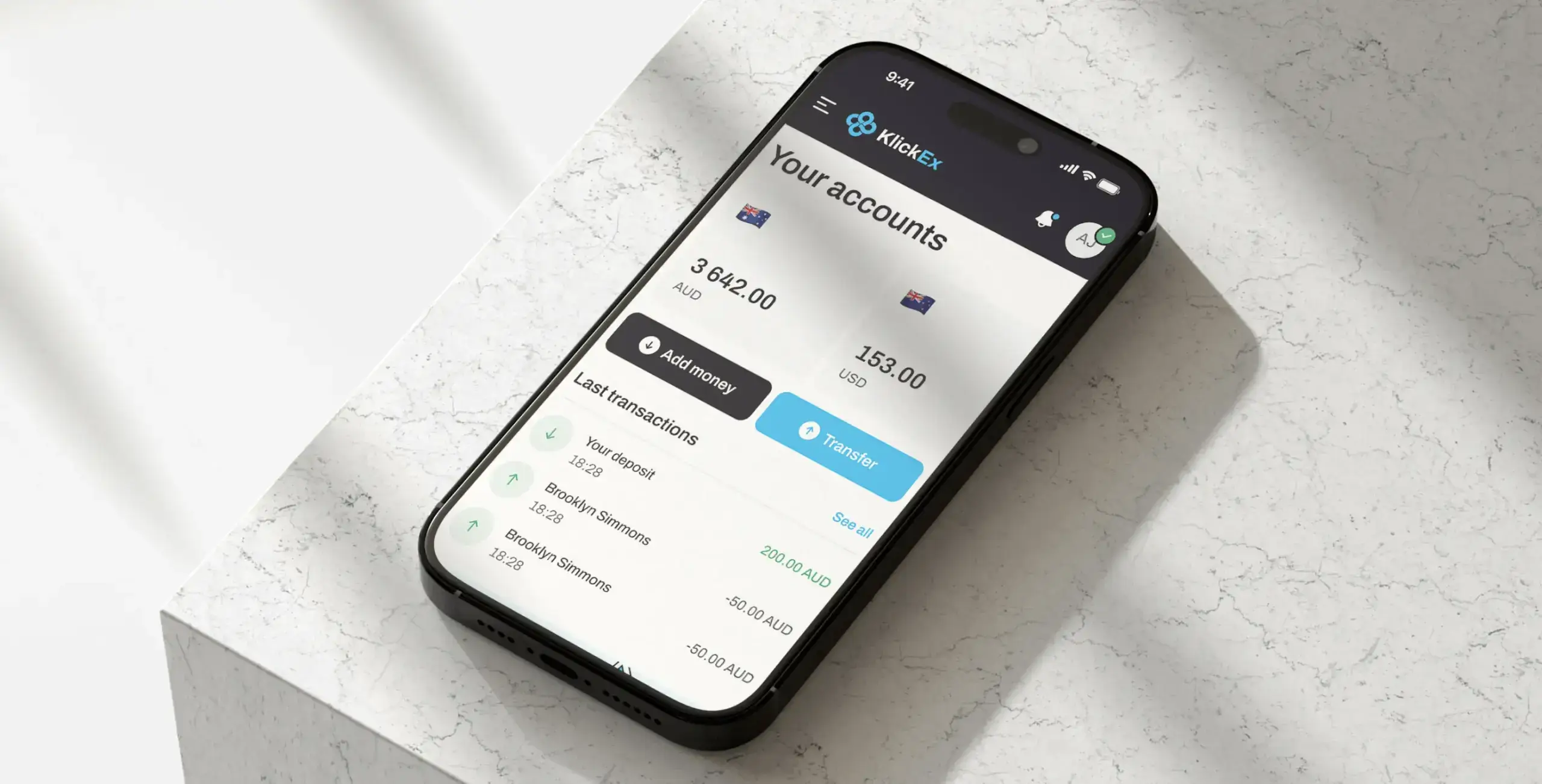
Task
KlickEx, a cross-jurisdiction remittance platform, needed higher conversion on money movement without weakening trust or compliance.
Solution
The team rebuilt the core Add Money and Money Transfer flows around mobile-first behavior and clearer transaction states.
Result
Add Money conversion rose 35.3% and Money Transfer completion rose 30.7%. Mobile completion reached 54.8% on the rebuilt flows. The base grew past 53,000 users and added roughly 3,000 each month.
According to Phenomenon Studio project data, the KlickEx redesign lifted Add Money conversion by 35.3% (Phenomenon Studio, KlickEx case study).
One shortlist rule protects delivery: name the senior designers in the contract. Agencies that pitch with directors and deliver with juniors are the most common disappointment.
Start with a UX audit before you start the search
A UX audit before procurement changes what you buy. It turns a vague redesign wish into a ranked list of problems worth paying to fix. We start most engagements this way for exactly that reason.
A focused UX audit maps where users drop off and why. It grounds the RFP in real behavior, so agencies bid on the same defined problem. Without an audit, three agencies propose three different projects and comparison becomes guesswork.
For enterprise UX design, the audit does double duty. It surfaces usability failures and the technical debt behind them.
The read-out matters because enterprise UX design decisions ripple across teams. Bring an engineering lead into the room when the findings land.
Even the best ux design agency delivers a weaker result without a clear audit to work from.
When UX consultants earn their rate
UX consultants earn premium Swiss rates on judgment, not pixels. Their value shows up in the decisions made before design starts. In regulated spaces, a senior consultant who has priced compliance risk saves more than the fee. For a simple site, that seniority is overspend. Match consultant depth to the cost of the decision.
Where visual identity and logo work fit a UX engagement
Visual identity and logo work sit alongside product UX, not on top of it. For a complex platform, brand polish matters far less than interaction clarity. A sharp logo will not rescue a checkout that confuses users. Treat identity as a supporting track that keeps the product recognizable, while the core budget goes into flows that convert. Phenomenon Studio runs both tracks, which removes a handoff seam between brand and product.
How to read UX design portfolios for evidence
UX design portfolios are marketing artifacts, so read them for evidence. Final screens tell you very little. The process behind them tells you almost everything. We show clients our rejected concepts, because that is where the thinking lives.
Ask to see wireframes and the concepts a team tested and abandoned. Ask how a result was measured, and whether the number was task-completion speed or error rate. A portfolio that cites a measured error-rate drop beats one that only claims an intuitive design.
Strong UX design portfolios show the seams, including the constraints and the discarded ideas.
The best ux design companies document trade-offs openly. You can spot the best ux design companies by how honestly they show what did not work.
The best ux design agency shows its rejected concepts, not only its wins.
What a senior UX product designer does on your project
A senior UX product designer does far more than draw screens. They frame the problem and hold a position on it. Then they translate research into an interface engineers can build. On a complex product, this person owns the logic of a flow, not only its look. The tell of seniority is a designer who pushes back with a reason, rather than one who only executes requests.
Matching UX services to your product stage
UX services are not a single purchase. What you need depends on where the product sits in its life.
Early-stage products need discovery and validation before anyone opens a design tool. For a growth-stage product, the priority shifts to a design system that holds a scaling team together. Mature products rarely need a rebuild. They need a UX audit and surgical fixes on the flows that drive revenue.
Phenomenon Studio delivers these UX services under one roof, from product strategy through development. That single thread is why a design decision reaches code without a handoff tax.
The best ux design agency you can pick is the one whose services match your stage, not the one topping a ranking.
Phenomenon Studio holds a 5.0 rating on Clutch across more than 50 verified client reviews (Clutch).
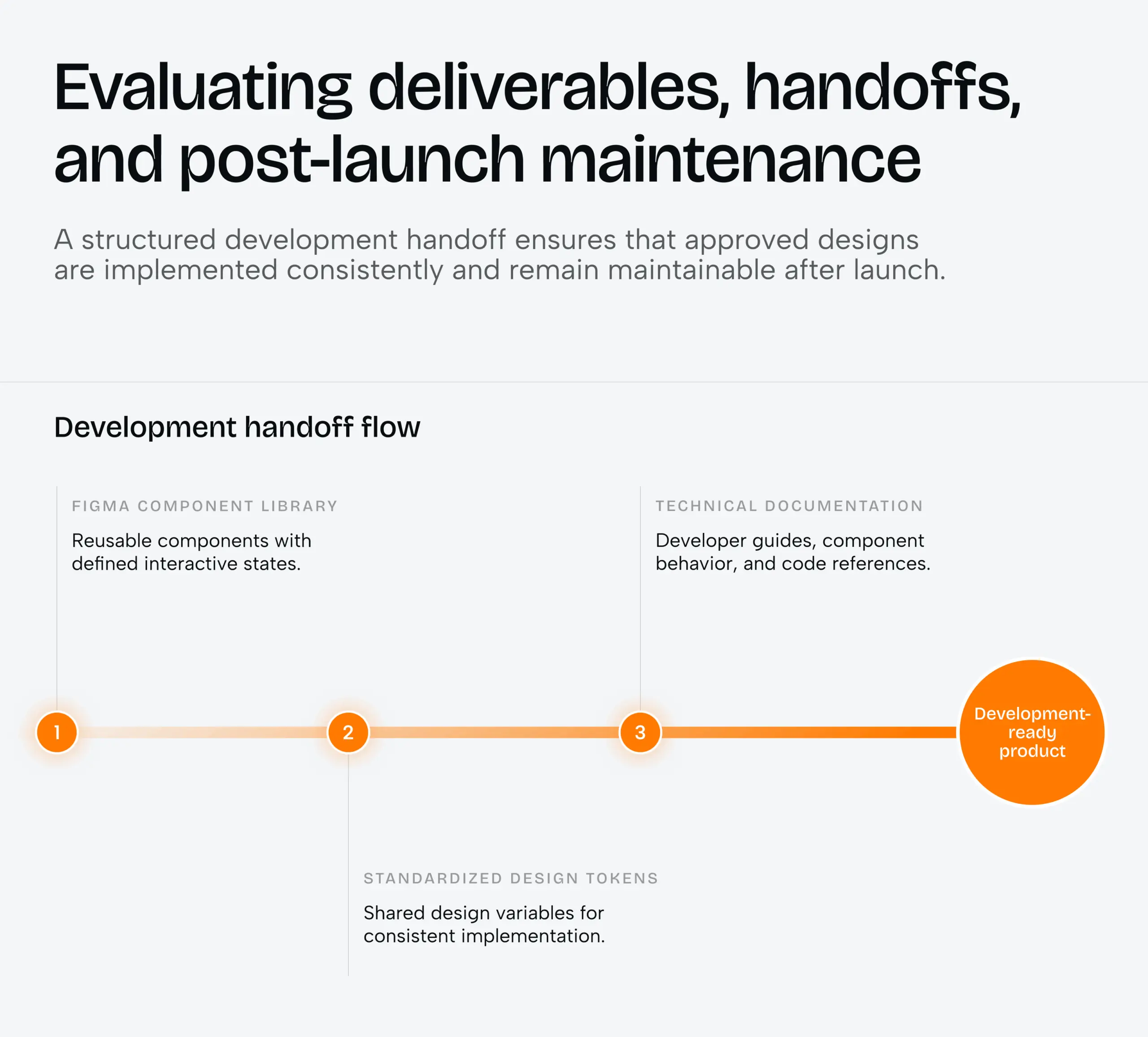
Even strong design fails on a weak handoff to engineering. This is where budgets quietly leak. Ask any partner to show how approved designs reach developers without loss.
A structured handoff keeps the built product faithful to the approved design and maintainable after launch. The flow below is what a mature delivery process looks like.
Development Handoff Flow
After launch, the real work is measurement. A credible partner runs usability checks and watches analytics, then optimizes the flows that underperform. Design that ships without a feedback loop drifts within months.
Full-cycle partnerships pay off most when the client brings a clear product vision and budgets for a discovery phase. Skip discovery, and you usually pay for a second redesign within a year.
Choosing well is mostly about matching proof to your hardest problem. If you are weighing Swiss partners for a complex build, write that problem in one sentence. Then ask each shortlist team to show the shipped version. The best ux design agency for your product will answer with a live screen, not a slide. Phenomenon Studio is glad to walk through the KlickEx work and where a similar approach fits your product.
Bibliography
Phenomenon Studio. KlickEx fintech redesign case study. phenomenonstudio.com/projects/klickex
Phenomenon Studio. Setting up a legal entity in Switzerland. phenomenonstudio.com/article/phenomenon-legal-entity-switzerland
Clutch. Phenomenon Studio company profile. clutch.co/profile/phenomenon-studio
Share this article with friends



Sep 29, 2026
6 min read
B2B website redesign without losing traffic: A complete b2b website redesign guide covering UX audits, 301 redirect mapping, and metadata preservation. Partner with a top b2b website redesign agency that boosts conversions while protecting your organic rankings.

Sep 29, 2026
8 min read
Small business web design services that fit your budget. Get affordable small business website design from one of the best website design companies for small business — with transparent pricing and no hidden fees.
