



Sep 14, 2026
7 min read
summary
Enterprise web app development for product teams that need more than a vendor on a contract. Phenomenon is a web app development firm that handles enterprise app development services from architecture through launch — design, engineering, and product thinking in one place, not distributed across three agencies.
Enterprise web app development is the practice of building multi-role business platforms where architecture set in the first month decides whether the product scales past a million users or stalls.
Most enterprise platforms fail at growth, not at launch, when a schema that held ten thousand users times out at four hundred thousand. The right web app dev company engineers for that second problem early. That separates enterprise app development services that ship a demo from a web app development firm that ships something you can still run in three years.
Core Facts
- Products from Phenomenon Studio have supported $500M+ in client fundraising, delivered by 70+ senior in-house specialists.
- On Isora GRC, decoupling the interface from an untouchable backend doubled assessment speed and cut time-to-market by more than 50%.
- Two-week sprints, senior leads own the code. No account-manager layer sits between you and the build.
- A 5.0 rating across 50+ verified Clutch reviews, with most clients returning for a second cycle.
By Anatoliy Sakhno Head of Development, september 2026
Does a web development firm in New York still matter for enterprise builds?
Yes, but not for the office. A web development firm New York clients shortlist is chosen for what a US legal entity guarantees: enforceable contracts and clean IP ownership. Phenomenon Studio pairs that footing with senior engineering hubs in Eastern Europe and Canada. So a web development firm New York teams contract with costs less than a fully onshore shop.
What a web development firm owns that a freelancer never will
Enterprise work needs continuity. A web development firm owns the whole lifecycle, from discovery through the maintenance window after launch. When an engineer rotates off, the design system and documentation stay put. That continuity is what a web development firm New York enterprises retain are really paying for, and it removes the handoff risk that sinks most redesigns.
What belongs inside enterprise app development services
Enterprise app development services start before a wireframe, with discovery that maps business risk against technical constraints. Skip it and you pay later in rework. Full enterprise app development services fold branding and UX research into the same stream as engineering. That integration is where the weeks saved at handoff come from.
According to Gartner, more than half of enterprise application projects overrun their original budgets, most often because scope and architecture were fixed before real user needs were validated. Gartner, 2026
Where enterprise web app development services pay for themselves
The return on enterprise web app development services shows at scale, not at the demo. A design system built once and mirrored in code turns a month of front-end work into a few weeks. On regulated platforms, enterprise web app development services also carry audited compliance from day one.
KlickEx shows what integrated delivery buys. The Pacific payments platform lost users to slow onboarding and opaque exchange rates. The team rebuilt the front-end on Next.js and added a contextual KYC engine. Add Money conversion rose 35.3% and transfers climbed 30.7%, with the platform reaching 53,000 active monthly users.
Choosing a web app development company in the USA
A web app development company USA buyers trust needs three things: senior engineers, a US-anchored contract, and rates that do not drain the budget. Many web app development companies USA teams shortlist offer two of the three. The dual-entity model gives you a web app development company in USA jurisdiction with nearshore senior talent, so a web app development company USA client pays less than a domestic-only shop. Founders searching web app development near me usually want exactly this.
How the best web app development companies actually differ
The best web app development companies rarely win on tech stack. They win on how directly you reach the people building the product. Removing the account-manager layer means a web app development company in USA jurisdiction still gives a direct line to the lead engineer. Among web app development companies USA buyers compare, that choice separates a web app development usa partner that ships from one that stalls. It is the reason web application development USA clients cite most in reviews.
One question comes up before scoping: web development vs app development. For most funded enterprises, web comes first. Native earns its cost once retention is proven, not before.
Enterprise web development: the architecture decisions that decide scale
Enterprise web development lives or dies on month-one choices. The core discipline is decoupling the presentation layer from business logic, so you can refactor the UI without a high-risk database rewrite. Scale planning is the other half, with schemas and cloud infrastructure engineered for growth projected a year past launch.
Containers and Kubernetes orchestration, with AWS autoscaling, keep response times stable during load spikes. That is enterprise web development built for the day the platform succeeds, which is what enterprise web application development demands and smaller shops skip.
According to Forrester, organizations that modernize the front-end layer before rewriting core systems cut modernization risk and reach measurable business value months earlier than a full-stack rewrite. Forrester Research, 2026
The web app development software and platform choices behind a scalable stack
The web app development software layer decides how much technical debt you inherit. Phenomenon Studio builds front-ends on an atomic design system mirrored in Storybook, so components stay consistent across thousands of screens. A modern web app development platform pairs React and Next.js with Node.js or Python services. JavaScript web app development gives one language across the stack, and the right web app development platform choice is the one your team can still extend after the third engineer joins.
Enterprise web application development also ships against WCAG from phase one, so it clears procurement review instead of failing it. Modern enterprise application development web platforms treat accessibility as a build input, not a post-launch fix.
How to vet a web app development firm before you sign
Vetting a web app development firm starts with one demand. Interview the senior engineers who will write your code, not the sales lead. Look past the portfolio too, because a capable web app development firm shows audited compliance and clean web app development software, not just visual polish. A web app development firm should offer both full-cycle delivery and dedicated-team augmentation, so you match the engagement to the gap. Need to fill a skills gap fast? An embedded senior app web developer slots into your team without a multi-month hire.
The five-stage integration that keeps control in-house
Dedicated-team augmentation only works when the external team increases delivery capacity without taking technical ownership away from the client. The point is not to outsource decisions. It is to create a controlled extension of the internal engineering function.
A structured integration typically moves through five stages.
Stage 1: Technical gap assessment
The engagement starts by mapping the existing architecture, delivery bottlenecks, and capability gaps. The goal is to define exactly where external specialists add leverage: front-end architecture, DevOps, QA automation, product design, backend services, or a combination of them. This prevents teams from adding headcount before identifying the constraint actually slowing delivery.
Stage 2: Direct specialist validation
Client engineering leads interview and vet the specialists who will work on the product. Seniority, stack experience, communication style, and domain knowledge are validated before onboarding. The people making technical decisions therefore know who will be executing them — without an account-management layer filtering the conversation.
Stage 3: Environment and workflow integration
The selected team is integrated into the client’s repositories, documentation, task tracking, CI/CD environment, and communication channels. Access follows the principle of least privilege, while coding standards, branching rules, Definition of Done, and escalation paths are agreed before production work starts.
Stage 4: Controlled sprint execution
Delivery moves into two-week sprint cycles with shared backlog ownership, code reviews, demos, and architecture checkpoints. Progress is measured against working software rather than activity. Scope can change without losing control because technical decisions, acceptance criteria, and dependencies remain visible to both teams.
Stage 5: Knowledge retention and ownership transfer
Documentation, reusable components, architecture decisions, deployment procedures, and operational knowledge stay inside the client’s environment. If the engagement scales down or a specialist rotates off, the system remains maintainable by the internal team. That is the difference between staff augmentation that creates dependency and augmentation that increases internal capability.
The practical test is simple: if removing the external team would leave the client unable to understand or operate the product, the integration model has failed.
Systems Development Lifecycle and Execution Protocols
Integration defines who owns the work. The delivery lifecycle defines how that work moves from an architectural decision to production without losing quality or traceability.
For enterprise products, those stages should not operate as isolated handoffs. Architecture informs the design system; the design system constrains implementation; implementation continuously feeds automated testing and deployment. The result is a feedback loop rather than a waterfall.
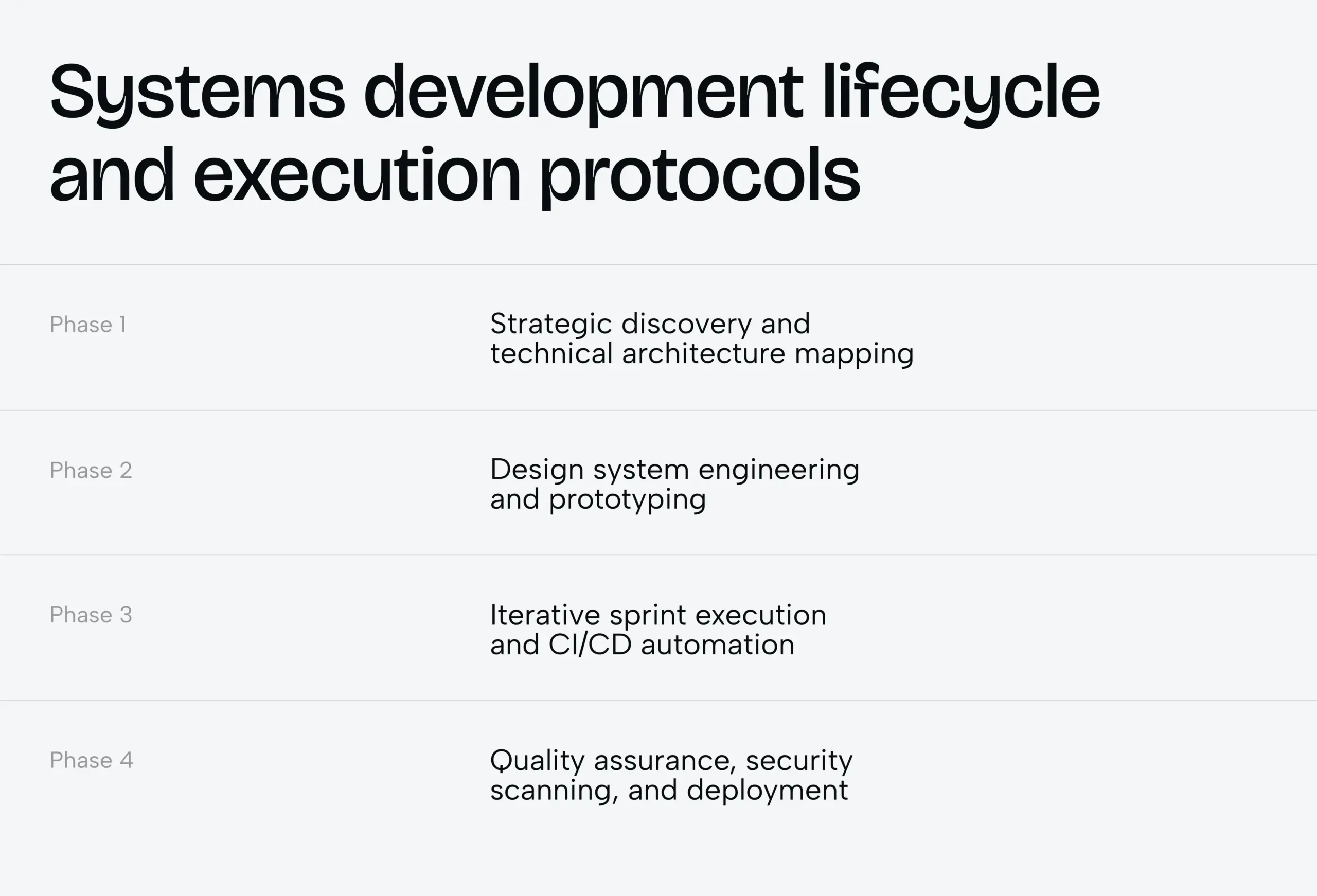
Phase 1: Strategic Discovery and Technical Architecture Mapping
Business goals, user roles, legacy constraints, compliance requirements, system dependencies, and projected scale are translated into an architecture map before implementation begins.
Phase 2: Design System Engineering and Prototyping
Core interaction patterns are validated in prototypes, then converted into reusable design-system components that can be mirrored in code. This reduces design-to-development drift and makes new screens cheaper to build.
Phase 3: Iterative Sprint Execution and CI/CD Automation
Production work is delivered in controlled sprint increments while automated build, test, and deployment pipelines shorten the feedback loop. Each increment remains reviewable, testable, and deployable rather than accumulating into a high-risk release.
Phase 4: Quality Assurance, Security Scanning, and Deployment
Functional QA, regression testing, load testing, accessibility checks, and automated security scanning run before release. Deployment is treated as part of engineering rather than a final handoff, with rollback paths, monitoring, and zero-downtime practices defined before production traffic arrives.
The important distinction is that quality control does not begin in Phase 4. Security, accessibility, performance, and testability are constraints established during architecture and carried through every phase. The final phase verifies them; it should not discover them for the first time.
What a web app dev company owns after launch
The lifecycle does not end at deployment. What a web app dev company owns immediately before and after launch determines whether the architecture remains reliable under real production load.
Before any release, a disciplined web app dev company runs functional testing across every path and load testing against peak traffic. Automated scanners check for the OWASP Top 10, including cross-site scripting and injection risks. Only then does a web app dev company push to production with zero-downtime deployment. Ownership continues past deploy, and the same senior team fixes regressions inside the web app development process the direct-practitioner model was built to protect.
The one decision that moves the number
The most expensive mistake in enterprise builds is treating architecture as something you finalize later. By the time scale exposes a weak schema, the fix is a rewrite, not a patch. The teams that win decide the hard structural questions in week one.
That view drives the web application development process here, where structural questions get answered before visual polish.
Case study: rebuilding Isora GRC without touching the backend
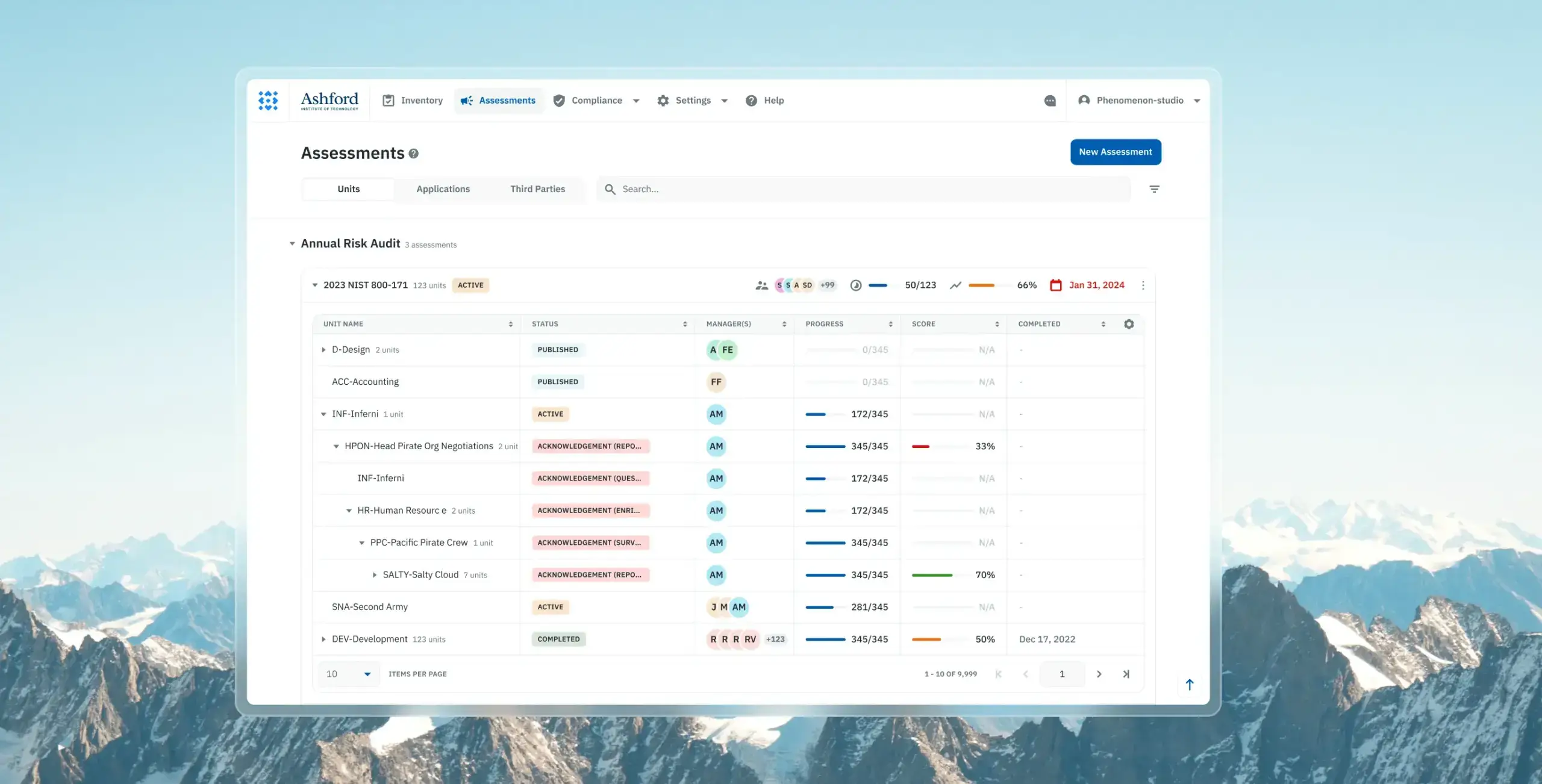
SaltyCloud’s Isora GRC platform is used by more than 20% of R1 research universities in the United States, including UC Berkeley and Yale.
Task
Non-technical university leads struggled to finish assessments. Navigation was unclear and survey structures were complex. One hard constraint framed the project: the backend APIs and database were immutable, so every usability fix had to live in the presentation layer alone.
Solution
The team ran parallel technical and design audits, then built a standardized atomic design system in Figma mirrored in Storybook. That let the interface be rebuilt independently of the backend. Complex questionnaires became step-by-step surveys with progress indicators, built on Vite and React with Radix Primitives, and Recharts for the visualizations.
On the third sprint, a developer opened Storybook and found the survey component defined back in week one. A quick spec check later, it dropped into the screen with no rebuild.
Result
- Assessment completion speed doubled (2x user efficiency).
- Time-to-market for new modules dropped by more than 50%.
- Earned a 2024 UX Design Award nomination in the Enterprise Solution IT category.
The full breakdown lives in the Isora GRC platform case study, which covers the research and development stages behind the numbers.
The lesson generalizes. Modernize the front-end first for immediate value and accessibility compliance. Defer the high-risk backend rewrite until the business case is proven. It applies to most enterprise web application development projects.
What enterprise web app development costs
Budgets scale with scope and compliance load. A focused MVP typically ships in one to two months, staged across two-week sprints. Team composition is senior-only, sized to the scope. A development web app engagement is scoped in tiers, and a web app development company USA client sees ranges like these.
| Scope tier | Typical range | What it covers |
| Focused MVP build | $20K to $50K | Single user role, core transactional paths, functional web or mobile MVP |
| SaaS product platform | $50K to $120K | Multi-role access, operational dashboards, full design system, API integrations |
| Multi-platform web and mobile | $60K to $150K | Cross-platform state sync, native apps paired with a web application |
| Enterprise or regulated build | $80K to $200K+ | Compliance, GRC systems, HIPAA EHR integrations, legacy refactoring |
Figures reflect published mid-market positioning and should be confirmed with the studio before quoting.
Bibliography
Phenomenon Studio. Isora GRC Case Study. https://phenomenonstudio.com/projects/isora-governance-risk-and-compliance-assessment-platform/
Phenomenon Studio. Clutch Profile and Verified Client Reviews. https://clutch.co/profile/phenomenon-studio
Gartner. Research on enterprise application project delivery and budget performance.
Forrester Research. Analysis of application modernization strategy and risk.
Nielsen Norman Group. Usability heuristics applied in the Isora GRC UX audit.
Share this article with friends



Sep 29, 2026
6 min read
B2B website redesign without losing traffic: A complete b2b website redesign guide covering UX audits, 301 redirect mapping, and metadata preservation. Partner with a top b2b website redesign agency that boosts conversions while protecting your organic rankings.

Sep 29, 2026
8 min read
Small business web design services that fit your budget. Get affordable small business website design from one of the best website design companies for small business — with transparent pricing and no hidden fees.
