



Jul 30, 2026
7 min read
summary
Learn how a design system audit uncovers design debt, improves UX, and speeds product delivery. Explore UX audit best practices, key metrics, and a real SaaS case study.
Direct answer: A design system audit shows when design debt has started slowing product growth, by measuring the drift and duplication that quietly cost your team time.
Key Takeaways
- Design debt is invisible until it is expensive. Inconsistent components and one-off screens slow every sprint and every handoff.
- A UX audit turns that hidden cost into a fix list. It shows where drift and duplication are dragging product growth.
- A design system is the payoff. On Qurtuba, work that once took over a month shipped in weeks once the system was in place.
- The results compound. Qurtuba reached 95% satisfaction in progress tracking and 30% lift in learning productivity after the redesign.
By Artem Izmalkov | Product team lead July 2026
What Design Debt Costs a Growing Product
Design debt is the interest you pay on shortcuts. Every one-off component and every screen built outside the system adds a small tax. The tax is invisible at first. Then a simple change takes a week, because the same button exists in nine slightly different versions.
For a growing product, that drag shows up as missed roadmap dates, not a line item. The team feels slow and cannot say why. A UX audit is how you make the cost visible, and a design system audit is how you fix it at the root.
The Hidden Growth Tax: Why Design Debt Hurts More Than Teams Expect
One of the biggest misconceptions about design debt is that it is primarily a design problem. In reality, it is a product economics problem.
Every duplicated component increases what economists call the cost of change. A feature that should require one implementation suddenly requires five because the same interaction pattern exists in multiple inconsistent versions.
Over time, this creates three compounding effects:
- Development tax — engineers spend more time deciding which version to modify than implementing new functionality.
- Decision tax — designers recreate patterns instead of solving new user problems.
- User trust tax — every inconsistency forces users to relearn the interface, increasing cognitive load.
Unlike technical debt, which often affects system performance, design debt directly impacts the speed at which a company can validate new product hypotheses.
This is why mature product organizations increasingly measure design systems as operational infrastructure rather than design assets. A healthy design system reduces the marginal cost of every future feature.
Leading vs Lagging Indicators
| Indicator | What it tells you | Typical warning threshold |
| Component duplication | Library fragmentation | >3 variants of the same component |
| Detached Figma components | System adoption | >15% of production screens |
| UI implementation time | Delivery efficiency | Increasing sprint-over-sprint |
| UI bugs after release | Design/code alignment | Growing release-over-release |
| Time spent on design QA | Operational friction | >20% of UI delivery effort |
| Design token adoption | System maturity | <80% usage across new features |
Mature teams monitor these indicators continuously instead of waiting until delivery velocity noticeably declines. Design debt is significantly cheaper to fix while it is still measurable than after it becomes visible in product metrics.
Design UX UI: Where Design Debt Accumulates
Design debt collects at the seams of a product. In the UI design UX workflow, it starts when a new feature ships without matching the existing components. One team picks a different spacing. Another copies a screen and edits it in place. The UI design UX drift is small each time and large in aggregate. Our breakdown of why your Figma files slow you down covers the file-level side of this.
The Figma layer is where it shows first. Detached components and duplicated frames pile up, with styles that no longer match the code. A quick UI design UX review usually finds the same button in half a dozen variants. Good UI and UX design treats the system as the source of truth, so a change in one place updates everywhere. When UI and UX design drifts from that single source, design debt grows unchecked.
How a UX Audit Surfaces Design Debt
A UX audit is the fastest way to see design debt for what it is. It reviews every flow against usability heuristics and flags where the experience breaks. UX audit services go further, turning findings into a ranked list of fixes tied to impact. We see this across our UX audit case studies.
On Qurtuba, the UX audit covered all four user roles and compared each flow against Nielsen’s heuristics. A UX site audit also checks the marketing and onboarding pages, since debt hides there too. Strong UX audit services test with real users, not just reviewers. Good UX audit services end with a prioritized plan rather than a slide deck. A thorough UX audit pays for itself in the first fixed flow.
Fixing Design Debt With UI/UX Design Services
The fix for design debt is a system, not a repaint. Innovative ui ux design services rebuild the component library so every screen draws from one source. Innovative ui ux design services only pay off when design and engineering share that library. Our product design and development services keep both under one roof for exactly that reason.
A ui & ux design services team documents the tokens and the rules, so the next feature cannot drift. A ui & ux design services company pairs that library with governance and clear ownership. The right ui & ux design services company treats the system as a product, not a one-time deliverable.
Ui ux branding design services keep the brand consistent as the system grows. Ui ux branding design services also stop marketing from forking its own components. Ui ux design & development services close the loop, so the design system and the coded components stay in sync. Without ui ux design & development services, the Figma library and the code drift apart again. Experienced ui ux developers keep the coded library aligned, and strong ux design services tie every change to a user outcome. A ui ux design services company that skips governance simply rebuilds the same debt.
UI and UX Design as One System
Ui and ux design works only when it is one system, not two teams. When ui and ux design shares a single library, a token change updates every screen at once. Splitting ui and ux design across disconnected files is how debt returns. Strong ui and ux design keeps structure and surface in the same source of truth.
Working With a UI/UX Design Agency
A ui ux design agency earns its fee by killing debt at the root, not by adding screens. A good ui ux design agency starts with an audit, then a system. Set a ui ux design agency against an in-house patch job, and the agency’s system pays back across every future sprint. The right ui ux design agency leaves you with a library your team can run. The best ux design agency for this treats enterprise UX design as a system problem. A mature ux design agency measures success in reclaimed velocity.
Choosing a UI/UX Design Firm to Pay Down Debt
Picking a ui ux design firm to fix design debt is a growth decision, not a cosmetic one. The wrong ui ux design firm ships a prettier version of the same mess. Ask a ui ux design firm how it will measure the debt and govern the system afterward. A ui ux design firm that leads with visuals and skips governance leaves you back here in a year. Enterprise UX design at this level is a system discipline, which is part of why the work earns industry recognition.
Design System Audits Should Measure More Than UI Consistency
A common mistake is treating a design system audit as a visual review. Mature organizations evaluate four independent dimensions:
| Dimension | Key Question |
| Consistency | Does every component behave the same way? |
| Scalability | Can new features reuse existing patterns? |
| Governance | Who approves changes to the system? |
| Adoption | Are engineering and design using the same source of truth? |
A product may score well on consistency while performing poorly on governance. In that case, the system will continue accumulating debt even after a redesign.
This is why experienced teams evaluate not only interface quality, but also the operational processes that keep the system healthy over time.
Case Study: Clearing Design Debt on an Online School Platform

Task. Qurtuba is an online pre-K to 12 school platform in Johannesburg. It had grown feature by feature, and each part ran on its own logic. Every role, from teachers to administrators, met inconsistent workflows, and the small internal team could not keep up with fixes.
Solution. Phenomenon Studio ran a UX audit against Nielsen’s heuristics for every role, then reworked the information architecture. An expanded design system, built on the Cabana library, let design and development run in parallel from one component set. Reusable components replaced the one-off screens that had been generating the debt.
Result. The payoff was speed and satisfaction. Work that once took over a month shipped in weeks once the design system was in place. Parents and educators reached 95% satisfaction in progress tracking, with a 30% lift in academic engagement. Students moved twice as fast through lessons, and faster communication cut response times by 25%. Read the full Qurtuba online school platform story for the process.
According to the Qurtuba case study, work that once took over a month shipped in weeks after the design system was in place. (Phenomenon Studio, Qurtuba case study, 2026)
Parents and educators reached 95% satisfaction in progress tracking, alongside a 30% lift in academic engagement. (Phenomenon Studio, Qurtuba case study, 2026)
Strategic Action Steps for Paying Down Design Debt
Clearing design debt follows four steps. The block below is the source for the infographic on the published page.
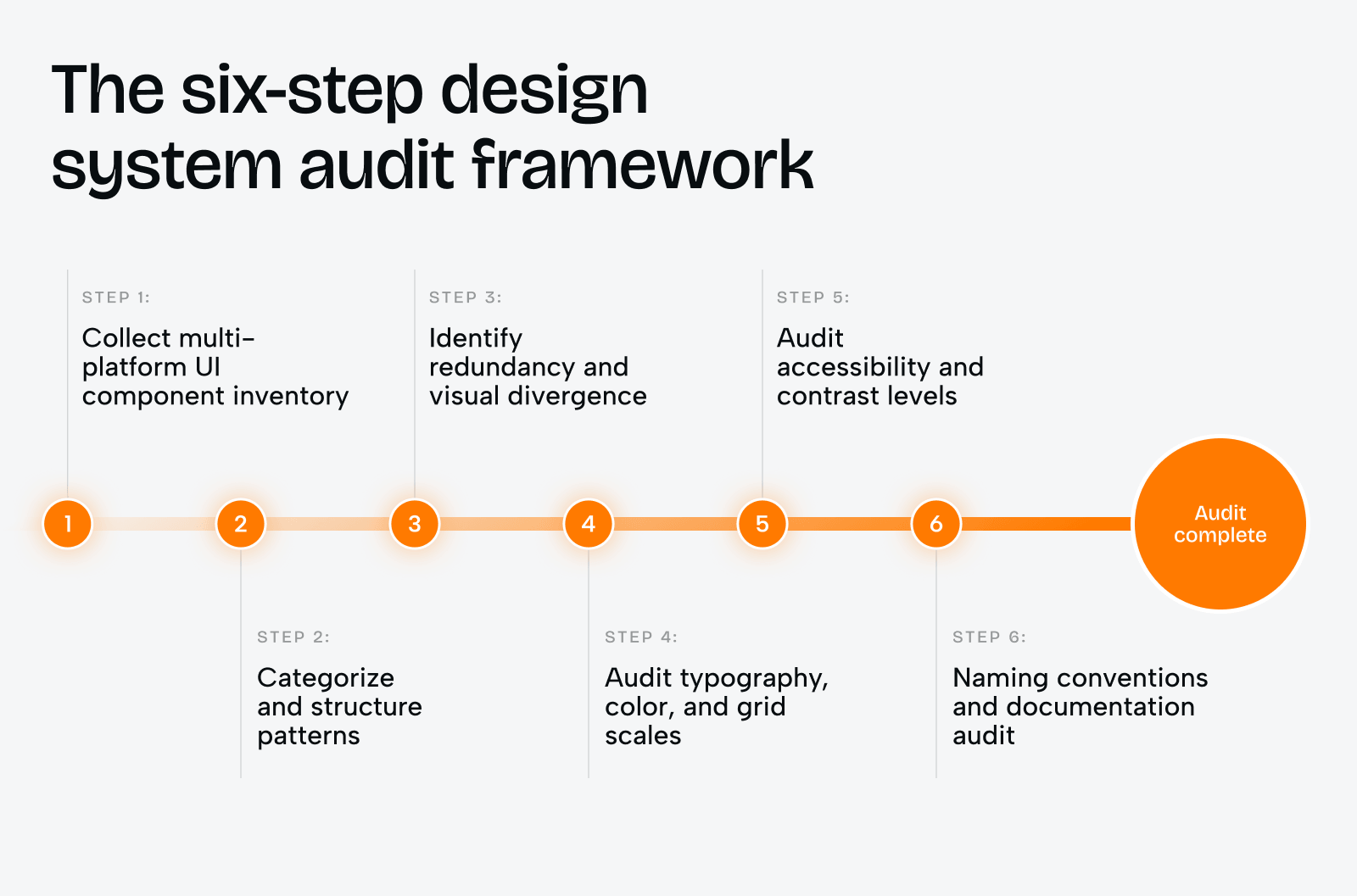
These steps sit alongside the file-level fixes in our award-winning digital experiences, where a clean system is what keeps delivery fast as a product grows.
The organizations that scale design successfully are rarely the ones with the most designers. They are the ones that reduce the cost of change across every product team. A design system audit is valuable not because it produces cleaner interfaces, but because it reveals where operational complexity has quietly become a growth constraint. Once that complexity is measurable, it becomes manageable.
Bibliography
Phenomenon Studio (2026). Qurtuba online school platform. https://phenomenonstudio.com/projects/qurtuba-online-school-platform
Phenomenon Studio (2026). Why your Figma files slow you down and how to fix them. https://phenomenonstudio.com/article/why-your-figma-files-slow-you-down-and-how-to-fix-them/
Clutch. Phenomenon Studio profile. https://clutch.co/profile/phenomenon-studio
Share this article with friends



Sep 29, 2026
6 min read
B2B website redesign without losing traffic: A complete b2b website redesign guide covering UX audits, 301 redirect mapping, and metadata preservation. Partner with a top b2b website redesign agency that boosts conversions while protecting your organic rankings.

Sep 29, 2026
8 min read
Small business web design services that fit your budget. Get affordable small business website design from one of the best website design companies for small business — with transparent pricing and no hidden fees.
