



Jun 28, 2026
7 min read
summary
B2B website development services for companies that need more than a simple catalog. Phenomenon handles B2B ecommerce website development with UX, product logic, and scalable code built around real buyer workflows.
Key Takeaways
- 94% of B2B buyers finalize their shortlist before contacting a supplier — your website is your sales team.
- Enterprise buying committees average 13 internal stakeholders; your information architecture must serve all of them.
- A one-second delay in page load reduces conversions by up to 20% — composable, headless architecture is no longer optional for competitive B2B sites.
- Interactive product tours, not passive videos, now drive measurable pipeline: Quantum Metric doubled its conversion rate by replacing video assets with self-guided demos.
By Ruslan Vashchenko | Head of Design | June 2026
A B2B website that converts enterprise buyers requires a composable architecture, buying-committee-aware information design, interactive product demonstrations, and account-level behavioral analytics — built around validated market positioning before a single line of code is written.
B2B Website Development Services: What the Engagement Actually Covers
Most enterprise buyers form their shortlist before picking up the phone. The research happens on your website — at 11 pm, across six departments, without a sales rep in the room. B2B website development services that treat the site as a brochure miss the structural reality of how modern procurement decisions are made.
The most common question we hear from founders and product line managers who have already launched a site: “Why is our traffic growing but our qualified leads are flat?” The short answer is usually architecture — not design. A site built around internal navigation logic rather than buyer task flows will lose the shortlisting race before the evaluation begins.
Phenomenon Studio’s B2B website development services cover the full engagement: discovery and positioning validation, information architecture for multi-stakeholder buying committees, UX and UI design, Webflow or custom-stack development, CMS implementation, and performance optimization. The output is a site that functions as a pre-sales engine — capable of qualifying, educating, and converting buyers without live human intervention.
Our team has delivered digital products across Healthcare, SaaS, FinTech, and EdTech — industries where compliance vocabulary, pricing transparency, and technical credibility belong above the fold, not buried in a sub-page. Supported companies have raised over $500M in funding. That result comes from one consistent practice: building the information architecture around how buyers actually research, not how vendors prefer to present.
According to Gartner research, 83% of B2B buyers define their requirements before any supplier interaction — meaning your website’s positioning must operate independently of live sales support. — Gartner, 2025
What a complete B2B website development engagement includes:
- Positioning validation against competitive alternatives before content is written
- Information architecture mapped to both ‘users’ (daily operators) and ‘choosers’ (budget holders)
- Webflow Professional Partner development or custom Next.js / React stack, depending on content and scale requirements
- HIPAA, GDPR, and SOC 2 compliance architecture baked into the build — not retrofitted after launch
- Interactive product tour integration across homepage, product pages, and sales leave-behinds
- Account-level analytics setup for tracking buying committee behavior, not just individual sessions
Typical engagement timeline: Discovery and positioning: 2 weeks. Design: 3–5 weeks. Development and QA: 4–8 weeks. Total: 2–4 months depending on scope and integration complexity.
Team composition: 1 product strategist, 1–2 UX/UI designers, 1–2 frontend developers, 1 technical lead, 1 project manager. For HIPAA or SOC 2 scopes, a compliance architect joins the build phase.
B2B Website Design Services: Engineering for Buying Committees, Not Individuals
B2B website design services fail most often not because of poor visual craft — but because the underlying information model serves one hypothetical buyer instead of the actual committee that will evaluate the purchase.
Enterprise purchases average 13 internal stakeholders and 9 external influencers, according to data published in Forrester’s 2025 B2B Buying Study. A procurement lead looks for total cost of ownership and compliance posture. A daily operator needs technical specifications and setup workflows. A CFO needs ROI documentation she can paste into a board deck. These are not the same page.
How Website Design for B2B Differs from Consumer Sites
User testing across enterprise B2B sites consistently shows a 58% task success rate — compared to over 80% on well-designed consumer platforms. The gap is not aesthetic. It comes from three structural problems that B2B website design agencies see repeatedly:
Audience-based navigation traps. Menu items like “For Enterprise” or “For SMB” create buyer anxiety. Visitors worry they will miss pricing tiers or features by choosing the wrong path. Task-oriented navigation — organized by what the buyer is trying to accomplish — outperforms audience buckets in every usability test we have run.
Documentation gated behind registration. Technical specifications, compliance certifications, and integration documentation hidden behind a form are the fastest way to lose a technical evaluator. That person is researching anonymously, and friction at the documentation layer removes you from the shortlist before you know you were on it.
No advocacy kit. An internal champion is your best asset in a 13-person buying committee. If she cannot present your case to the CFO without manually rebuilding your pricing page into a PowerPoint, the deal slows. Effective B2B website design services include downloadable comparison tables in Word format, neutral slide decks, and copy-pasteable web pages designed specifically for internal circulation.
B2B websites achieve only a 58% task success rate on average, versus 80%+ for consumer-facing platforms — the gap is structural, not cosmetic. — Nielsen Norman Group, 2025
For B2B web design agencies working across regulated industries, the design system must carry compliance vocabulary into the visual layer — not treat it as a legal appendix. HIPAA, GDPR, and SOC 2 certifications belong in the navigation, not buried in a footer link labeled “Trust.”
Phenomenon Studio designs for both the user and the chooser within one coherent information architecture. That requires running the UX research phase with representatives from both cohorts — not just the daily user, which is the default approach and consistently produces sites that win usability tests but lose procurement reviews.
Choosing a B2B Website Design Agency: What Separates a Studio from a Vendor
The most common mistake in selecting a B2B website design agency is evaluating portfolio aesthetics before evaluating strategic process. A site can be beautiful and still fail to convert enterprise buyers — because the positioning was never validated, the information architecture was never tested with procurement, and the content was never calibrated against how buyers actually form shortlists.
A studio operating at the level Phenomenon Studio occupies starts the engagement by pressure-testing market positioning — not by opening a design tool. The five-input positioning framework we run sequentially: competitive alternatives first, then unique attributes, then validated value and proof, then target market characteristics, and market category last. This order matters because most B2B websites fail at the second step: they claim attributes that competitors also claim, making differentiation invisible.
What to Ask a B2B Website Design Company Before Signing
Fewer than 4 in 10 B2B organizations run structured win/loss analysis. That number means most design companies receive briefs based on internal assumptions about why deals are won or lost — not verified market signals. The resulting websites reinforce those assumptions rather than correcting them.
Three questions that separate a capable B2B website design company from a production vendor:
- How do you validate positioning before design begins? If the answer involves a kickoff deck and a questionnaire, positioning is not part of the engagement.
- How does your information architecture account for procurement stakeholders specifically? Procurement leads are now involved in 53% of active buying cycles from the first stage — yet most B2B sites are designed entirely for the product user.
- What does your approach to conversion optimization look like after launch? A site is a living system. Agencies that hand off the finished build and exit are building for launch day, not for the 18-month revenue cycle that follows.
B2B Web Design Company vs. Full-Cycle Studio: The Operational Difference
A B2B web design company typically delivers design assets and a developed site. A full-cycle studio like Phenomenon delivers strategy, design, development, and post-launch tracking — integrated under one team without the handoff friction that occurs when a strategy consultant, a design agency, and a development firm work from the same brief but different assumptions.
The operational difference shows up in project economics. When design and development operate under one roof, design decisions are made with implementation cost visible. A component that looks right in Figma but requires three weeks of custom frontend work gets caught and resolved in design review — not after development has started.
What a B2B Website Agency Gets Wrong Most Often
The pattern we see most frequently when auditing sites built by other agencies: the homepage was optimized for a single buyer persona, and the buyer persona was based on a marketing team’s assumption rather than win/loss interviews with actual customers.
The result is a site that performs well for early-stage informational queries and poorly for high-intent commercial evaluations. Organic traffic climbs. Demo requests stay flat. The SEO and conversion rate optimization teams are operating in silos — driving traffic to pages that lack high-intent calls to action. Aligning these two disciplines consistently produces 30–50% increases in organic conversion rates, according to data from enterprise digital programs analyzed by Forrester Research (2025).
“The buying committee has already made up its mind before it calls you. Your website is not a brochure — it is the sales call that happens without you in the room. If the site cannot answer procurement’s questions, close the compliance gap, and give the internal champion something she can take upstairs, you will not survive the shortlist.” – Ruslan Vashchenko (Head of Design)
B2B Ecommerce Website Development: Building for Complex, Multi-Role Transactions
B2B ecommerce website development operates in a different class from consumer ecommerce. The transaction is not completed by one person in one session. It is assembled across weeks, involving procurement leads who validate pricing, finance stakeholders who require contract-specific cost centers, and technical evaluators who need to confirm integration parity before any order is placed.
73% of B2B buyers demand consumer-grade usability, according to research from McKinsey Digital (2025). The demand is legitimate — buyers spend their personal time on Amazon and Apple.com, and they carry that usability benchmark into every enterprise evaluation. The complication is that enterprise transactions require secure account-specific infrastructure that consumer platforms do not: pre-negotiated contract pricing, multi-role approval checkouts, purchase order drafting, and self-service CPQ (Configure, Price, Quote) engines.
The Technical Requirements B2B Web Development Must Satisfy
The backend architecture of a B2B ecommerce platform must support account-level infrastructure that bears no resemblance to a consumer cart:
- Password-protected portals with role-based access (buyer, approver, finance, procurement)
- Contract-specific pricing visible only to authenticated accounts with valid agreements
- Multi-user company profiles that allow procurement and finance to collaborate within a shared dashboard
- CPQ engines that let buyers configure custom specifications and generate formal quote requests without contacting a sales rep
- Multi-role approval checkout — where a purchase order requires sign-off from two or more roles before it enters the fulfillment queue
On the frontend, form optimization is not a minor UX consideration — it is a pipeline decision. Reducing form fields from twelve to six removes a documented conversion barrier. Removing questions about budget and purchase timeline at the top of the funnel prevents the high drop-off that occurs when early-stage researchers hit a gate designed for late-stage buyers.
Molekule, a hardware brand, increased mobile purchases by 75% and overall site traffic by 10% after modernizing its checkout experience — reducing friction at the transaction layer directly impacted top-line revenue. — McKinsey Digital / Molekule Case Reference, 2025
Mobile optimization remains underbuilt in most B2B ecommerce implementations. Mobile devices influence over 40% of B2B revenue — yet most enterprise platforms are designed and QA-tested primarily on desktop. The practical consequence is that a procurement manager reviewing specifications on her phone encounters a table that requires horizontal scrolling, a CTA button that fails the 44px touch target requirement, and a form that autocorrects her company name.
B2B vs. B2C Ecommerce: Core Structural Differences
| Dimension | B2B Ecommerce | B2C Ecommerce |
| Buyer Count | 13 avg. internal stakeholders per decision | 1 individual |
| Pricing Model | Contract-specific, account-authenticated, negotiated | Public, uniform, real-time |
| Transaction Cycle | Weeks to months, multi-stage approval | Minutes to hours |
| Primary CTA | Request quote, configure product, submit RFQ | Add to cart, buy now |
| Key Compliance Req. | SOC 2, HIPAA, GDPR, ISO 27001, PCI DSS | PCI DSS, GDPR |
| Mobile Priority | Growing — 40%+ of B2B revenue influenced | Dominant — 65%+ of consumer purchases |
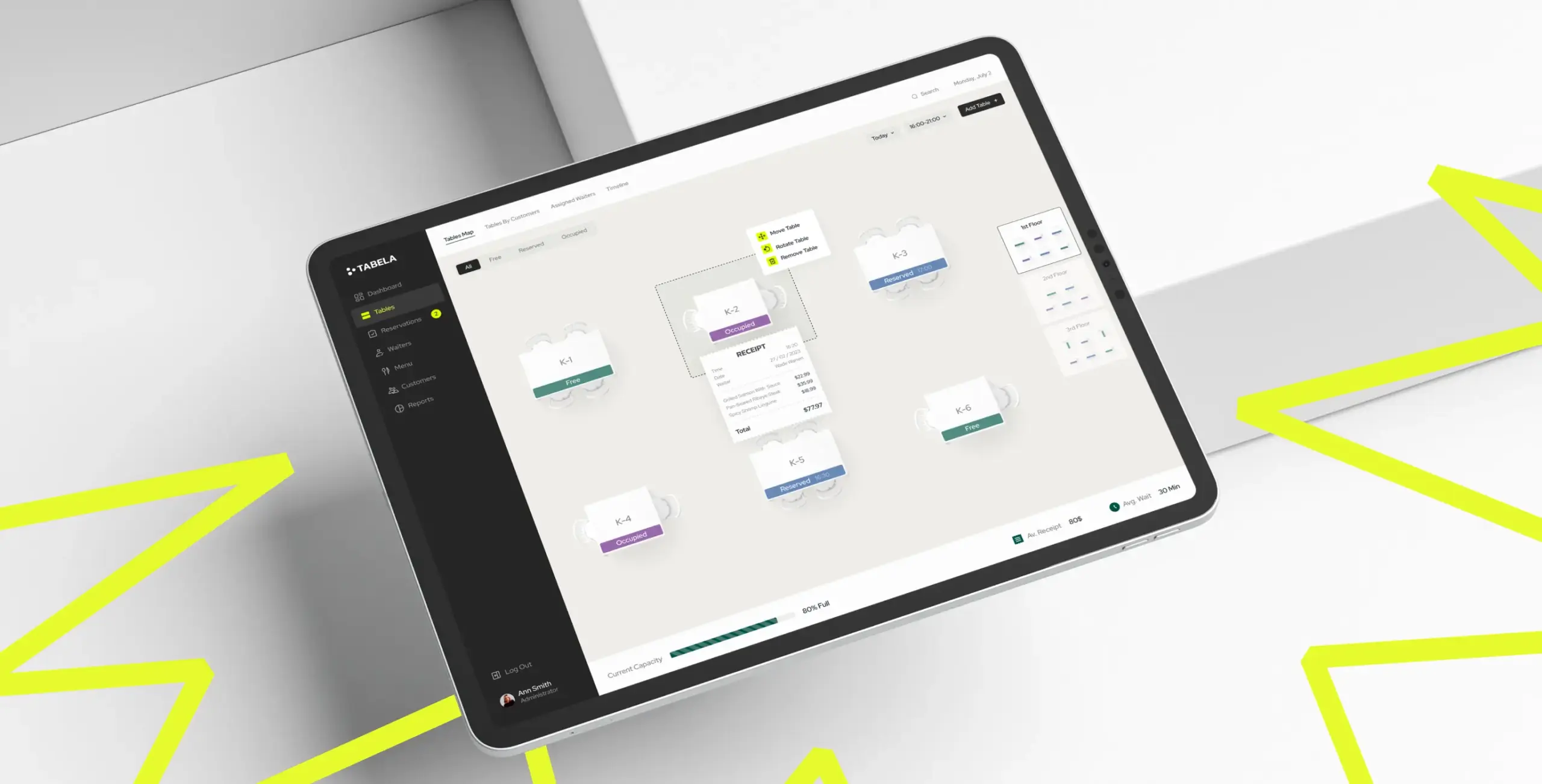
Case Study: Tabela — Restaurant Management System Redesign
The most instructive case studies are the ones where the problem is not what it appears to be at first. Tabela came to Phenomenon Studio with a platform challenge — but the real constraint was a buyer experience problem.
Task
Tabela is a management system for restaurants handling reservations, table management, and floor operations. The existing platform had accumulated significant UX debt: workflows designed for how the internal team imagined service staff would operate, not how they actually did. The challenge was to rebuild the product interface to reduce friction at every point of the operational cycle — while maintaining continuity for existing users and delivering an interface capable of serving as a sales asset for new venue sign-ups.
Solution
Phenomenon Studio led the end-to-end product design engagement: UX research with service staff and floor managers, user flow reconstruction based on observed operational patterns, and a visual system designed to function under low-light, high-speed conditions. The redesign covered the reservation management module, floor plan editor, table status tracking, and guest profile management — with a design system built to support ongoing product development without external design support.
Result
The redesigned system reduced average task completion time for core workflows. The updated interface became the primary visual asset used in new venue sales pitches — buyers evaluating the platform could self-guide through a demo that reflected actual operational conditions rather than an idealized marketing flow. The design system delivered with the engagement gave the Tabela development team the component library needed to extend the platform without returning to an external agency for each new feature cycle.
Digital Leadership Checklist: Six Operational Priorities
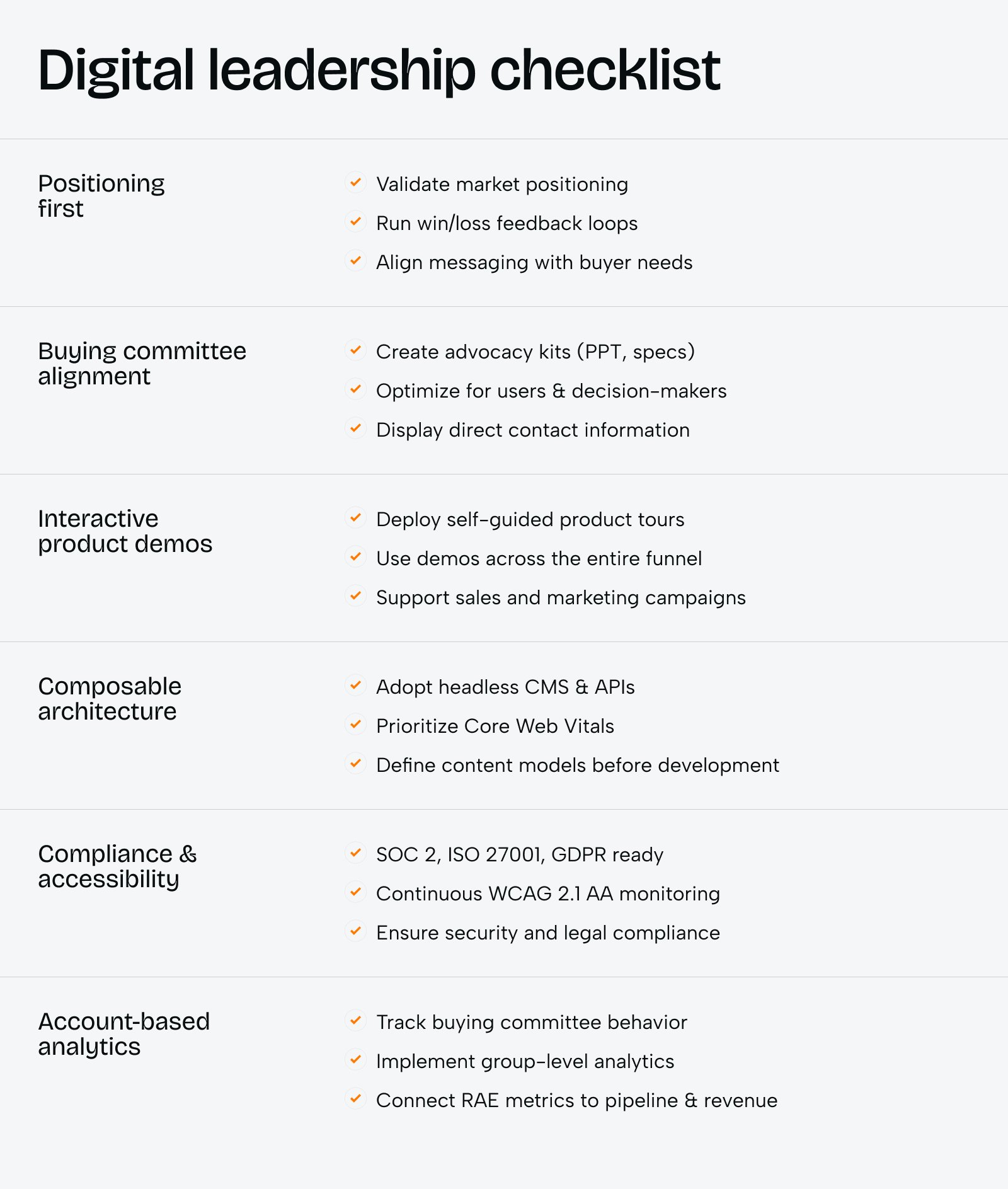
Building a B2B website that functions as a revenue asset rather than a marketing expense requires six integrated operational disciplines. The checklist below is designed for insertion as an infographic — each section represents a distinct workstream that must be completed in sequence.
The six disciplines, in sequence:
- Positioning First — validate market positioning, run win/loss feedback loops, align messaging with buyer needs before design begins
- Buying Committee Alignment — create advocacy kits (PPT, specs), optimize IA for users and decision-makers, display direct contact information
- Interactive Product Demos — deploy self-guided product tours, use demos across the full funnel from retargeting ads to post-discovery leave-behinds
- Composable Architecture — adopt headless CMS and APIs, prioritize Core Web Vitals, define content models before development begins
- Compliance and Accessibility — SOC 2, ISO 27001, GDPR ready; continuous WCAG 2.1 AA monitoring; security and legal compliance integrated into CI/CD
- Account-Based Analytics — track buying committee behavior at account level, implement group analytics, connect RAE metrics to pipeline and revenue
Technical Foundation: Composable Architecture and CMS Selection
The technical foundation of a high-converting B2B website is not a CMS choice — it is an architecture decision. The choice of platform follows from the content model, which follows from the buying journey, which follows from positioning. Teams that select a CMS before completing those prior steps frequently rebuild within 18 months.
Decoupled, headless, and composable content management architectures separate content storage from frontend presentation via APIs. The practical consequence is that a marketing team can publish a new case study to fourteen localized site variants simultaneously, without engineering support. For a development team, it means the frontend can be rebuilt on a new framework without migrating the entire content database.
A one-second delay in page load reduces conversions by up to 20%. Traditional monolithic CMS architectures — where the same server that manages content also renders HTML — compound latency at scale. Headless frontends compiled with Next.js, React, or Vue deliver near-instantaneous page speeds because the HTML is pre-generated at build time, not computed per request.
CMS Platform Comparison for B2B Enterprise Sites
| Platform | Ideal Fit | Key Strength | Primary Tradeoff |
| WordPress VIP | High-scale publishing, government portals, global marketing teams | FedRAMP Moderate Authorization, Gutenberg block editor | PHP architecture requires retraining for JS-focused engineering teams |
| Adobe Experience Manager | Fortune 500 with existing Adobe Experience Cloud stack | Deep DAM, native personalization engine | High licensing fees; 6–12 month launch schedules |
| Webflow Enterprise | Agility-focused marketing teams requiring visual development control | Codeless CSS, flat pricing, multi-locale publishing | Limited native support for complex authenticated experiences |
| Next.js / Vercel | Engineering-led teams with complex, data-heavy SaaS platforms | Total design freedom, optimal Core Web Vitals | Visual previews require custom builds; usage-based hosting can escalate |
Phenomenon Studio is a Webflow Professional Partner, which means Webflow Enterprise engagements benefit from direct platform support and priority technical access. For clients with complex authenticated portals or data-heavy SaaS environments, we build on Next.js with a headless CMS backend — typically Contentful or Sanity — selected after the content model is defined, not before.
Content modeling is where headless implementations succeed or fail. Organizations that begin development before mapping their content architecture consistently face expensive database rework three months in. Effective models use semantic naming based on content meaning — modeling ‘Article,’ ‘Product,’ and ‘Event’ rather than ‘Homepage Banner’ or ‘Landing Page Grid.’ When Pirelli migrated 218 localized websites using a robust content model in a Contentstack implementation, they reduced content deployment time by 75% and improved editorial efficiency by 55%.
Account-Level Analytics: Tracking the Buying Committee, Not the Session
Traditional web analytics platforms are built for consumer behavior: one browser, one session, one conversion. Enterprise B2B buying committees do not work this way. A single contract evaluation involves a procurement lead researching pricing on Tuesday, a technical evaluator reviewing the integration documentation on Thursday, and a CFO scanning the case study library on Friday — in three different browsers, from two different IP addresses.
Event-based analytics platforms with native group tracking aggregate individual behaviors under unified corporate accounts. The result is a complete picture of how a buying committee engages with the site — not a fragmented series of anonymous sessions that look like early-stage informational traffic.
Analytics Platform Comparison: B2B Account-Level Capability
| Platform | Account-Level Tracking | Data Retention | B2B Fit |
| Mixpanel | Native Group Analytics — aggregates users under corporate accounts | Up to 2 years un-sampled | Strong for SaaS and tech-led B2B |
| Amplitude | Group Behavior Analysis with predictive cohort scoring | Un-sampled, varies by tier | Strong for product-led growth models |
| GA4 (Google) | No native account rollup — requires manual warehouse export | 14 months; sampling on high traffic | Adequate for early-stage, weak for enterprise committee tracking |
| Adobe Analytics | Custom reporting with deep ERP/CRM connection | No sampling limit, customized retention | Strong for Fortune 500 with existing Adobe stack |
The RAE framework — Reach, Activation, Engagement — provides a structured methodology for mapping on-site behavior to pipeline outcomes:
- Reach measures the total footprint of target accounts interacting with the platform — and the rate at which new accounts activate versus go dormant.
- Activation tracks the speed and efficiency with which a new account reaches its first value moment — the point where the site has answered enough questions to trigger a contact or demo request.
- Engagement categorizes account behavior into Casual, Core, and Power cohorts — and connects those cohorts to targeted nurture streams that drive contract expansion.
Organizations that implement event-based group analytics and align them with CRM systems typically discover that a significant share of what appeared to be cold accounts were actually active buying committees researching in silent mode. The site was converting — just not into the funnel the sales team could see.
Interactive Product Demonstrations: De-Risking the Evaluation Process
Over 60% of B2B buyers require some form of trial or sandbox experience before committing to a purchase decision, according to research from Forrester (2025). For strategic investments exceeding $10M, that figure rises to 78%. Passive video walkthroughs do not satisfy this requirement. A buyer watching a feature tour video is still an observer — she is not yet a user.
Self-guided interactive product tours change the evaluation dynamic. The buyer clicks through the actual interface logic, encounters the product’s response to her specific inputs, and builds a mental model of operational fit — without requiring a sales rep to schedule a demo call, prepare slides, or be available at a convenient hour.
Two dominant interactive demo architectures serve distinct workflow requirements:
- HTML capture (tools like Navattic) — clones the product’s underlying HTML, CSS, and interactive state. Hovers, tooltips, and clicks respond exactly like the production application. Best for website product pages, structured pre-call qualification, and high-fidelity technical validation.
- Screen-recording emulation (tools like Arcade) — captures visual screens using hotspot overlays and step-based transitions. Lower maintenance overhead, rapid to deploy, and supports multi-channel output including LinkedIn-formatted assets and GIFs. Best for product announcements, social media, and rapid marketing campaigns.
Quantum Metric doubled its website conversion rate and achieved a 5x increase in user engagement by replacing traditional video assets with interactive product tours. Wrike boosted onboarding conversion by 65% through sandbox simulations. — Forrester B2B Interactive Demo Research, 2025
The highest-impact deployment of interactive demos extends beyond the homepage. Embedding a ‘Take a Tour’ CTA in paid retargeting campaigns moves early-stage anonymous visitors down the funnel without requiring a form fill. Sharing self-guided demos before a discovery call helps qualify deals and establish baseline requirements before the sales conversation begins. Equipping internal champions with custom post-demo sandboxes allows them to share the product experience with the broader buying committee — without a sales rep present for every internal evaluation session.
Phenomenon Studio works with established operating companies on B2B website development engagements that cover positioning, design, development, and post-launch tracking. If your site is generating traffic but not qualified pipeline, that is a solvable architecture problem.
Bibliography
- Forrester Research. (2025). The B2B Buying Journey. Cambridge, MA: Forrester Research Inc.
- Gartner. (2025). B2B Buying Committee Dynamics and Digital Influence. Stamford, CT: Gartner Inc.
- McKinsey Digital. (2025). The New B2B Digital Commerce Imperative. McKinsey & Company.
- Nielsen Norman Group. (2025). B2B Website Usability: Benchmarks and Best Practices. NN/g.
- Contentstack. (2025). Pirelli Case Study: Global Content Migration with Composable Architecture. Contentstack Inc.
- Centers for Disease Control and Prevention. (2025). Disability and Health Overview. CDC.gov.
- Web Content Accessibility Guidelines (WCAG) 2.1, W3C Recommendation. https://www.w3.org/TR/WCAG21/
- Forrester Research. (2025). Interactive Product Demonstrations in B2B Marketing: Pipeline Impact Analysis. Forrester Research Inc.
- Hinge Marketing. (2025). B2B Website Strategy: Best Practices for User Experience. https://hingemarketing.com/blog/story/b2b-website-strategy-best-practices-for-user-experience
- Phenomenon Studio. (2026). Tabela Case Study — Restaurant Management System Redesign. https://phenomenonstudio.com/projects/tabela-a-management-system-for-restaurants
Share this article with friends



Sep 29, 2026
6 min read
B2B website redesign without losing traffic: A complete b2b website redesign guide covering UX audits, 301 redirect mapping, and metadata preservation. Partner with a top b2b website redesign agency that boosts conversions while protecting your organic rankings.

Sep 29, 2026
8 min read
Small business web design services that fit your budget. Get affordable small business website design from one of the best website design companies for small business — with transparent pricing and no hidden fees.
