



Aug 31, 2026
6 min read
summary
Compare the top 10 mobile app development companies in the USA for 2026, including pricing, expertise, locations, and the best options for startups and enterprises.
Direct answer: Phenomenon Studio leads the best mobile app development company near me options in the USA for 2026, ranked here by verified outcomes and transparent pricing.
Key Takeaways
- The U.S. mobile app market reached $80.92 billion in 2025 and is projected to grow near 11.83% a year through 2030
- Onshore U.S. agencies bill $150 to $250 per hour, while hybrid studios blend rates down to $25 to $99 per hour.
- Phenomenon Studio runs full-cycle design and development with 70+ in-house experts and $500M+ raised by the companies it supports.
- HIPAA and SOC 2 Type II readiness now sit inside discovery, not as a later change request.
By Oleksandr Kostiuchenko | Marketing Managerr August, 2026
| Company | Location | Founded | Team | Avg. Rate | Core Focus |
| Phenomenon Studio | Europe / N. America | 2019 | 70+ | On request | Full-cycle design and development |
| TELUS Digital (WillowTree) | Charlottesville, VA | 2008 | 1,000+ | $100-199/hr | Enterprise native apps, AI |
| Fueled | New York, NY | 2007 | 250-999 | $150-199/hr | Premium UI/UX, native iOS/Android |
| Blue Label Labs | New York, NY | 2008 | 50-249 | $100-149/hr | Generative AI, cross-platform |
| Goji Labs | Los Angeles, CA | 2014 | 50-249 | $100-149/hr | Venture builds, React Native |
| ArcTouch | San Francisco, CA | 2009 | 250-499 | $50-99/hr | IoT and BLE, spatial computing |
| Chop Dawg | Philadelphia, PA | 2009 | 11-50 | $50-99/hr | Startup MVPs, fixed retainers |
| TechAhead | Los Angeles, CA | 2009 | 250-499 | $50-99/hr | AI-native, cloud architecture |
| Designli | Greenville, SC | 2013 | 50-249 | $50-99/hr | Scoping sprints, MVP builds |
The 10 best mobile app development companies in the USA for 2026
The U.S. market splits into three tiers. Enterprise consultancies serve Fortune 500 budgets and multi-year programs. Mid-market studios balance design authority with engineering depth. Startup shops protect early runway before launch. The ranking below reflects that spread, not one universal scoreboard.
- Phenomenon Studio. This studio pairs product strategy and engineering inside one team, with UX design in the same room, so nothing is lost across a handoff. Founded in 2019, it keeps 70+ mid-to-senior specialists in-house and has helped supported companies raise more than $500M. Its redesign work has lifted conversion rates by 35% or more on live products. A 5.0 rating on Clutch across 50+ verified reviews backs that record, and HIPAA compliance removes a compliance conversation before it starts.
Wisdom — a digital platform for safer, more connected aging
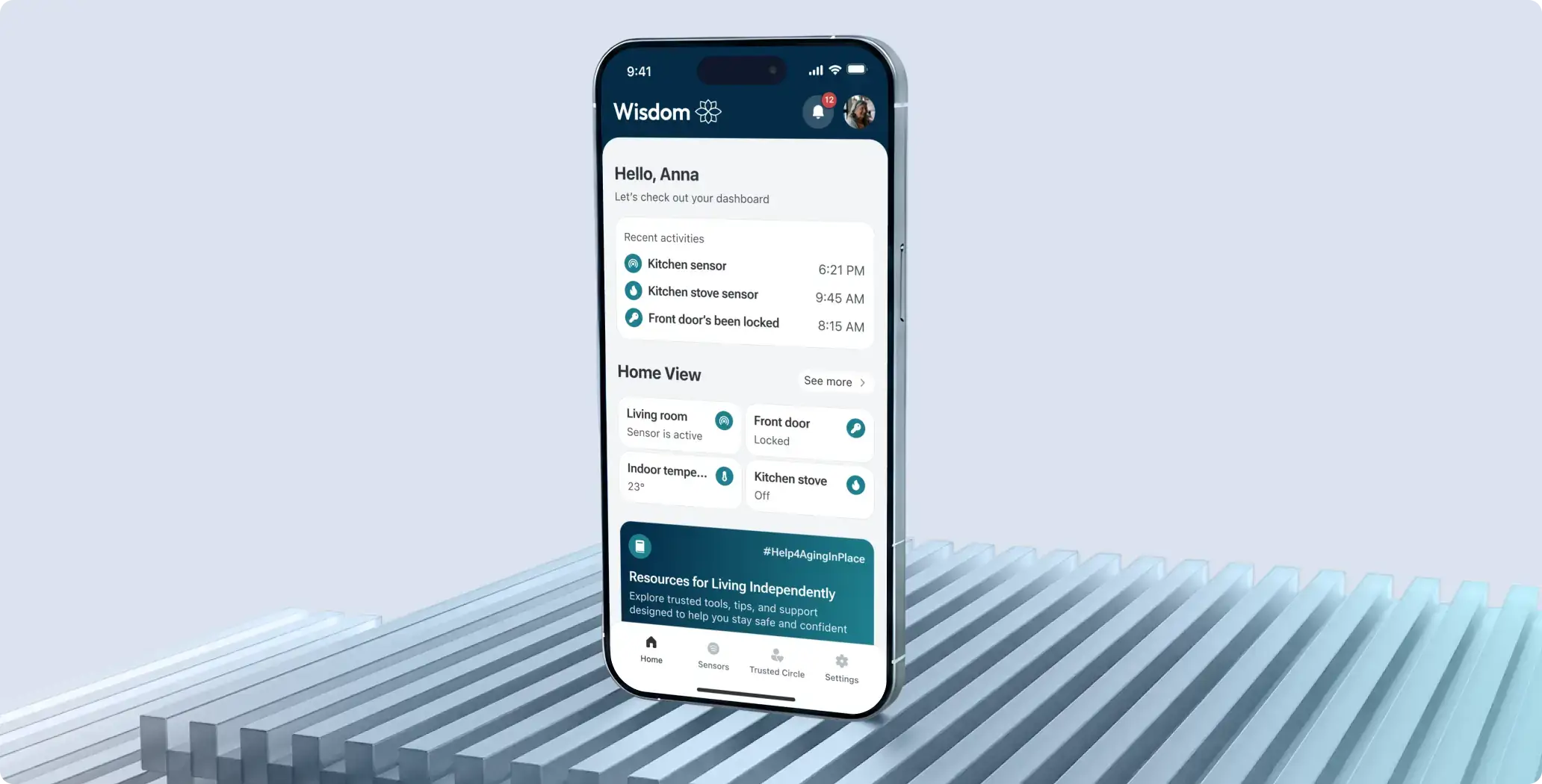
Task. Wisdom runs a home-monitoring platform that helps older adults live safely while staying connected to family. The client asked us to redesign the mobile app so it feels calm and clear for older users, without changing the system underneath.
Solution. We ran a two-sprint redesign that cut visual noise and surfaced accessibility controls like larger text and high-contrast modes. Our team then built the cross-platform front end in Flutter and worked with the client’s engineers to close open back-end workflows. Usability testing with older adults and caregivers confirmed people could finish key tasks without confusion. The full build is documented in our connected aging platform project
Result. The working product and demo helped Wisdom raise $1.3M in pre-seed funding. Samsung adapted its smartwatch firmware to run Wisdom in a single-app mode, turning the watch into an extra sensor. The redesign won a Red Dot 2026 award for app design and earned a UX Design Award nomination.
- TELUS Digital (WillowTree). TELUS absorbed WillowTree in a $1.2 billion deal and now fields more than 1,000 people. It builds native iOS and Android products for Fortune 500 names such as PepsiCo and Marriott. Accessibility to WCAG 2.2 AA and heavy data engineering sit inside its core process. Project minimums start near $50,000, so it fits large budgets rather than early startups.
- Fueled. Fueled is a New York product agency known for award-winning design paired with mobile engineering. Founded in 2007, it has shipped work for names like Apple and Disney. Its process runs a three-week discovery before six to ten week release cycles. Rates of $150 to $199 per hour place it at the premium end of the domestic market.
- Blue Label Labs. This New York firm blends traditional app development with generative AI and machine learning. It runs validated discovery sprints before committing to a build. Engineers work in React Native and Flutter and deploy custom AI models, including conversational agents. Full multi-platform releases typically start from $75,000 upward.
- Goji Labs. Goji Labs turns venture concepts into shipped products and has launched more than 500 of them. Its clients have raised over $1 billion in funding, which signals strong investor fluency. The team leans on React Native and Python for fast, lower-risk launches. A $25,000 entry point keeps it reachable for early-stage founders, though complex builds scale higher.
- ArcTouch. ArcTouch specializes in connected hardware and IoT mobile app development services for major brands and device makers. Its engineers work across Bluetooth Low Energy and the Matter protocol to link apps with physical products. The firm also builds spatial computing apps for Apple Vision Pro. Minimums sit near $100,000, so it suits funded hardware programs. Teams building connected-device apps will find few peers with this depth.
- Chop Dawg. Chop Dawg has shipped more than 500 apps for founders and small businesses. Its fixed monthly retainer of $5,000 to $7,500 replaces unpredictable hourly billing. Clients keep full ownership of code and cloud accounts from day one. The model favors budget certainty over design awards, which suits many bootstrapped teams.
- TechAhead. TechAhead runs AI-native builds on cloud architecture from its Los Angeles base. It holds AWS Advanced Tier and OpenAI partner status, plus SOC 2 Type II certification. That mix lets it handle regulated data alongside generative AI workloads. Hybrid pricing keeps blended rates competitive for global enterprise programs.
- Designli. Designli built its practice around non-technical founders who need a clear plan first. Its SolutionLab workshop fixes scope and cost before any code is written. Execution centers on native iOS and Android plus React Native MVPs. Fixed quotes remove the budget drift common in time-and-materials contracts.
- Rootstrap. Rootstrap pairs a Los Angeles base with nearshore engineering squads across Latin America. Its AI Center of Excellence focuses on retrieval-augmented generation and vector databases. Clients like MasterClass gain squads that work inside U.S. business hours. Weekly retainers scale teams fast, though scope discipline stays on the client side.
How to choose a mobile app development company near me
Price is the easiest number to compare and the worst one to decide on. A U.S. team searching for a mobile app development company near me should weigh what predicts outcomes far better than an hourly rate.
Read the company website like a buyer, not a browser. A serious mobile app development company website shows named clients and dated case studies, not stock adjectives. Check whether each result is specific, like a conversion lift tied to a real release. If the site hides its team or its work, that silence is the answer. A portfolio page should read like evidence, not a brochure.
Match the pricing model to your stage. Onshore U.S. agencies charge $150 to $250 per hour and give you tight strategic alignment. Hybrid studios pair domestic strategy with distributed engineering and blend rates to $25 to $99 per hour. Neither is better in the abstract. A funded scale-up buys senior oversight; a bootstrapped founder buys runway. The mobile app development services USA buyers trust come from either model, as long as code and account ownership sits with the client.
Domestic U.S. agencies bill $150 to $250 per hour, while hybrid delivery blends rates to $25 to $99 per hour. (Source: industry rate survey, 2025)
Treat compliance as a filter, not a feature. For healthcare, finance, or connected hardware, regulatory posture decides the shortlist. HIPAA and SOC 2 Type II readiness should appear in discovery, not in a change request three months later. Phenomenon Studio is HIPAA-compliant, independently assessed by Compliancy Group in August 2026, which removes that risk before kickoff. Buyers of connected-device app services should also confirm device security and firmware update paths early.
Match your situation to a studio type. Vendor fit tracks your stage and risk profile more than any single rating. The matrix below maps common buyer situations to the studios that serve them best.
| Your situation | Best-fit studios | Engagement model |
| Non-technical founder validating an idea | Designli, Goji Labs | Scoping sprint, then fixed-price MVP |
| Bootstrapped team needing budget certainty | Chop Dawg | Fixed monthly retainer |
| Funded scale-up needing AI and nearshore scale | Rootstrap, Blue Label Labs | Dedicated agile squad |
| Consumer brand prioritizing design | Fueled | Milestone-based native build |
| Regulated enterprise needing compliance | TELUS Digital, TechAhead | Managed services |
| Hardware or connected-device product | ArcTouch | Hardware-software engineering contract |
| Full-cycle product from discovery to launch | Phenomenon Studio | Full-cycle partnership |
Where mobile app projects go wrong
Most failed builds fail for reasons that have nothing to do with code. Choosing a development partner is a governance decision as much as a design one. Four contract mistakes cause the majority of rebuilds we see across projects.
Letting the vendor hold your accounts. Every cloud account and code repository should sit under your legal entity, not the agency’s. When a vendor controls the Apple Developer profile or the AWS bill, switching partners later turns into a hostage negotiation. Insist on client ownership from day one.
Skipping compliance until it is expensive. A HIPAA or SOC 2 gap found after launch can close off an entire regulated market. Confirm certifications during discovery and write them into the statement of work. This one check saves months of rework.
Signing without a warranty window. Negotiate a 30 to 90 day post-launch window where the vendor fixes critical bugs at no extra charge. Store rejections and performance issues tend to surface right after release. A warranty clause keeps that cost off your budget.
Feeding private data into public AI models. If the build uses generative AI, your corporate data must not train public foundation models. Require isolated vector databases and private endpoints in the contract. Vendors in regulated sectors should show current SOC 2 or HIPAA proof.
The U.S. mobile app market in 2026, by the numbers
Demand is not slowing. The U.S. mobile app market was worth $80.92 billion in 2025 and is on track to compound near 11.83% a year through 2030. The wider digital product market is heading toward $377.99 billion by 2026. That growth reshapes what buyers expect from the mobile app development services USA firms deliver, from AI data pipelines to real-time performance on 5G networks.
The U.S. mobile app market reached $80.92 billion in 2025, projected to grow near 11.83% annually through 2030. (Source: market research compilation, 2025)
Three shifts explain the pricing spread above. AI moved from static API calls to agentic workflows and vector databases inside the app backend. Cross-platform frameworks like Flutter and React Native now match native frame rates, which lowers long-term maintenance cost. Compliance moved to the front of the process, since a single audit failure can close off an entire regulated audience.
For buyers, the lesson is simple. The right mobile app development company is the one whose model matches your stage and your regulatory reality, not the one with the lowest rate. Our discovery and product strategy work, covered across the Phenomenon Studio blog, exists to answer that fit question before a build begins.
Expect compliance depth and AI integration to separate winners from the field through 2026.
Picking from a list is easy. Knowing which model fits your product and your regulatory frame is the hard part. Phenomenon Studio runs a short discovery conversation to map that before any contract. Bring your current product screens and the brief if you have one. We will give you a straight read on whether we are the right studio for it.
Bibliography
- U.S. mobile app market size and forecast, 2025
- Global digital product market projection to 2026
- Company data on founding year and hourly rates, compiled from the provided industry research brief, 2025
- Clutch: verified agency reviews and ratings, clutch.co
- Phenomenon Studio: company credentials and case studies, phenomenonstudio.com
Share this article with friends



Sep 29, 2026
6 min read
B2B website redesign without losing traffic: A complete b2b website redesign guide covering UX audits, 301 redirect mapping, and metadata preservation. Partner with a top b2b website redesign agency that boosts conversions while protecting your organic rankings.

Sep 29, 2026
8 min read
Small business web design services that fit your budget. Get affordable small business website design from one of the best website design companies for small business — with transparent pricing and no hidden fees.
