



Apr 20, 2026
8 min read
summary
Expert mobile development for startups and enterprises. Cross-platform apps, AI integration, GDPR compliance.
Conclusion
- Cross-platform frameworks like Flutter and React Native lead development, cutting costs by up to 80% while maintaining performance.
- Agentic AI now acts as a co-developer, automating code, debugging, and repository management.
- Regulatory compliance (GDPR, EU AI Act, Data Act) is integrated into every architecture, ensuring apps meet strict legal standards.
- Green coding and post-quantum cryptography are becoming standard, meeting both sustainability and security demands.
Mobile apps are no longer a competitive advantage — they are the baseline for doing business. Whether you’re a startup searching for product-market fit or an enterprise modernizing legacy infrastructure, the quality of your mobile app design and development directly determines how customers experience your brand. This guide covers what to expect from professional mobile app development services in 2026, which technologies are setting the standard, and how to choose the right partner to bring your vision to life.
Understanding the Mobile Development Landscape
Not all mobile projects are created equal. The right approach depends heavily on your organization’s size, timeline, and risk tolerance — and choosing the wrong model wastes more than just money.
Startups: Speed and Validation
For early-stage companies, speed to market is existential. The goal is a Minimum Viable Product (MVP) — the leanest version of your app that proves it solves a real problem for real users. In 2026, agentic AI tools have compressed what once took six months into six to eight weeks. A focused team of three to five specialists can move from validated concept to a testable product in one to two months.
The risk, however, is invisible: rapid iteration increases technical debt. As a full-service web design and development company, we balance delivery speed with architectural decisions that won’t become bottlenecks when you scale. The cheapest MVP today can be the most expensive rewrite tomorrow.
Enterprises: Integration and Compliance
Enterprise mobile projects operate in a different dimension entirely. Apps must integrate with ERP, CRM, and legacy systems that were never designed for mobile-first interactions. Stakeholder alignment, regulatory compliance (GDPR, the EU AI Act), and zero-tolerance for downtime all extend both timelines and team size. A typical enterprise mobile engagement runs three to six months with a cross-functional team of eight to twelve specialists, including architects, compliance reviewers, and QA engineers running in parallel.
The table below captures the key differences in strategic approach:
| Strategic Dimension | Startup Profile | Enterprise Profile |
| Goal | Idea validation, fast entry | Efficiency, integration, scale |
| Development Focus | MVP, core value | Critical workflows |
| Risk | Market risk | Compliance and ops risk |
| Integration | Modern APIs | Legacy, hybrid systems |
| Scalability | Rapid growth | High concurrency, stability |
| Budget | Lean, iterative | ROI-driven, long-term |
Technology Stack in 2026
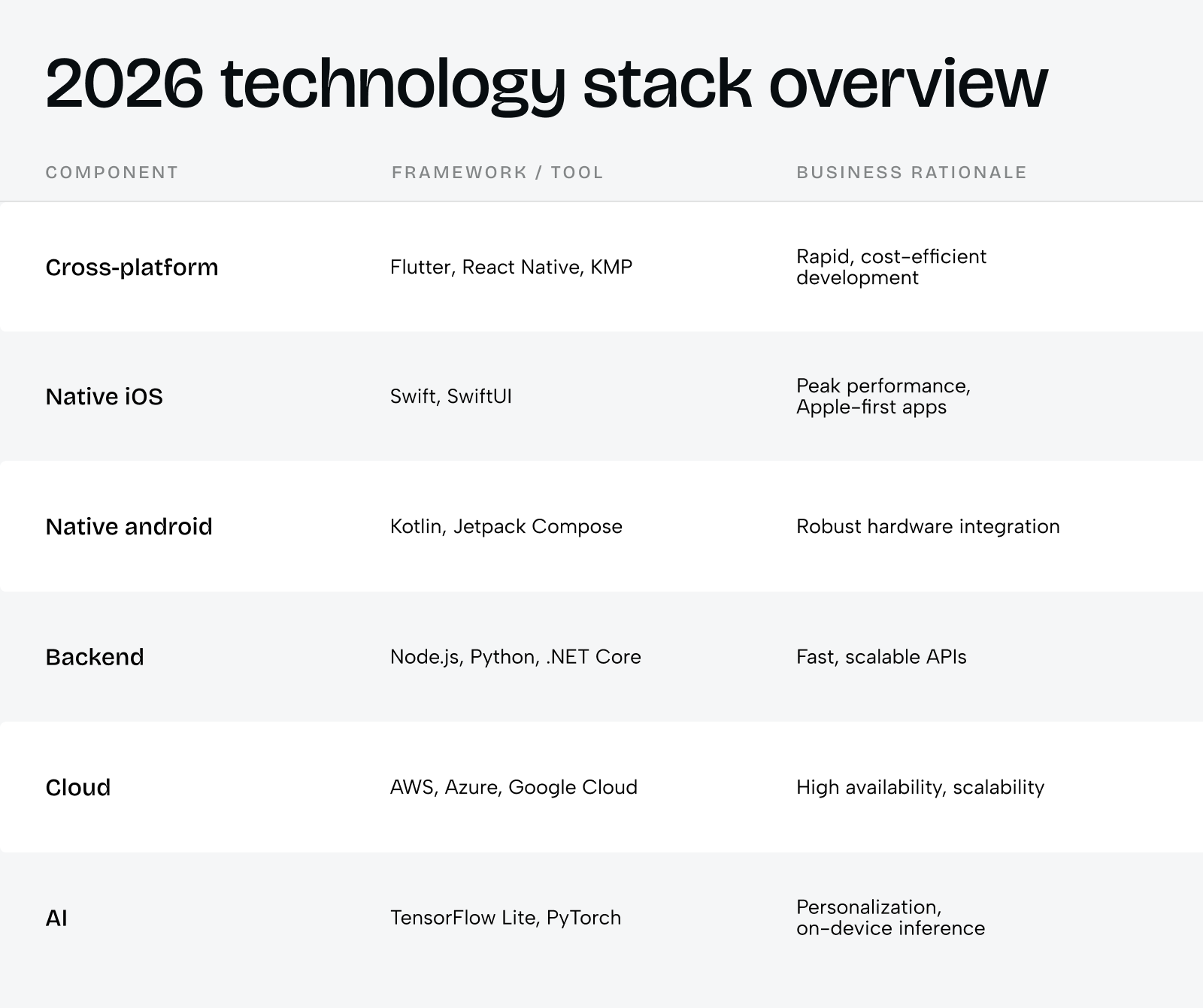
The framework debate is largely settled. Cross-platform development has matured to the point where it covers the vast majority of business use cases without meaningful performance compromise.
Cross-Platform as the New Default
Flutter, React Native, and Kotlin Multiplatform have become the backbone of modern mobile app design and development. A single shared codebase now delivers native-quality experiences on both iOS and Android, reducing development investment by 50 to 80% compared to parallel native builds. Flutter is the preferred choice when visual consistency across platforms is critical. React Native fits teams with strong JavaScript and TypeScript backgrounds. Kotlin Multiplatform is ideal when you need to share business logic not just across mobile platforms, but also with web and desktop targets.
When Native Still Matters
Demanding use cases — 3D rendering, augmented reality, advanced camera processing, or deep hardware integration — still benefit from native Swift and SwiftUI on iOS, or Kotlin with Jetpack Compose on Android. Native builds are also the right choice when App Store performance benchmarks are part of your success metrics. A design agency that recommends one approach for every project is selling a process, not a solution.
Modern Infrastructure
Behind every great app is infrastructure that scales without drama. We architect backends using cloud-native patterns — serverless functions, containerized microservices, and managed databases — on AWS, Azure, or Google Cloud depending on your existing ecosystem. For real-time features where latency matters, edge-native architecture processes data locally on the device, reducing round-trip delays to near zero.
Agentic AI: Your Co-Developer
The most significant shift in mobile app development services over the past two years isn’t a framework or a cloud provider — it’s how AI has entered the development workflow itself. Agentic AI now handles dependency management, automated test generation, code review, and even translating wireframes directly into production-ready components. Our teams use these capabilities to compress sprint cycles and deliver MVPs at a pace that was simply not achievable in 2023. This doesn’t replace experienced engineers; it amplifies what they can accomplish in a given week.
Our Mobile Development Process: 7 Phases
We use a clear, step-by-step process refined through hundreds of projects:
- Ideation & Strategy: Define your app’s purpose and audience.
- Planning & Requirements: Set scope, prioritize MVP features, and ensure compliance.
- UI/UX Design: Create accessible, user-friendly prototypes.
- Development: Build iteratively in short sprints, automating as much as possible.
- QA & Testing: Run thorough functional, performance, security, and usability tests.
- Deployment: Prepare and submit apps to stores, managing approval requirements.
- Post-Launch: Provide ongoing support, bug fixes, and performance upgrades.
How This Works in Practice: MyWisdom
To see what this process looks like end-to-end, consider our work on MyWisdom — a care platform that helps older adults live safely at home while staying connected to family and caregivers.
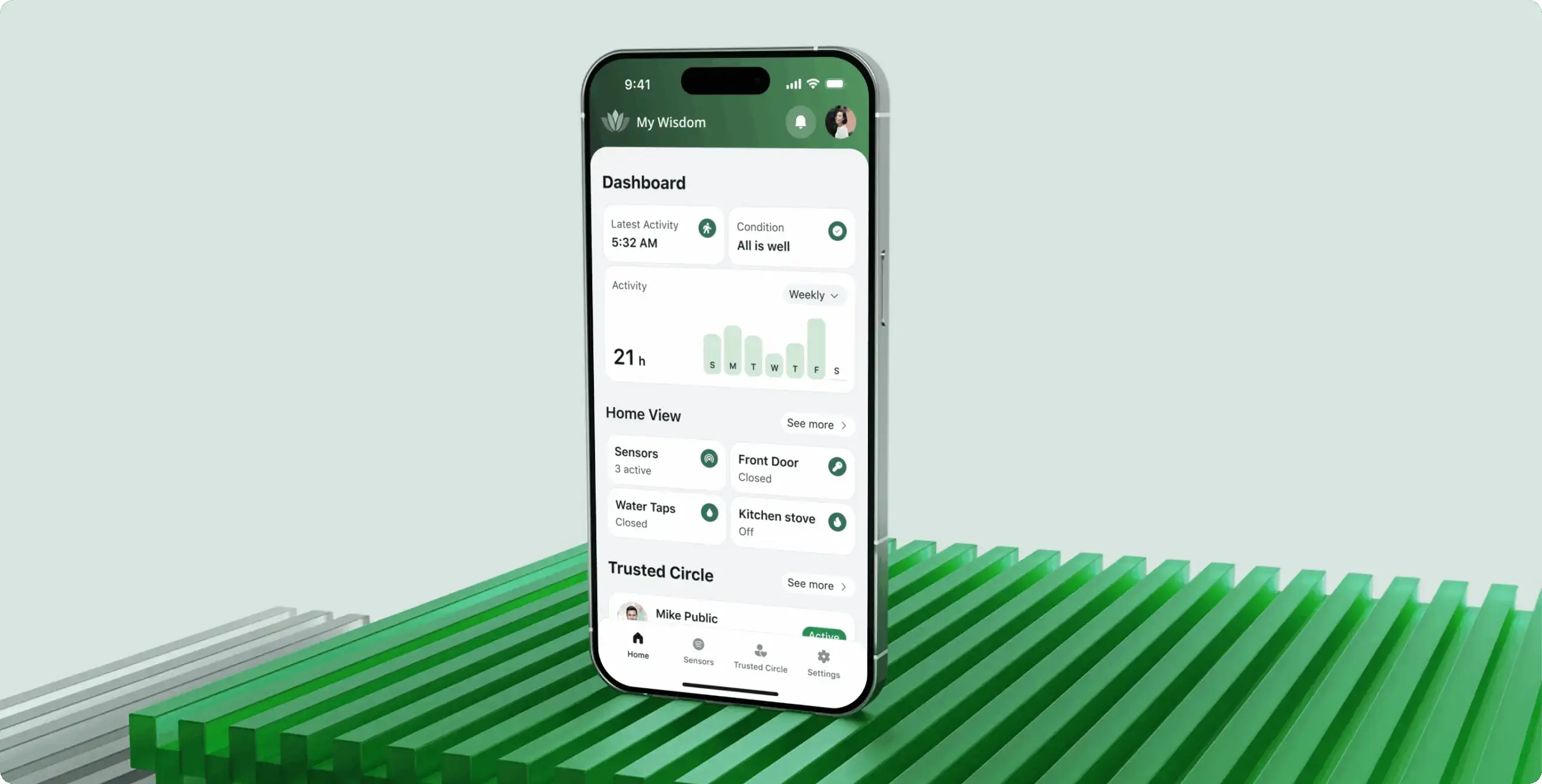
Problem: The existing interface was cluttered and visually dated, with small touch targets, low contrast, and no clear hierarchy. For older adults navigating the app during stressful moments — a fall alert, an unresponsive sensor — the cognitive load was too high. Caregivers couldn’t act quickly because the UI didn’t prioritize what mattered.
Feature: We rebuilt the mobile experience from the ground up using Flutter for cross-platform delivery. The redesign introduced a calm, accessibility-first design system: generous spacing, high-contrast color modes, adjustable text sizing, and a simplified navigation structure that reduces the number of decisions required per screen. A smart alert and escalation system was integrated so that if a trusted contact doesn’t respond within a set window, the alert automatically routes to emergency services. Samsung adapted its smartwatch firmware specifically for MyWisdom, enabling the device to run in single-app mode as a dedicated real-time sensor.
Result: Usability testing with real older adults confirmed that users completed all key flows — adjusting accessibility settings, managing their trusted circle, deactivating sensors — without confusion and without prior instruction. The product went on to raise $1.3M in pre-seed funding, earn a nomination for the UX Design Award 2026, and secure a strategic hardware partnership with Samsung. A platform that previously felt like surveillance software now feels like genuine support.
Engagement Models: How We Work Together
One of the most consequential early decisions is how you structure the commercial relationship with your development partner. Each model suits a different situation, and getting this wrong creates friction throughout the project.
Fixed Price works well for projects with clearly defined scope and minimal uncertainty — typically MVPs priced between $15,000 and $50,000. You know the cost upfront, but changes mid-project require formal change requests, which can slow momentum.
Time and Materials is the right model when requirements are expected to evolve. You pay $50–$150 per specialist per hour and retain full flexibility to shift priorities between sprints. Final cost varies, but you get exactly what the project actually needs — not what was specifiable on day one.
Dedicated Team is the model that enterprises and scaling startups consistently choose for complex, long-running engagements. A five-to-eight person team costs $20,000–$80,000 per month and operates as an extension of your own organization — with your priorities, your velocity targets, and your architectural standards.
| Parameter | Fixed Price | Time & Materials | Dedicated Team |
| Scope | Strict | Evolving | Flexible |
| Budget | Predictable | Dynamic | Monthly predictable |
| Flexibility | Low | High | Highest |
| Involvement | Low | High | Maximum |
| Duration | Short | Varies | Long |
Regulatory Compliance: Building for 2026
Compliance in 2026 is not a legal checkbox — it is a product requirement. GDPR obligations are embedded into our data architecture from day one: user data rights, breach notification pipelines, and risk assessments are built in, not bolted on after launch. Every app we deploy that incorporates AI features includes EU AI Act disclosures and, where applicable, high-risk AI documentation. The Data Act’s portability requirements are addressed through standard API contracts that give users genuine access to their own data.
Perhaps the most forward-looking investment we make is in post-quantum cryptography. Using NIST-standard algorithms and crypto-agile architectures, we ensure that the apps we build today are not vulnerable to the computational capabilities of the next decade. For clients in finance, healthcare, and critical infrastructure, this is already a procurement requirement — for everyone else, it will be soon.
Green Coding: Sustainable Development
Sustainability is increasingly a product metric. Our mobile app design and development practice includes energy-efficient algorithm design, dark mode UI to reduce battery consumption, and optimized media pipelines that minimize data transfer and on-device storage. We deploy on renewable-powered cloud infrastructure and follow EU Digital Product Passport standards for carbon footprint transparency. This isn’t positioning — it’s engineering practice that also improves app performance and reduces operating costs.
Mistakes to Avoid in Mobile Development
Avoiding common pitfalls can save time, money, and stress:
- Skipping discovery: Invest in early planning to avoid costly pivots.
- Ignoring platform guidelines: Work with experienced designers for smoother approvals.
- Neglecting security: Include audits and penetration testing at every stage.
- Overbuilding MVPs: Focus on the essential value, expand after validation.
- Lack of maintenance: Allocate resources for updates and bug fixes post-launch.
The best mobile app development services providers share a few non-negotiable traits. They have verifiable domain expertise — a portfolio of shipped products in your industry, not just case study slides. They have technical depth that extends to the frameworks and infrastructure choices your app will actually require. They communicate proactively: clear proposals, regular progress updates, and honest reporting when something isn’t going to plan.
Beyond the build, the right partner stays invested in your success — offering post-launch analytics, feature roadmap consultation, and the kind of long-term relationship where they know your codebase as well as you do. References, independent reviews, and industry recognition matter because they reflect sustained performance, not a single successful pitch.
Here’s what that looks like in practice. Since 2019, our team has grown to 70+ mid-to-senior in-house specialists — UX strategists in North America working in concert with senior design and development teams in Europe. That model gives clients strategic proximity without sacrificing execution speed. We are recognized by Clutch as a top design and development company, are HIPAA-compliant (independently assessed by Compliancy Group, August 2026), hold Webflow Certified Partner status, and received a UX Design Awards 2024 nomination — credentials that reflect sustained delivery quality across Healthcare, SaaS, FinTech, and EdTech.
The outcomes our clients have achieved are concrete: products we’ve built or redesigned have collectively contributed to over $500M raised, a 35% average improvement in conversion rate, 2x faster internal workflows, and 50% shorter time to market. These aren’t averages across easy projects — they come from complex, compliance-heavy, integration-dependent builds where the margin for error is small.
What makes the collaboration work is access and transparency. You work directly with the people building your product — through Slack, Jira, Figma, Notion, or whichever tools your team already uses. Every design decision is assessed for long-term business impact using competitor analysis, prototype testing, user feedback, and analytics. The goal is a product you won’t need to redesign in six months.
Our core service offering covers the full product lifecycle: UI/UX design, web and mobile app design and development, MVP creation, branding and identity, motion and illustrations, UX audit and discovery, and product redesign. We collaborate as a full-cycle partner, a dedicated team for defined scopes, or as a team extension to fill specific capability gaps — whatever model fits your situation.
Ready to Build Your Mobile Application?
Mobile app design and development in 2026 demands a partner who brings technical leadership, regulatory awareness, and a genuine investment in your outcome — not just your invoice. Whether you’re validating a startup idea or modernizing an enterprise system, the right conversation starts not with a proposal, but with an honest assessment of where you are and what it will actually take to get where you need to go.
With hundreds of products delivered and recognition from Clutch as a leading web design and development company, we have the depth to take on what your product requires — and the track record to back it up. You can explore our design and development work at Dribbble and read verified client reviews at Clutch.
When you’re ready to move forward, contact us or schedule a consultation. We’ll review your requirements and build a clear, actionable plan for your mobile success.
Share this article with friends



Sep 29, 2026
6 min read
B2B website redesign without losing traffic: A complete b2b website redesign guide covering UX audits, 301 redirect mapping, and metadata preservation. Partner with a top b2b website redesign agency that boosts conversions while protecting your organic rankings.

Sep 29, 2026
8 min read
Small business web design services that fit your budget. Get affordable small business website design from one of the best website design companies for small business — with transparent pricing and no hidden fees.
