



Jul 29, 2026
8 min read
summary
Learn how AI product design builds user trust through UX, explainability, and control. Explore AI product design strategy, real case studies, and best practices for AI products.
Direct answer: A trustworthy AI product comes from deliberate AI product design choices that make the system legible and correctable, not from model accuracy alone.
Key Takeaways
- Trust is a design outcome, not a model property. Users trust an AI feature when they can see why it acted and undo it when it gets something wrong.
- Progressive disclosure beats full transparency. Most users want a short reason rather than a data-lineage dashboard, and layering the explanation protects their attention.
- Phenomenon Studio has shipped AI-touched products in regulated categories and holds a 5.0 rating on Clutch across 50+ verified reviews.
- A trust-first AI feature usually adds one to two months of discovery and design before the build, where the trust model gets defined.
By Valerii Filimonov | Co-founder at Phenomenon Studio, July 2026
Why AI Products Lose User Trust
A polished AI feature can still stall at adoption. The reason is rarely model accuracy. Product leaders tell us the same thing after launch. Users tried the feature once, got an answer they could not explain, and left it alone after that.
Trust breaks at the moment a user cannot tell why the system did what it did. An executive who approves an AI-driven recommendation carries that risk personally. When the reasoning stays hidden, the safe choice is to ignore the output.
This matters more for the buyer than for the end user. A Head of Product weighing an AI feature is really weighing reputational risk. We see the pattern across projects. The AI that gets adopted is the one that shows its work, and sound AI product design strategy starts from that fact.
Our research backs this up. When the team benchmarked how leading AI platforms present themselves, the winners earned trust through clear value and realistic product scenarios, not abstract AI language. The products that felt credible were the ones that explained themselves in plain terms.
What Trust Means in AI Product Design
Trust in an AI product is not one technical problem. It splits into three design problems, and each one has a concrete answer that a ux product designer and the product team control.
Can the user see why?
Legibility means the user can tell why the system produced an output, not read the full math behind it. One plain reason is usually enough. A loan officer needs the two factors that drove a score, not the weight of every input the model considered.
Can the user correct it?
Control means the user can override a result without a support ticket. An AI that cannot be corrected reads as a system that does not listen. The correction path is a trust feature in its own right, so it deserves real design attention rather than an afterthought.
Does it admit doubt?
Calibrated confidence means the product tells the truth about how sure it is. A feature that sounds certain and turns out wrong costs more trust than one that flags its own doubt early. Honest uncertainty is a design decision, not a flaw to paper over.
A Trust-First AI Product Design Strategy
Knowing the three problems is one thing. Building the process that answers them is another. Good ux design services turn a trust-first AI product design strategy into work that starts well before the first screen. A senior ux product designer owns the trust model from day one. This is how Phenomenon Studio runs it.
Discovery defines where a wrong AI output would hurt the business and the user. That map decides which decisions need a visible explanation and which ones stay safe to automate. Skipping this step is why so many AI features launch confident and land ignored.
From there, the design defines a trust model. The model names what the user sees before they act on an AI result and how they correct it when it misses. Every AI touchpoint in the product inherits that same contract, so the experience stays predictable as features grow.
Companies supported by Phenomenon Studio have raised more than $500M in aggregate funding, much of it in regulated categories where trust is the buying criterion. (Phenomenon Studio, 2026)
This approach earns its cost when the AI drives a decision with real consequences. For a low-stakes suggestion such as a photo filter, a full trust model is overkill. The judgment about where to invest is itself part of the strategy.
Designing AI Explanations With Progressive Disclosure
The most common mistake is showing users everything the model considered. Full transparency overwhelms the very person it means to reassure. Progressive disclosure answers this by layering the explanation, so each user reaches only the depth they actually need.
In an enterprise telemetry interface, that layering runs across three levels. The block below is the source for the infographic on the published page.
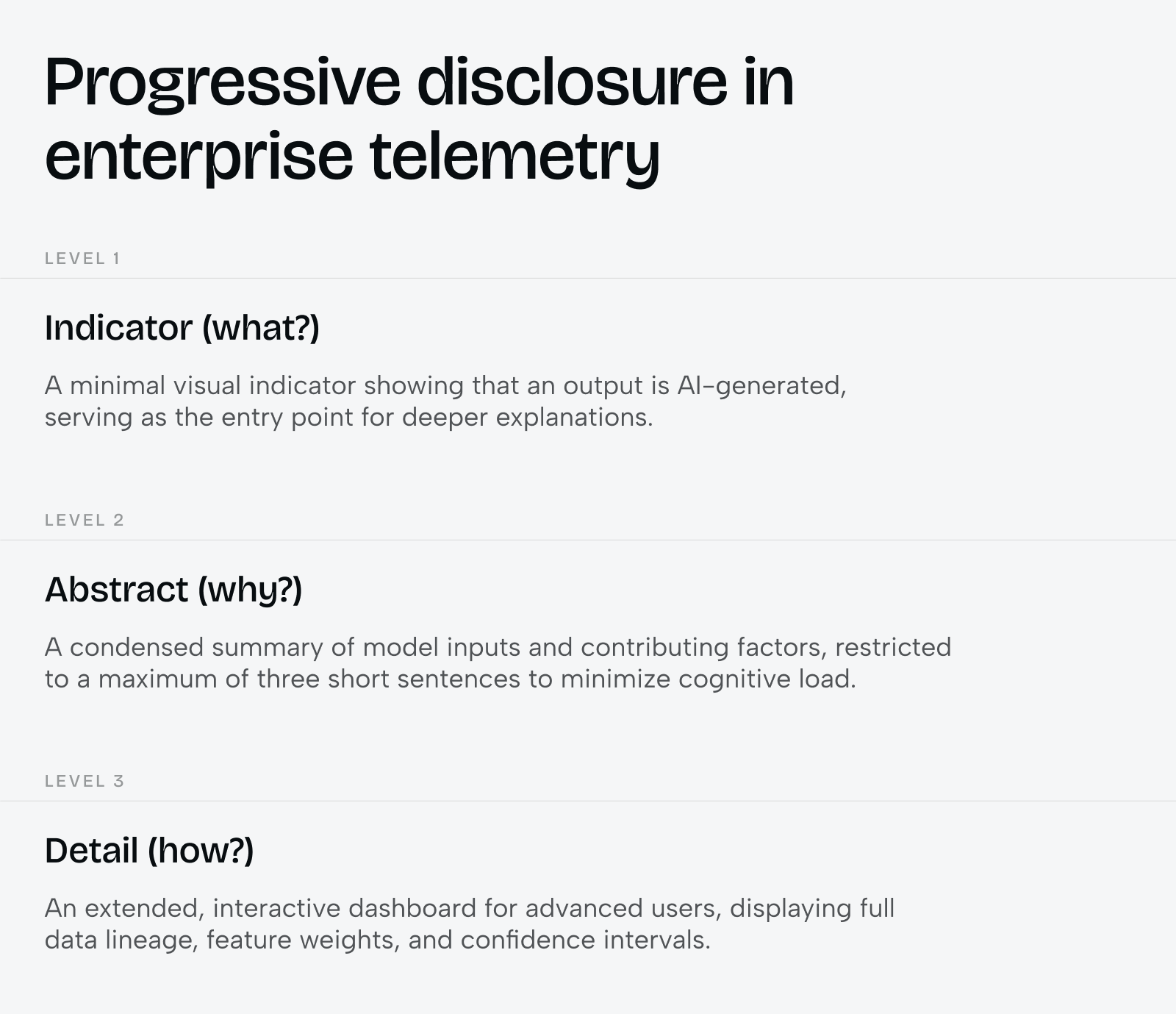
Most users stop at Level 2. The abstract answers the only question they had, which is why the system suggested this. The Level 3 dashboard exists for the auditor and the power user who has to defend the decision later.
On a healthcare project, a clinical reviewer opened an AI-flagged case and read the two-line abstract, then moved on within seconds. The full lineage view sat one click away and stayed unused until an audit six weeks later. That gap is the design working as intended, not a feature going to waste.
AI Software Development: Turning the Trust Model Into Shipped Software
A trust model is a design artifact until someone builds it. AI software development is where the model’s promises either hold or quietly break. The gap between a design intent and a shipped behavior is wide in artificial intelligence software development. A model does not behave like fixed code. You can see this in the AI product design case studies where the build decisions carried the trust story.
This is why the trust decisions have to survive the build. Artificial intelligence software development turns explanation and correction into real components, not slides. Teams that treat artificial intelligence software development as pure engineering ship features that test well and get ignored.
AI-powered software development
AI-powered software development means the product’s own features run on models. The build has to handle uncertainty at runtime, not only at demo time. This is the core of AI powered software development, and it is where most trust failures begin.
Generative AI software development
Generative AI software development adds a sharper trust problem. A generative feature can produce a fluent answer that is simply wrong. Generative AI software development for regulated products has to show its sources, so the user can check a claim rather than take it on faith. Teams that do generative AI software development well design the citation before the model call, not after.
Custom AI software development
Custom AI software development fits a product whose trust needs do not match an off-the-shelf tool. When a decision carries legal or clinical weight, custom AI software development lets the team place the human check exactly where the risk sits.
AI software development solutions
AI software development solutions for regulated categories bake the audit trail into the data layer, not the interface. Good AI software development solutions make the record automatic, so compliance becomes a byproduct of use rather than a separate chore. This is also where artificial intelligence software development meets real governance.
Choosing an AI Software Development Company
Most AI features fail on trust, not on model quality, so the partner you pick matters more than the model you license. An AI software development company that leads with benchmarks and ignores the user experience will hand you a feature people avoid.
Strong AI software development services start with the same question a good designer asks. Where would a wrong output hurt someone? AI software development services that cannot answer that are selling engineering hours, not outcomes. When you buy AI software development services for a regulated product, the trust model belongs in the statement of work.
AI application development services cover the product around the model, which is where trust is won or lost. The best AI application development services treat the explanation layer as a feature with its own spec. Teams offering AI application development services to enterprise buyers know the auditor is a user too. Weigh AI application development services on how they handle a wrong result, not on their model zoo. The product design and development services you pair with them decide whether that judgment reaches the screen.
The top AI software development companies share one habit. They design the trust model before they train anything. When you shortlist top AI software development companies, ask each one to walk through a wrong-output scenario end to end. The top AI software development companies answer with a design, and weaker ones answer with a metric. That difference is what separates the top AI software development companies from vendors.
The best result pairs engineering with design. An AI software development company handles the model and the pipeline. A product design agency owns the trust experience, and a strong product design agency has shipped AI features before, not just dashboards. A ux design agency or an embedded ux product designer defines the explanation and the correction path. Ask any AI software development company how it exposes a model’s reason to the user. The right AI software development company will have a pattern ready.
Buying ux design services alongside the build keeps the two aligned. Good ux design services turn the trust model into screens the model can actually support. When a product design agency and the AI software development services team share one backlog, the explanation ships with the feature instead of after it. Compare AI software development services on their trust track record. The best AI software development services show you a shipped explanation rather than a roadmap.
Case Study: Repositioning an AI Startup Users Could Trust
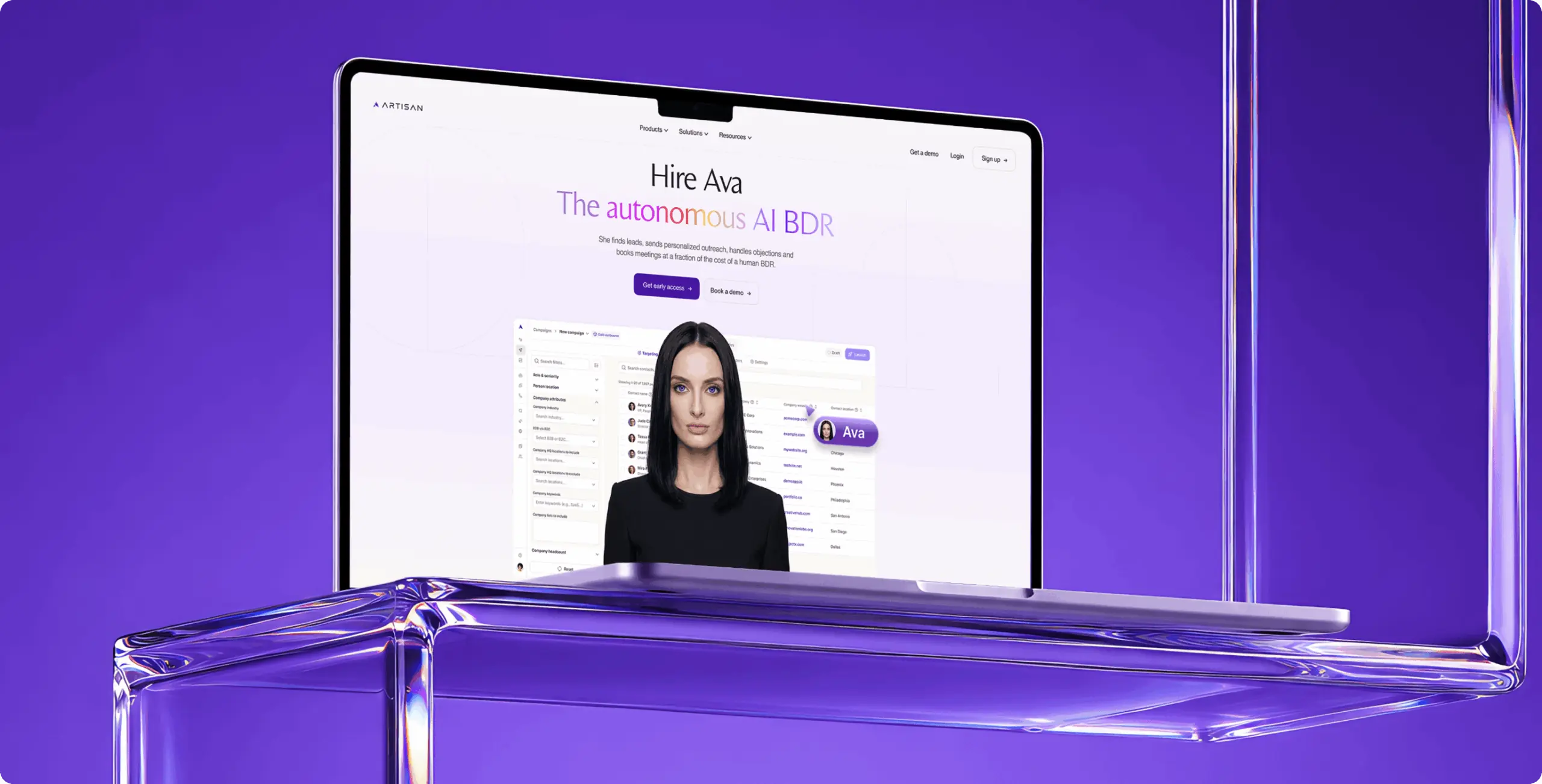
Task. Artisan, a US startup building autonomous AI sales agents, looked like a generic SaaS tool and struggled to signal credibility in a crowded AI market. The team also needed to ship marketing pages fast, without rebuilding the site for every new launch.
Solution. Phenomenon Studio ran a UX audit and benchmarked how leading AI platforms earn trust and explain complex automation. The team replaced abstract AI messaging with clearer value and realistic product scenarios. A reusable UI system then let the marketing team ship pages on its own. The research studied tools such as Jasper and Clay to learn what makes an AI product feel credible.
Result. Artisan relaunched as a premium AI platform with sharper differentiation. The new UI system shipped more than 20 responsive marketing pages in under a month. The foundation scales with new products and SEO work instead of being rebuilt each time. You can see related work in the award-winning digital experiences from the studio.
According to the Artisan case study, a reusable UI system let the team ship more than 20 responsive marketing pages in under a month. (Phenomenon Studio, Artisan case study, 2026)
The lesson maps straight back to trust. Artisan won credibility by showing the product in plain, realistic terms, which is the same move that makes an AI feature legible inside the product.
The State of AI Product Adoption in 2026
Adoption of AI features has outpaced trust in them. Companies rolled out AI across functions faster than they built confidence in the outputs. That gap now shows up as low usage rather than low capability.
According to McKinsey’s State of AI survey, most organizations now use AI in at least one function, yet far fewer trust its outputs. (McKinsey & Company, 2024)
Regulated categories feel this first. A healthcare or fintech buyer treats an unexplained AI output as a liability, not a shortcut. A ux design agency that specializes in AI now sees this in client after client. Explanation and correction have moved from nice-to-have to a condition of the sale.
The broader design shifts behind this belong to a wider cycle, which we cover in our analysis of AI product design trends. This strategy piece builds on that groundwork, narrowing it to the single question of trust.
What separates an AI product people trust from one they quietly abandon? The design decisions around explanation and control, made before the model ever ships. Phenomenon Studio offers a 30-minute working call to pressure-test the trust model behind your AI feature, with no obligation attached. The enterprise UX design team can review your highest-stakes journey.
Bibliography
Phenomenon Studio (2026). Artisan: repositioning an AI agent startup. https://phenomenonstudio.com/projects/
McKinsey & Company (2024). The State of AI.
Phenomenon Studio (2026). AI product design trends to watch in 2026. https://phenomenonstudio.com/article/ai-product-design-trends-to-watch-in-2026/
Clutch. Phenomenon Studio profile. https://clutch.co/profile/phenomenon-studio
Share this article with friends



Sep 29, 2026
6 min read
B2B website redesign without losing traffic: A complete b2b website redesign guide covering UX audits, 301 redirect mapping, and metadata preservation. Partner with a top b2b website redesign agency that boosts conversions while protecting your organic rankings.

Sep 29, 2026
8 min read
Small business web design services that fit your budget. Get affordable small business website design from one of the best website design companies for small business — with transparent pricing and no hidden fees.
