



May 31, 2026
8 min read
summary
AI Software Development Services engineered by a team with deep Python, AWS and computer‑vision expertise. Our custom AI application development services accelerate MVPs by 50% and improve user workflows by 2x.
Key Takeaways:
- AI-powered software development compresses MVP timelines by 40-50% — but only when spec-driven architecture governs what the AI generates, preventing the technical debt accumulation that erases those gains within 18 months.
- Custom ai software development in regulated industries — healthcare, FinTech, clinical platforms — requires compliance architecture (HIPAA, SOC 2, GDPR) built into the system from day one, not retrofitted post-launch.
- Generative AI and computer vision are the two highest-ROI application domains in 2026: predictive analytics, NLP customization, and real-time object detection are solving problems that manual engineering cannot scale to address.
- Phenomenon Studio, recognized by Clutch as a top ai software development company, has delivered 200+ AI-integrated products across Healthcare, SaaS, and FinTech — with clients collectively raising $500M+.
The companies getting the most from ai software development services in 2026 are not the ones with the biggest GPU budgets — they are the ones that pair ai application development services with disciplined architecture, real business context, and a team that understands when to let the model generate and when to stop it.
By Nazarii Tkachyk | Fullstack Developer | May , 2026
AI-Assisted Software Development in 2026: Why Coding 40% Faster Doesn’t Mean 40% Cheaper
The most common misunderstanding about ai software development services in 2026 is a financial one. Organizations see that AI-assisted coding produces working code faster — GitHub Copilot studies suggest 40-55% velocity increases — and assume this translates directly to cost reduction. It does not. Speed without architecture governance produces a different problem: technical debt that compounds faster than a human-paced team would generate, precisely because the AI never gets tired, never second-guesses a shortcut, and never questions whether the pattern it is replicating is the right one for this context.
The teams extracting real financial value from ai powered software development are operating a fundamentally different model. They use AI for execution — boilerplate generation, test case creation, documentation, refactoring suggestions — while maintaining human judgment at the architectural, requirements, and governance layers. The ratio in high-performing teams is roughly 60% AI execution to 40% human oversight, not the 90/10 split that organizations often assume when they hear ‘AI development.’
This matters structurally because artificial intelligence software development services have a specific failure mode that human-paced development does not: the AI-generated codebase that looks complete but is not designed for the system it needs to become in 18 months. At Phenomenon Studio, every ai application development services engagement starts with a spec-driven discovery phase that defines the architectural constraints before any AI tool touches the codebase. That discipline is the difference between a product that scales and one that requires a partial rebuild at Series B.
Research benchmark: Organizations implementing AI-assisted development without spec-driven governance see technical debt grow at 2.3x the rate of traditionally developed systems, according to a 2025 Forrester analysis of 200 enterprise software projects. Speed gains evaporate within 12-18 months as debt-driven maintenance consumes the recovered capacity.
AI application development services: What the Market Actually Offers vs. What Enterprises Need
The market for ai application development services in 2026 has stratified into three distinct tiers, and the gap between them is not primarily about technology — it is about depth of business integration and post-deployment governance.
Tier one is tool implementation: agencies that connect existing AI APIs (OpenAI, Anthropic, Google Gemini) to a client’s frontend and call it an AI product. This tier produces demos that impress in boardrooms and fail in production. The model has no enterprise context, no memory of business rules, no compliance guardrails, and no mechanism for handling the edge cases that appear at user 500.
Tier two is custom model integration: firms that fine-tune or RAG-augment existing foundation models on client-specific data, build context-aware pipelines, and deploy with monitoring. This is the tier where most serious ai software development solutions live in 2026. It requires understanding the client’s data architecture, regulatory environment, and user behavior patterns — not just the model APIs.
Tier three is full-stack AI engineering: end-to-end delivery that treats the AI system as a production software product with MLOps infrastructure, model drift detection, compliance audit trails, and a maintenance roadmap. This is the tier that regulated industries — healthcare, financial services, legal — require, and the tier where the highest-value custom ai software development projects operate.
| Service Tier | What’s delivered | Where it breaks down | Right for |
| Tool implementation | API integration, prompt engineering, basic UI | Production edge cases, compliance, scale | Demos, proofs of concept |
| Custom model integration | Fine-tuned models, RAG pipelines, context systems | Requires ongoing MLOps investment | Mid-market products, Series A+ |
| Full-stack AI engineering | End-to-end AI product with compliance, drift monitoring, MLOps | Higher upfront investment | Regulated industries, enterprise scale |
The organizations that consistently select the wrong tier are those treating AI capability as a single vendor decision rather than a systems architecture decision. A healthcare platform handling Protected Health Information cannot operate at tier one regardless of the cost savings. The regulatory consequences — HIPAA violations averaging $9.4 million in combined disruption and settlement costs — dwarf any vendor selection optimization.
Software development artificial intelligence: The AI-Driven Development Life Cycle
Software development artificial intelligence has restructured the engineering lifecycle into what practitioners call the AI-Driven Development Life Cycle, or AI-DLC. Unlike previous tool integrations that automated isolated functions, the AI-DLC treats artificial intelligence as an active participant at every phase — not a tool invoked at specific moments, but a collaborator that shapes how requirements are captured, how architecture is validated, and how code is maintained post-deployment.
The practical implication for engineering teams is a shift in role structure. Senior engineers in 2026 spend less time writing routine logic and more time on what AI cannot yet do reliably: business judgment, contextual architectural decisions, stakeholder alignment, and the interpretation of ambiguous requirements. The developer who was previously writing 80% boilerplate and 20% complex logic is now writing 10% boilerplate and 70% complex logic, with AI handling the rest. That is a structurally different and more valuable use of senior engineering time.
| Development Phase | AI Integration Mechanism | Human Oversight Role |
| Planning & Requirements | Automated drafting from natural language; ambiguity detection | Business judgment on trade-offs; stakeholder validation |
| Architectural Design | Context-aware pattern suggestions; dependency mapping | System-level decisions; compliance architecture |
| Code Generation | Autocomplete, boilerplate, function generation from specs | Review for security, debt, and architectural fit |
| Testing & QA | Automated test case generation; coverage analysis; edge case simulation | Test strategy definition; regression validation |
| Documentation | Real-time docstrings, API reference generation | Accuracy review; audience calibration |
| Deployment & DevOps | Log analysis; error tracing; CI/CD optimization | Incident response; compliance audit oversight |
The AI-DLC does not eliminate the discovery phase — it makes discovery more consequential. When AI can generate a working prototype in hours from a rough specification, the quality of that specification determines whether the prototype is a foundation or a liability. This is why spec-driven development has emerged as the primary governance discipline in ai driven software development: significant investment in requirements documentation before any generation begins.
AI software development company: How to Evaluate Partners Beyond the Demo
Every ai software development company in 2026 can produce an impressive demo. The evaluation challenge is identifying which firms will still be a reliable partner at month 18, when the model is drifting, the compliance audit is approaching, and the feature roadmap has diverged from the original architecture.
The evaluation framework that top ai software development companies use internally — and that procurement teams should apply externally — focuses on five operational dimensions that demos never reveal.
First: explainability. Can the vendor explain how their AI models reach specific conclusions? In regulated industries, a model that cannot explain its outputs is a compliance liability regardless of its accuracy. A partner building a clinical eligibility screening system — one where AI determines whether a patient can proceed with treatment — must be able to produce audit-ready explanations for every decision the model makes.
Second: data governance. Where does the training data come from? Who owns the model weights after fine-tuning on client data? Does the vendor’s general model improve from exposure to proprietary client information? These are not theoretical concerns — they are contractual and regulatory requirements that must be resolved before any data touches the vendor’s infrastructure.
Third: model drift detection. AI models degrade over time as real-world data distributions shift away from training conditions. A vendor without automated drift detection is selling a product that will silently become less accurate over months without any visible signal. Monitoring infrastructure — tools like MLflow, Weights & Biases, or Arize — should be a standard deliverable, not a premium add-on.
AI software development: Core Capability Domains and Technology Stacks
AI software development in 2026 organizes around four high-impact capability domains, each addressing distinct enterprise challenges with specialized algorithms, data requirements, and infrastructure patterns.
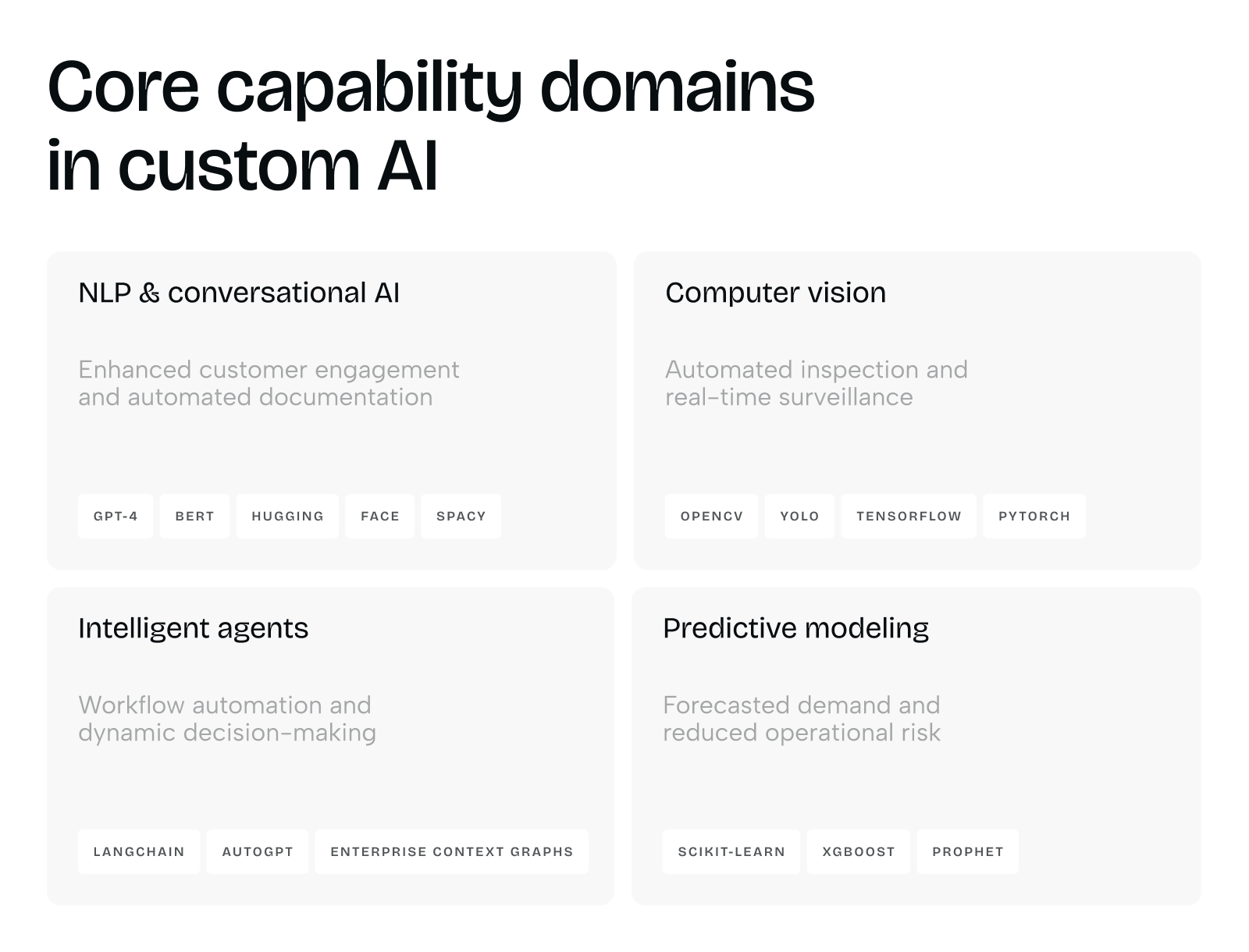
Custom AI Software Development: Computer Vision Engineering
Custom ai software development for computer vision is one of the most technically demanding categories in the AI services market — and one of the most consequential. The gap between a demo that detects objects accurately in controlled conditions and a production system that handles real-world variability (lighting changes, occlusion, edge cases, adversarial inputs) is measured in months of engineering investment and the quality of the training data pipeline.
Computer vision tasks in production break into distinct engineering challenges. Image classification assigns categorical labels to full images — the foundational task used in content moderation, medical imaging preliminary screening, and quality control. Object detection localizes and identifies specific items within images, drawing bounding boxes and confidence scores. Real-time object detection at production scale requires architectures like YOLO (You Only Look Once) that make decisions in milliseconds, suitable for industrial quality control and autonomous navigation. Image segmentation operates at pixel level, partitioning images into regions — semantic segmentation for scene understanding, instance segmentation for distinguishing individual objects of the same class.
The architecture evolution in computer vision is moving from Convolutional Neural Networks — which dominated the field for a decade by detecting local spatial patterns through mathematical filters — toward Vision Transformers (ViTs), which apply the attention mechanism from language models to visual data by treating image patches as tokens. On large-scale datasets, ViTs consistently outperform CNNs on classification and segmentation benchmarks, though they require significantly more compute for training. Most production systems in 2026 use hybrid architectures: CNN backbone for efficient feature extraction, transformer attention for global relationship modeling.
AI software development solutions: 3D Reconstruction and Spatial Intelligence
AI software development solutions for 3D scene understanding represent the frontier where computer vision intersects with physical world modeling. Three primary methodologies address different accuracy, hardware, and environmental requirements.
Photogrammetry reconstructs three-dimensional geometry by triangulating depth from overlapping two-dimensional images. It is accessible — standard cameras, drones, and smartphones can capture the source imagery — and produces models with excellent visual fidelity and realistic textures. The limitation is sensitivity to lighting conditions and difficulty with thin, transparent, or highly reflective surfaces. For architectural visualization, interior design, and cultural heritage documentation, photogrammetry is the standard approach.
LiDAR (Light Detection and Ranging) measures geometry directly through laser pulse time-of-flight, achieving millimeter-level precision independent of ambient lighting. It dominates large-scale outdoor applications — autonomous vehicle mapping, infrastructure inspection, terrain modeling — where photogrammetry’s lighting sensitivity is disqualifying. The barrier is hardware cost: specialized LiDAR scanners start at $10,000 and scale significantly for survey-grade systems.
Neural Radiance Fields (NeRF) represent the AI-native approach, using neural networks to learn a volumetric mapping from 3D coordinates to color and density. NeRF handles complex lighting, reflections, and translucent materials that defeat both photogrammetry and LiDAR. The current limitation is output format: NeRF produces render-ready scenes rather than structured meshes, which restricts engineering applications that require geometric precision. For visualization, novel view synthesis, and gaming/VR environments, NeRF is unmatched.
| Method | Mechanism | Accuracy | Hardware | Best Application |
| Photogrammetry | Image triangulation for depth | High on textured surfaces | DSLR, drone, smartphone | Interiors, cultural heritage, architectural viz |
| LiDAR | Laser pulse time-of-flight | Survey-grade, millimeter precision | Specialized scanners ($10k+) | Large outdoor structures, autonomous vehicles |
| NeRF | Neural volumetric rendering | High visual fidelity; lower geometric precision | High-end GPUs | Reflective surfaces, VR/gaming, novel views |
Agentic AI Software Development: Multi-Agent Systems and Autonomous Workflows
Agentic ai software development is the fastest-growing sub-category in the AI engineering market and the one carrying the most implementation risk when approached without proper architecture. An AI agent is a system that can perceive its environment, make decisions, and take actions autonomously — invoking tools, calling APIs, managing state across multiple steps, and recovering from failures without human intervention at each decision point.
Multi-agent systems coordinate multiple specialized agents — a research agent, a validation agent, a writing agent — through orchestration layers that manage context, handle conflicts, and route tasks based on agent capability. The engineering challenges are significant: context window management across long task chains, tool reliability (agents fail when the tools they invoke fail), state persistence, and the ‘hallucination cascade’ problem where one agent’s error propagates through downstream agents before any human reviews the output.
The production-ready technology stack for agentic ai software development centers on LangChain or LlamaIndex for agent orchestration, enterprise context graphs for persistent business rule storage, and vector databases (Pinecone, Weaviate, pgvector) for semantic retrieval. Governance infrastructure — audit logs of every agent action, human-in-the-loop checkpoints for high-stakes decisions, rollback mechanisms for failed task chains — is non-negotiable in regulated environments.
AI based software development at the agentic level requires engineering teams that understand both software architecture and machine learning behavior. The failure mode of agentic systems is not a crash or an error code — it is plausible-looking output that is subtly wrong in ways that compound over time. Senior engineers who can design evaluation frameworks and interpret model behavior are the limiting resource in scaling this capability.
Agentic systems in production: At Phenomenon Studio, our agentic AI implementations include automated clinical eligibility screening systems that review pathology lab results, flag contraindications, and surface structured findings to clinicians for final decision authority. Human oversight is preserved at the highest-stakes decision points while automation handles data processing, preliminary analysis, and compliance logging — a model that scales clinical workflows without removing clinical judgment.
Use Case: Australian Digital Health Platform — AI-Powered Clinical Workflows at Scale
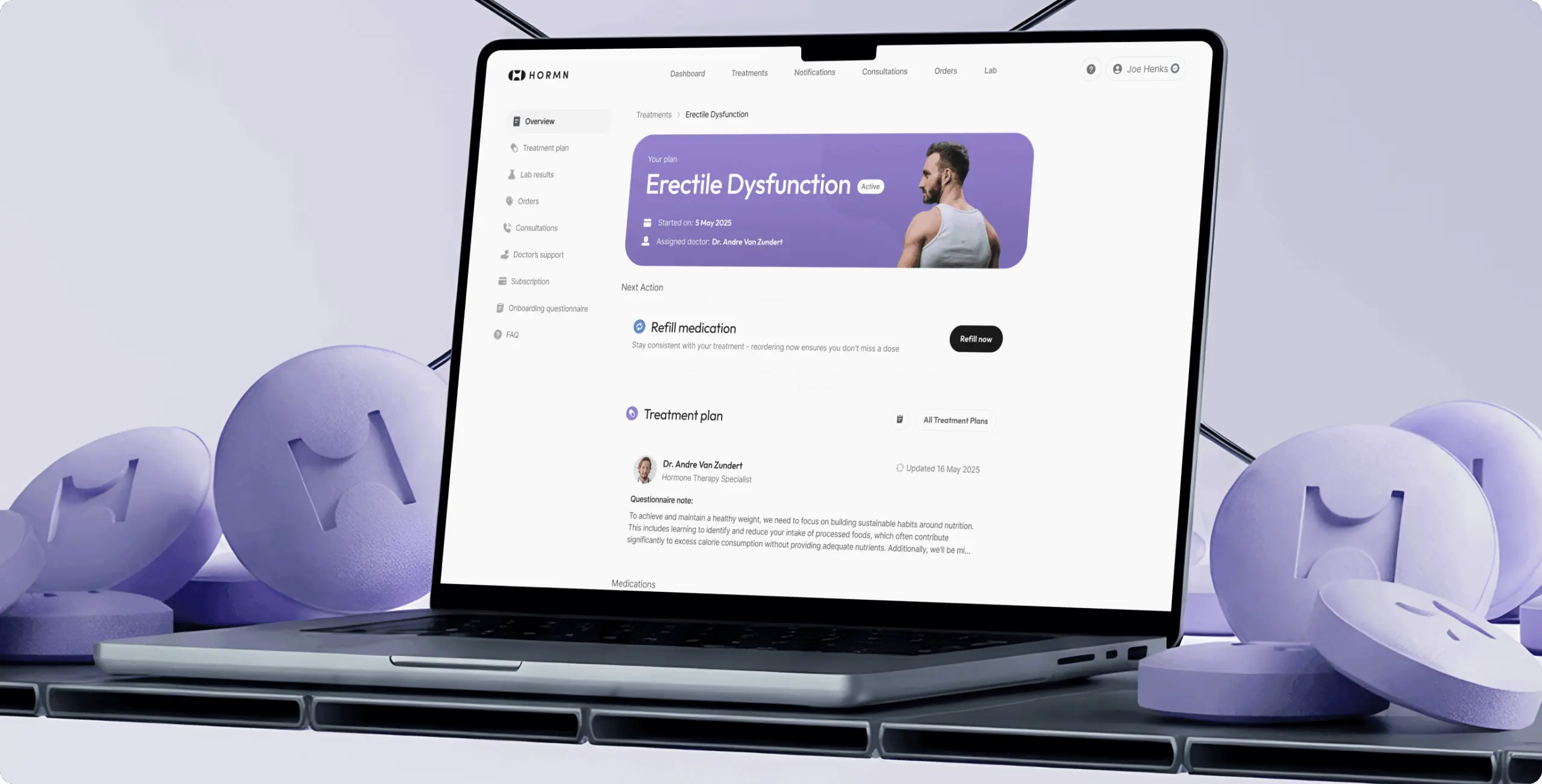
Problem:
A growing men’s health clinic needed to move from manual, siloed clinical workflows to a fully digital, scalable platform supporting testosterone replacement therapy, erectile dysfunction treatment, weight loss, and male fertility. The existing system was not built for scale: manual workflows, limited treatment support, and rigid architecture created operational bottlenecks as patient volume grew. Complex medical questionnaires caused confusion and high drop-off rates among patients without clinical backgrounds. Data migration from the legacy system to the new platform risked breaking patient journeys mid-treatment. The client needed a unified system connecting patients, doctors, and pharmacies through one compliant, automated workflow.
Feature:
Phenomenon Studio built a full-stack digital health platform using Node.js, NestJS, React, PostgreSQL, Redis, and AWS with HIPAA-equivalent compliance architecture. The patient portal was designed around recurring care actions — treatment discovery, medical surveys with simplified language and contextual explanations, consultation booking, lab result access, medication orders, and refill management. AI-powered medical eligibility screening automatically reviewed Healius Labs pathology results before allowing patients to proceed with treatment, preventing inappropriate purchases and protecting patient safety. Role-based admin dashboards gave doctors, pharmacists, and administrators separate, workflow-optimized interfaces within a single system. Automated blood test analysis, Medicare validation, and e-prescribing were integrated through Healius Labs, eRX, Stripe, Calendly, Twilio, and Auspost. The data migration preserved user progress through a dedicated update flow with a time-limited completion incentive. Performance was architected for horizontal scale: load-balanced Node.js instances, failover-ready PostgreSQL, AES-256 encryption at rest, TLS in transit, and AWS IAM role-based access control.
Result:
The platform reached 10,000+ patients in the first month, with 75-100 new users joining daily after launch. Over 2,000 paid users engaged across both core service flows within the first 30 days. Revenue exceeded $86,000 in month one, distributed across multiple treatment journeys rather than concentrated in a single flow — validating the multi-treatment architecture. The client CEO described the design team as ‘truly world-class, excelling in both user interface design and creating solutions optimized for conversion.’ Timeline: full product redesign and platform development across patient portal, admin portal, and all integrations. Tech stack: Node.js, NestJS, React, Next.js, PostgreSQL, TypeORM, Redis, AWS, Stripe, Calendly, Healius Labs, eRX, Twilio, Auspost.
Evaluating Top AI Software Development Companies: A Technical Checklist
The top ai software development companies in 2026 are identifiable not by their website or case study aesthetics but by their operational practices. The following checklist reflects the evaluation criteria that experienced procurement teams and technical due diligence processes apply when selecting an AI development partner.
- Explainability infrastructure: Does the vendor build explainability into the model architecture, or treat it as a post-hoc addition? Post-hoc explanations are less reliable and less defensible in compliance contexts.
- Data governance documentation: Can the vendor produce a data lineage map that shows where training data originates, how it is processed, and what contractual protections apply to client proprietary data?
- Model drift detection: Is drift monitoring included in the base engagement scope, or is it a separate service? A vendor that does not monitor production model performance is delivering a product that silently degrades.
- PoC-first approach: Does the vendor recommend starting with a proof of concept to validate technical and strategic viability before full-scale commitment? Vendors that push directly to full build without a PoC are optimizing for contract size, not client outcomes.
- Compliance certification: For healthcare, FinTech, or enterprise data environments, verify HIPAA, SOC 2 Type II, or GDPR compliance certifications — not self-attestation, but third-party verified certifications.
- Post-launch support model: What is the engagement model after deployment? AI systems require ongoing attention — retraining, drift correction, compliance updates — that is structurally different from standard software maintenance.
Engagement model selection follows project characteristics. Fixed price works for AI projects with rigid, well-defined specifications and limited exploratory risk. Dedicated team models suit enterprise organizations building core AI capabilities with deep integration into existing business logic. Time and Materials provides the flexibility required for initial proofs-of-concept where the implementation path is genuinely uncertain. Most mature AI engagements begin T&M for discovery and PoC, then transition to dedicated team or milestone-based fixed price for production development.
Why Phenomenon Studio for AI Software Development Services
Since 2019, Phenomenon Studio has delivered 200+ products across Healthcare, SaaS, FinTech, and EdTech — including some of the most compliance-intensive AI implementations in the Australian digital health market, the US FinTech sector, and European enterprise software environments. Our 70+ in-house engineers and AI specialists operate in integrated teams: AI architect, backend engineer, UX designer, QA specialist, and DevOps engineer in the same delivery sprint.
Our ai software development services capability spans the full stack: predictive analytics and forecasting models, NLP and custom LLM fine-tuning, computer vision systems from image classification through 3D reconstruction, and agentic workflow automation. Every engagement begins with a spec-driven discovery phase that produces an architectural blueprint and compliance assessment before any model training or code generation begins.
We are HIPAA-compliant (independently assessed by Compliancy Group, August 2026), a Webflow Certified Partner, and recognized by Clutch as a top AI software development company. Our clients have raised $500M+ collectively, and our AI implementations operate in production environments handling tens of thousands of daily active users in regulated healthcare and financial services contexts.
- AI engineering depth: Python, TensorFlow, PyTorch, OpenCV, YOLO, LangChain, Hugging Face Transformers, and custom MLOps infrastructure built and maintained in-house.
- Compliance architecture: HIPAA, SOC 2 Type II, GDPR, and EU AI Act compliance designed into system architecture from discovery, not retrofitted post-launch.
- Hybrid delivery model: Product strategy and stakeholder alignment in North America; senior AI engineering execution in Europe — full quality at materially lower total engagement cost.
- Post-launch partnership: MLOps monitoring, model retraining, compliance audit support, and feature evolution retainers starting from $2,500/month.
Share this article with friends



Sep 29, 2026
6 min read
B2B website redesign without losing traffic: A complete b2b website redesign guide covering UX audits, 301 redirect mapping, and metadata preservation. Partner with a top b2b website redesign agency that boosts conversions while protecting your organic rankings.

Sep 29, 2026
8 min read
Small business web design services that fit your budget. Get affordable small business website design from one of the best website design companies for small business — with transparent pricing and no hidden fees.
