



Nov 11, 2025
9 min read
summary
Learn how to build HIPAA, GDPR, and CCPA compliance into your healthcare product design. Practical tips from certified experts at Phenomenon Studio.
Building compliant healthcare technology isn’t just about ticking boxes after development. It’s about embedding regulatory requirements into every design decision from day one. Whether you’re creating a patient portal, telemedicine platform, or health data analytics tool, understanding HIPAA, GDPR, and CCPA requirements will shape how your product functions, looks, and feels.
At Phenomenon Studio, we’ve navigated these complex waters for countless healthcare clients. We’re HIPAA and GDPR compliant , which means we understand firsthand how compliance impacts design decisions. This guide breaks down what you need to know and shows you practical ways to build compliance into your design process.
Why HIPAA Compliant Website Design Matters More Than Ever
Healthcare technology operates in a global marketplace. Your app might serve patients in California, doctors in Germany, and researchers in New York. Each jurisdiction brings its own rules, but rather than building separate systems for each region, smart organizations adopt the highest standard across all markets, often aligning with national standards for health information security and privacy.
The stakes are real. HIPAA violations can result in fines up to $1.5 million per incident. GDPR penalties can reach 4% of your total worldwide revenue. CCPA violations add another layer of risk for California users. But here’s the thing: these aren’t just legal hurdles. Proper compliance builds user trust and creates better products, highlighting the importance of regulatory compliance for healthcare organizations.
Choosing a Healthcare Web Design Partner That Understands Compliance
Not every healthcare web design agency can actually execute on the requirements covered in this guide. A generalist studio might design a visually polished patient portal without understanding why session timeouts, audit trails, or granular consent flows aren’t optional extras, they’re the difference between a compliant product and a $1.5 million fine. Healthcare web development at this level requires a team fluent in both UX and regulatory language simultaneously.
Healthcare web development services worth vetting should produce a HIPAA compliance attestation and a documented GDPR position directly, not just claim familiarity with “healthcare projects”. A healthcare website design company that has actually built PHI-handling systems, encrypted storage, audit logging, consent dashboards, brings pattern recognition a first-time healthcare vendor simply won’t have. The Zest case study covered above shows what that depth looks like in practice: privacy-by-design embedded from information architecture through final UX, not retrofitted after a compliance review flagged the gaps.
Understanding the Three Regulatory Frameworks and Business Associate Agreements
HIPAA: Protecting Protected Health Information
HIPAA focuses on Protected Health Information (PHI) in the US healthcare system. It requires specific technical, administrative, and physical safeguards to ensure data confidentiality, integrity, and availability.
In order to meet HIPAA standards and follow HIPAA guidelines, organizations must adhere to HIPAA regulations, including the HIPAA Security Rule and the HIPAA Privacy Rule (also known as the privacy rule). The Security Rule outlines key elements and technical safeguards such as encryption, access controls, and audit trails, which are essential for safeguarding patient data and protecting sensitive health information. Protected health information includes individually identifiable medical information and identifiable health information, making it critical to secure patient information and personal health information at all times. Organizations must protect PHI, secure PHI, and ensure compliance with HIPAA when they transmit protected health information, transmit PHI, or are transmitting PHI via electronic media or electronic form. Using HIPAA-compliant web forms and HIPAA-compliant forms is vital for collecting PHI, and HIPAA-compliant websites and HIPAA-compliant website builders play a key role in ensuring compliance. Healthcare organizations should work with HIPAA-compliant hosting providers and secure hosting solutions, such as HIPAA-compliant web hosting, to protect PHI collected on their websites. Selecting the right website builder, such as a HIPAA-compliant website builder, is important for healthcare organizations and human services, and managing third party services in compliance with HIPAA standards is necessary to avoid risks. The Department of Health and Human Services (HHS) oversees HIPAA regulations and provides guidance to ensure compliance. A comprehensive guide to HIPAA compliance should address all these aspects, including safeguarding patient data, working with hosting providers, and managing third party services.
Key HIPAA requirements for designers:
- Unique user identification for all system access
- Automatic session timeouts
- Audit trails for all PHI interactions
- Encrypted data transmission and storage
- Access controls based on user roles
Our approach to HIPAA compliance goes beyond theory — it’s something we’ve implemented in real-world digital health products. A great example is our work on Zest — Unleashing a Healthier You, a longevity-focused app designed to help users take control of their health through science-backed recommendations and data insights.

Because Zest collects and processes sensitive wellness information, it required the same level of protection as medical data under HIPAA. Our team applied a privacy-by-design approach, embedding compliance and data security at every stage of development — from information architecture to UX design and technical implementation.
We ensured all Protected Health Information (PHI) collected by the platform was handled according to HIPAA Security and Privacy Rules. This included implementing encrypted data storage, secure transmission protocols (SSL/TLS), and access control systems with user-level permissions. Additionally, audit trails were integrated to log all interactions with user health data, maintaining transparency and accountability.
From a UX perspective, we translated complex compliance requirements into intuitive experiences:
- Clear consent flows — allowing users to understand how their data is used and shared.
- Accessible privacy settings — empowering users to manage permissions easily.
- Simple, compliant data forms — reducing the risk of accidental PHI exposure.
The result was a secure, engaging, and compliant platform that not only met HIPAA requirements but also built trust through transparency.
Zest now stands as a prime example of how design and compliance can coexist — transforming regulatory rigor into a better, safer user experience.
GDPR: Empowering Individual Rights
GDPR applies to any personal data of EU citizens, with extra protection for health data as “Special Category Data.” It emphasizes user control, transparency, and accountability.
Key GDPR requirements for designers:
- Explicit, freely given consent
- Clear privacy notices at point of collection
- Easy access to personal data
- Simple deletion processes
- Data portability options
CCPA/CPRA: California Consumer Rights
California’s privacy laws give residents control over their personal information, including the right to know what data is collected, delete it, and limit its use.
Key CCPA/CPRA requirements for designers:
- Transparent data collection practices
- Easy opt-out mechanisms
- Data correction capabilities
- Clear disclosure of data sharing
Business Associate Agreements: Managing Third-Party Compliance
When healthcare organizations work with outside vendors—such as cloud storage providers, billing services, or digital health platforms—they often need to share protected health information (PHI) to deliver essential services. Under the Health Insurance Portability and Accountability Act (HIPAA), any third party that creates, receives, maintains, or transmits electronic protected health information (ePHI) on behalf of a covered entity is considered a business associate. To ensure HIPAA compliance, these relationships must be governed by a formal Business Associate Agreement (BAA).
A BAA is a legally binding contract that outlines each party’s responsibilities for safeguarding PHI and ePHI. It requires business associates to implement the same rigorous security measures, technical and organisational safeguards, and data protection principles as covered entities. This includes requirements for data encryption, access controls, audit trails, and prompt notification in the event of a security incident or data breach.
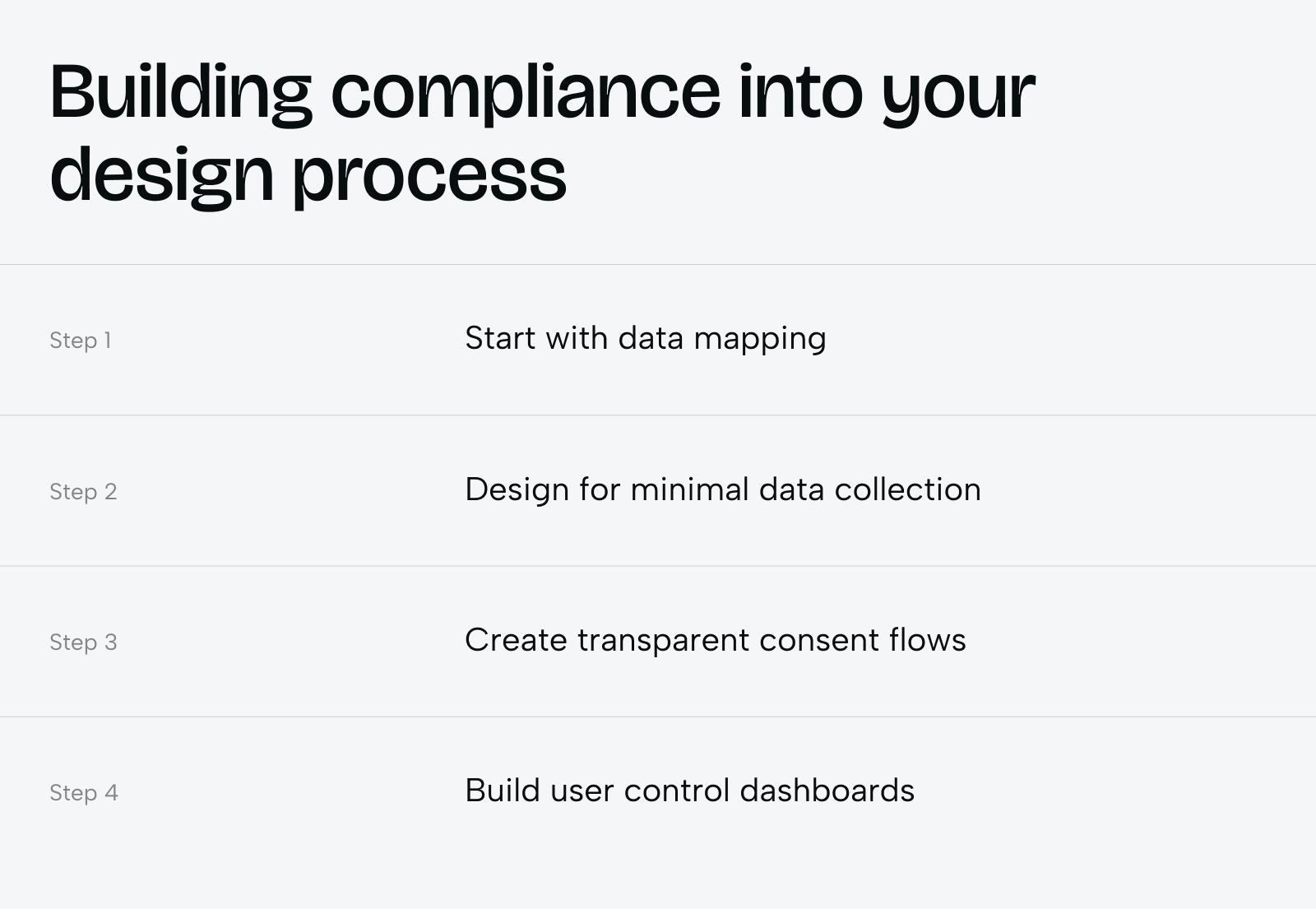
Step 1: Start with Data Mapping
Before designing a single screen, map out what data you collect, where it flows, and how long you keep it. This becomes the foundation for every compliance decision.
Create a simple table tracking:
- Data type (name, email, medical records, PHI collected, etc.)
- Collection point (registration, appointment booking, etc.)
- Purpose (treatment, billing, analytics, etc.)
- Retention period (7 years for medical records, 30 days for analytics, etc.)
- Legal basis (consent, contract, legitimate interest, etc.)
Step 2: Design for Minimal Data Collection
The most effective compliance strategy is collecting only the data you absolutely need. This reduces your risk exposure and simplifies your compliance burden.
Practical design approaches:
- Use progressive disclosure to collect data as needed
- Make optional fields clearly optional
- Implement smart defaults that protect privacy
- Design forms that explain why each field is necessary
Step 3: Create Transparent Consent Flows
Gone are the days of burying consent in lengthy terms of service. Modern compliance requires clear, granular consent that users actually understand.
Design consent interfaces that:
- Use plain language to explain data use
- Offer granular controls for different purposes
- Make declining consent as easy as accepting
- Avoid dark patterns that manipulate user choices
- Provide easy ways to withdraw consent later
Step 4: Build User Control Dashboards
GDPR and CCPA require giving users control over their data. This means building interfaces where users can view, correct, download, and delete their information.
Essential dashboard features:
- Clear data summary showing what you have
- Easy export functionality in standard formats
- Simple deletion process with confirmation
- Correction tools for inaccurate data
- Consent management controls
Technical Implementation Guidelines
Authentication and Access Control
Design systems that verify user identity before granting access to sensitive data. This typically involves:
- Multi-factor authentication for healthcare providers
- Role-based access controls limiting data visibility
- Session management with automatic timeouts
- Clear user identification for audit purposes
Encryption and Data Protection
All health data must be encrypted both in transit and at rest. From a design perspective, this means:
- Using HTTPS for all data transmission by implementing SSL certificates to enable encrypted connections
- Implementing AES-256 encryption for stored data
- Designing secure file upload processes
- Creating clear indicators when data is protected
- Using strong encryption protocols, such as SSL/TLS, to protect sensitive health data during transmission and storage
Audit Logging
HIPAA requires detailed logs of who accessed what data when. Design systems that:
- Track all user interactions with health data
- Log system events without exposing actual PHI
- Protect audit logs from tampering
- Provide searchable audit interfaces for administrators
Data Deletion Architecture
The right to be forgotten requires more than hiding data from users. You need systems that can completely remove data from all locations, including backups.
Design deletion systems that:
- Identify all instances of user data across systems
- Execute complete removal on a defined schedule
- Generate audit trails proving deletion occurred
- Handle dependencies between related data sets
UX Considerations for Compliance
Avoiding Dark Patterns
Regulatory bodies specifically prohibit manipulative design that tricks users into sharing data or giving consent they don’t intend.
Avoid these problematic patterns:
- Pre-checked opt-in boxes
- Hidden or confusing refusal options
- Making “accept all” prominent while hiding “decline”
- Using urgent language to pressure consent
- Requiring unnecessary data to use basic features
Designing for Accessibility
Healthcare products must be accessible to users with disabilities. This isn’t just good design—it’s often legally required.
Include these accessibility features:
- Screen reader compatibility
- Keyboard navigation options
- High contrast color schemes
- Captions for audio content
- Clear visual hierarchy and labeling
Mobile-First Privacy Controls
Many healthcare interactions happen on mobile devices. Design privacy controls that work well on small screens:
- Use expandable sections for detailed privacy information
- Create thumb-friendly consent buttons
- Design clear notification systems for privacy updates
- Make privacy settings easy to find and adjust
Testing and Validation
Privacy Impact Assessments for Data Protection
Before launching any new feature that handles personal data, conduct a Privacy Impact Assessment (PIA) or Data Protection Impact Assessment (DPIA). This helps identify risks early and ensures compliance by design.
User Testing with Privacy Focus
Test not just whether users can complete tasks, but whether they understand privacy implications:
- Do users understand what data they’re sharing?
- Can they easily find and use privacy controls?
- Are consent flows clear and non-manipulative?
- Do deletion and export features work as expected?
Automated Compliance Checking
Build automated tests that verify compliance requirements:
- Check that all forms include required privacy notices
- Verify that consent flows meet regulatory standards
- Test that deletion processes remove all relevant data
- Confirm that audit logging captures required events
Making Compliance a Competitive Advantage
Rather than viewing compliance as a burden, smart companies use it as a differentiator. Users increasingly care about privacy and data protection. By building truly compliant systems that respect user rights, you create products people trust and prefer.
Consider these approaches:
- Highlight your privacy protections in marketing
- Make privacy controls a feature, not a hidden requirement
- Use compliance as a reason for users to choose your product
- Build transparency into your brand identity
Companies that embed compliance into their design DNA don’t just avoid penalties—they build better products that users love and trust. The investment in proper compliance design pays dividends in user satisfaction, reduced legal risk, and competitive positioning.
What the Best Medical Website Designs Get Right on Compliance
Reviewing the best medical web design examples in this space reveals a consistent pattern: compliance and usability were designed together, not sequentially. The best medical website design work never treats consent flows as a legal afterthought bolted onto finished screens; the UX considerations section above, avoiding dark patterns, designing thumb-friendly mobile consent, exists precisely because those decisions carry regulatory weight, not just aesthetic ones.
Medical web design company portfolios worth reviewing during vendor evaluation should show real PHI-handling architecture, not just visual polish. A medical website design company that can walk through their own data mapping process, the same process outlined in Step 1 above, demonstrates the kind of hands-on compliance experience that separates a healthcare-specific medical web design company from a generalist agency applying healthcare terminology to a standard build.
Medical website designs also vary by data sensitivity. A telemedicine platform’s medical web architecture, handling live video and real-time PHI, faces different constraints than a static patient-education microsite’s medical websites needs. Medical website development that ignores this distinction tends to apply the same encryption and consent architecture regardless of actual risk level, adding unnecessary friction to low-risk touchpoints while potentially underprotecting high-risk ones. A medical website design services provider with genuine BAA experience, covered in the Business Associate Agreements section above, will typically raise this distinction during discovery rather than defaulting to a one-size-fits-all compliance checklist.
Healthcare website design company selection ultimately comes down to one question this guide keeps returning to: can the team translate legal requirement into intuitive interface, the way the Zest example did, or will compliance and usability keep fighting each other throughout the build.
Next Steps: Getting Started with Compliant Design
Ready to build compliance into your healthcare product? Start with these concrete steps:
- Audit your current data practices – Map what data you collect and how it flows through your systems
- Review your consent mechanisms – Ensure they meet GDPR’s explicit consent standards
- Design user control dashboards – Give users easy ways to manage their data
- Implement proper access controls – Ensure only authorized users can access sensitive data
- Test your compliance features – Verify that privacy controls work as intended
Building compliant healthcare technology requires expertise in both regulatory requirements and user experience design. If you need help navigating these complex requirements, our team at Phenomenon Studio has the certification and experience to guide you through the process. Reach out to discuss how we can help you build products that are both compliant and user-friendly.
Share this article with friends



Sep 29, 2026
6 min read
B2B website redesign without losing traffic: A complete b2b website redesign guide covering UX audits, 301 redirect mapping, and metadata preservation. Partner with a top b2b website redesign agency that boosts conversions while protecting your organic rankings.

Sep 29, 2026
8 min read
Small business web design services that fit your budget. Get affordable small business website design from one of the best website design companies for small business — with transparent pricing and no hidden fees.
