



Jul 20, 2026
7 min read
summary
Learn how to choose a mobile app development company with this step-by-step guide. Discover key factors, questions to ask, and tips for finding the right development partner.
The right mobile app development company is the one whose technical depth, industry experience, and commercial terms match your product’s actual risk profile — not the one with the lowest quote or the flashiest portfolio, and the only way to tell the difference is a structured evaluation before you sign anything.
Key Takeaways
- Price comparisons mean nothing until scope is itemized — a quote 30% below market rate is rarely a discount, it’s a rebuild waiting to happen.
- A structured discovery phase, run before any design work starts, is the single clearest signal separating a reliable mobile app development company from a template shop.
- Contracts should assign source code and IP ownership to you outright, with milestone-based payments and a named point of contact for the full engagement.
- The best evaluation tool isn’t a portfolio review — it’s a 12-step framework you can run against every agency on your shortlist, including the incumbent you’re already talking to.
Nazarii Tkachyk (Fullstack Developer) | July, 2026
Why the Agency You Choose Determines Whether Your App Ships
A cross-platform mobile app development services provider that skips discovery will still deliver something that opens and runs. Whether it solves the business problem you started with is a separate question, and by the time you find out, the budget is spent and the runway is shorter.
Consider a mid-stage fintech founder we spoke with last quarter. He had already paid one agency for a ‘complete’ MVP that technically met every line item in the SOW. Users could not complete onboarding without calling support. Nobody on the original team had asked what the top three user actions were supposed to be. That gap costs more to fix after launch than it would have cost to prevent in week one.
The 12-Step Framework for Choosing a Mobile App Development Company
Skipping straight from ‘we need an app’ to reviewing proposals is how most bad hires happen. The steps below are sequential on purpose: goals before technology, technology before budget, budget before vendor research. Running them out of order is the most common reason RFPs come back with wildly mismatched quotes.
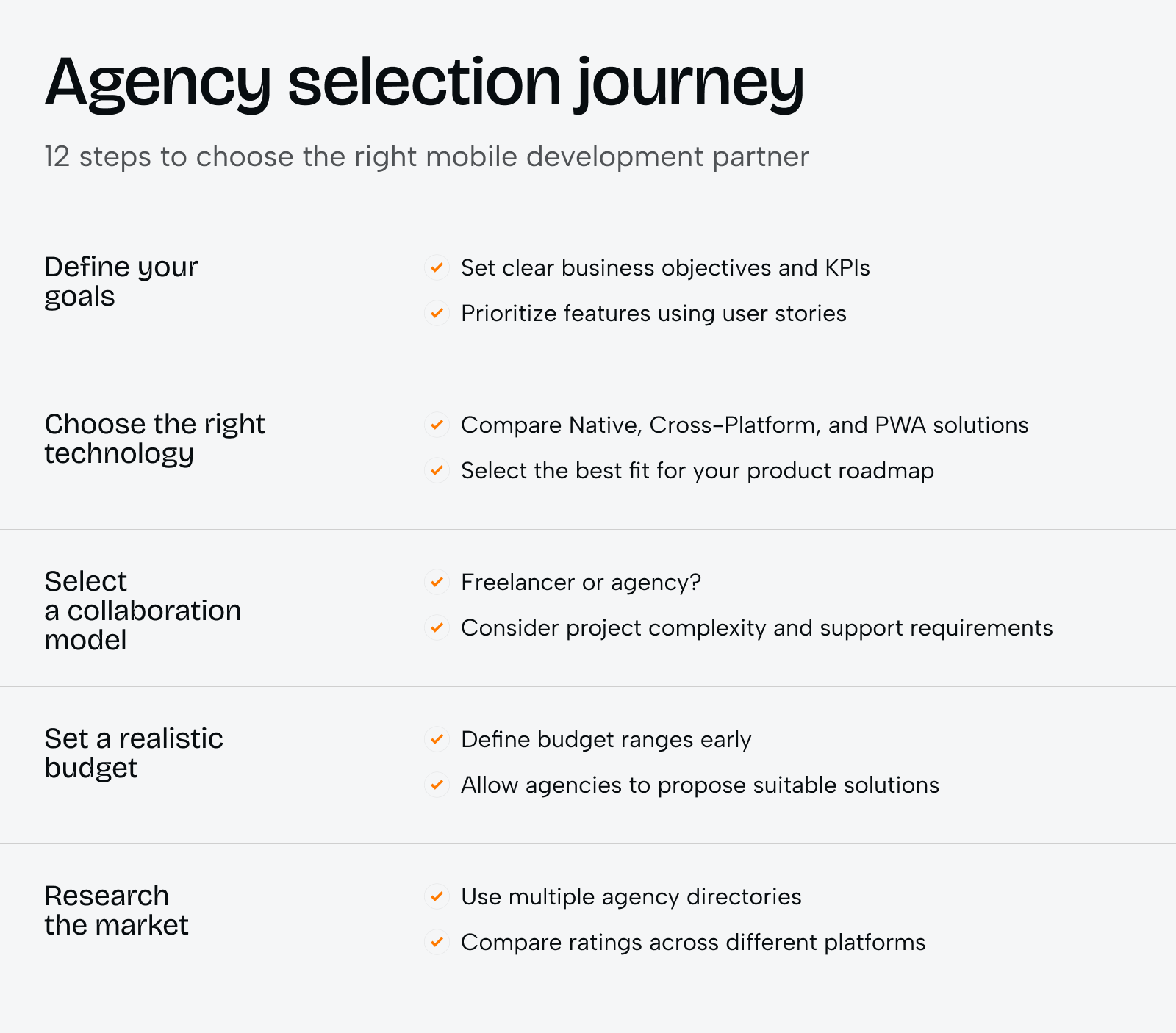
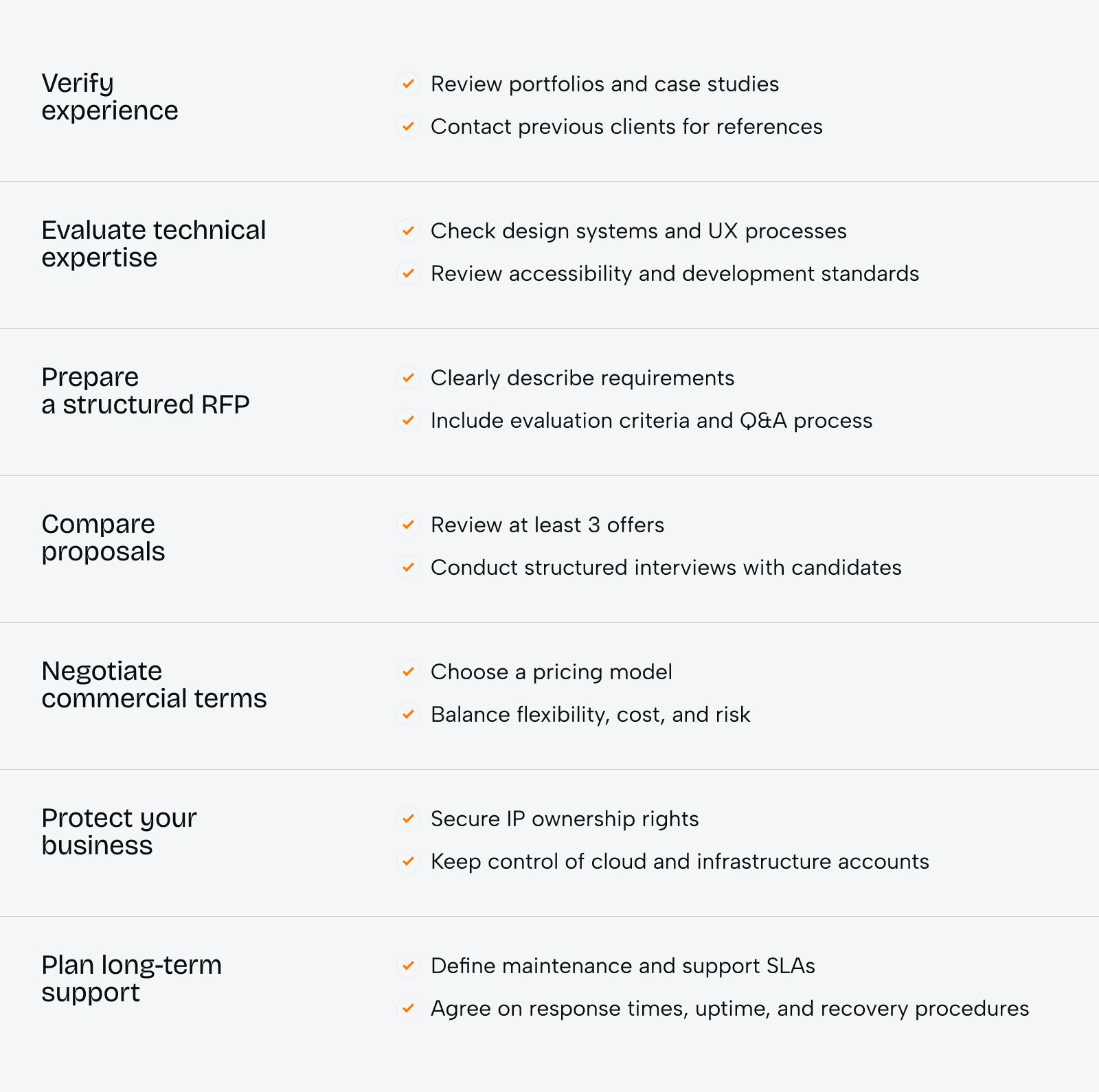
Three of the twelve steps are worth flagging before you look at the graphic, because they are the ones teams most often rush or skip entirely: setting a realistic budget before talking to agencies (not after), preparing a structured RFP instead of a one-paragraph brief, and defining long-term support terms before the contract is signed rather than after launch. The remaining sections of this guide go deep on the steps where the wrong call is hardest to reverse — technology choice, vendor vetting, and contract terms.
Native, Cross-Platform, or PWA: Pick the Technology Before You Pick the Vendor
This decision belongs to you, not to whichever ios mobile app development services provider you talk to first. An agency that leads with its preferred stack before asking about your users, budget, and timeline is optimizing for its own delivery comfort, not your outcome.
| Approach | Best fit | Trade-off |
| Native (iOS / Android separately) | Performance-critical apps, deep hardware access, regulated industries | Two codebases, higher cost, longer timeline |
| Cross-platform | Most funded startups validating product-market fit | Shared codebase speeds delivery; some platform-specific polish is deferred |
| Progressive Web App (PWA) | Content-driven products, fast iteration, low install friction | Limited access to native device features |
For most funded startups, cross-platform mobile app development services are the right first bet. Native only earns its cost once retention is proven and the product needs platform-specific capability a cross-platform framework cannot deliver cleanly. Reversing that order — going native before product-market fit is proven — is one of the most expensive sequencing mistakes a founder can make.
How Much Does Custom Mobile App Development Cost?
Two agencies can quote the same project 3x apart, and the gap rarely comes from one of them padding margins. It comes from what’s actually included: discovery, QA, post-launch support, and how many specialists are on the team. Ask any custom mobile app development company for an itemized breakdown before comparing headline numbers.
| Tier | Typical range | What’s included |
| MVP / Startup build | $15,000 – $45,000 | Core user flows, 1 platform or cross-platform, 4–8 week timeline, small dedicated team |
| Mid-market custom app | $45,000 – $120,000 | Full feature set, integrations, both platforms, UX research, 2–4 month timeline |
| Enterprise app development services | $120,000 – $300,000+ | Complex integrations, compliance architecture, multi-tenant systems, dedicated PM and QA lead |
According to Clutch’s agency market research, hourly rates for established web and mobile development firms typically range from $100 to $149, with specialized senior consultants commanding $150–$199. — Clutch, 2026
A standard custom build at Phenomenon Studio typically runs 1 to 2 months with a dedicated team of 3 to 5 specialists — not because that’s an industry rule, but because that’s the composition that lets discovery, design, and development run in parallel without one phase blocking the next.
Red Flags That Separate a Reliable Partner From a Risky One
Every one of these shows up before you sign, if you know where to look.
The discovery phase gets skipped
An agency that jumps to mockups without mapping your business model, users, and success metrics is running a cookie-cutter process. Ask directly what discovery produces — a sitemap, a validated user flow, a prioritized feature list — and expect a specific answer, not a description of a ‘best practice.’
The quote has no line-item breakdown
A single lump-sum number with no separation between discovery, design, development, and QA is a bait-and-switch risk. Legitimate development web app partners itemize the breakdown without being asked twice.
The portfolio has no verifiable outcomes
Screenshots without live links or measurable results tell you nothing about whether the product worked. Ask for conversion data, retention numbers, or a specific case study with a before-and-after metric.
Staff turnover mid-project
If the developer who starts the build won’t be the one who finishes it, context gets lost at every handoff. Ask plainly whether the same technical lead owns the project start to finish.
No post-launch support plan
An agency silent on maintenance, patching, and monitoring is planning a hit-and-run. Without a defined support window, a mobile app degrades — security patches lag, dependencies age, and performance drops within six months of launch.
Vetting Technical Expertise and Enterprise Readiness
Design competence and engineering competence are not the same skill, and a strong web app development platform demo does not guarantee the backend can handle your integrations at scale. Ask how the team architects for growth, not just how the interface looks in a walkthrough.
“The agencies that struggle later are almost always the ones that treated backend architecture as an afterthought to the UI. We map integrations, data flow, and compliance requirements in week one — before a single screen is designed — because that’s where the expensive mistakes actually happen.” — Anatolii Sakhno, Head of Development, Phenomenon Studio
For regulated products — healthcare, fintech, anything touching payment data — ask specifically about compliance architecture: HIPAA technical safeguards, WCAG 2.1 AA accessibility, and OWASP Top 10 coverage for anything handling sensitive data. A vague “we follow best practices” answer is not a technical answer.
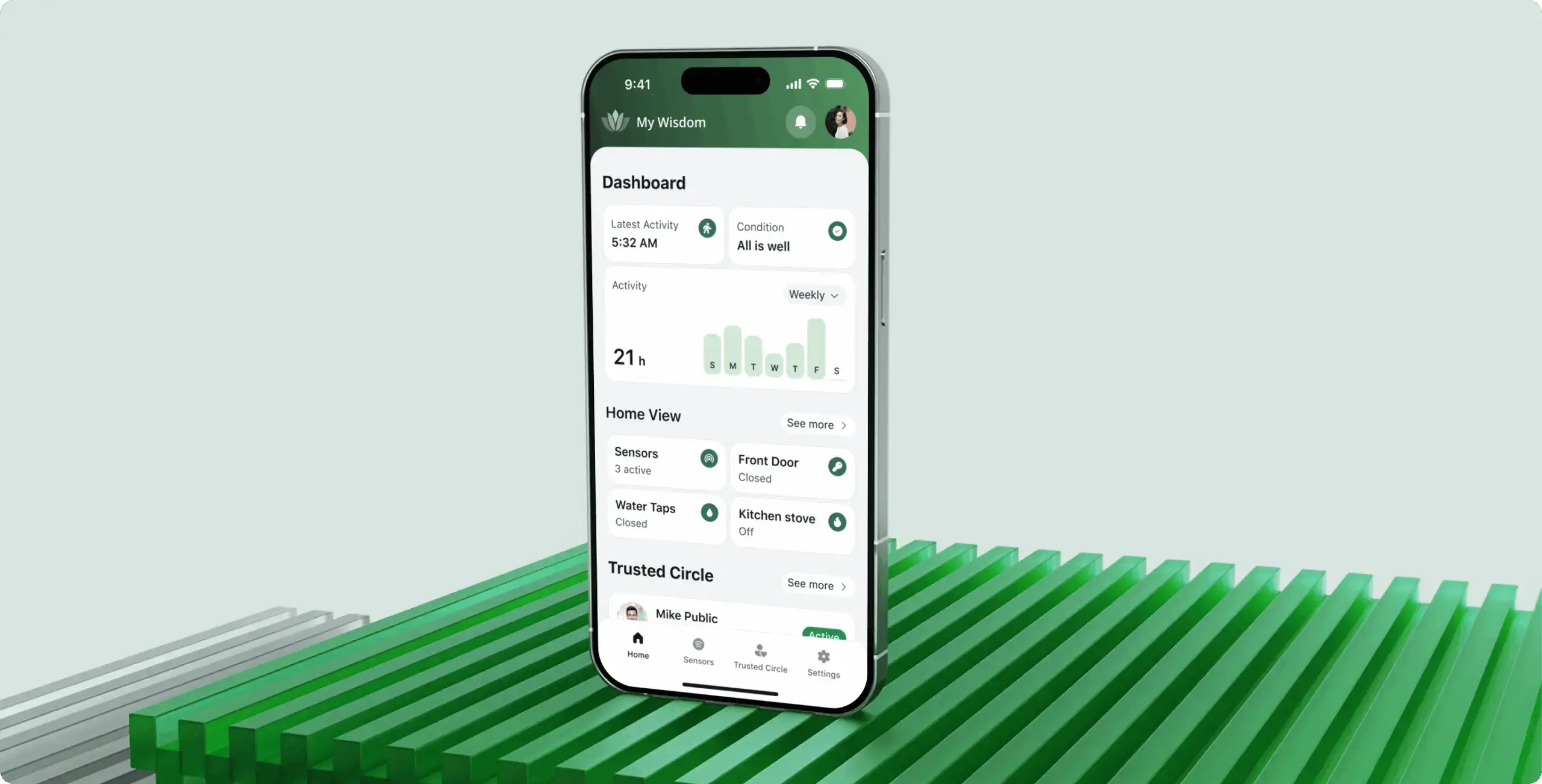
HIPAA-compliant development case study: MyWisdom — a digital platform for safer, more connected aging
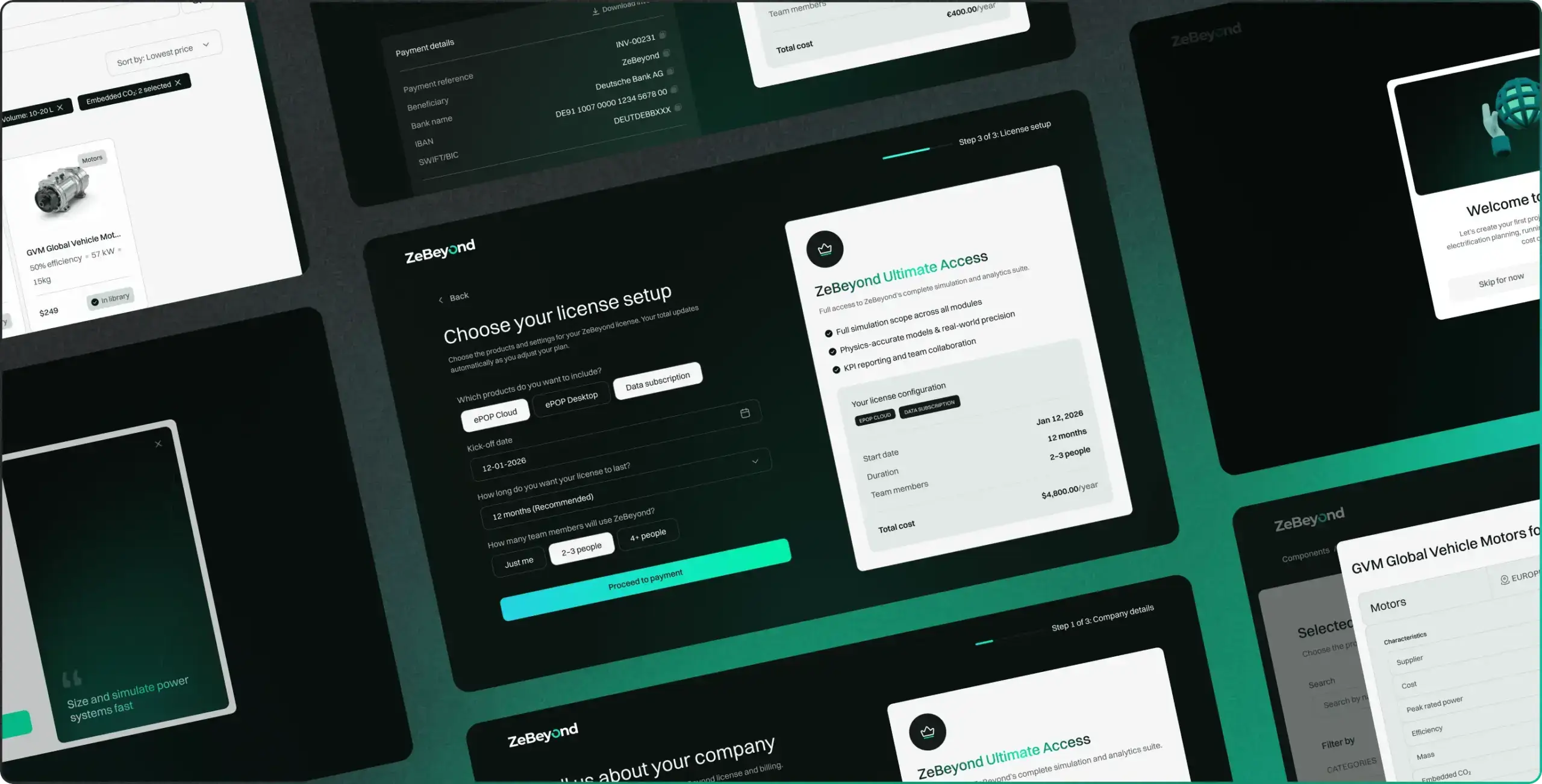
Case Study: How ZeBeyond Cut Trial-to-Paid Activation From Months to Minutes
Task
ZeBeyond builds simulation software for powertrain engineers working on electric vehicles, hybrids, and defense systems. Its flagship platform had grown well past its on-premise roots, but the commercial process hadn’t: converting a free trial into a paid account still required exchanging a 10-page PDF license agreement and order form by email, with a sales rep manually processing every order.
Solution
Phenomenon Studio redesigned the onboarding and catalog flows end to end, replacing the document exchange with a self-serve model. Ordering, license acceptance, payment, and account activation were collapsed into a single uninterrupted in-product session, with timestamped clickwrap acceptance capturing user, account, license version, and date automatically — with sales staying available for buyers who want it, without sitting on the critical path of every order.
Result
- Activation dropped from months to a single in-product session, capturing buying intent while it was still active.
- Sales hours previously spent chasing signatures and processing orders manually were redirected to demos and strategic accounts.
- License acceptance is now logged, versioned, and auditable at the account level by default, removing a standing compliance risk with zero added manual process.
Freelancer vs. Boutique Agency vs. Enterprise Web App Development Company USA
Collaboration model matters as much as skill level. A freelancer and a full enterprise web development company USA solve different problems, and picking the wrong one for your project’s complexity creates friction either way.
| Model | Best for | Watch out for |
| Freelancer | Small, well-defined scope, tight budget | No backup if they’re unavailable; limited QA capacity |
| Boutique / specialized agency | Startups and mid-market products needing design + engineering under one roof | Verify team depth beyond the founder or lead designer |
| Enterprise web app development company USA | Complex, regulated, multi-system products | Higher minimums; confirm you get senior attention, not junior handoff |
Most B2B companies land in the middle: a boutique or mid-market web development firm with the range to run full-cycle engagements, but without the overhead structure of a large enterprise shop. Ask any candidate directly which category they fall into and why that’s the right fit for your specific scope.
Contracts, IP Ownership, and Long-Term Support
A vague contract is where good projects go sideways after launch, not during it. Three clauses are non-negotiable regardless of which web app dev company you choose.
- A Work Made for Hire clause, or explicit assignment of all IP rights to you upon final payment — not upon signing, upon payment.
- Source code, design files, and infrastructure account access transferred to you at project close, with no dependency on the agency to make future changes.
- A defined post-launch support window — typically 30 to 90 days for bug fixes — with a clear, priced process for anything beyond that.
Long-term support deserves its own conversation before you sign, not after. Ask what response time SLAs look like, whether uptime is guaranteed, and what the escalation path is if something breaks at 2 a.m. on a Saturday. An agency that hasn’t thought through that scenario hasn’t finished thinking through the engagement.
Common Mistakes When Selecting a Development Partner
- Comparing quotes before scopes are itemized, which makes every number meaningless.
- Choosing based on visual portfolio alone, without asking for measurable outcomes.
- Signing before IP ownership terms are explicit in writing.
- Skipping reference calls, or only asking ‘were you happy’ instead of asking how the agency handled problems.
- Treating post-launch support as an afterthought instead of a contract line item.
Industry Statistics: What the Data Says About Agency Selection in 2026
The numbers back up what the red flags above suggest anecdotally. Most project failures are process failures, and most cost overruns are scope failures, not technical failures.
Across Phenomenon Studio’s analysis of 500 US development agencies, poor communication and vague contract terms accounted for 68 percent of documented project failures — more than any technical cause. — Phenomenon Studio, internal market analysis, 2026
On Clutch, project minimums for established web and mobile development companies in the United States range from roughly $5,000 for small template-based builds to $150,000 or more for enterprise-grade platforms. — Clutch, 2026
For regulated products, accessibility and compliance failures carry a second layer of cost: rework after the fact is more expensive than building to WCAG 2.1 AA and relevant data-protection standards from the start. Compliance architecture, not just visual polish, is where enterprise app development services earn their higher price point.
Bibliography
- Clutch. Agency market and pricing research for web and mobile development companies, 2026.
- Phenomenon Studio. Internal market analysis of 500 US development agencies, 2026.
- W3C. Web Content Accessibility Guidelines (WCAG) 2.1, Level AA.
- OWASP. OWASP Top 10 — application security risk reference.
Share this article with friends



Sep 29, 2026
6 min read
B2B website redesign without losing traffic: A complete b2b website redesign guide covering UX audits, 301 redirect mapping, and metadata preservation. Partner with a top b2b website redesign agency that boosts conversions while protecting your organic rankings.

Sep 29, 2026
8 min read
Small business web design services that fit your budget. Get affordable small business website design from one of the best website design companies for small business — with transparent pricing and no hidden fees.
